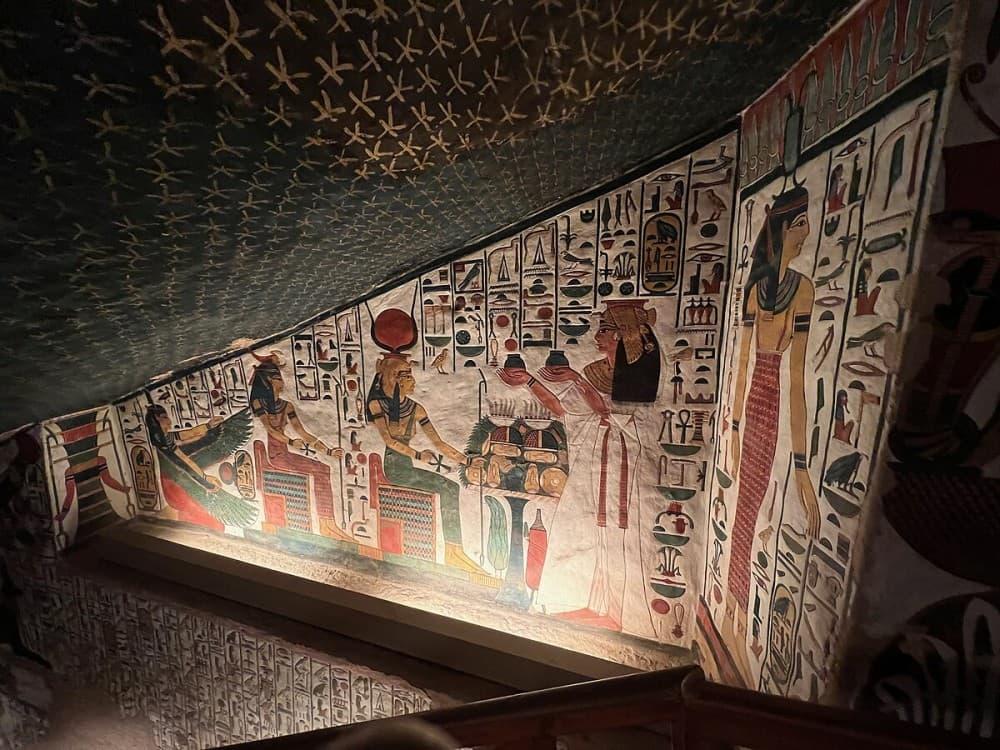
In one of the smallest of the Tombs of the Nobles, a painted room cut into the hill of Sheikh Abd el-Qurna, a blind harpist sits cross-legged at a party, his eyes closed and his mouth open in song, while three young women play the lute, the double pipe and the harp beside him. Under a chair nearby a cat is eating a fish. The room belongs to Nakht, a scribe and astronomer of Amun who lived about 3,400 years ago, and it is barely the size of a hotel bathroom. It holds more ordinary life than the entire Valley of the Kings.
That is the whole case for these chapels. The pharaohs decorated their tombs with guidebooks to the underworld; the officials who served them painted harvests, banquets, workshops, fishing trips and family outings, a world they hoped to keep. A short drive south, at Deir el-Medina, the craftsmen who cut and painted the royal tombs built their own village and their own small, brilliant tombs. This guide explains which ones to choose as of autumn 2026, how the confusing ticket system works, and why so many people who love Egypt say these were their favourite hours in Luxor.
At a Glance
What they are: decorated tomb chapels of New Kingdom officials and of the royal tomb builders, on Luxor's West Bank
Main areas: Sheikh Abd el-Qurna, Khokha, Assasif, Dra Abu el-Naga and Qurnet Murai for the nobles; Deir el-Medina for the workmen
Tickets: sold in small groups of tombs, 120 to 200 EGP each, about 2 to 3.50 USD as of autumn 2026
Deir el-Medina: 220 EGP for the village, temple and usually three tombs; Pashedu 120 EGP extra
Where to buy: the main West Bank ticket office near the Colossi of Memnon, not at the tombs
Payment: bank card only
Opening hours: from 6am, closing around 5pm, or 4pm on winter and Ramadan schedules
Time needed: two to three hours for two noble groups and Deir el-Medina
Best for: anyone who prefers colour, detail and daily life to sheer scale
Bring: a small torch, water and patience on steep, narrow stairs
Why Choose the Tombs of the Nobles Over the Royal Tombs
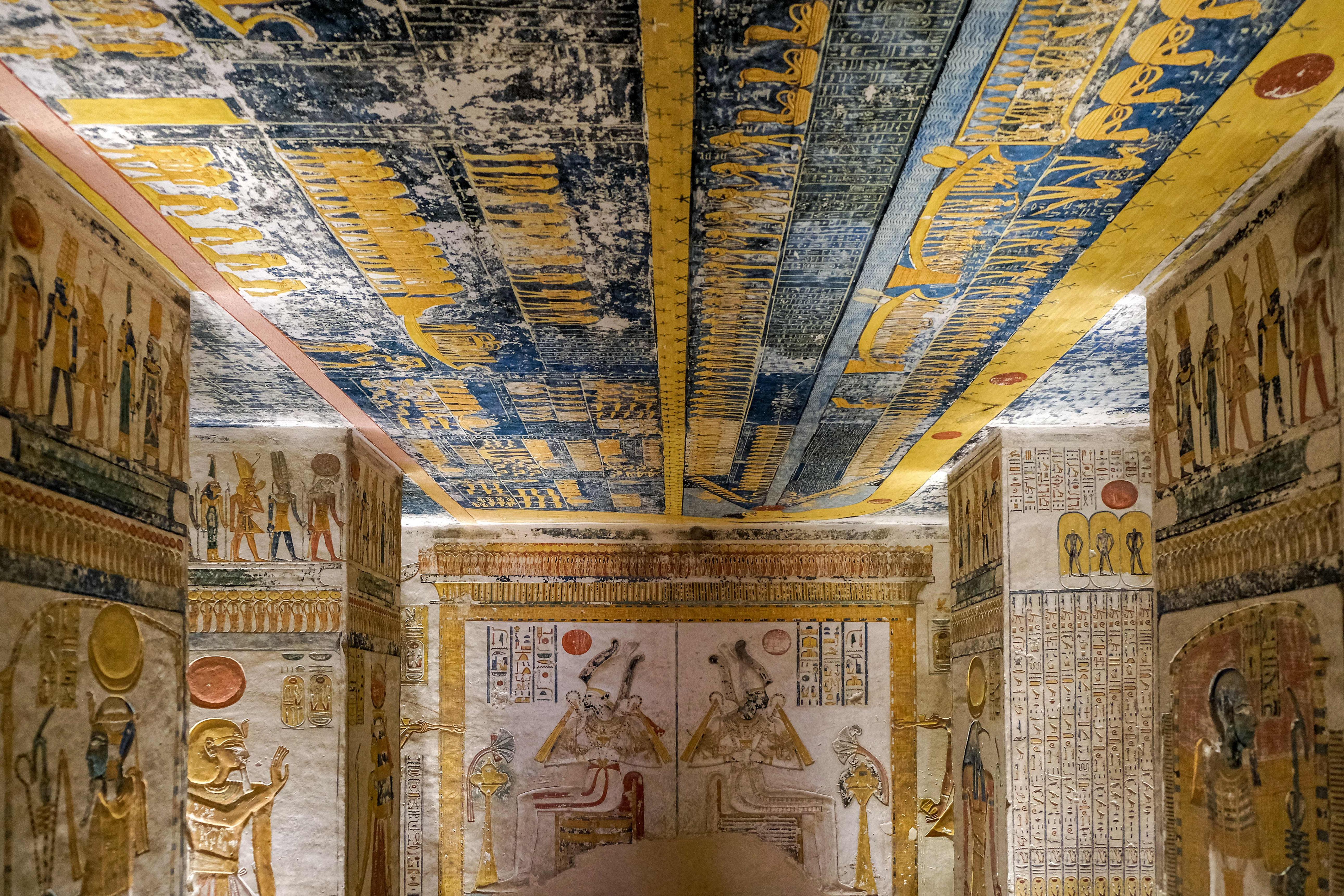
The royal tombs in the Valley of the Kings are long, deep and covered in religious texts: the hours of the night, the gates of the underworld, the sun god's journey. They are magnificent and, for many visitors, hard to read. The officials buried in the Theban hills had different priorities. Their tomb chapels, mostly from the 18th Dynasty, show the owner at work and at leisure: inspecting fields, receiving foreign envoys, hunting birds in the marshes, feasting with his family. The point was magical as much as decorative, since the images were meant to keep those pleasures going for eternity, but the result is a window onto the world above ground.
The scale helps too. Most noble tombs are a few small rooms, so you can stand a metre from a painted face, and the crowds are far thinner: on a winter morning when the Valley of the Kings is queuing at every door, you may have Menna's chapel to yourself. Our Valley of the Kings guide covers the royal tombs; this is the other half of the story.
How the Ticket System Works
This is the part that confuses everyone. There is no single ticket for the Tombs of the Nobles. The necropolis holds more than 400 numbered tombs, only a small fraction of them open at any one time, and the open ones are sold in small groups, each with its own ticket. You buy them in advance at the main West Bank ticket office near the Colossi of Memnon, which also sells Deir el-Medina, Medinet Habu and the Ramesseum. There are no ticket sales at the tombs themselves, so decide your list before you set off.
These are the main groups on the Ministry's price list of 5 November 2024, still being charged in autumn 2026, with student prices at half:
- Rekhmire and Sennefer: 120 EGP
- Menna and Nakht: 200 EGP
- Ramose: 200 EGP, which has traditionally also covered the neighbouring tombs of Userhat and Khaemhat
- Userhat and Khonsu: 120 EGP, a different Userhat, a priest of the 19th Dynasty
- Khokha tombs: 120 EGP
- Assasif tombs: 200 EGP
- Qurnet Murai tombs: 120 EGP
- Deir el-Medina: 220 EGP, plus 120 EGP for the tomb of Pashedu
Groupings, and the exact tombs inside each group, shift from time to time as tombs close for conservation, so check the board at the office before you pay. Payment is by bank card only, as at Luxor's other major sites. For prices across the country, see our guide to Egypt ticket prices for every major site.
Rekhmire and Sennefer: Power and Vines
If you buy one ticket, buy this one, partly because it is the cheapest and partly because the two tombs complement each other so well. Rekhmire was vizier of the south under Thutmose III and Amenhotep II, the most powerful official in Egypt after the king, and his chapel reads like an annual report. The T-shaped tomb has a long corridor whose ceiling rises towards the back, to about 8 metres (26 feet), and its walls are covered with the business of the state.
Look for the processions of foreign tribute: Nubians with gold rings and a giraffe, Syrians with chariots and horses, men from the Aegean carrying fine metal vessels, alongside products from Punt. Further in, craftsmen make furniture, jewellery and weapons, brickmakers mould mud, and sculptors finish a colossal statue. A long text sets out the duties of the vizier, one of the most important administrative documents to survive from ancient Egypt, and a scene shows Rekhmire's installation in office. His name, and those of his family, were hacked out in antiquity, for reasons nobody knows.
Sennefer's tomb is the opposite in mood. Sennefer was mayor of Thebes under Amenhotep II, and you descend a steep, narrow stair into a small underground chamber whose uneven rock ceiling has been painted as a vine heavy with dark grapes. The vine follows every bump and hollow, so you feel you are standing under a pergola. On the walls Sennefer and his wife Meryt appear together again and again. Glass protects the paintings and reflects your torch, which is the only real drawback.
Menna and Nakht: Fields, Feasts and Music
These two tombs, side by side in the same hill, hold some of the finest painting in Theban private tombs. Both men served Thutmose IV around 1400 BC. Menna was a scribe of the fields of the king, responsible for assessing harvests, and his walls show exactly that: surveyors stretching a measuring cord across standing grain, scribes recording the crop, a defaulter being punished, and girls quarrelling in the stubble. On another wall Menna hunts birds from a papyrus skiff in the marshes, with his family in the boat beside him.
Look closely at Menna's own face. In many scenes his eyes have been deliberately damaged by someone who knew exactly what the paintings were for.
Nakht's tomb is tiny, with only its first room decorated, and you will see it through a glass screen. It does not matter. The banquet with the blind harpist and the three musicians, the grape harvest and the wine press, the fowling in the marshes and the cat under the chair are among the most reproduced images in Egyptian art, and seeing them in place is something else again. Nakht's title, astronomer of Amun, probably meant he kept the temple's calendar and the hours of the night.
Ramose, Userhat and Khaemhat: Art at a Turning Point
The tomb of Ramose is the one we send art lovers to first. Ramose was vizier at the end of Amenhotep III's reign and the start of Akhenaten's, and his tomb was cut just as Egyptian art was about to change. The great columned hall is decorated in raised relief of extraordinary refinement, most of it never painted: the elegant guests at Ramose's funerary banquet have only their eyes outlined in black, which makes them look strangely alive. Nearby, a painted procession of mourning women raises its arms in grief.
Turn to the back wall and the style shifts. Here Ramose appears before the new king Akhenaten and Queen Nefertiti on a balcony beneath the rays of the Aten, carved in the elongated Amarna manner. The tomb was never finished. Around the time the court moved to Akhenaten's new capital, Ramose disappears from the record, and nobody knows where he was finally buried. Our guide to Tell el-Amarna picks up the story.
The neighbouring tombs of Userhat, a royal scribe under Amenhotep II, and Khaemhat, an overseer of granaries under Amenhotep III, are smaller and often quieter. Userhat's chapel is full of lively everyday scenes, including men waiting their turn with the barber under the trees, while Khaemhat's has fine raised relief of the harvest and the granaries.
Khokha, Assasif and Qurnet Murai
Most visitors stop at Sheikh Abd el-Qurna, and the other areas reward a second visit. The Assasif, in the plain below Hatshepsut's temple, holds some of the largest private tombs in Egypt, including those of Kheruef, steward to Queen Tiye, with exquisite relief, and of officials from the 25th and 26th Dynasties such as Ankhhor, with the tomb of Pabasa sold on a separate ticket of around 100 EGP. Khokha's small group, built for officials of the 18th and 19th Dynasties, is pleasant but lit with harsh fluorescent tubes. Qurnet Murai, on a low hill near the ticket office, has three small tombs, damaged but interesting, including that of Amenhotep called Huy, viceroy of Kush under Tutankhamun, whose walls show Nubian princes bringing tribute.
These suit second visits rather than a first morning; with one West Bank day, two groups at Sheikh Abd el-Qurna plus Deir el-Medina is the right balance.
Deir el-Medina: The Village of the Royal Tomb Builders
Over a low ridge to the south lies Deir el-Medina, the walled village of the men who cut and decorated the royal tombs. They called it Set Maat, the Place of Truth, and called themselves Servants in the Place of Truth. The earliest datable remains go back to the reign of Thutmose I, around 1500 BC, and the community lived here for roughly four centuries, until the reign of Ramesses XI, when tomb robbery, Libyan raids and civil disorder brought the royal works to an end.
What survives is the plan of a small town: a main street, the stone footings of some 68 to 70 houses inside the wall, each with a front room, a living room with a raised platform, sleeping space and a kitchen open to the sky, plus more houses outside. Families lived here for generations, and sons followed their fathers into the work. The men were organised in two gangs, the right side and the left side, each under its own foreman, with scribes keeping the records, and were paid in grain rations topped up with fish, vegetables, firewood and, on good days, beer and meat.
They also wrote things down. Literacy was unusually high here, and thousands of ostraca, inscribed limestone flakes and potsherds, many from a great pit near the village, record absences from work, loans, court cases, love poems and complaints. Late in the reign of Ramesses III, when rations failed to arrive, the workmen downed tools and sat in protest beside the temples, generally cited as the earliest strike on record. The village was excavated by Schiaparelli's Italian mission from 1905 to 1909 and by Bernard Bruyère's French team from 1922 to 1951.
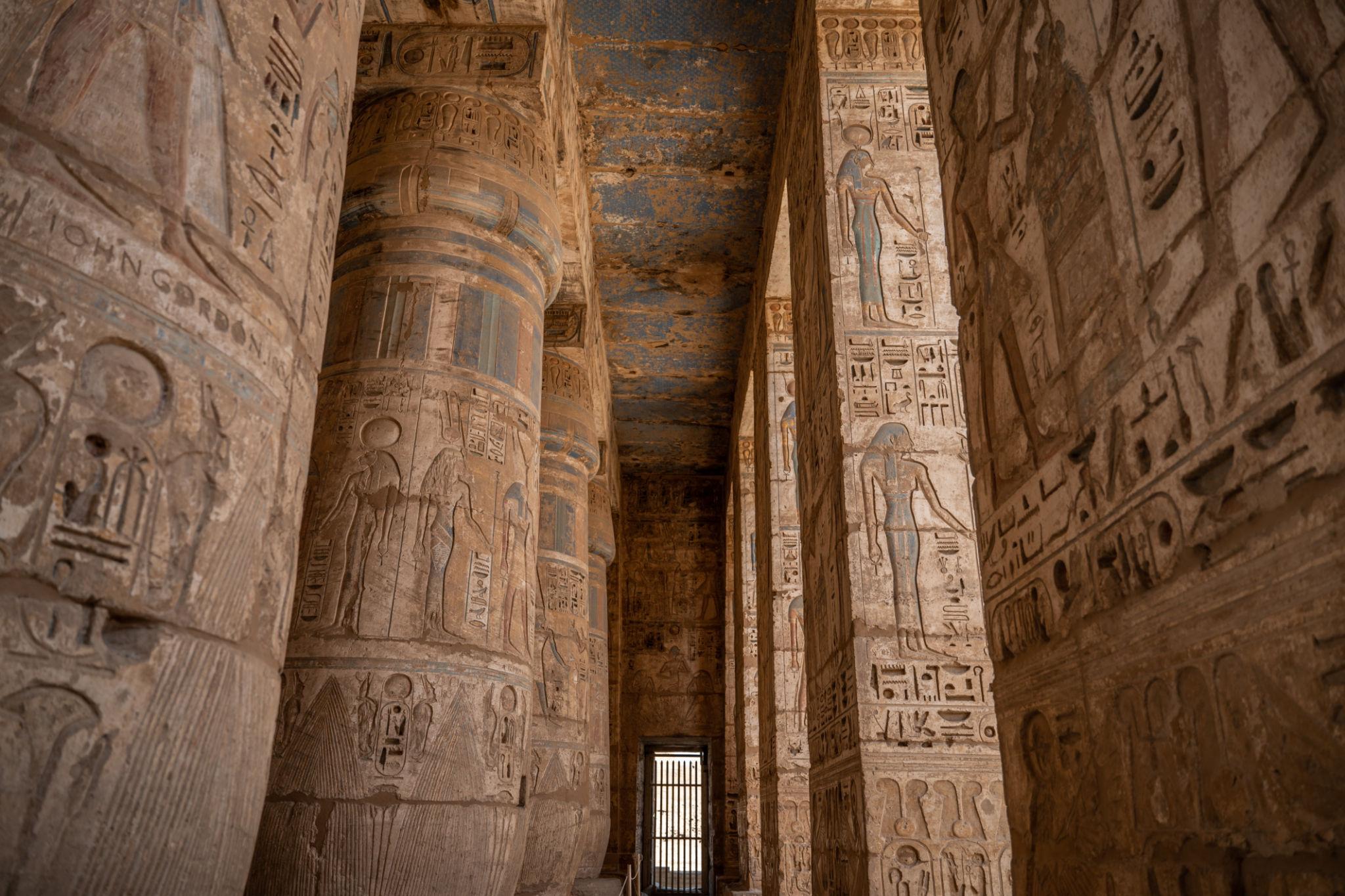
At the northern end stands a small, well-preserved temple of Hathor begun under Ptolemy IV, extended under his successors and never finished. Christians later used it as a monastery, which gave the site its Arabic name, the Monastery of the Town.
The Tomb of Sennedjem and Its Neighbours
The workmen built their tombs on the hillside above the village, each with a small chapel topped by a little mudbrick pyramid and a burial chamber cut into the rock below. They had the skills of the royal workshops and used them for themselves. The Deir el-Medina ticket usually covers three tombs, and as of recent seasons they have been these:
- Sennedjem (TT1): a Servant in the Place of Truth under Seti I and Ramesses II, whose tomb was found intact in 1886 with about twenty burials of his family. The vaulted burial chamber, painted on a warm yellow ground, is one of the most beautiful small rooms in Egypt: Anubis bends over Sennedjem's mummy on a lion-shaped bed, and Sennedjem and his wife Iyneferti plough and harvest in the Field of Reeds, the ideal farmland of the afterlife. The wooden door and much of the burial equipment went to Cairo, with other pieces now in New York and Berlin.
- Inherkhau (TT359): a foreman of the gang under Ramesses III and IV. Look for the harpist singing before Inherkhau and his wife, and the great cat of Ra cutting the head off the serpent Apophis beneath a sacred tree.
- Amennakht, Nebenmaat and Khaemteri (TT218 to 220): a family tomb of the workman Amennakht and his sons under Ramesses II, with daily life and Book of the Dead scenes.
The tomb of Pashedu (TT3), on its separate ticket, is worth the extra when it is open, which it is not always, and if your knees can handle a very steep descent. At the bottom, a jackal of Anubis watches over the entrance, and on one wall Pashedu kneels to drink from a pool beneath a palm tree, one of the loveliest images on the West Bank.
Did You Know: The Painters Who Signed Nothing
The craftsmen of Deir el-Medina decorated the tombs of Seti I, Ramesses II and their successors, yet the royal tombs tell us almost nothing about them. Their own village tells us everything else. We know the names of individual foremen, scribes and draughtsmen, their quarrels with neighbours, who was off work with a scorpion sting or brewing beer for a festival, and who stole tools from the royal works. When you stand in Sennedjem's tomb, you are seeing the private work of the same hands that painted the Valley of the Kings.
Insider Tip: Torches, Guardians and Photography
Bring a small torch. Some of the Tombs of the Nobles are well lit; others rely on a single bulb, and a beam raking across a wall brings out details you will otherwise miss. Keep the beam soft, as strong light on painted surfaces is discouraged.
Each tomb has a guardian with the key, and some will offer to show you something special or let you photograph a forbidden corner in exchange for a tip. A polite no is fine. Never pay for flash photography, which damages the pigments. Phone photography without flash is generally included in the ticket across the West Bank, but individual tombs apply their own rules, and photography has at times been banned inside the Deir el-Medina tombs, so follow the signs on the day. Our temple etiquette guide covers the basics, and our guide to money and tipping explains small change.
Warning: Steep Stairs and Low Ceilings
The stairs into Sennefer's burial chamber and Pashedu's tomb are steep, narrow and worn, and the ceilings are low enough to catch the tall. These are not good choices for anyone with bad knees, a fear of enclosed spaces or a heart condition, and the air at the bottom can be hot and close. The chapels of Rekhmire, Ramose, Menna and Nakht involve uneven hillside paths but no steep descent, and are much easier. Tell your guide in advance and they will plan the route accordingly.
Planning Your Visit
A good half-day starts at the main ticket office at opening, takes in two groups at Sheikh Abd el-Qurna, usually Rekhmire and Sennefer plus Menna and Nakht, and finishes at Deir el-Medina before the heat sets in. That combines well with Medinet Habu or the Valley of the Queens on the same morning, and the Tombs of the Nobles reward a second, slower visit if your stay allows it. Our complete West Bank tour can be built around exactly that, and our Medinet Habu and Ramesseum tour is a natural partner for a slower second day.
If you are planning a longer stay in Luxor, our guides to the Temple of Hatshepsut and to Nefertari's tomb and the Valley of the Queens cover the rest of the necropolis. Tell us what you love most, colour, history, architecture or simply avoiding the crowds, through our contact page, and we will suggest the tombs that suit you best.