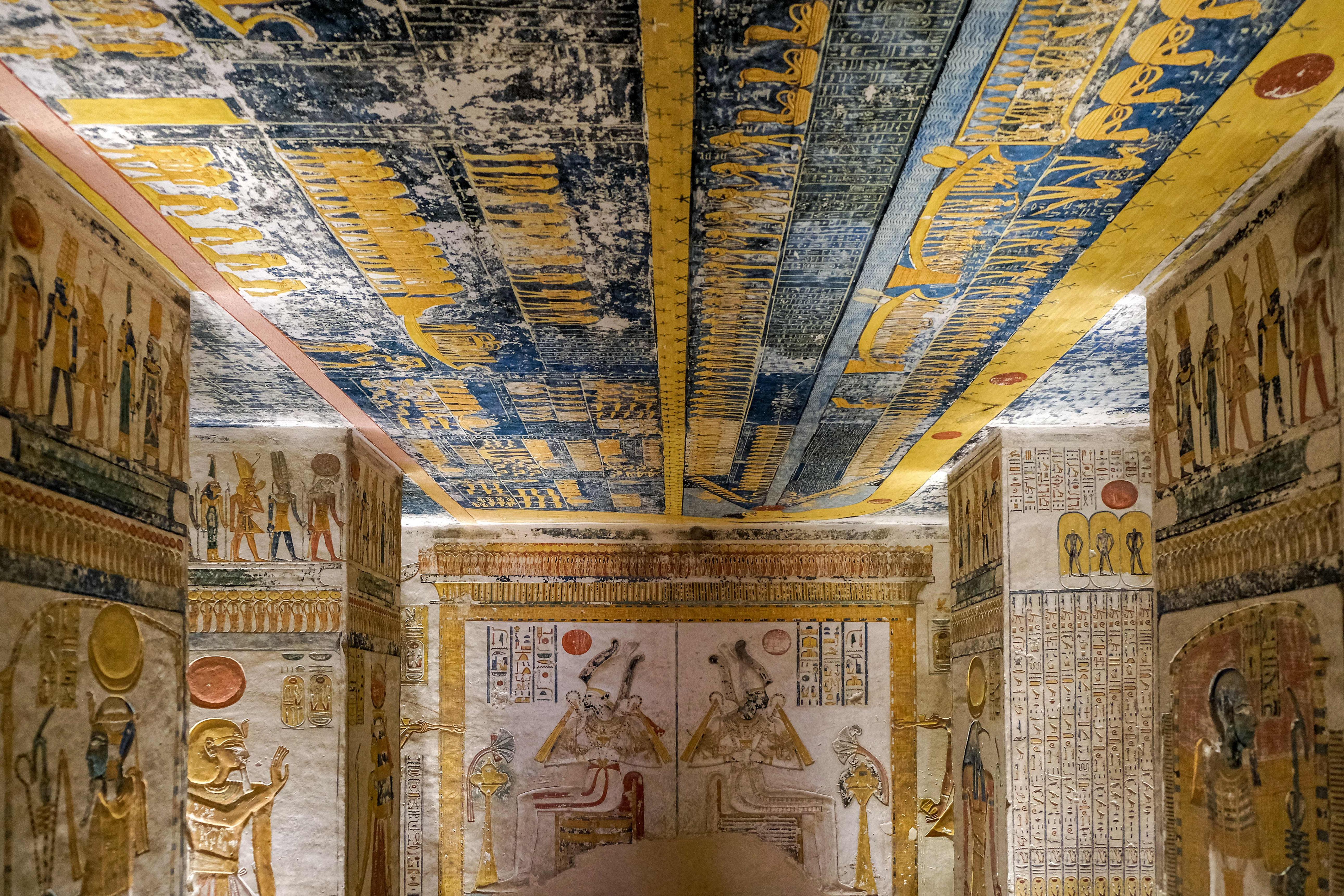
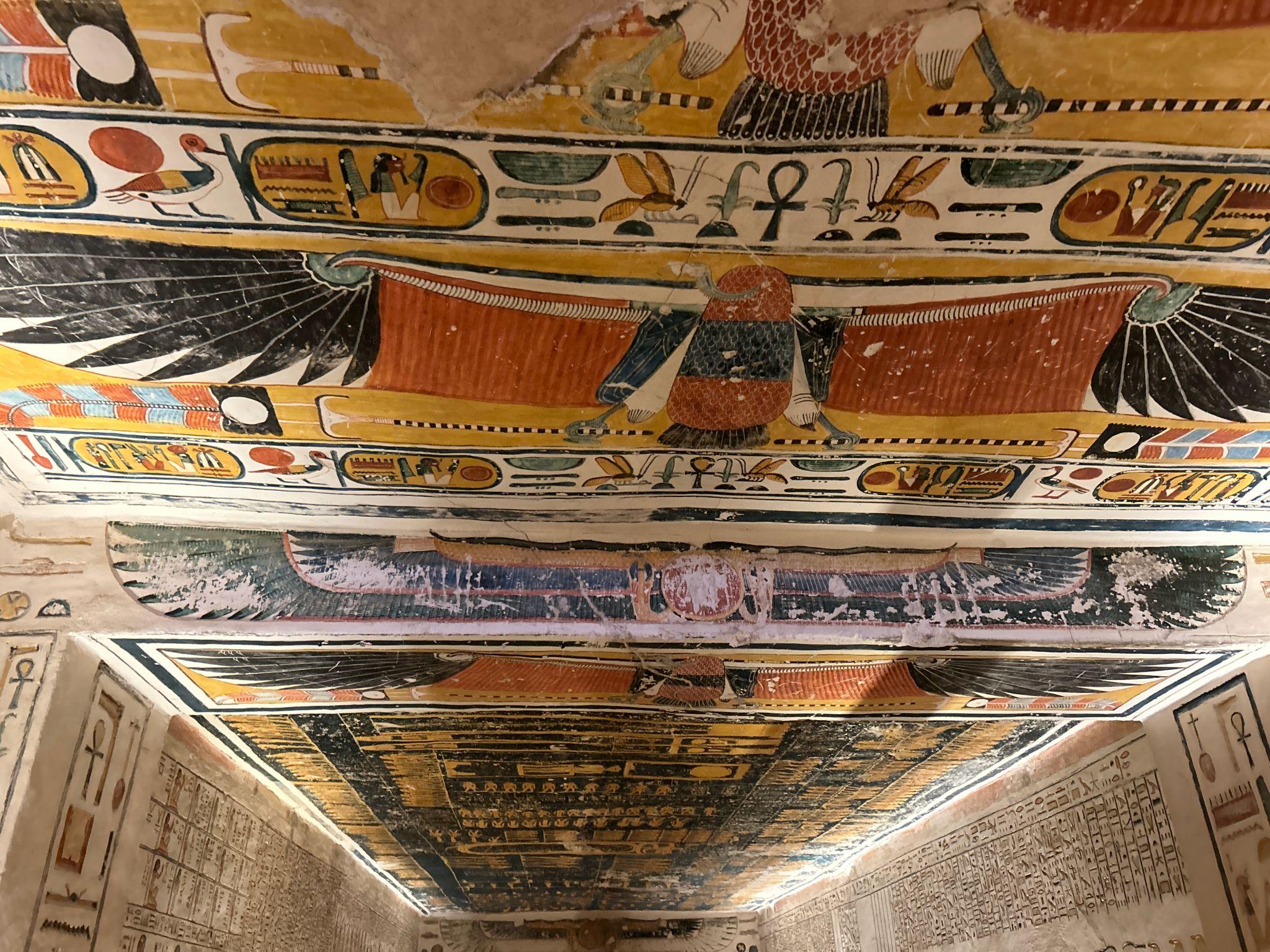
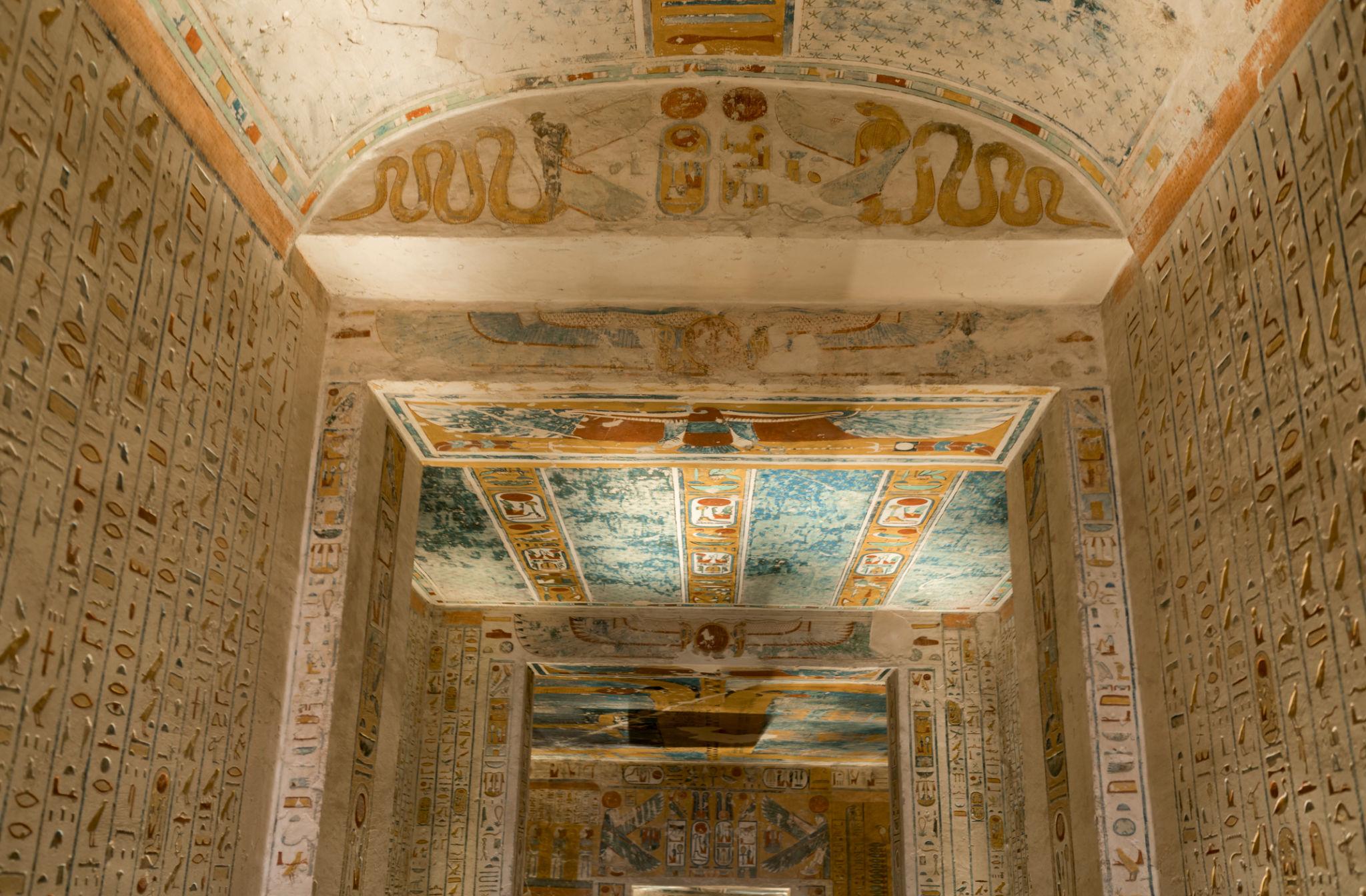
The ceiling of the burial chamber is painted the deep blue of a desert night and scattered with yellow five-pointed stars. Beneath it a queen in a pleated white gown moves through the underworld, led by the hand by Isis, offering linen to Ptah, sitting alone at a board game whose moves decide the fate of her soul. Some 520 square metres of painted plaster cover the Tomb of Nefertari, numbered QV66 by Egyptologists, and for most of the time since its discovery it has been the most celebrated and least visited room in Egypt.
Since 2 March 2024 it has also been closed. As of late October 2026 no public ticket is on sale and no reopening date has been announced. The latest official word, an inspection on 18 September 2026 by the head of Egypt's Supreme Council of Antiquities, ordered more monitoring rather than an opening. This guide explains what the tomb is and why it is shut, what the Valley of the Queens still shows visitors, and how to plan a day on Luxor's West Bank without paying for a promise nobody can keep.
At a Glance
Tomb of Nefertari (QV66): closed to visitors since 2 March 2024, with no reopening date as of October 2026
Last official price: 2,500 EGP on the Ministry's November 2024 list, on top of the valley ticket, but not currently sold
Valley of the Queens ticket: 220 EGP, students 110 EGP, about 4 USD (3.50 EUR) as of autumn 2026
Tombs on that ticket: Khaemwaset (QV44), Tyti (QV52) and Amenherkhepshef (QV55), subject to rotation
Opening hours: from 6am, closing around 5pm in summer and 4pm in winter and Ramadan
Payment: bank card only at the ticket office
Photography: phones without flash are included; larger cameras and tripods need a separate permit
Time needed: an hour to an hour and a half for the valley
Location: the southern end of the Theban necropolis, minutes by car from Medinet Habu and Deir el-Medina
Pairs well with: Deir el-Medina, Medinet Habu and the Ramesseum
Is the Tomb of Nefertari Open in 2026?
No. The tomb closed to the public in early March 2024, and the antiquities authorities have never published a detailed explanation. Every statement since has centred on the same subject: humidity. In late October 2024 the then Secretary-General of the Supreme Council of Antiquities, Mohamed Ismail Khaled, inspected the tomb, described it as well preserved, and set up a specialist committee to measure humidity and work out rules under which it could reopen without rising visitor numbers damaging the paintings.
Two years on, the question remains open. On 18 September 2026 his successor, Hisham El-Leithy, visited QV66 during a wider tour of Luxor and Qena, ordered further studies of the paintings and inscriptions, and asked for regular monitoring of temperature and humidity inside the chamber. Reopening was examined; no date was set. Read together, the statements suggest that a return to public access is being actively considered, would be tightly controlled, and is unlikely to be announced far in advance.
The practical conclusion is simple. Plan your West Bank day on the basis that QV66 will be shut, and treat a reopening as a bonus. If it does reopen during the 2026 to 2027 season, expect a small daily quota and a premium ticket, as before.
Nefertari, the Queen Beside Ramesses II
Nefertari, sometimes written Nefertari Meritmut, was the first of the Great Royal Wives of Ramesses II, and she married him before he came to the throne around 1279 BC. She bore him at least four sons and two daughters. Her eldest son, Amun-her-khepeshef, was crown prince for years, though, like many of his brothers, he did not outlive his long-reigning father.
Her titles included Great Royal Wife, Lady of the Two Lands and God's Wife, and she is thought to have been literate, which was rare even at court. After Egypt made peace with the Hittites, she exchanged letters and gifts with the Hittite royal couple, Hattusili III and Queen Puduhepa, a rare glimpse of a queen with her own diplomatic voice.
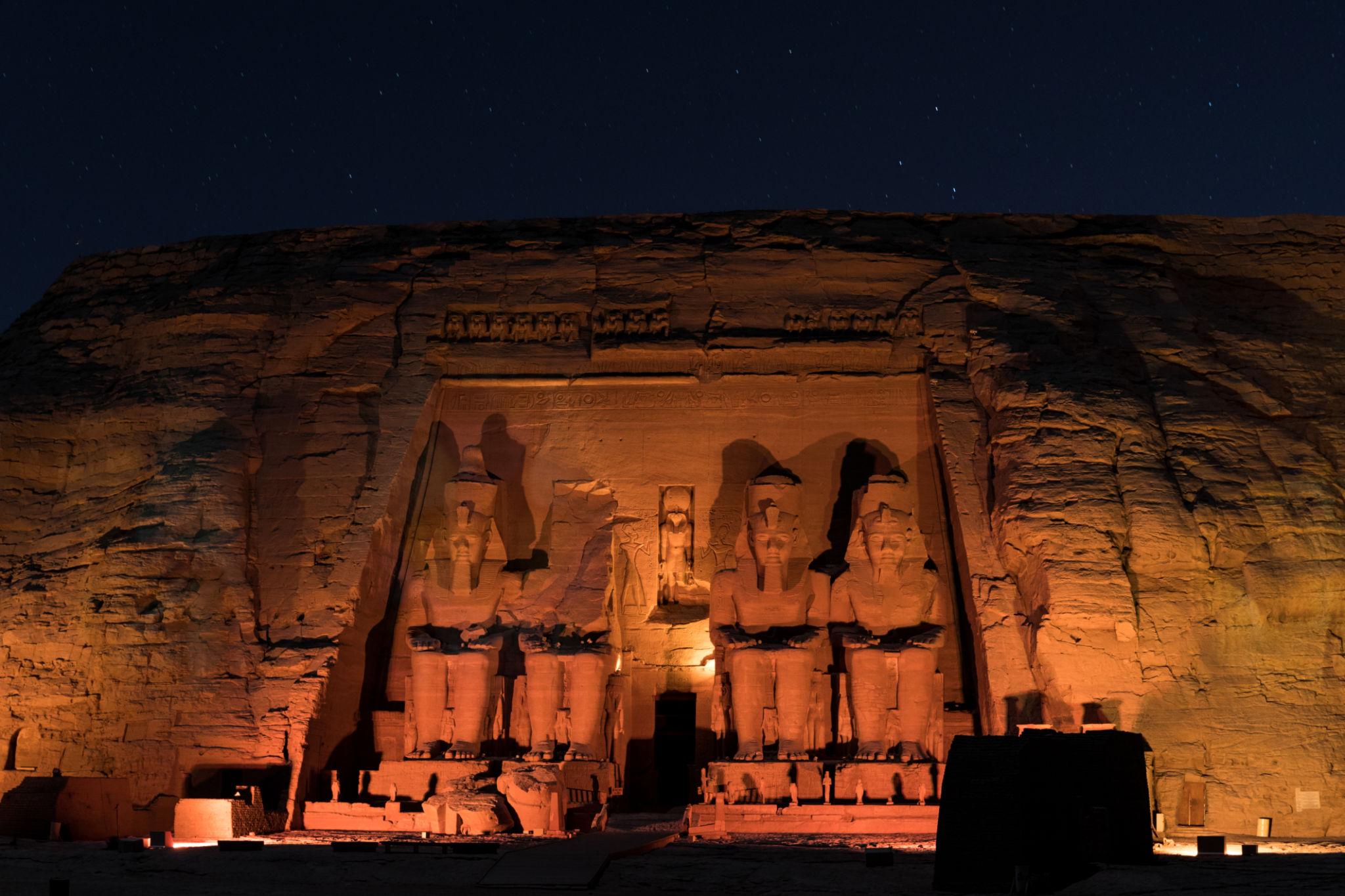
Her most public monument is far to the south. At Abu Simbel, Ramesses cut a second, smaller temple into the cliff for Nefertari and the goddess Hathor, and on its façade her standing statues are the same height as his. She seems to have died before the 24th year of his reign, around 1255 BC, barely a third of the way through a reign of some 66 years. Our Abu Simbel temples guide covers that temple in detail.
Inside QV66: What the Walls Show
The tomb is cut into the hillside on two levels. A staircase leads down to an antechamber and a side room, then a second, steeper descent reaches the burial chamber, whose four pillars surround the place where the queen's sarcophagus once lay, with small annexes opening off it. Almost every surface is decorated, and the effect is closer to stepping inside an illuminated manuscript than into a cave.
The scenes follow the queen's journey towards eternity, largely drawn from the Book of the Dead, with chapters 17, 94, 144 and 146 among those identified. Look for these if the tomb ever reopens, or in any good photographic book:
- Nefertari seated at the senet board, playing against an unseen opponent, the game standing for the soul's passage through the underworld
- Isis leading the queen by the hand, and Horus, son of Isis, presenting her to the gods
- The queen offering linen to Ptah, and standing before Thoth, god of writing, beside a scribe's palette and water bowl
- Winged Ma'at kneeling with her wings spread over a doorway
- A ram-headed mummiform figure, the fusion of the night sun Ra with Osiris, flanked by Isis and Nephthys: the theological heart of the tomb
- The gates of the realm of Osiris, each with its seated guardian, along the lower walls
What makes the colour so intense is the white ground behind it. The figures are carved in low relief into a thick layer of plaster, then painted in mineral blues, greens, reds and yellows against a plain, bright white background. Those same layers of plaster are the tomb's weakness.
Why the Plaster Is So Fragile
The limestone in this valley is poor and fractured, so the ancient artists could not carve directly into it. They laid plaster over the rock, modelled the reliefs in that, and painted them. Salt is locked into both the stone and the plaster, and moisture sets it moving: water left from the original plastering, occasional flood water seeping in, damp absorbed by the rock, and the breath and sweat of visitors. As the moisture evaporates, the salt recrystallises behind the paint and pushes it off the wall in flakes and sheets.
By the 1980s large areas were coming loose. From 1986 to 1992 the Getty Conservation Institute worked with Egypt's antiquities authority to save the paintings, starting with emergency work in which loose fragments were held in place with roughly 10,000 small strips of Japanese mulberry paper while some 7,000 photographs recorded the walls. The conservators cleaned and consolidated what survived; they did not repaint it.
The tomb reopened in 1995 and has since alternated between restricted access and long closures. When it was open, visits came with conditions: a daily cap historically reported at about 150 people, ten to fifteen minutes inside, and an air-circulation system. Price became a conservation tool as well. The premium ticket rose in steps, from around 1,000 EGP in 2018 to 1,400 EGP a few years later and 2,000 EGP or more by the time it closed, and the Ministry's price list of 5 November 2024 still showed 2,500 EGP, by which point the tomb had already been shut for eight months.
Did You Know: The King Who Is Not There
Ramesses II, the most self-promoting pharaoh in Egyptian history, appears nowhere on the walls of the Tomb of Nefertari. Male royal figures were not part of the decorative programme for queens' tombs in this period, so Nefertari stands before the gods entirely on her own account.
Of the queen herself, only a pair of mummified legs survived the ancient robbers. They were found by Ernesto Schiaparelli, whose Italian mission discovered the tomb in 1904, and are now in Turin's Museo Egizio, where a multidisciplinary study published in 2016 concluded that they very probably belonged to Nefertari. Smaller survivors of her burial are scattered further: shabti figures and fragments of gold bracelets went to the Museum of Fine Arts in Boston, and other shabtis are in Cairo.
The Valley of the Queens Beyond Nefertari
The ancient name was Ta-Set-Neferu, usually rendered as the Place of Beauty or the Place of the Royal Children, and both fit. The main wadi holds 91 tombs and the side valleys another 19, about 110 in all, cut between roughly 1560 and 1130 BC. In the 18th Dynasty the side valleys took princes, princesses and court officials; in the 19th the main valley was reserved for royal women; and in the 20th the sons of Ramesses III joined them. After that, the valley ceased to be a royal cemetery.
Within the valley a natural grotto was sacred to Hathor and may have been linked with the rebirth of the dead. Schiaparelli's mission worked here from 1903 to 1906, recording more than eighty tombs, every one already robbed in antiquity. The Valley of the Kings lies only about 1 km (0.6 miles) away in a straight line, but there is no road over the ridge, so the drive goes back round through the plain.
What visitors notice is the scale. The Valley of the Queens is smaller, lower and much quieter than its royal neighbour, with walled paths, wooden floors and plexiglass panels protecting the open tombs. A few tombs are deliberately left open for colonies of bats.
The Open Tombs: Khaemwaset, Tyti and Amenherkhepshef
As of autumn 2026 the valley ticket covers three tombs, all from the 20th Dynasty, about a century after Nefertari. None matches QV66, but each is worth its ten to fifteen minutes, and together they show how royal tomb painting changed after Ramesses II.
- Khaemwaset (QV44): the tomb of a son of Ramesses III, not to be confused with Ramesses II's famous son of the same name. The colours are strong and the corridors long, with the young prince accompanying his father before a sequence of gods and gate guardians.
- Amenherkhepshef (QV55): another son of Ramesses III, and the closest the valley now comes to Nefertari's colour. Ramesses III leads the boy, shown with the sidelock of youth, before the gods on a white ground of vivid blues, reds and yellows. A small mummified foetus associated with the tomb was for many years displayed there in a glass case; whose it was remains unknown.
- Tyti (QV52): a queen of the same royal family, usually linked with Ramesses III, though her exact relationships are debated. The paintings are paler and partly lost, but a starry ceiling and elegant offering scenes survive behind glass.
The roster rotates for conservation reasons. Check the board at the ticket office before you buy, and ask your guide which three are open that morning.
Tickets, Hours and Photography
The Valley of the Queens ticket costs 220 EGP for adults and 110 EGP for students with a valid ISIC card, as of autumn 2026. Those figures come from the Ministry list of 5 November 2024 and were still being charged in October 2026. Buy at the valley's own ticket office at the entrance, and bring a bank card: Luxor's major sites, the Valley of the Queens among them, stopped accepting cash in 2023.
Hours run officially from 6am to 5pm in summer, with closing brought forward to around 4pm in winter and during Ramadan. A few visitors report gates opening later than advertised, so an early start is wise but not guaranteed. The Luxor Pass, a multi-day ticket priced in US dollars, historically included Nefertari in its premium version; with the tomb closed, confirm exactly what any pass covers before you buy it.
Phone photography without flash is included in the ticket. Larger cameras, tripods, lighting and filming need separate permits. Do not touch the walls or lean on the glass panels, and step aside in narrow corridors so others can pass.
Egyptian site prices are reviewed periodically, often around November. We had seen no announcement of new Luxor prices at the time of writing, though the Grand Egyptian Museum's increase on 1 November 2026 is a reminder that lists change. Our guide to Egypt ticket prices for every major site is kept up to date.
Warning: Be Sceptical of Guaranteed Entry
Since the closure, some itineraries still list the Tomb of Nefertari. Some simply have not been updated since 2023; others hint at special or private access. There is no public ticket for QV66. Any exceptional access, if it is granted at all, is a decision for the antiquities authorities, not something a driver, a hotel desk or a man at the valley gate can arrange.
If a package includes Nefertari, ask in writing exactly what is being sold, who has authorised it, and what you get back if entry is refused on the day. Do not pay a supplement on the strength of a verbal assurance. When an itinerary says only the Valley of the Queens, that is the honest version.
Where Else to Meet Nefertari
The best substitute is the small temple at Abu Simbel, where the queen stands on the façade as the king's equal and reappears inside, crowned with Hathor's horns and sun disc, making offerings to the goddess. It is a long way from Luxor, but if your trip reaches Aswan it is the most complete portrait of her that anyone can visit today.
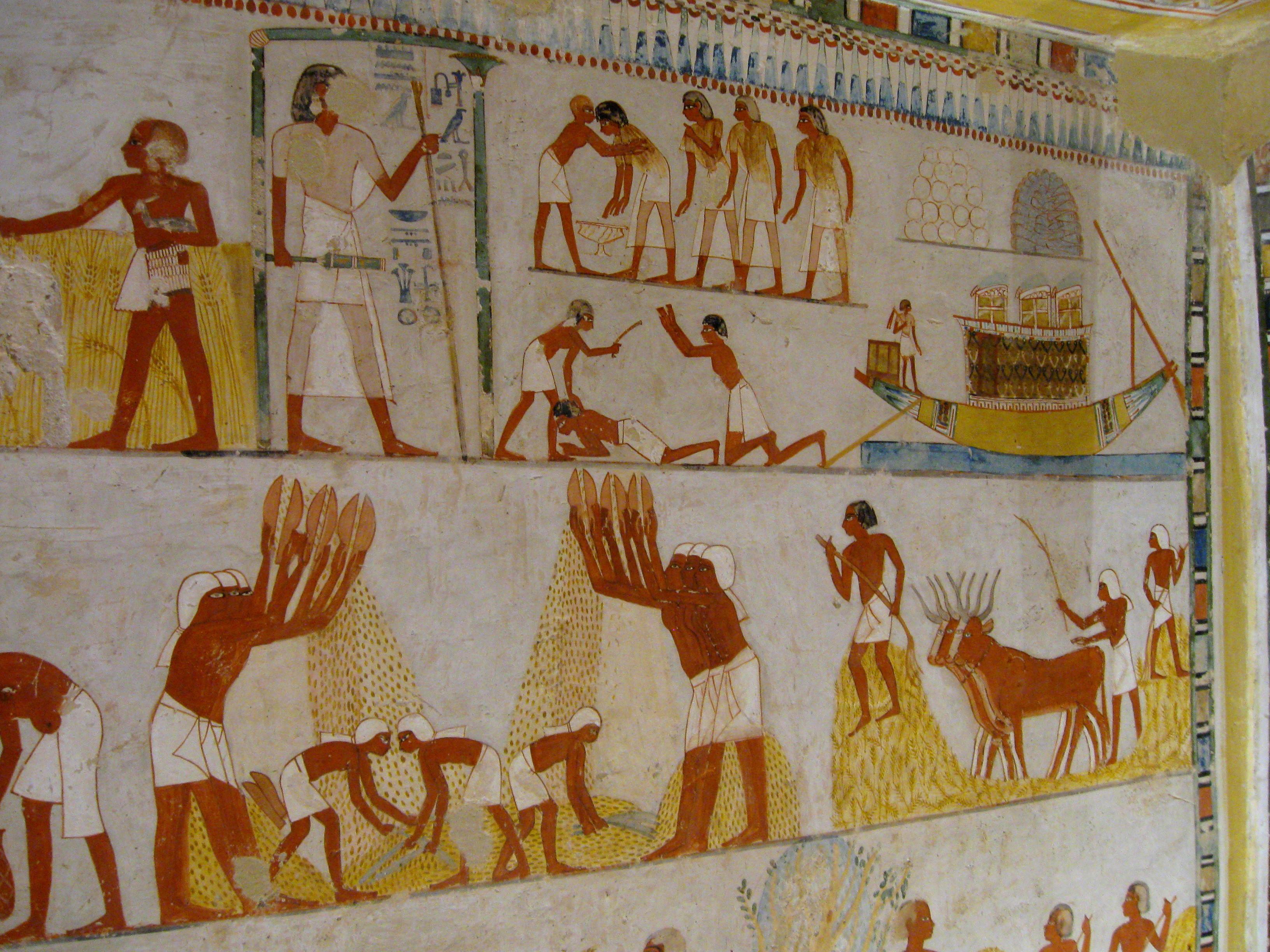
For the archaeology, Turin's Museo Egizio holds the remains of her legs and other material from Schiaparelli's excavations, part of the collection his work built. Closer to hand, the open tombs of the valley and the painted chapels of the nobles give a sense of the palette and craftsmanship of the period. Our guide to the Tombs of the Nobles and Deir el-Medina covers the painted tombs that remain open on the West Bank.
Insider Tip: Build the Day From the South
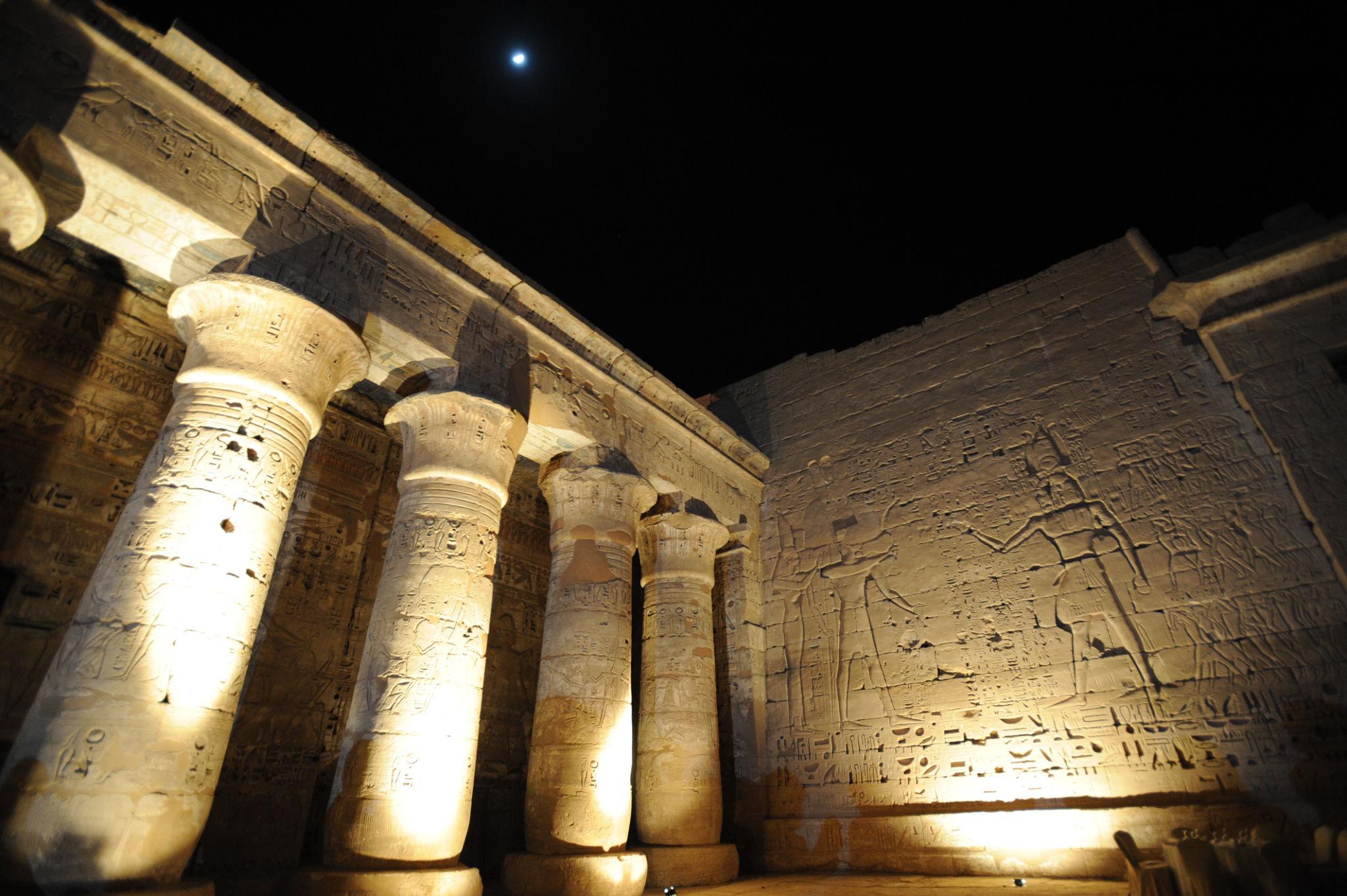
The Valley of the Queens sits at the southern end of the necropolis, and that geography suggests the order. Arrive at opening, when the tombs are cool and empty, then drive a few minutes to the workmen's village of Deir el-Medina, and finish at Medinet Habu, whose deep colonnades give shade by mid-morning. Three sites, little backtracking, and done before the worst of the heat.
For a first visit to Luxor we would still put the Valley of the Kings and Hatshepsut's terraces first, since they carry the biggest stories, and save this southern loop for a second West Bank morning. Our Medinet Habu and Ramesseum guide and our Temple of Hatshepsut guide cover the rest of the bank.
Planning Your Visit
A realistic West Bank day includes the Valley of the Kings, the Temple of Hatshepsut and one southern site; a second day can take in the Valley of the Queens, Deir el-Medina and Medinet Habu at a slower pace. Our complete West Bank tour is built around that kind of route, and the shorter Valley of the Kings and Hatshepsut tour suits travellers with a single morning. Our Valley of the Kings guide explains which royal tombs are worth the extra tickets.
If QV66 reopens, it will almost certainly be on quota and at a premium price, and the first weeks will be competitive. Tell us when you are travelling through our contact page and we will tell you plainly what is open, what is worth the money and how to fit it around everything else you want to see.