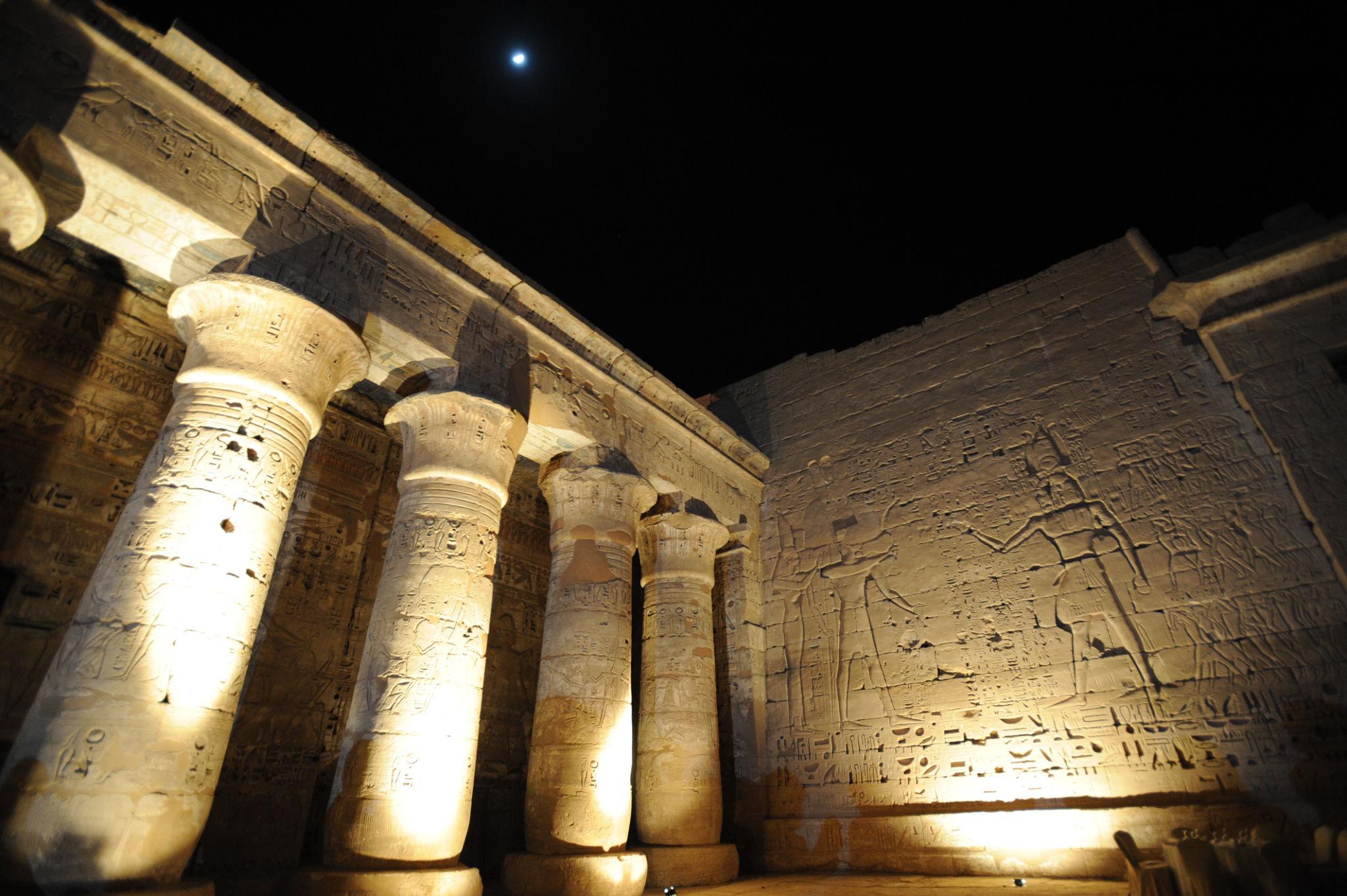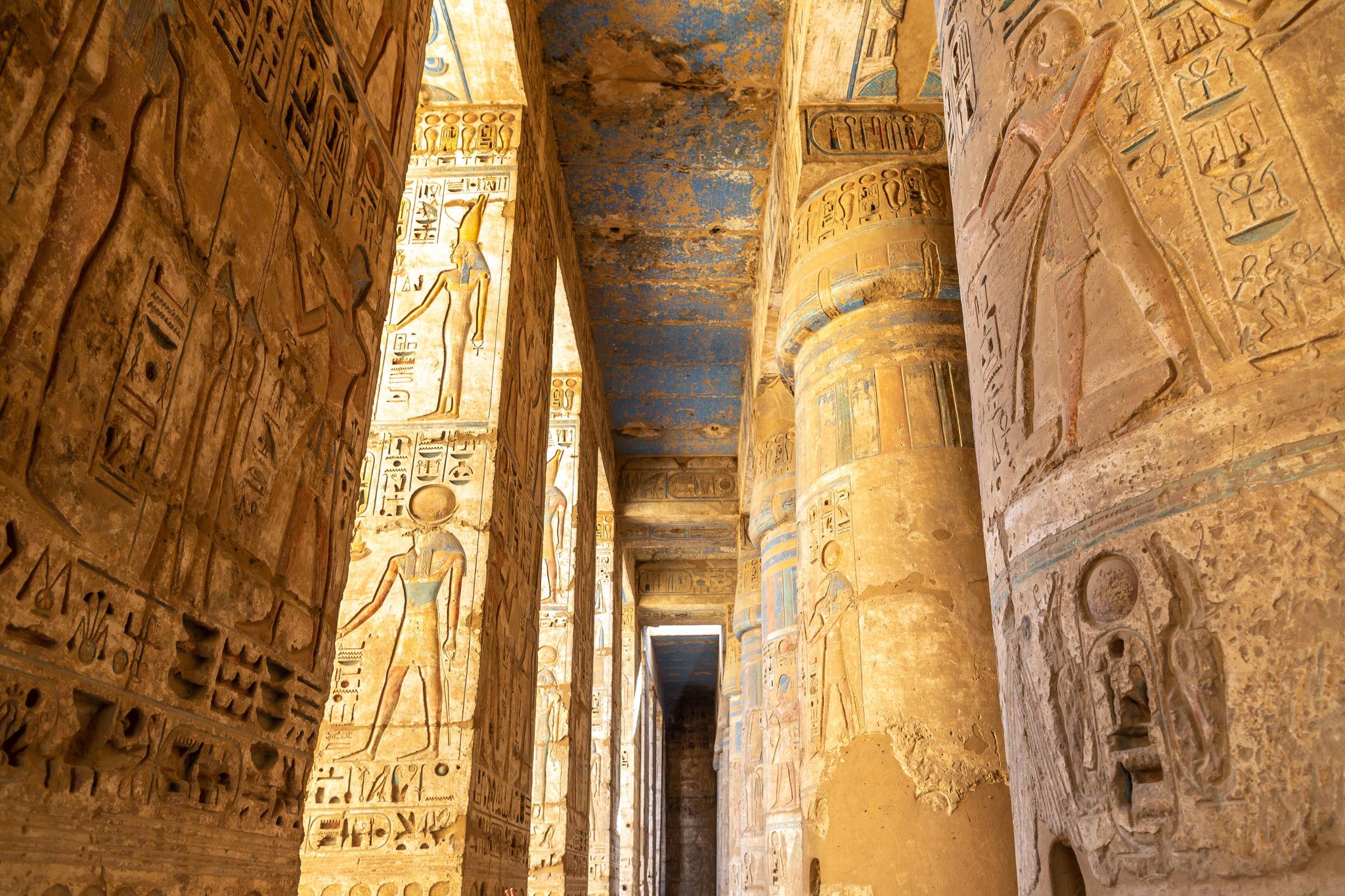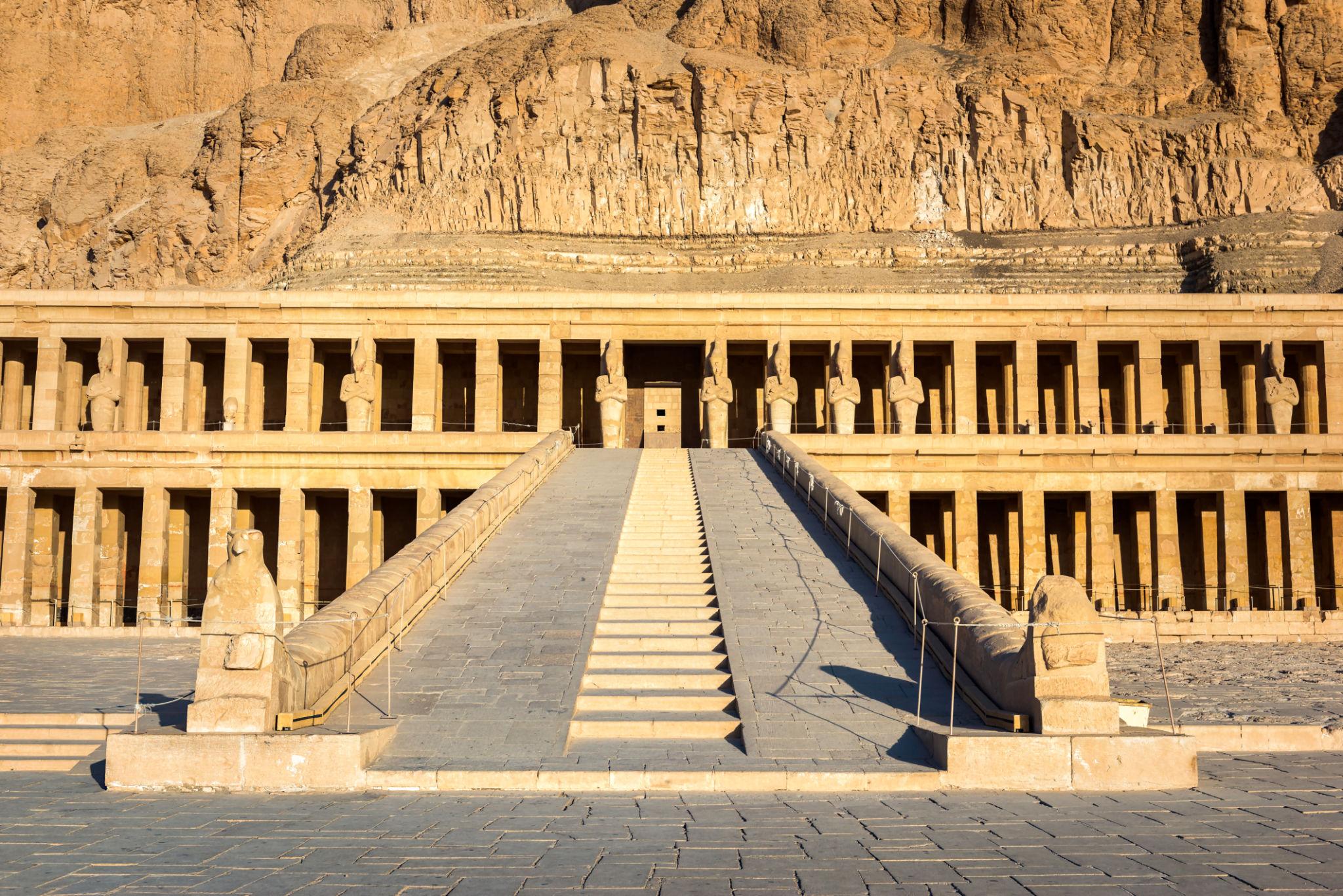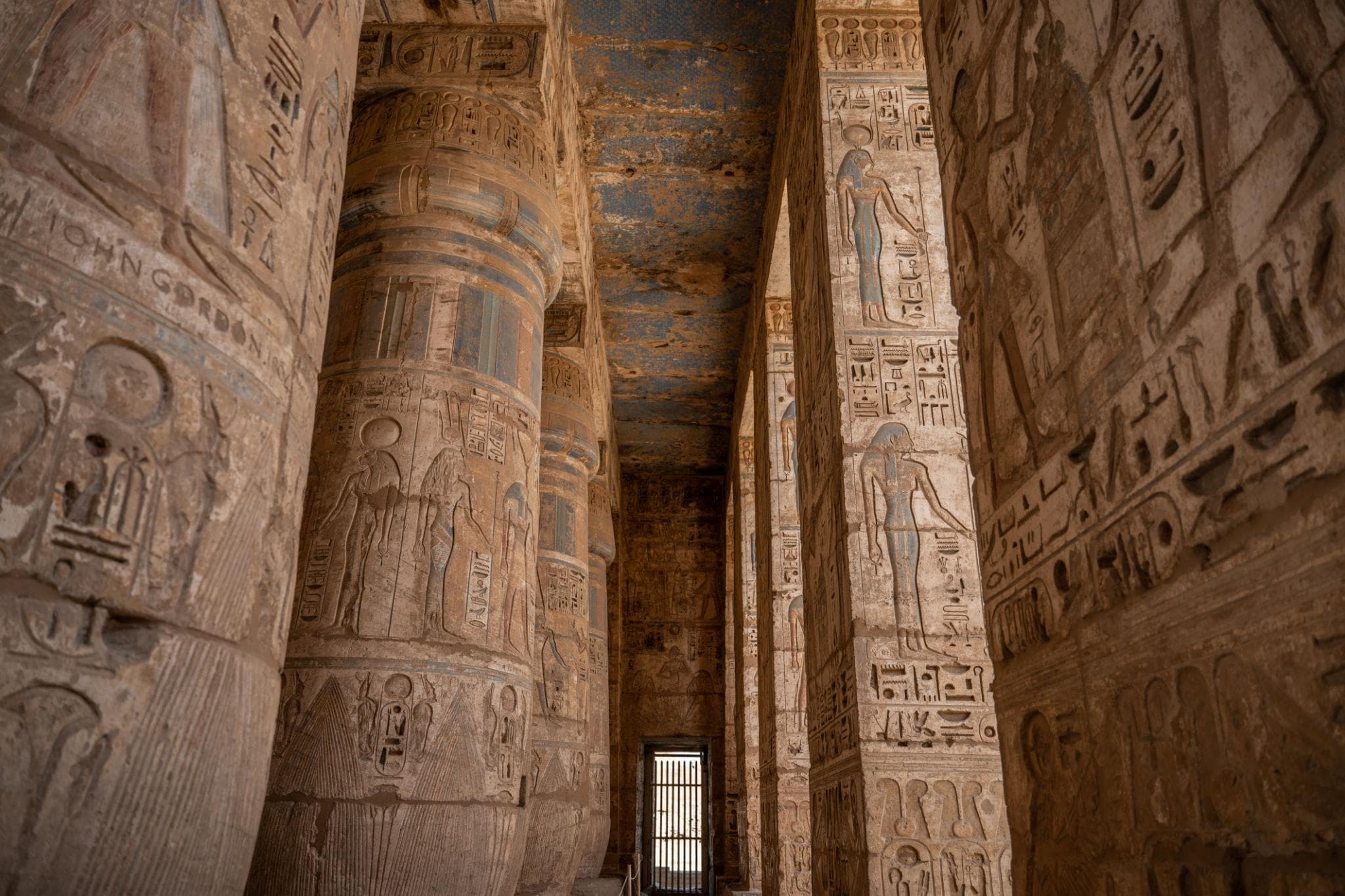
At half past three on a January afternoon, while the coaches are still filing out of the Valley of the Kings car park, the second court of Medinet Habu can be almost empty. The sun has slid round towards the Theban hills, the sandstone has turned the colour of toast, and on the undersides of the architraves the blues and reds laid down by Ramesses III's painters more than 3,100 years ago are still sharp enough to read from across the court. A guard sweeps the paving. Footsteps carry between the pillars. It is the hour most visitors to Luxor never see, because they spent the morning in three royal tombs, the middle of the day on Hatshepsut's terraces, and then went back to the hotel.
Less than 2 km apart on the plain below the cliffs stand the mortuary temples of Egypt's two most famous kings called Ramesses. Medinet Habu is the fortress-temple of Ramesses III and the best-preserved large temple on the West Bank. The Ramesseum is the broken memorial of Ramesses II, whose fallen colossus has been tied, by long tradition, to Shelley's Ozymandias. Together they cost less than one Valley of the Kings ticket and take about three hours, and between them they say more about how the New Kingdom saw itself than any tomb. This guide covers what to look for in each, tickets and opening hours as of autumn 2026, the best time to visit, and how to fit both into a West Bank day.
At a Glance
Location: Luxor's West Bank, less than 2 km apart; Medinet Habu at the southern end near the Valley of the Queens, the Ramesseum near the Tombs of the Nobles
Tickets: 220 EGP each for foreign adults, 110 EGP for students, about 4 USD (3.50 EUR) each, as of autumn 2026
Opening hours: from 6am, closing at 5pm or an hour earlier in winter and Ramadan
Time needed: two hours for Medinet Habu, 45 minutes to an hour for the Ramesseum
Payment: card at most ticket offices; the Luxor Pass is sold for cash in US dollars or euros
Luxor Pass: covers both; 130 USD standard or 250 USD premium for five consecutive days
Best light: the first hour after opening, or after 3pm in winter
Shade: almost none at the Ramesseum, some in Medinet Habu's gate and side rooms
Builders: Ramesses III, about 1186 to 1155 BC; Ramesses II, about 1279 to 1213 BC
Eclipse: both lie under the path of totality on 2 August 2027, for just over six minutes
Why These Two Temples Stay Quiet
Every New Kingdom pharaoh needed two monuments on the West Bank: a hidden tomb in the hills and a public temple on the edge of the fields, where priests would keep his cult alive for ever. The Egyptians called these temples Houses of Millions of Years. They once stood in a line along the desert margin, from Seti I's temple at Qurna in the north, past the Ramesseum and the vanished temple of Amenhotep III, whose two seated guardians survive as the Colossi of Memnon, down to Medinet Habu at the southern end.
Most were quarried away for building stone. Two survive at real scale, and most package itineraries drive past both: three tombs in the Valley of the Kings, Hatshepsut's temple and a photo stop at the Colossi, and by then the group is hot and the word temple has lost its pull. So two of the finest royal temples on this side of the river are often quieter at ten in the morning than the Valley is at six. If you want the background first, our primer on Egyptian temple architecture explains the pylon, court and hall sequence that both follow.
Medinet Habu: A Temple Built Like a Fortress
Ramesses III was the last of the great warrior kings of the New Kingdom, and he idolised Ramesses II. His temple at Medinet Habu copies the Ramesseum's plan closely, which is the best reason to see both on one day: one shows you the design in ruins, the other shows it almost whole.
What Ramesses III added was a wall. The temple sits inside a mudbrick enclosure that once rose to around 18 metres (60 ft), and you enter not through a pylon but through the Eastern High Gate, a stone gatehouse modelled on the fortified towers the Egyptians had seen in the Levant. Look up as you pass through. The upper rooms carry relaxed, almost domestic reliefs of the king with young women of his household, a startling change of mood from the smiting scenes on the outer faces. Beyond the gate the first pylon rises across the forecourt, and the scale of a temple that is still largely roofed, walled and painted arrives all at once.
The Sea Peoples on the North Wall
Before going in, walk round to the outer north wall, which most groups never see. Here Ramesses III recorded the defining event of his reign. In his eighth year, around 1177 BC, a coalition of migrants and raiders that the Egyptians listed as the Peleset, Tjeker, Shekelesh, Denyen and Weshesh attacked Egypt by land and sea, at the moment the Late Bronze Age world of the eastern Mediterranean was coming apart.
The naval battle relief is usually described as the oldest surviving depiction of a sea battle. Egyptian ships grapple with enemy boats whose crews wear horned helmets or tall feathered headdresses, bodies tumble into the water, and the Peleset are generally identified with the Philistines of the Bible. Further along, the Libyan campaigns end with scribes tallying the severed hands of the dead, a piece of bureaucracy carved at heroic scale. Our guide to the great pharaohs sets Ramesses III against the kings before and after him.
Colour in the Second Court
Inside, the first court is lined on one side by colossal figures of the king as Osiris and on the other by the facade of the royal palace, where a Window of Appearances let Ramesses III show himself to the court at festivals. It is impressive, but the second court is the reason to come.
Its pillars and colonnades keep paint on a scale no other West Bank temple matches: sky-blue ceilings scattered with vultures, red and ochre figures of the king before Amun, long processions for the festivals of Min and Sokar. Two things saved it. Ramesses III's sculptors cut their reliefs deep, so the pigment sits sheltered in the recesses. And in the Christian centuries, when the town of Djeme, named after the ancient sacred mound here, grew up inside the walls and lasted until around the 9th century AD, a church was built in this court and the pharaonic scenes were plastered over. The plaster that hid the old gods kept the light off the paint.
Beyond, the hypostyle halls are roofless and their columns cut down to stumps, but the small rooms opening off them are worth a look, among them a treasury whose walls show the gold and precious vessels once stored inside. A phone torch helps.
The Small Temple, the Chapels and the Western Sector
Medinet Habu is a complex rather than a single building, and the parts most visitors miss are both older and younger than Ramesses III. Between the gate and the first pylon stands the small temple of Amun, begun by Hatshepsut and Thutmose III some three centuries earlier and added to as late as the Ptolemaic and Roman periods. It marks the mound where the Egyptians believed the eight primeval gods of creation were buried, and every ten days the image of Amun from Luxor Temple crossed the river to visit them.
Close by are the chapels of the God's Wives of Amun, royal women who ran the vast Theban temple estates between the 8th and 6th centuries BC. The best preserved belongs to Amenirdis I, a Kushite princess of the 25th Dynasty, and its doorway reliefs repay ten minutes.
At the back of the enclosure, a USAID-funded project run with the University of Chicago's Epigraphic Survey, which has been recording Medinet Habu since 1924, set out to open up a western sector long closed to visitors. Between 2015 and 2023 it laid sandstone walkways round three sides of the temple, cleared the foundations of the Western High Gate and restored the house of Butehamun, a scribe of the royal necropolis.
Did You Know: The King Who Was Murdered
The builder of Egypt's best-defended temple did not die safely. Papyri now in Turin record the trial of dozens of conspirators, including women of the royal household and palace officials, who plotted to kill Ramesses III and place the son of a secondary queen on the throne. For generations Egyptologists argued over whether the plot had succeeded. In 2012 a CT study of his mummy, published in the BMJ, found a deep wound across his throat that would have killed him almost at once.
His reign also produced the first recorded strike in history. In his 29th year the tomb builders of Deir el-Medina, whose grain rations had not arrived, downed tools and staged sit-ins at the West Bank temples until they were paid. Their village and family tombs are a few minutes' drive from Medinet Habu, and our guide to the Tombs of the Nobles and Deir el-Medina covers them in detail.
The Ramesseum and the Fallen King
Ramesses II reigned for about 66 years and covered Egypt with his name. His mortuary temple was the model for Medinet Habu, but it fared far worse: set close to the floodplain, it was weakened by the annual inundation and then quarried for centuries. What remains is a half-standing ruin of pylons, columns and broken granite, which is much of its appeal. The tomb of Osymandyas described by the Greek historian Diodorus Siculus in the 1st century BC is generally identified with this temple, the name being his rendering of the king's throne name, Usermaatre.
In the second court lies what is left of a seated colossus of Ramesses in Aswan granite, estimated at 17 to 20 metres (56 to 66 ft) tall when whole and roughly 1,000 tonnes. It is in pieces now: a shoulder carrying the king's cartouche, an upper arm, a fist, a foot. Shelley never came to Egypt. He wrote his sonnet late in 1817, in a friendly contest with his friend Horace Smith, while a colossal bust of the king, the so-called Younger Memnon that Giovanni Belzoni had hauled out of this temple in 1816, was on its way to the British Museum. Stand beside the broken torso and the last lines do the rest.
Round the decay / Of that colossal Wreck, boundless and bare / The lone and level sands stretch far away.
— Percy Bysshe Shelley, Ozymandias (1818)
Reading the Ramesseum's Walls
The pylons carry Ramesses II's favourite story, the Battle of Kadesh, fought against the Hittites in Syria around 1274 BC. Look for the Egyptian camp under surprise attack, the king charging alone in his chariot, and Hittite soldiers being dragged half-drowned from the Orontes. The carving claims total victory. The real outcome was closer to a stalemate, and about 15 years later the two powers agreed the oldest peace treaty whose text survives, a replica of which is displayed at the United Nations in New York.
Further in, the hypostyle hall still has a good number of its 48 columns standing, and a smaller hall beyond preserves part of an astronomical ceiling. Then walk out to the edges of the site. Ringing the temple are long vaulted storerooms of mudbrick, among the best-preserved ancient brick vaults in Egypt, where grain, oil, wine and offerings were kept. They are a reminder that a temple like this was also a granary, a treasury and the largest employer for miles. A French and Egyptian mission has spent decades excavating and stabilising the site.
Insider Tip: Save Medinet Habu for Last
On a full West Bank day we start at the Valley of the Kings at 6am, reach Hatshepsut's temple before the heat builds, take the Ramesseum mid-morning while the plain is still bearable, break for lunch, and arrive at Medinet Habu around 3pm in winter. By then the tour coaches have gone, the second court is warmly lit and you can walk the outer walls without company.
With only a morning, reverse it: Medinet Habu at opening, when the courts are cool and the first sun strikes the east-facing gate and pylon, then the Ramesseum by about 9am. Either way, keep the Ramesseum out of the middle of the day from April to October.
Medinet Habu Tickets, Opening Hours and the Luxor Pass
As of autumn 2026 each temple costs 220 EGP (about 4 USD or 3.50 EUR) for foreign adults and 110 EGP for students with a valid ISIC card; one Ministry page shows 230 EGP for Medinet Habu. Both open at 6am and close at 5pm, an hour earlier in winter, and Ramadan hours can be shorter. Egypt has moved most site ticket offices to card-only payment, so bring a Visa or Mastercard, and keep some small notes for toilets and the occasional helpful guardian.
Tickets for the smaller West Bank sites have long been sold at the central antiquities ticket office near the Colossi of Memnon rather than at each gate, and visitor reports from late 2025 say that was still the case for these two. If you are travelling independently, buy there first rather than risk a wasted drive.
Both temples are included in the Luxor Pass: 130 USD standard or 250 USD premium (70 and 130 USD for students with a card), valid for five consecutive days. It is sold only at Karnak and the Valley of the Kings visitor centre, for US dollars or euros in clean notes, with a passport copy and a photo. It pays off only if you plan to cover most of Luxor; for these two temples alone, single tickets are far cheaper. Our Egypt ticket prices guide lists every West Bank fee, and since prices are usually revised in the autumn, check before you go.
How Long to Allow and How to Get There
Allow two hours for Medinet Habu if you walk the outer walls, the small temple and the western sector, and 45 minutes to an hour for the Ramesseum. With the short drive between them that is a comfortable half day; Deir el-Medina and the Valley of the Queens are a few minutes from Medinet Habu.
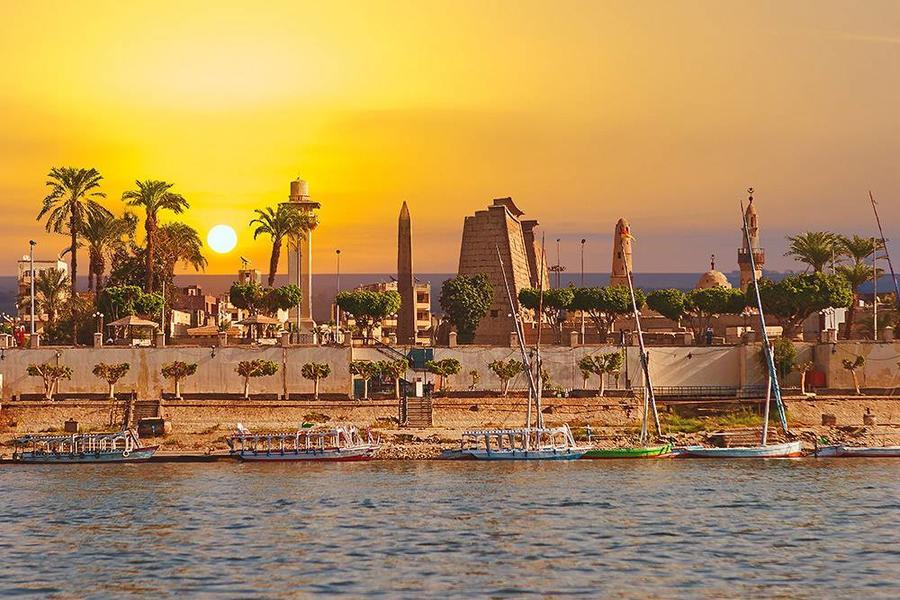
From the East Bank you cross by the road bridge south of town, or by the public ferry or a private motorboat from the corniche, with taxis waiting at the West Bank landing. The plain is flat, which makes cycling realistic from November to February, and our West Bank cycling tour threads between the temples on farm tracks. The simplest arrangement is a car and an Egyptologist, which is what our Medinet Habu, Ramesseum and Deir el-Medina tour provides: three sites, a guide who knows where the colour is, and no queue.
Warning: The Plain Has No Shade
The Ramesseum has almost no shade at all, and the open courts at Medinet Habu are not much better. In July and August afternoon highs in Luxor run past 40 C (104 F), and the stone throws the heat back at you. From May to September go in the first two hours after opening, carry more water than you think you need, and wear a hat with a real brim.
The ground is uneven at both sites, with fallen blocks and high thresholds, so wear proper shoes. Do not climb on the colossus or touch painted walls. Guardians sometimes offer to unlock a closed corner in exchange for a few pounds; a polite no is entirely acceptable.
Planning Your West Bank Day
These two temples reward a slower day. If you want everything in one sweep, our complete West Bank day pairs the Valley of the Kings with Medinet Habu and Deir el-Medina; if you prefer quieter sites, build the day around the two Ramesside temples and add Hatshepsut's terraces, which our Hatshepsut temple guide covers. A dawn hot air balloon flight often drifts over this part of the plain, which is a fine way to see Ramesses III's walls before walking through them.
Anyone in Luxor on 2 August 2027 will stand under one of the longest total eclipses of the century, with just over six minutes of totality at both temples, though August heat makes that a demanding day. For everything else on this side of the river, our Luxor travel guide is the place to start, and if you tell us your dates and interests, we will suggest how to pace the temples around them.