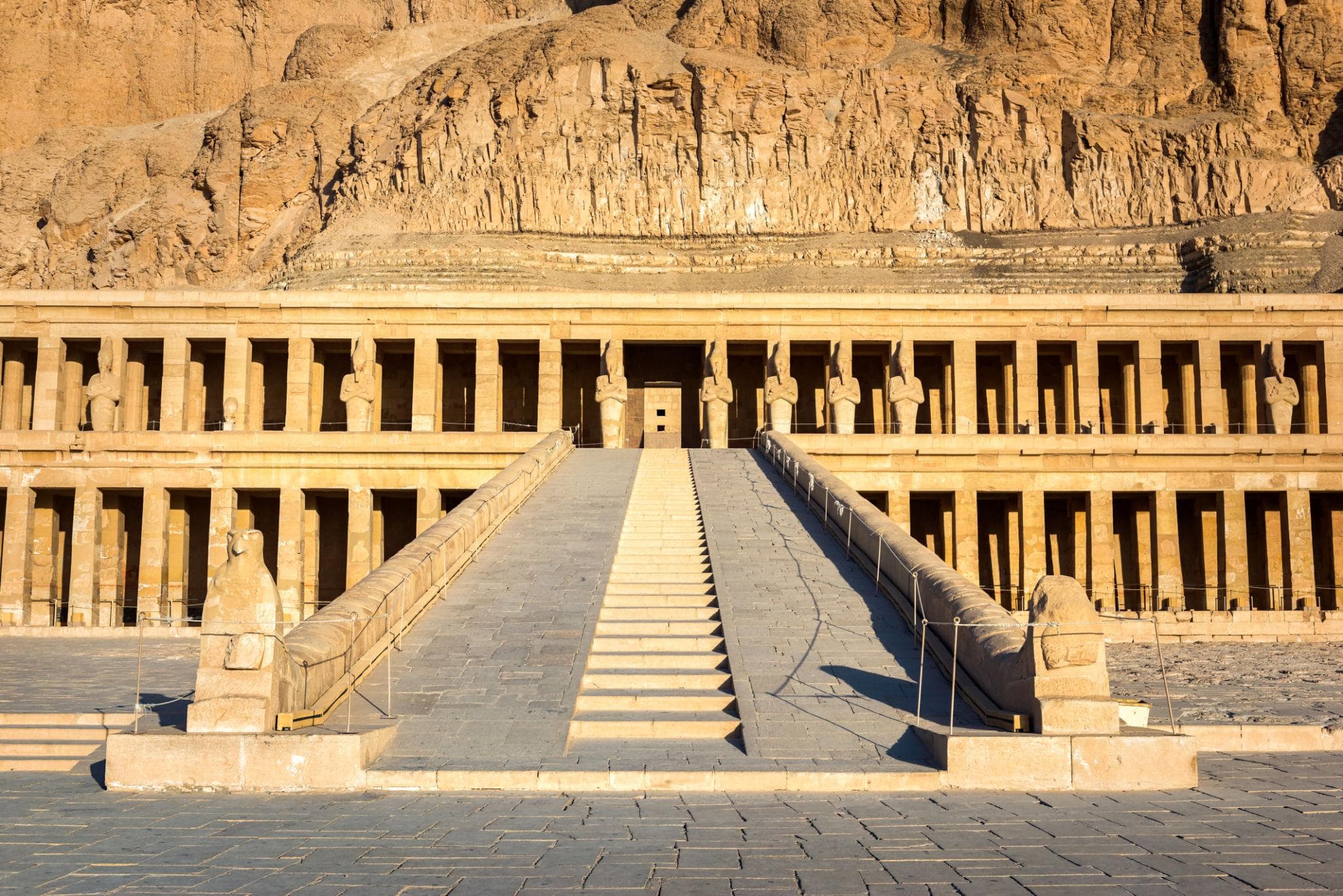
At six in the morning the cliffs of Deir el-Bahari are still grey, and the Temple of Hatshepsut is a pale shape at their foot: three broad terraces, one above another, joined by long ramps. Then the sun clears the Eastern Desert, and the light comes across the Nile to strike the colonnades full on, so for a few minutes the whole building looks as if it were lit from inside. Nothing else in Egypt looks like it. The temple is almost 3,500 years old, and it still looks modern.
It was built for a woman who ruled Egypt as king for around two decades, and whose successors later tried to cut her out of the record. This guide covers what to look for on each terrace, from the expedition to Punt to the chapels of Hathor and Anubis, along with the history most tours compress into a sentence, and the practical side as of autumn 2026: tickets, opening hours, the electric train from the car park, and how to avoid the heat and glare that catch out most visitors to the Temple of Hatshepsut.
At a Glance
Ancient name: Djeser-Djeseru, usually translated as Holy of Holies
Built: for Hatshepsut, who ruled about 1479 to 1458 BC, mostly between her 7th and 20th regnal years
Ticket: 440 EGP, students 220 EGP, about 8 USD (7 EUR) as of autumn 2026, bank card only
Opening hours: from 6am, closing around 5pm, an hour earlier on some winter and Ramadan schedules
From the car park: a small electric train covers the few hundred metres to the forecourt for a nominal fee
Time needed: one to one and a half hours
Best time: at opening, before the tour buses arrive at around half past eight
Shade: almost none outside the colonnades; the limestone reflects both heat and light
Accessibility: ramps rather than stairs between the terraces, though they are long and fairly steep
Combine with: the Valley of the Kings, just over the ridge, and the Tombs of the Nobles below
Hatshepsut, the King Who Was a Woman
Hatshepsut was the daughter of Thutmose I and the wife of her half-brother Thutmose II. When he died young, the heir was Thutmose III, his son by a minor wife, still a small child. Hatshepsut began as his regent, as royal widows had done before. By about the seventh year of the boy's reign she had taken the full titles of a pharaoh, and from then on she ruled as senior king, with the young Thutmose as her junior partner.
Ancient sources credit her with a reign of about 21 to 22 years, and it was prosperous and largely peaceful. She sent a trading expedition to Punt, raised two obelisks at Karnak that were the tallest in the world when they went up, and built on a scale that few rulers matched. In her official images she gradually takes on the conventional appearance of a king, the kilt, the false beard, the broad shoulders, while the texts often keep feminine grammatical endings. She was cutting a new role for herself out of the existing iconography.
Her temple was the centrepiece of that project. It was dedicated to Amun, whom she called her father, and it was also a place for her own cult and that of Thutmose I. Our guide to the great pharaohs of Egypt places her among the rulers around her.
Senenmut and the Design of Djeser-Djeseru
Most guides will tell you the architect was Senenmut, Hatshepsut's steward, tutor to her daughter Neferure, and her closest official. That is the traditional attribution, and he did hold the title of overseer of works, but no text names him as the designer, and the high priest Hapuseneb has also been proposed. The honest answer is that the design came out of her court, and that Hatshepsut almost certainly shaped it herself.
What is certain is where the idea came from. Immediately to the south lie the ruins of the terraced temple of Mentuhotep II, built some five centuries earlier, around 2050 BC, by the king who reunified Egypt. Hatshepsut's builders took his idea of a temple stepping up the cliff in terraces and refined it into something lighter and more open. Building ran from about her seventh year to her twentieth, and the plans were revised several times along the way.
Visitors now arrive from a car park, but in antiquity the approach was a processional causeway about 1 km (0.6 miles) long, rising from a valley temple on the edge of the cultivation. Once a year, in the Beautiful Festival of the Valley, the barque of Amun was carried across the river from Karnak and up that causeway to spend the night in the sanctuary, as the living of Thebes visited the tombs of their dead.
The Lower Terrace and the Great Ramps
From the forecourt a long ramp climbs to the middle terrace, flanked by two colonnades at ground level. They are easy to walk past on the way up, and they hold some of the temple's most interesting carving. In the southern portico, to your left as you face the cliff, the reliefs record the transport of two great obelisks by river from the quarries at Elephantine, near Aswan, to Karnak. In the northern portico Hatshepsut appears as a sphinx trampling Egypt's enemies, beside hunting and fishing scenes.
Look for the faint figures of the tow boats and the obelisks laid end to end on a huge barge. The scale is the point: the reliefs are as much an account of engineering as of piety, and they help explain how a reign without major wars still filled its monuments with achievement.
The Punt Colonnade
The southern half of the middle terrace holds the reliefs most visitors come for. In the ninth year of her reign, around 1471 BC, Hatshepsut sent a fleet down the Red Sea to Punt, the source of incense, ebony and exotic animals. Where Punt was remains debated, but most scholars put it somewhere along the southern Red Sea coast, in the region of modern Sudan, Eritrea and the Horn of Africa.
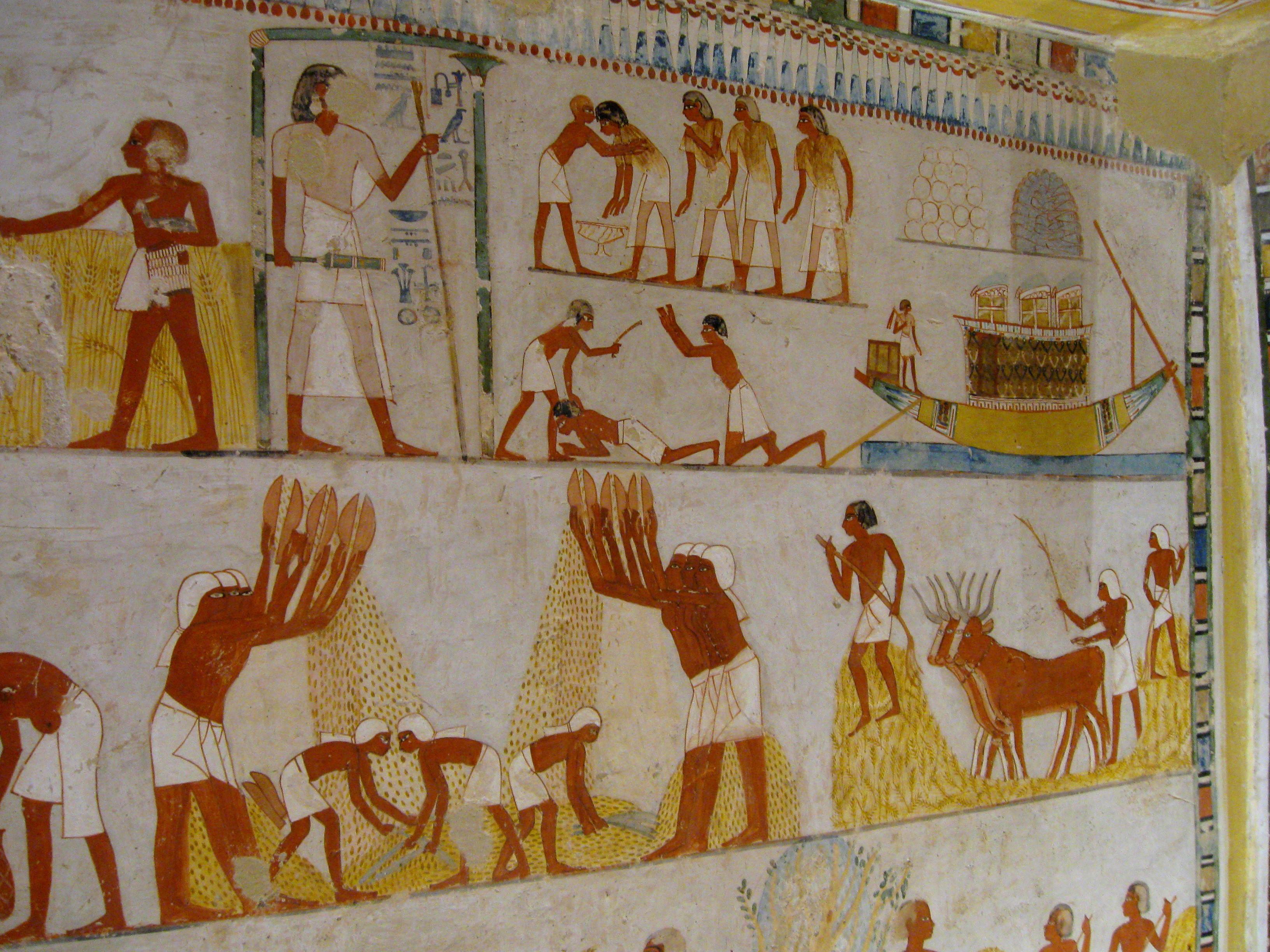
The reliefs read like a travel report. Ships with rigged sails arrive at a coast of houses raised on stilts among palms. The ruler of Punt and his wife come to meet the Egyptians, she drawn with a heavy, rounded body that has fascinated visitors ever since; the original block is now in Cairo, and a cast stands in its place. Then the loading begins: sacks of incense, ebony, ivory, panther skins, baboons, and most precious of all, living myrrh trees, carried on board in baskets so they could be replanted in Amun's garden at home.
Bring your eyes close to the wall. The colour is faded, many details are damaged, and morning light raking across the surface helps. A good guide will show you the fish beneath the ships, carved with enough precision that some species can still be identified.
The Birth Colonnade, Hathor and Anubis
The northern half of the middle terrace answers the obvious question about a woman on the throne. Its reliefs tell the story of Hatshepsut's divine birth: Amun visits her mother, Queen Ahmose, in the form of her husband, Thutmose I; the ram-headed god Khnum shapes the child and her spirit-double on his potter's wheel; and the goddesses attend the birth. It is the oldest surviving cycle of this kind, and its message is plain: she was the god's own child, chosen before she was born.
At each end of the terrace stands a chapel. To the south, the Hathor shrine has columns whose capitals are carved as the face of the goddess, with her cow's ears, and inside are scenes of Hathor as a cow nursing the young queen. Elsewhere in the temple, small figures of Senenmut were carved in places where an open shrine door would have hidden them, a liberty hard to imagine without royal consent. To the north, the Anubis shrine has a hall of twelve columns and some of the best-preserved colour in the temple: blues, reds and ochres still bright on the ceiling and walls, with Anubis receiving offerings.
The Upper Terrace and the Sanctuary of Amun
The second ramp brings you to the upper terrace, fronted by a portico of colossal statues of Hatshepsut in the form of Osiris, arms crossed and holding the crook and flail. Many have been reassembled from fragments, and the faces repay a close look. Through the central granite gateway lies a festival courtyard, and on the axis behind it the sanctuary of Amun is cut directly into the cliff, where the god's barque rested during the festival.
To the north of the courtyard an open court served the cult of the sun god, with an altar open to the sky. To the south a complex of offering halls served the cult of Hatshepsut herself and of her father, Thutmose I. The temple was a dynastic monument as much as a religious one, binding her claim to the throne to her father's.
Did You Know: The Queen Who Was Erased
Late in the reign of Thutmose III, around his 42nd year and some twenty years after Hatshepsut died, a campaign began to remove her from the monuments. Her statues were smashed and thrown into quarries, her names chiselled out, and her figures carved over or replaced with those of her father, husband or stepson. The work was patchy and appears to have stopped within a couple of years, as Amenhotep II came to the throne.
The motive remains unclear. The old story of a stepson taking revenge does not fit the twenty-year delay, and scholars now prefer explanations about the succession or about restoring the expected male order of kingship. Walk the terraces and you will see the scars everywhere: a carefully cut gap where a figure should be, a cartouche hacked out. Further damage came under Akhenaten, whose agents erased Amun's image, later restored by Tutankhamun, Horemheb and Ramesses II.
Remembering November 1997
On 17 November 1997, gunmen attacked visitors at the Temple of Hatshepsut. Sixty-two people were killed: fifty-eight visitors from abroad and four Egyptians. It remains one of the darkest days in the modern history of Egyptian travel, and it was met with widespread revulsion in Egypt. Luxor, which lives from its visitors, felt it as its own loss.
It reshaped how Egypt protects its heritage sites. The checkpoints, scanners and tourist police you meet across the West Bank today are part of the security system built in the years afterwards, and in the decades since, the temple has received millions of visitors. Our Egypt safety tips cover the current picture calmly. We mention the attack here because many visitors know of it, and because the people who died there deserve to be remembered at the place itself.
The Polish Mission and the Restoration
The temple you walk through owes a great deal to people who spent their working lives on it. Edouard Naville cleared it for the Egypt Exploration Fund between 1893 and 1906, removing the remains of the Coptic monastery of Saint Phoibammon, which had stood on the upper terrace from roughly the 6th to the 8th centuries AD and gave the site its Arabic name, Deir el-Bahari, the Northern Monastery. The Metropolitan Museum of Art followed from 1911 to 1936.
Since 1961 the Polish-Egyptian mission of the Polish Centre of Mediterranean Archaeology at the University of Warsaw, founded by Kazimierz Michałowski, has led the study and restoration of the temple. Decades of work have reassembled colonnades and statues from thousands of fragments, rebuilt the upper terrace and conserved the painted reliefs. In the early 1960s the same mission found the ruined temple of Thutmose III, Djeser-Akhet, between Hatshepsut's and Mentuhotep's, brought down in antiquity by rockfall.
The cliffs behind the temple hold another story. In 1881 a tomb high in the rock to the south, now known as DB320, was found to contain the mummies of about forty kings and members of the royal family, moved there for safety by priests some three thousand years ago. Hatshepsut's own probable mummy came from a different tomb in the Valley of the Kings and, after an identification announced in 2007 that some scholars still question, now lies in the royal mummies hall described in our NMEC guide.
Temple of Hatshepsut Tickets, Hours and the Electric Train
The ticket costs 440 EGP for foreign adults and 220 EGP for students with a valid ISIC card, as of autumn 2026, about 8 USD (7 EUR). That is the figure on the Ministry's list of 5 November 2024, and it was still being charged in October 2026. The temple has its own ticket office at the car park, separate from the main West Bank office that sells the nobles' tombs and the smaller temples. Payment is by bank card only, as at all of Luxor's major sites since 2023.
The site opens at 6am and closes around 5pm, sometimes an hour earlier in winter and during Ramadan. From the ticket office a small electric train, really a covered buggy, runs to the temple forecourt for a nominal fee, reported at around 5 EGP per person; keep a few small notes in case it is cash only that day. You can walk the few hundred metres instead, but in summer the train is worth it.
Egyptian site prices are reviewed periodically, often around November. We had seen no announcement of new Luxor prices at the time of writing, but check our Egypt ticket prices guide before you go. Phone photography is included, without flash inside the chapels.
Pro Tip: Beat the Heat and the Glare
Arrive at opening. The temple faces east, so in the first hour the façade is lit by low, warm light, the forecourt is still cool, and the coach groups have not yet arrived: they typically appear from around half past eight. By late morning the limestone terraces and the cliff behind them act as a reflector, and on a summer day the forecourt becomes one of the hottest open spaces on the West Bank.
Wear sunglasses and a brimmed hat even in winter, carry water, and use the colonnades for shade as you go. Photographers who want the whole building with a softer light can return in the late afternoon, when the sun drops behind the cliff and the terraces fall into even shadow. In June, July and August, aim to be back in the shade by ten.
The View From a Balloon
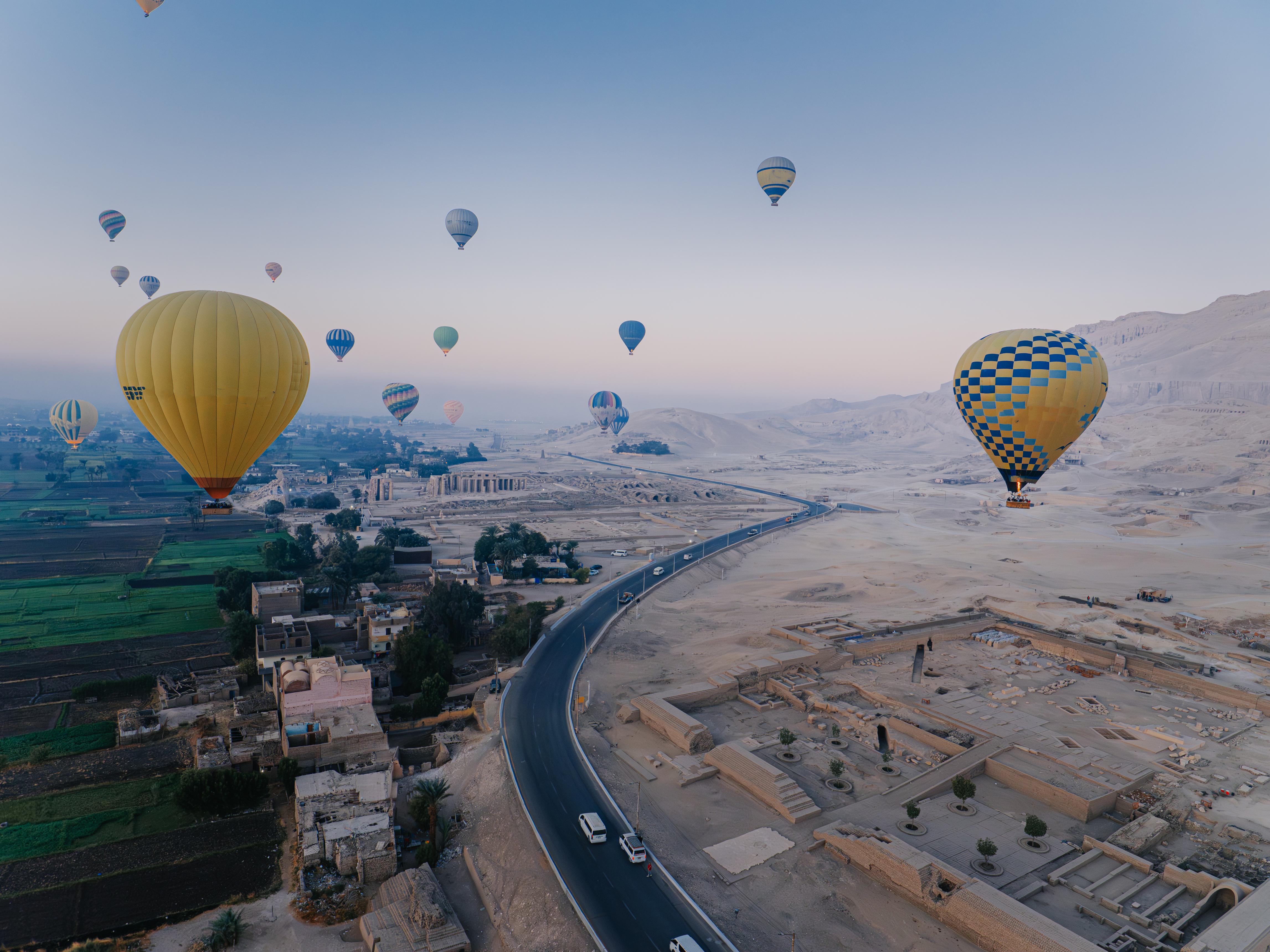
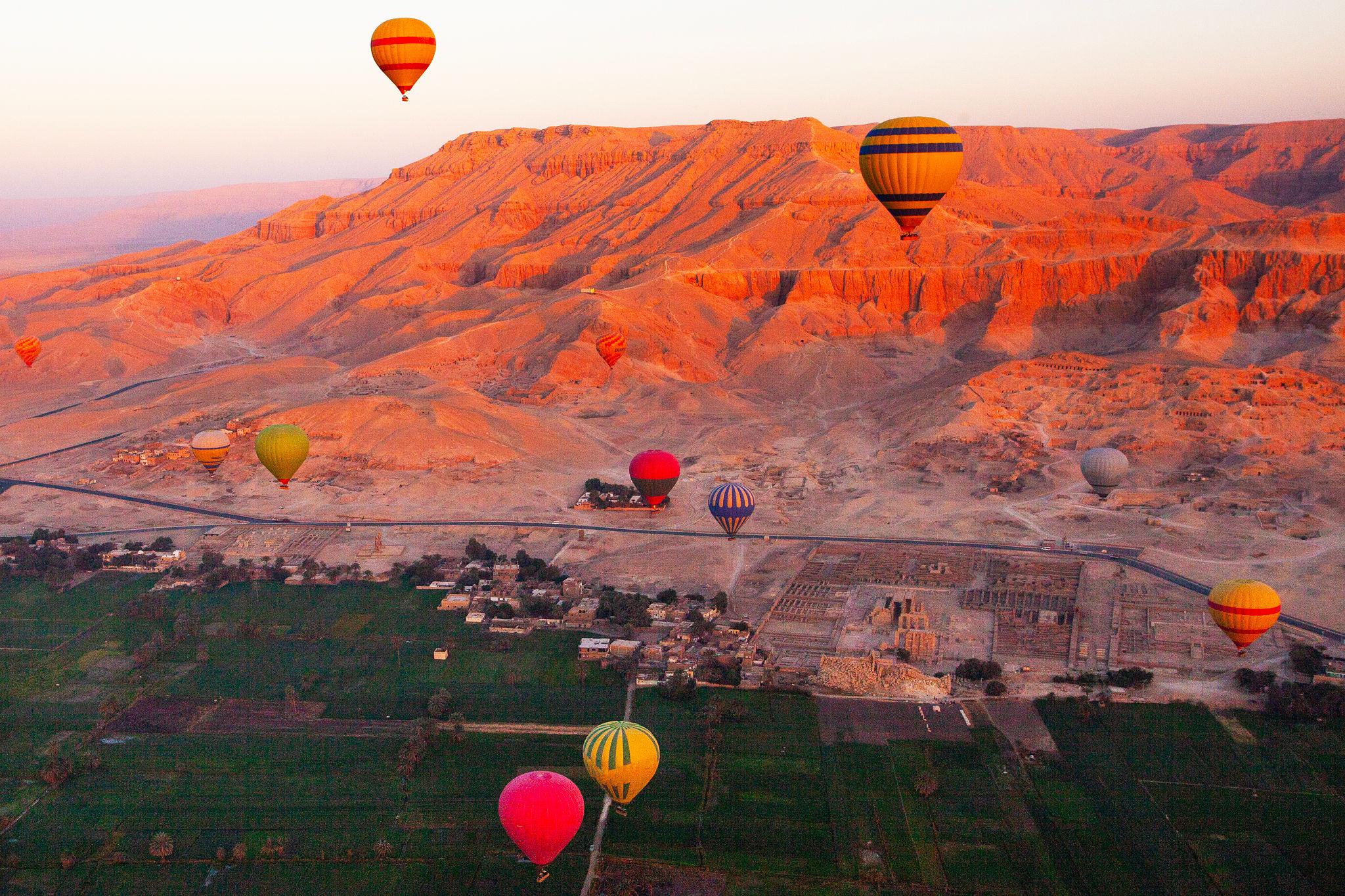
The best view of Deir el-Bahari is from the air. Hot air balloons launch from the West Bank before dawn and, on the usual morning breeze, drift along the edge of the cultivation as the sun comes up over the Nile, and from a few hundred metres the terraces sit in their bay of cliffs exactly as the architects intended them to be seen, with Mentuhotep's ruins beside them and the ridge hiding the Valley of the Kings beyond.
Flights depend on the wind and are sometimes cancelled at short notice, so put the balloon early in your stay to leave a spare morning. Our Luxor hot air balloon guide covers prices and safety, and our sunrise balloon flight is timed to land in time for a temple visit while it is still cool.
Planning Your Visit
The Temple of Hatshepsut fits naturally into a morning with the Valley of the Kings: the royal tombs first at opening, then the temple, or the reverse if you want the façade in early light. Our Valley of the Kings and Hatshepsut tour is built around exactly that pairing, and our complete West Bank tour adds the Colossi of Memnon, Medinet Habu and the painted tombs of the officials. Our guide to the Tombs of the Nobles and Deir el-Medina explains why those small chapels are worth an extra hour, and our guide to Nefertari's tomb and the Valley of the Queens covers the southern end of the necropolis.
For fitting the temple into a wider stay in Luxor, tell us your dates and how much heat you are prepared to tolerate through our contact page, and we will build the West Bank around the hours that suit it best.