At four in the morning the Corniche in Luxor is quiet enough to hear the river. A minibus idles outside the hotel, someone hands you instant coffee, and twenty minutes later you are crossing the Nile by motor launch in the dark with thirty people too tired to talk. On the far bank a line of headlights points at a field of stubble where nylon envelopes the size of houses lie on their sides, filling with cold air.
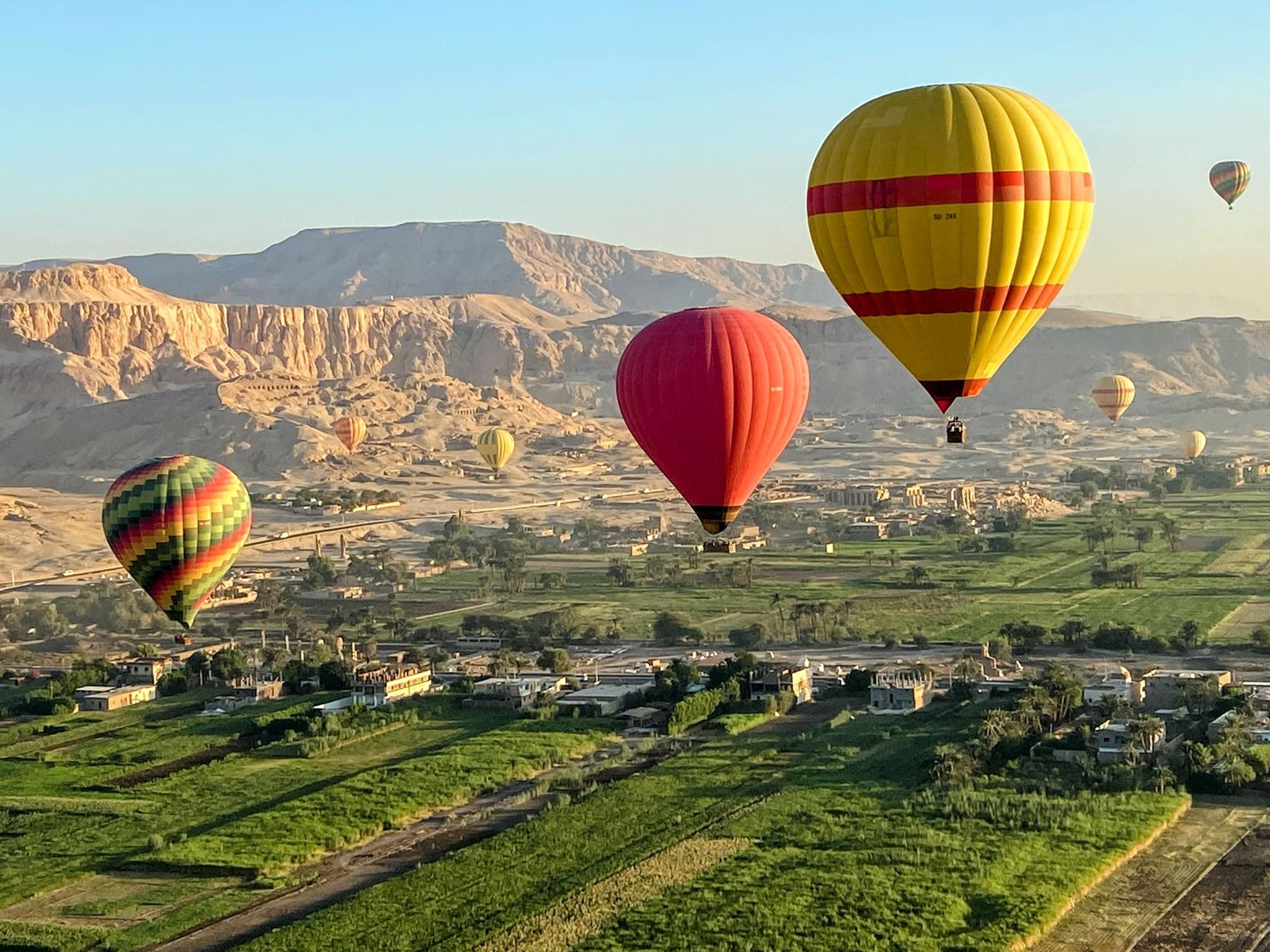
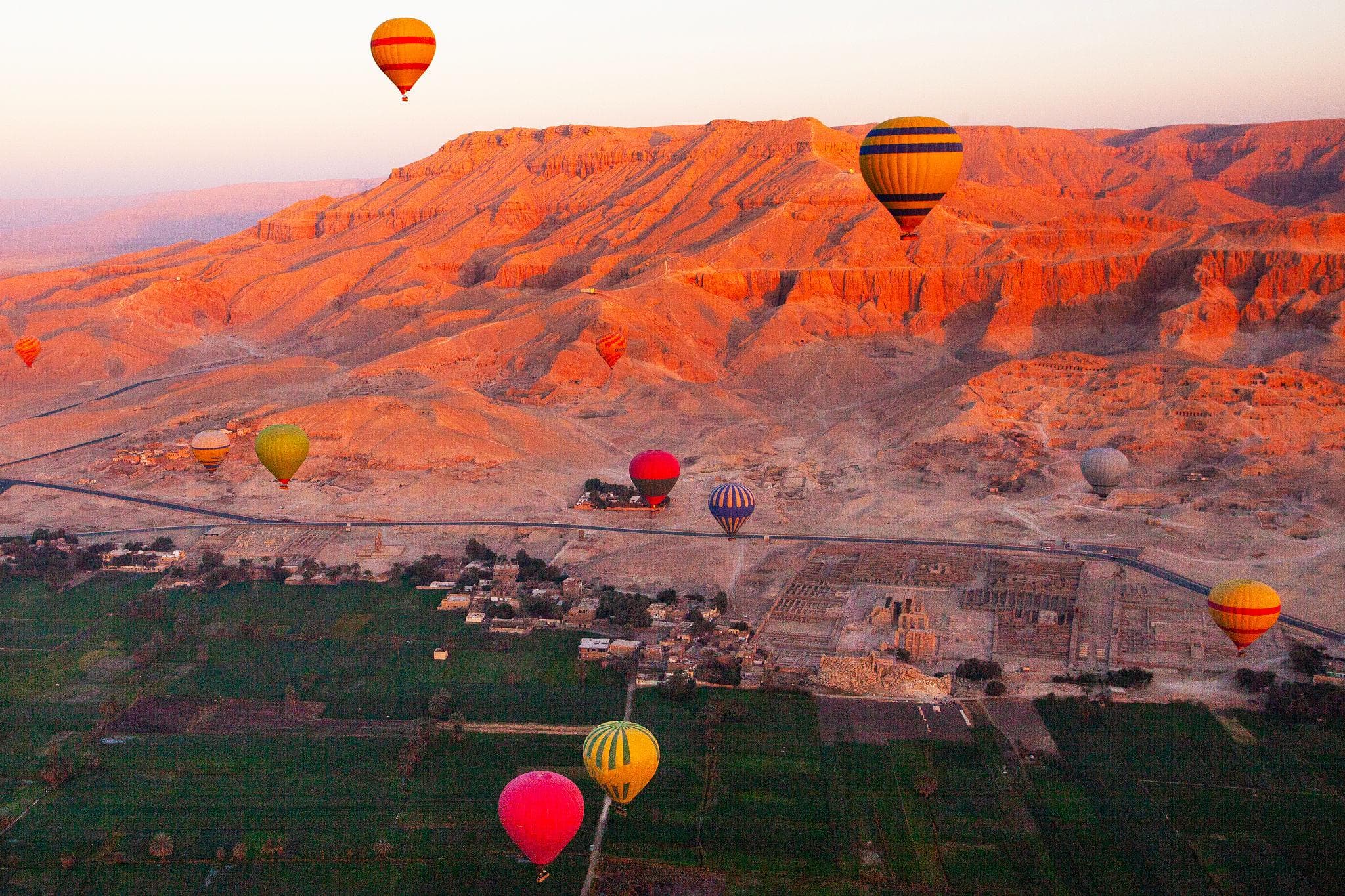
That hour is half of what you are paying for. The other half arrives forty minutes later, when the basket lifts, the burner cuts out and the Theban necropolis slides open beneath you: mortuary temples, cane fields, the dry gash of the royal valley, and a 450-metre limestone horn called al-Qurn taking the first light while the fields are still blue.
It is also the most closely regulated adventure activity in Egypt, with a mixed safety history and a habit of not flying at all for three months of the year.
At a Glance
Where: the licensed ballooning field on Luxor's West Bank, inland of the Colossi of Memnon, five minutes from the river
Pickup: roughly 3:30 to 5:00 am, set backwards from sunrise
Time in the air: 45 to 60 minutes; three to four hours door to door
Cruising height: usually 400 to 500 m, with an Egyptian ceiling of 2,000 m
Price as of 2026: about 75 to 150 USD per person shared, roughly 3,700 to 7,500 EGP at the August 2026 rate near 50 EGP to the dollar
Season: no commercial flights between 1 June and the end of August
Permits: none for you; the operator needs an Egyptian Civil Aviation Authority licence
Fitness: you must climb a basket wall about 1.2 m high and stand for the whole flight
Warning: Balloons Do Not Fly in High Summer
In June 2026 the Egyptian Civil Aviation Authority suspended commercial balloon flights over Luxor for three months, from 1 June to the end of August, at the request of the operating companies. The reasoning is physics rather than bureaucracy. As the ground heats, thermals and unstable morning air make an engineless aircraft hard to land predictably, and July in Luxor averages a daily high of 41.4°C (106.5°F).
A comparable stand-down ran through summer 2025, so this now reads as an annual pattern rather than a one-off, yet plenty of third-party booking pages will still take a July reservation from you. Flights are expected back with the autumn season from the start of September.
The 4am Pickup and the Nile Crossing
Pickup is calculated from sunrise, which is why quoted times differ so wildly between reviews written in different months. Sunrise in Luxor swings between roughly 5:20 and 6:40 across the year, partly seasonal and partly because Egypt puts its clocks forward from late April to late October. In January an East Bank hotel is collected around 5:00; in spring it can be 3:30. Nile cruise boats go first, because passengers take longest to walk off.
Most operators cross by launch rather than driving round by the road bridge south of town, which is one of the better parts of the morning. The tea handed round on the boat is not the breakfast you were promised, so ask the front desk the night before to keep something aside.
The Launch Field Before Dawn
Balloons do not take off wherever they like. After a bad run of accidents in 2009, takeoffs were confined to a dedicated licensed field on the West Bank, operated under the authority of Luxor International Airport, in farmland behind the Colossi of Memnon. Every company uses it. What varies between operators is the basket, not the address.
The inflation is worth staying awake for. The envelope is unrolled flat across the stubble, a petrol-driven fan pushes cold air in until it swells into a tunnel you could walk down, then the pilot tilts the burners in and twenty-odd metres of nylon stands upright in under a minute. On a busy winter morning twenty or more balloons do this at once and the field becomes a slow orange strobe. On 7 January 2024, according to figures reported in the Egyptian press, 45 balloons carried around 1,100 passengers over Luxor in one morning.
Baskets come in eight sizes, from two-passenger up to 32; most shared flights use compartmented baskets carrying 16 to 28. You climb in over a wall about 1.2 m high using footholds cut into the wicker, and there is nowhere to sit down.
What You Actually Fly Over
The route is not chosen. Balloons go where the wind goes, and a pilot steers only by climbing or descending into air moving a different way. The prevailing morning wind pushes most flights across the same band of the West Bank, and that band holds one of the densest concentrations of monumental architecture anywhere.
- The Colossi of Memnon, two quartzite statues of Amenhotep III about 18 m high, all that stands above ground of the largest mortuary temple ever built in Egypt
- The Ramesseum, mortuary temple of Ramesses II of the 19th Dynasty (reigned roughly 1279 to 1213 BC), with the shattered torso of his fallen colossus in the second court
- Medinet Habu, the fortress-temple of Ramesses III of the 20th Dynasty (roughly 1187 to 1156 BC), which holds more original paint than anything else on the bank
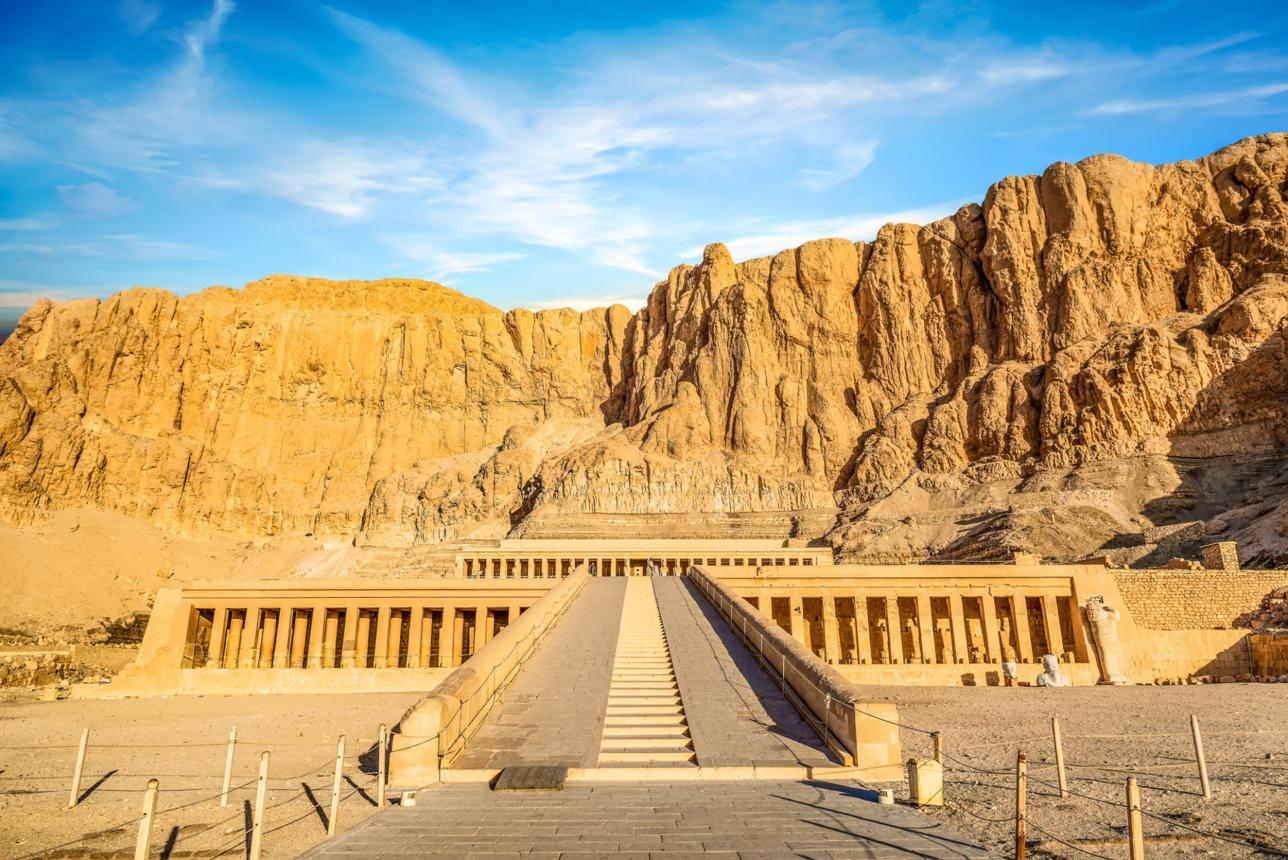
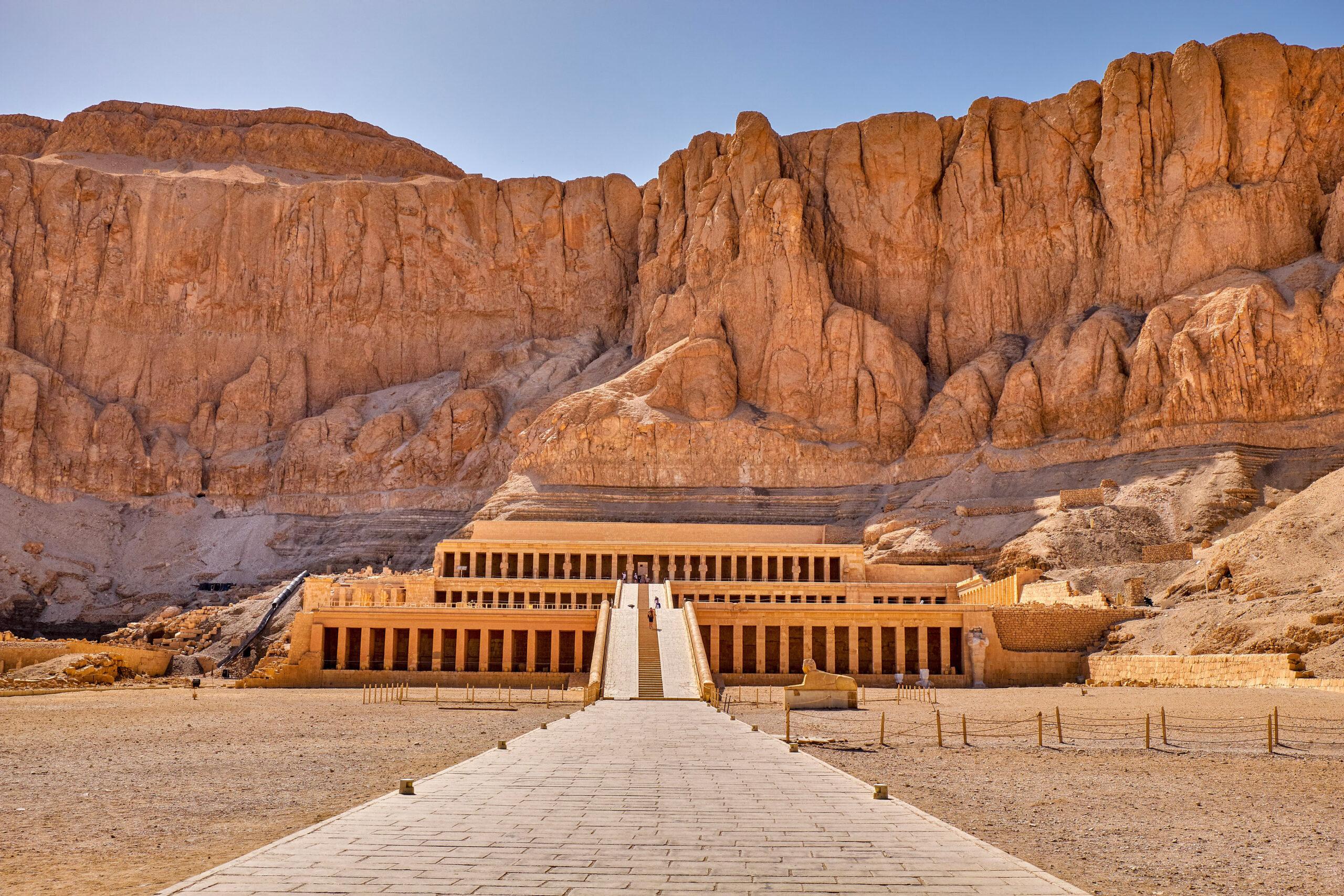
- Hatshepsut's terraces at Deir el-Bahari, built around 1479 to 1458 BC and legible from the air as pure geometry in a way they never are from the forecourt
- Al-Qurn, "the horn" in Arabic and Ta-dehent to the ancient Egyptians, the pyramid-shaped 450 m peak sacred to the cobra goddess Meretseger
Below all of it is the green: sugar cane standing three metres tall by midwinter and cut roughly between January and May, wheat, bananas, and the fodder clover Egyptians call barsim. The boundary between irrigated field and desert is not a gradient but a line, and from 400 m it looks ruled. You also fly over roofs. These are working villages, not an archaeological park, and you will see buffalo led out and children shouting up from flat rooftops. Somewhere under you is New Gourna, the mudbrick village Hassan Fathy built between 1946 and 1952 as an experiment in vernacular architecture, now reduced to its mosque, its market and a handful of houses.
How High and How Long
Most flights cruise 400 to 500 m above ground, high enough to hold the whole necropolis in one frame and low enough to pick out tomb entrances in the cliff. Pilots climb when they need a steering wind, and Egyptian rules cap balloons at 2,000 m. Almost every flight also drops to a few dozen metres over the fields, which is invariably the part passengers describe afterwards.
Advertised air time of 45 to 60 minutes is usually honoured, but it is weather-dependent and no honest operator guarantees a number. It is genuinely cold before dawn from November through February, when Luxor's January overnight low averages about 7°C (45°F), and the burner only warms the top of your head. A packable jacket is the most useful thing you will bring; our month-by-month weather guide has the seasonal detail.
Good to Know: Why Flights Get Cancelled at the Last Minute
Balloons need a narrow window of calm, stable air, and Luxor mornings do not always supply one. In March 2026 the Civil Aviation Authority grounded the entire Luxor fleet for the day over strong early-morning winds. Decisions are usually taken between 4 and 6 am, sometimes after you have crossed the river and drunk the tea.
The consequence is scheduling. Book the balloon for your first available morning in Luxor rather than your last, so a cancellation still leaves a second attempt, and confirm in writing whether the remedy is a cash refund or a credit.
Coming Down
Landing is the technically interesting part of ballooning and the part where things go wrong. The pilot picks a field of cut cane or bare stubble, the recovery pickups converge across the tracks, and passengers are told to face the direction of travel, grip the rope handles, bend their knees and brace. The basket may drag some distance and may tip onto its side. That is a normal landing rather than a bad one, and it is why operators ask about backs, hips and knees at booking.
Once down, men appear from the fields to hold the basket while the envelope deflates, and children arrive selling scarves and alabaster carvings. A few small notes for the ground crew is customary and entirely at your discretion.
What Separates a 70-Dollar Flight from a 150-Dollar One
As of 2026, shared sunrise flights are advertised from around 75 USD per person at the bottom of the market to roughly 150 USD at the top, with small-basket and private options above that. Sources disagree on the exact spread, which reflects a market where the same flight is resold several times over. What the extra money does not buy is a different flight. Every balloon leaves the same field at the same time into the same wind.
Basket size: the biggest variable. A 28-passenger basket is cheaper per head than a 12 and more crowded at the rail.
Position: some operators sell outside or corner compartments at a premium, worth paying if photography matters to you.
Transfers: the cheapest fares sometimes exclude hotel pickup, or surcharge collection from a cruise boat.
Extras: certificates, video files, a cooked breakfast. Pleasant, not decisive.
Maintenance margin: the one that matters and the one you cannot see on a booking page.
Our own Luxor sunrise balloon flight is sold as a fixed sunrise slot with hotel or cruise-boat pickup and a stated rebooking policy for weather days, which is the part we would want in writing as passengers.
The Safety Record, Told Straight
The history should not be smoothed over. In 2009 three balloons crashed near Luxor in a single day; flights stopped for six months, and the rules that followed limited how many balloons could fly at once and confined takeoffs to the field still used today. On 26 February 2013 a fuel line in service since 2005 sprang a leak and ignited as a balloon came in to land, killing 19 of the 21 people aboard. It remains the deadliest ballooning accident on record. The Civil Aviation Authority published its final report in January 2014; flights had resumed the previous April under industry pressure.
Since then the record has improved without becoming clean. A 2016 crash injured a party of Chinese tourists; a 2018 accident in high winds killed one passenger and injured twelve. In January 2025 a wind shift forced a balloon carrying 24 tourists into an emergency landing on high ground northwest of the city, and the Ministry of Defence search and rescue centre recovered everyone unharmed.
Against that sit very large numbers of uneventful flights, a 2,000 m ceiling, camera monitoring, and a regulator that has repeatedly grounded the whole fleet rather than let a marginal morning proceed. The fair summary is a low-probability, high-consequence activity run to standards that vary between operators.
Speak to your tour company before booking a hot air balloon flight. Some UK tour operators have stopped selling balloon flights because they have not been able to verify safety standards.
— UK Foreign, Commonwealth and Development Office travel advice for Egypt
What to Check Before You Pay
The Civil Aviation Authority licenses balloon operators in Luxor and the approved list changes, so general reassurance is worth nothing. Ask specific questions.
- Is the operator ECAA-licensed, and will they state that on the booking confirmation?
- Who is the actual flying company, as distinct from the agency selling the ticket?
- How many passengers in the basket, and which compartment are you in?
- What is the cancellation remedy: same-day refund, next-morning rebooking, or credit?
- Does your insurance cover ballooning? Many policies exclude it, and the FCDO warns that air or sea rescue in Egypt can cost more than 4,000 USD an hour.
Who Should Not Fly
Children under about six: most operators decline them, and the basket wall is taller than a small child.
Anyone who cannot stand for an hour: there is no seat and no room to sit down mid-flight.
Recent back, hip or knee surgery: the braced landing position is not optional.
Pregnancy: routinely declined by Luxor operators.
Passengers over about 120 kg: not a refusal, but declare it, because weight distribution across compartments is a real calculation.
Fear of heights is rarely the problem people expect. A balloon has no vibration and no motion relative to the air around it, and the wall reaches your chest.
Pro Tip: Camera Settings for a Moving Basket
Set shutter speed to 1/500 second or faster. The basket flexes, the burner shakes it, and anything slower than about 1/250 will be soft in a way you only discover at home. Let ISO float to 3200 or 6400 and accept the noise, because a sharp noisy frame beats a clean blurred one.
Shoot raw if your camera or phone allows it, and dial in about two-thirds of a stop of negative exposure compensation so the sky above the Theban hills does not blow out. Shadowed fields lift back in editing; a burnt sunrise does not. A wide lens around 16-35mm equivalent catches the other balloons and the curve of your own envelope overhead, while something near 70mm isolates Hatshepsut's terraces against the cliff. Longer than that is hard to hold steady. Use a wrist strap, clean the front element before leaving the hotel, and take one frame straight up into the envelope as the burner fires. Our Egypt photography guide covers the rest of the trip.
Building the Rest of Your Morning
You are back on the ground around seven, with the West Bank still in low golden light and the ticket offices open. That is the real argument for flying on your first Luxor morning rather than your last: everything you looked down on becomes somewhere you can walk into an hour later. The royal valley opens at 6 am, and as of 2026 a standard ticket covering three tombs runs about 750 EGP with Tutankhamun's tomb roughly 700 EGP on top, paid by card since the major sites went cashless. Our Valley of the Kings guide explains which tombs justify the extra fee.
From the landing field it is a short drive to almost everything. The straightforward pairing is a Valley of the Kings and Hatshepsut morning. For the full sweep, the complete West Bank day adds Medinet Habu and the artisans' village at Deir el-Medina, while the Medinet Habu and Ramesseum route favours the temples most groups drive past. In cooler months a West Bank cycling morning puts you at ground level among the cane fields you floated over, and our Luxor travel guide covers the wider city.
Book for a morning early in your stay, keep the next day free in case the wind decides otherwise, and set an alarm at a time that will feel unreasonable until roughly the moment the basket leaves the ground.