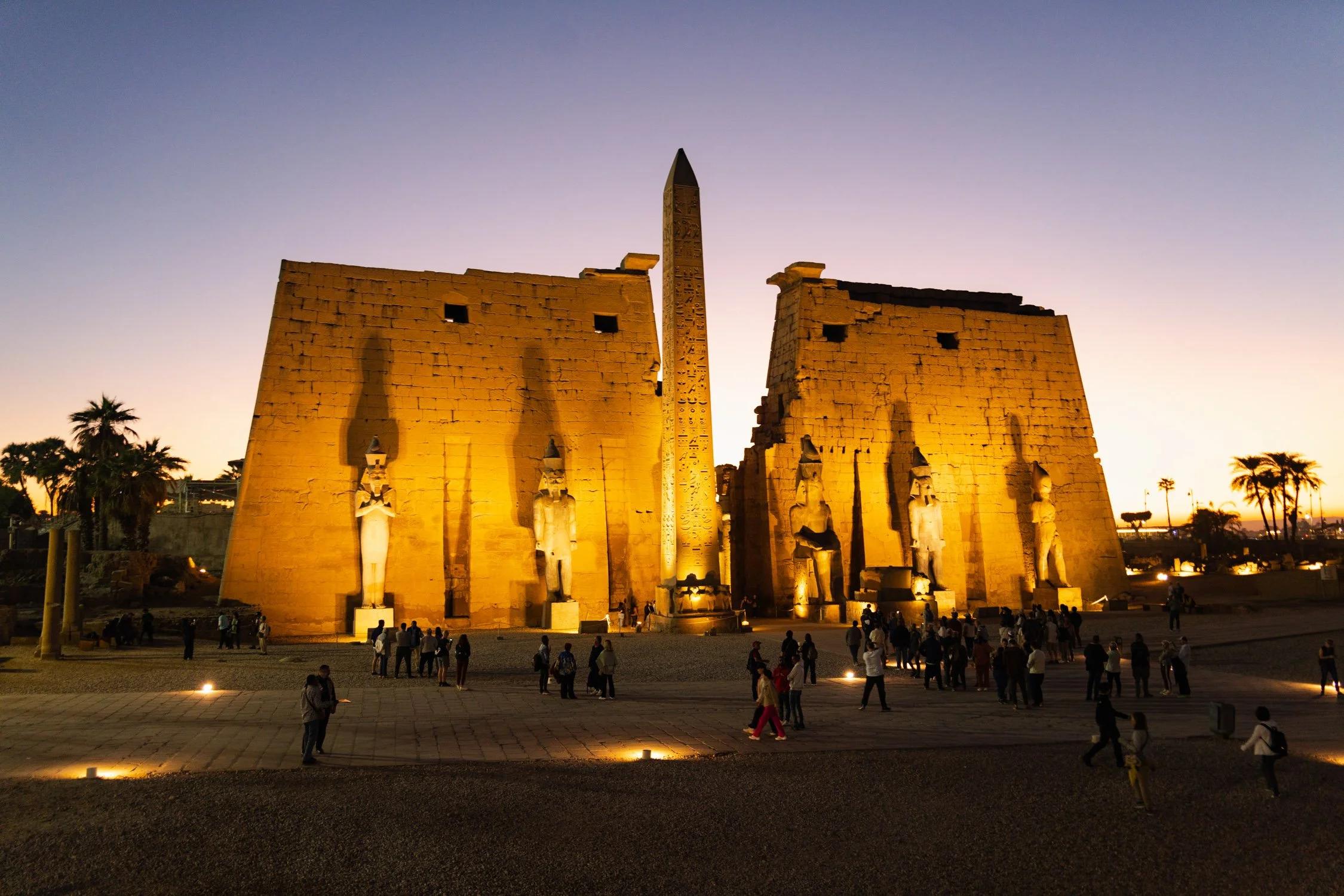
At eight o'clock on a January night in Luxor, the first pylon of Karnak is a black cliff against a slightly less black sky. Then a voice comes out of it, floodlights climb the stone, and the audience walks into a temple that closed to daytime visitors three hours earlier. You keep walking, through the Great Hypostyle Hall in near darkness, until the route delivers you to a stone grandstand above the Sacred Lake. That hour is the best after-dark sightseeing in Egypt, for about the price of a decent lunch.
Six Egyptian monuments currently run a sound and light show: the Giza plateau, Karnak in Luxor, Philae and Abu Simbel in the far south, Edfu on the Nile between them, and, since 2024, the Citadel of Qaitbay in Alexandria. They are run as a single commercial family, which is why they share a house style: recorded narration, an orchestral score, banks of coloured floodlights, no live performers at all. The format was invented at the Château de Chambord in France in 1952, and the Giza show, which opened on 13 April 1961, was the first in Africa. Karnak followed in 1972, Edfu only in 2010.
That range of dates matters more than any brochure admits. Some of these shows are genuinely moving. Some are a 1960s radio play with lighting cues, and the setting is doing all the work. What follows is what each evening gives you, what it costs in 2026, and when to spend the night somewhere else entirely.
At a Glance
Venues: Giza, Karnak in Luxor, Philae and Abu Simbel near Aswan, Edfu, and the Citadel of Qaitbay in Alexandria
Standard ticket: the operating company quotes 20 USD for adults and 11 USD for children aged 6 to 12, roughly 1,000 EGP at August 2026 rates of about 50 EGP to the dollar
Cheapest and dearest: Edfu at 15 USD, Qaitbay at 25 USD
Show length: about 45 to 60 minutes at most venues, roughly 75 minutes at Karnak
Sessions: usually two a night, most often 8pm and 9pm at the temple sites
Languages: up to ten, on a published rota; the later session is normally the multi-language headset show
Payment: card, in advance online or at the gate
What to wear: warmer clothes than you expect from November through February
Best single show: Karnak
Our Pick: Karnak, Because You Walk Through It
Karnak is the only one of the six that is not a seated performance. You enter through the avenue of ram-headed sphinxes, and the show moves you in stages through the courts and the hypostyle hall while lights pick out one architectural element at a time and a scripted dialogue between priests and pharaohs plays overhead. Roughly the first three quarters is walking; the last half hour is seated on the grandstand above the Sacred Lake, looking back at the temple with the whole complex lit behind it.
Sources put the running time at between 60 and 75 minutes, and in practice it depends on how briskly the group is moved. Two sessions run nightly, at 8pm in English and 9pm in the rotating multi-language format, with Thursday's later show given over to Arabic. Tickets are 20 USD.
Two practical points. The ground is ancient, uneven and unlit between the light cues, so closed shoes matter more here than anywhere else on this list. And the show is a poor substitute for a daytime visit rather than a rival to it, because you see fragments in isolation and never the scale. Walk the complex in daylight first, ideally on a tour like our Karnak and Luxor Temple sunset tour.
Giza: The Setting Carries a Very Old Script
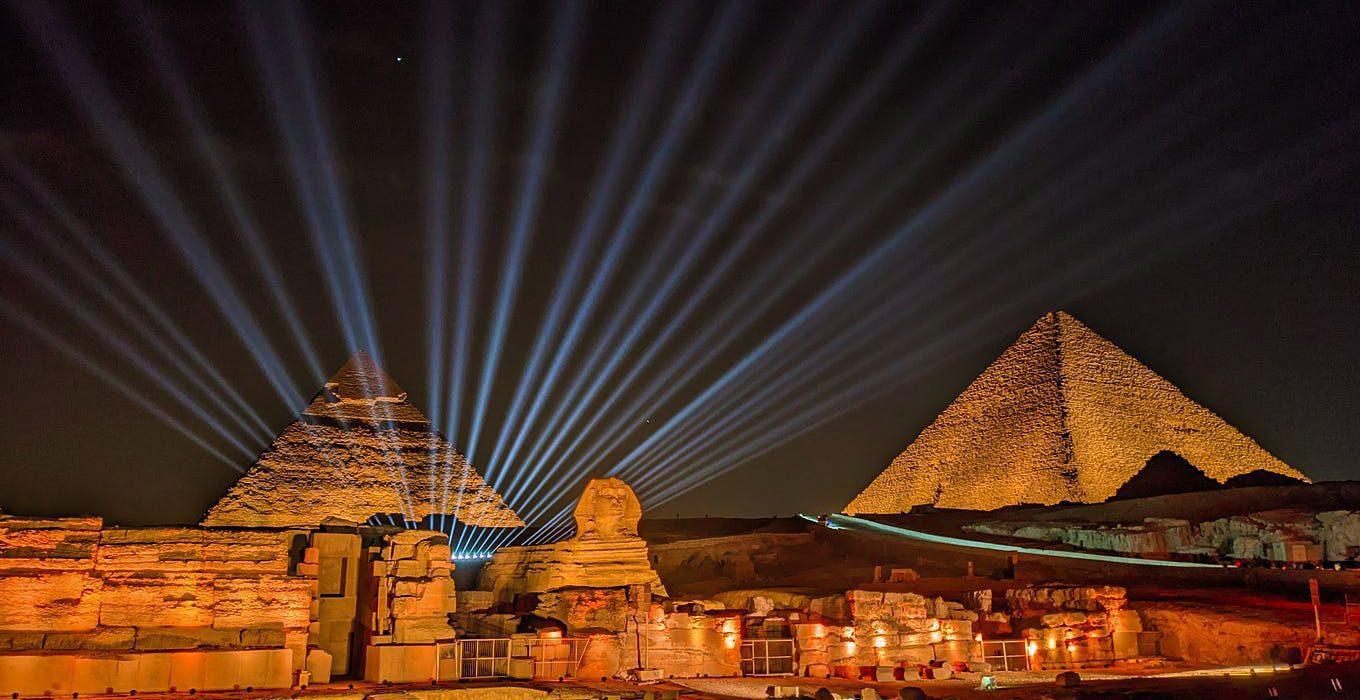
The Giza show seats you in an open-air amphitheatre facing the Great Sphinx, with the three pyramids ranked behind it, and lets the Sphinx narrate the story of Khufu, Khafre and Menkaure. The staging is coloured floodlighting plus some laser work, not projection mapping, and the narration is essentially the 1961 conception with later revisions. Reviews split hard along one line: people who arrived expecting a modern immersive production come away flat, and people who came to sit in the cold desert dark and watch the pyramids light up come away thrilled.
Both reactions are fair. The show runs about 45 to 60 minutes depending on which source you believe, with the first winter session starting somewhere between 6.30pm and 7pm, summer around 7.30pm, and later still in Ramadan. Seating is unnumbered, so arrive half an hour early for the middle rows.
The plateau itself changed in 2025. The old gate by the Mena House hotel is closed, access is now through a new visitor centre off the Fayoum road, private cars and coaches no longer drive inside, and electric shuttles move people between stops. Our complete guide to visiting the pyramids explains how the daytime site now works, and our Giza sound and light evening includes the transfer both ways.
The Giza Show Is Being Rebuilt, and Nobody Will Give You a Date
This is the thing to know before you book at Giza in 2026. Orascom Pyramids Entertainment, which now runs the plateau's visitor operation, won the concession to replace the show and has put around 200 million EGP into it, against a full project cost of roughly 350 million EGP. The Berlin exhibition-design studio Tamschick Media and Space lists the new production on its own portfolio as Echoes of the Pyramids, treating the valley temple, the Sphinx and the pyramids as three interlinked voices in one narrative, and gives 2026 as the launch year.
What nobody will confirm is whether it has opened. As of the second week of August 2026 the tickets on sale are still for the old show. Announced dates for Egyptian cultural projects slip routinely, so book on the assumption that you are getting the 1961 production, and treat anything more as a bonus.
Philae: The Boat Ride Is Half the Ticket
Philae is the most atmospheric of the seated shows, mostly because getting there is part of it. The temple stands on Agilkia island, about 8.5 km upstream from Aswan, where it was rebuilt stone by stone in the 1970s after the High Dam left the original island permanently submerged. You reach the pier by road, then cross by motorboat in the dark, and the temple rises out of the water already lit.
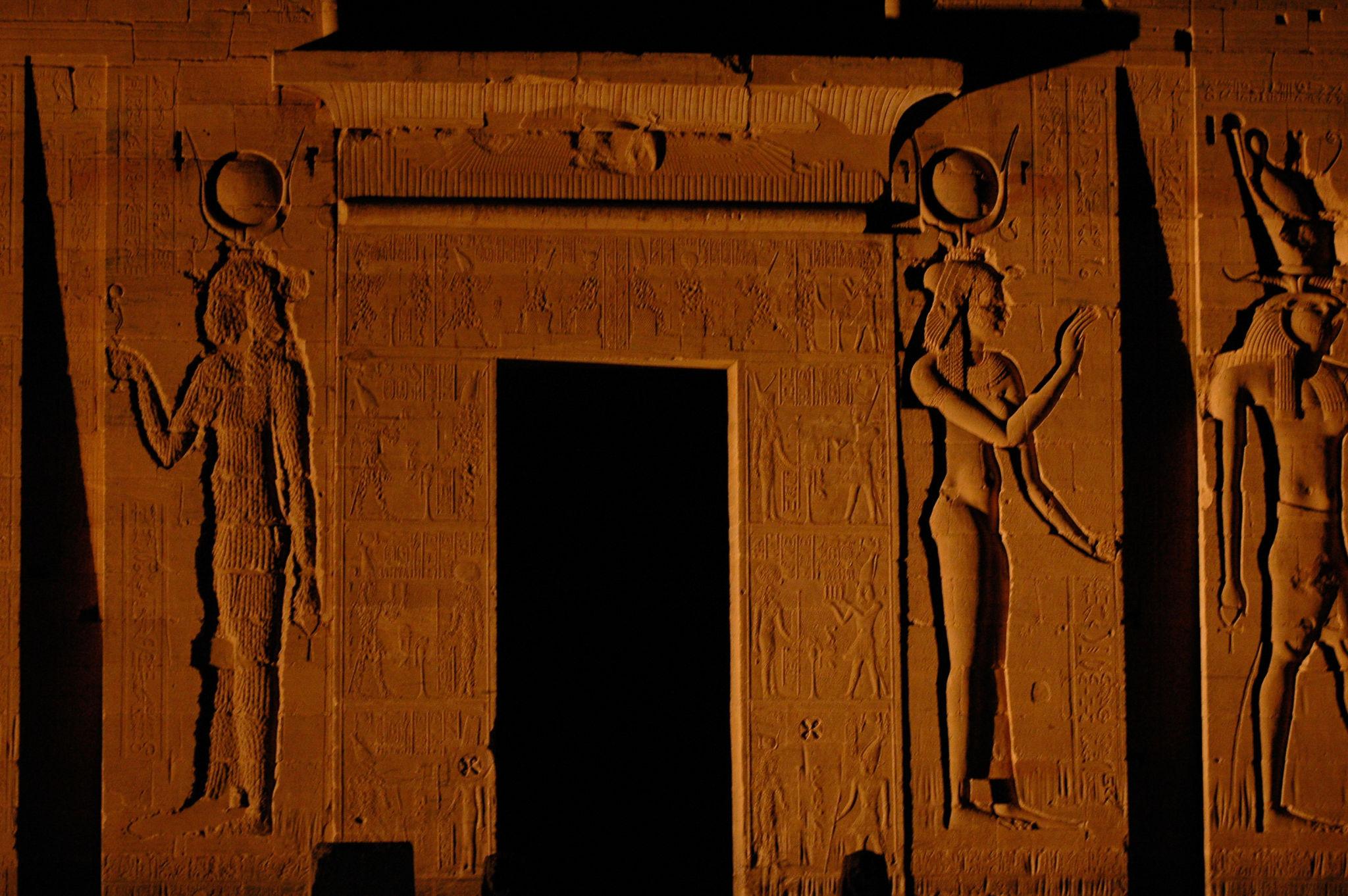
The narration tells the Isis and Osiris cycle, which suits the building: Philae was the great Isis sanctuary and one of the last places in Egypt where the old religion survived, into the sixth century AD. Two sessions run at 8pm and 9pm on a language rota that changes through the week, so check which night carries English. Tickets are 20 USD.
The catch is the boat. It is not included in the show ticket, there is no public ferry, and the boatmen at the pier quote what they think you will pay. Agree the round-trip fare and the waiting time before you step aboard, or go with a package that has already settled it, such as our Philae Temple and High Dam tour. Our Philae island guide covers the daytime visit and the rescue operation in more detail.
Abu Simbel: Spectacular, and Logistically Awkward
Four seated colossi of Ramesses II, each about 20 metres high, floodlit against a dark lake and an empty desert horizon: visually this is the most dramatic of the six. Shows run nightly at 8pm and 9pm in the multi-language format, and tickets are 20 USD.
The problem is arithmetic. Abu Simbel sits roughly 280 km south of Aswan, and the standard Abu Simbel day trip leaves before dawn and is back by mid-afternoon. To see the show you have to stay the night in a town with a handful of hotels, which costs you an entire extra day. It is a good evening, but it is a two-night decision, not an add-on. If you are building a trip around a night there anyway, the stronger reason is the solar alignment on 22 February and 22 October, covered in our guide to the Abu Simbel Sun Festival.
Edfu: The Cruise Boat Show
Edfu's show opened in 2010, is the cheapest at 15 USD, and runs at 8pm and 9pm. It handles the Horus material properly: the god's battle with Seth, and the annual festival in which the cult statue of Hathor travelled upstream from Dendera for the sacred marriage. The Temple of Horus is the best-preserved major temple in Egypt, built between 237 and 57 BC across successive Ptolemaic reigns, and the lighting works well on its intact roof and enclosure walls.
Almost everyone who sees it is on a Nile cruise moored a few hundred metres away, which is the right circumstance for it, and it does not justify a special journey. Our Edfu and Kom Ombo day tour covers both temples in daylight, which is when you should first see either.
Qaitbay: The Newest Show, and the First at an Islamic Site
Alexandria's fifteenth-century sea fort got the country's newest sound and light production, announced in October 2024 and billed as the first at one of Egypt's Islamic-era monuments. The narration runs from Alexander's foundation of the city through the Hellenistic, Roman, Coptic and early Islamic periods, using projection and lighting on the fort itself, which Sultan al-Ashraf Qaitbay built in the 1470s on the ruins of the Pharos lighthouse.
Pricing here is the odd one out, reported at launch as 150 EGP for Egyptians and 1,125 EGP for foreign visitors, which lines up with the 25 USD on the operator's own list. Whether it justifies a trip from Cairo is doubtful, but if you are staying overnight in the city, an hour at the Citadel of Qaitbay beats another corniche dinner.
Warning: The Late Session Can Be Cancelled Under Your Feet
The published schedules carry a condition most visitors never read. At several venues the second show only runs if a minimum number of ticket holders turns up, commonly five foreign tickets, and at Abu Simbel the first session has a stated minimum as well. On a quiet Tuesday in low season, a 9pm show can simply not happen. Tickets bought through the operator's own booking system are generally exempt from the minimum, which is the main argument for booking ahead.
The language rota bites in the same way. The earlier session is often the single-language performance and the later one the headset version, so an English speaker who turns up for the "English show" without checking the day of the week can end up at the wrong one. Confirm the night, not just the venue.
Two smaller traps. Prices quoted in Egyptian pounds on third-party guides, typically 350 to 550 EGP, are stale; the operator prices in dollars and the pound has moved a long way. And at Giza and Philae you finish in the dark with no taxi rank, so arrange the return before the show rather than after it.
Pro Tip: Take the First Show and Dress for Stone
Book the earlier session wherever you can. It is more likely to run, it is more often the single-language performance, and it gets you back for a reasonable dinner. Then dress for a cold stone seat. Upper Egypt loses heat fast once the sun goes: a January evening in Luxor or Aswan is often down around 10C to 12C (50F to 54F) by mid-show, and the open plateau at Giza adds wind. A fleece and long trousers are not overkill in December. In high summer the reverse applies, and the 9pm session is markedly more comfortable.
For photography, bring something that will hold a long exposure steady. Tripods are not always welcome, so a beanbag or a low wall does more good than a fast lens; our Egypt photography tips cover low-light settings.
Better Evenings, City by City
In Luxor, the strongest evening in town is not a show at all. Luxor Temple stays open until about 9pm and is lit superbly, for a fraction of a show ticket, though published prices vary between roughly 250 and 400 EGP depending on which list you read. Our piece on Luxor Temple after dark covers the colonnade at night, and it is the better fallback on any night the Karnak language rota does not suit you.
In Cairo, the Grand Egyptian Museum keeps its galleries open until 9pm on Wednesdays and Saturdays, which is the calmest way to see it and needs a timed online booking. A Nile dinner cruise is the other dependable evening, and Al-Muizz Street stays floodlit long after the mosques close.
In Aswan, a felucca at sunset and dinner in a Nubian house on the west bank will beat Philae for most people and costs less. Abu Simbel and Edfu have no real alternative, which is precisely why their shows exist.
Choosing Your One Evening
On a standard two-week route with a few free nights, the ranking is not close. Karnak first, because the walking format is genuinely different from anything else on offer. Giza second, on the strength of the location rather than the production, and knowing it may be a building site for its own replacement. Philae third, for the crossing. Edfu only if your boat is already tied up there, Abu Simbel only if you are staying the night anyway, Qaitbay only if you are in Alexandria.
Book the early session, confirm the language for that specific night, pay by card, take a jacket, and settle your transport home before you sit down. Tell us which cities you have free evenings in and we will say honestly whether a show is the right use of one.