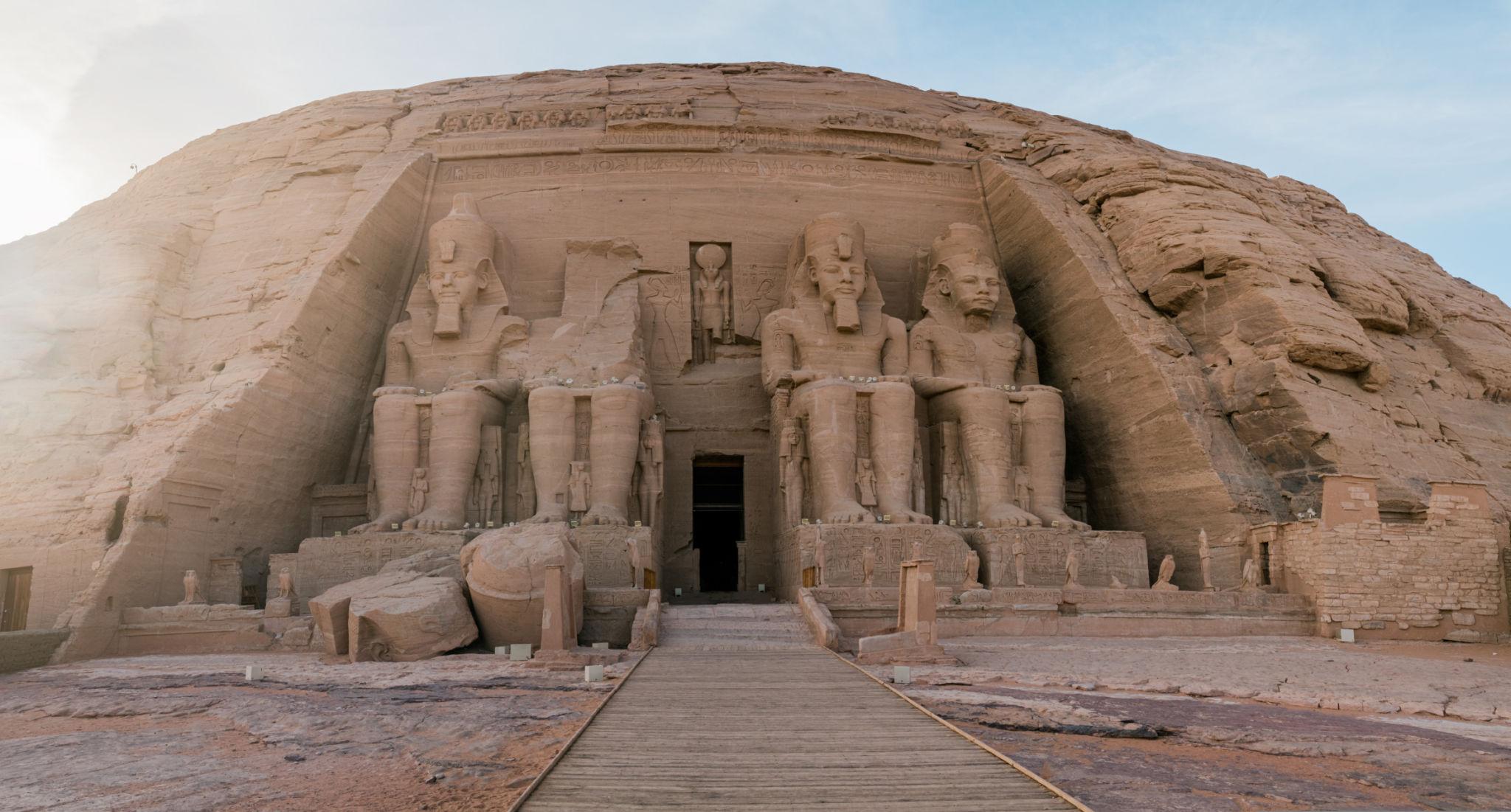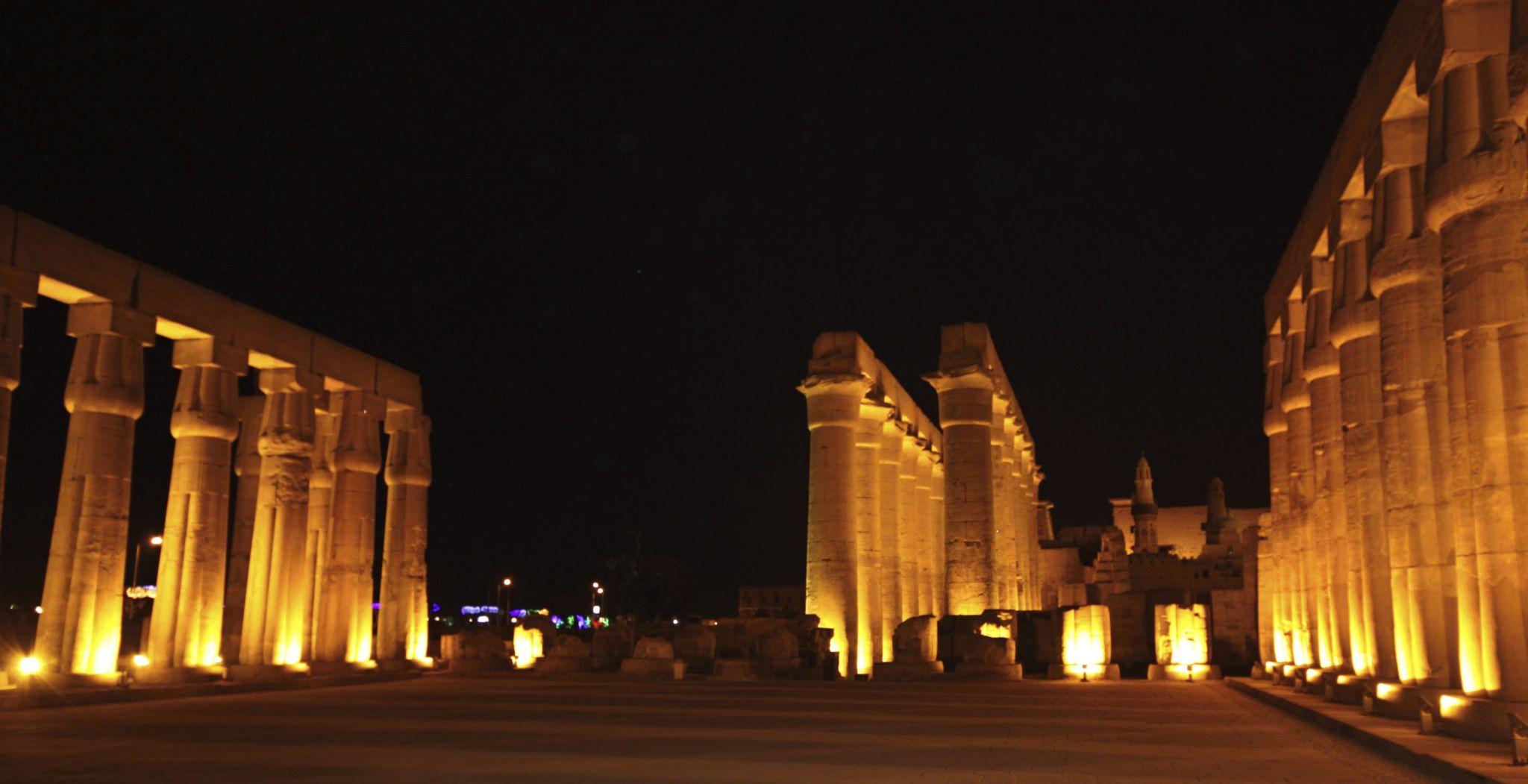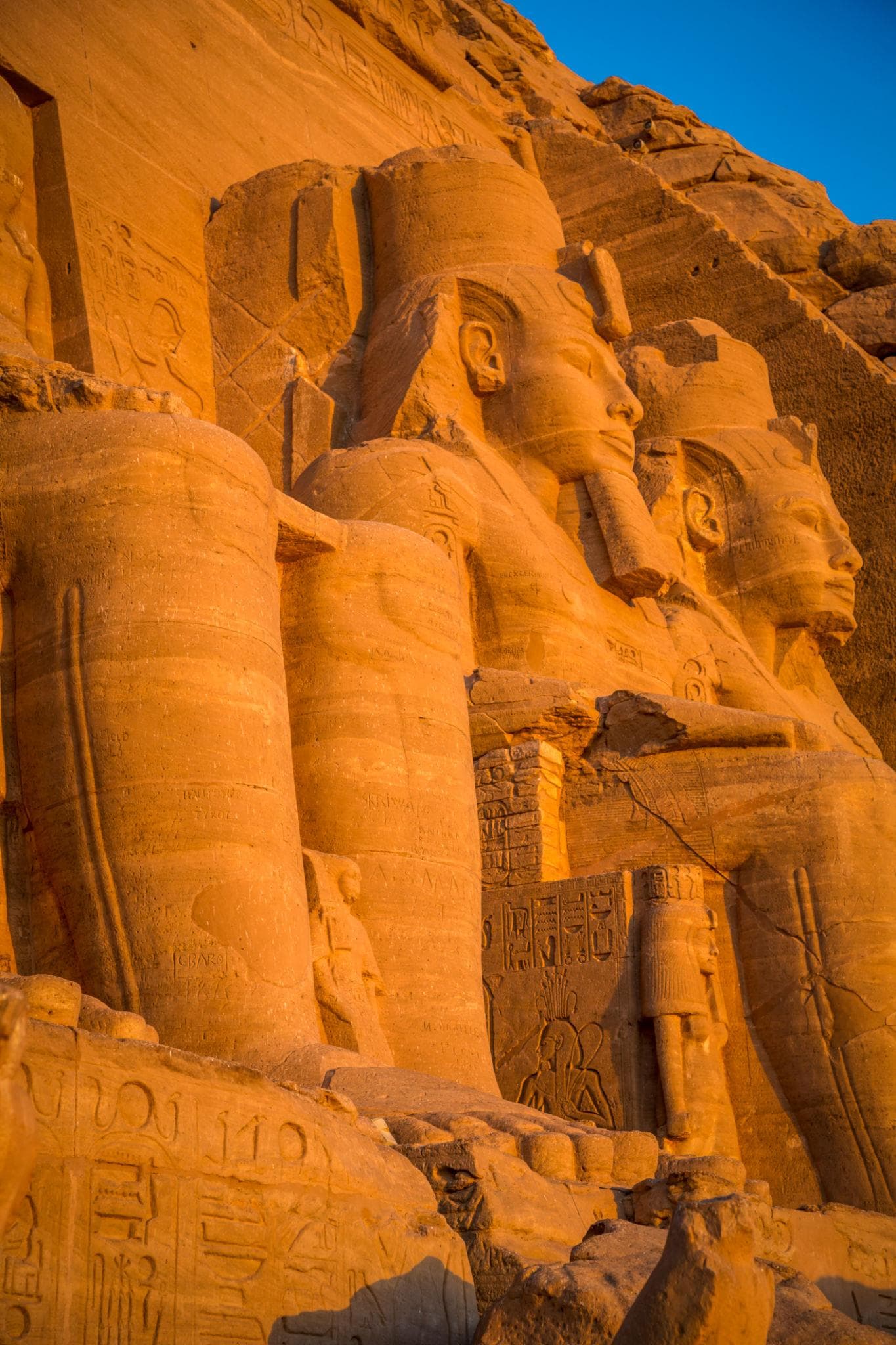
The Great Temple at Abu Simbel is cut into a sandstone cliff on an axis of roughly 101 degrees east of north, which is about twelve degrees south of due east. Twice a year the sun rises on exactly that bearing. For something like twenty minutes the light runs the full depth of the temple — through the door, down the hall of Osiride pillars, through a second pillared hall and a transverse vestibule — and lands on three of the four figures cut from the living rock in the sanctuary at the back. The fourth, Ptah, stays in the dark.
What has grown around it is a different thing: several thousand people in a car park before four in the morning, a queue that can run to two hours, drummers and dancers working the crowd with no stage to work from, and a single-file shuffle past the sanctuary door that gives most people a few seconds of looking. Both are true on the same morning, and it is worth knowing which one you are buying a ticket for.
This is a guide to the alignment at Abu Simbel: the geometry, what changed when the temples were moved in the 1960s, what the day costs and feels like as of 2026, and whether it beats an ordinary morning at the same temple. The next falls on 22 October 2026, the one after on 22 February 2027.
At a Glance
Dates: 22 February and 22 October, every year
Where: the Great Temple of Ramesses II, 280 km south of Aswan by road, about 40 km north of the Sudanese border
Sunrise: around 6:20am on 22 February; around 6:50am on 22 October, because Egypt is still on summer time until the last Thursday of the month
How long the light lasts: roughly twenty minutes on the sanctuary figures — Egypt's State Information Service put both the October 2025 and February 2026 alignments at 22 minutes
Alignment-day ticket: 1,200 EGP for foreign adults, 600 EGP for students, around 24 and 12 USD as of 2026
Ordinary-day ticket: 750 EGP and 375 EGP, roughly 15 and 7.50 USD
Site hours: 6am to 5pm, opened earlier on the two alignment mornings
Drive from Aswan: 3 to 3.5 hours each way; tour vehicles leave Aswan between 3am and 4am
Permits: none required for the road or the site
What the Light Actually Does
The Great Temple runs about 56 metres back into the cliff, though you will see 60 quoted as often as 56 and neither figure is measured the same way twice. At the far end sit four figures carved out of the rock face rather than set into it: Ptah on the left, then Amun-Ra, then the deified Ramesses II, then Ra-Horakhty. Three of them catch the beam. Ptah, the Memphite creator god who also belongs to the realm of the dead, does not, and the usual reading is that this was the point rather than an accident of the architecture.
The facade is roughly 30 metres high and 35 metres across, with published figures running as high as 33 by 38. Four seated colossi of Ramesses II, about 20 metres each, flank the entrance; the second from the left lost its head and torso to an earthquake in antiquity, and the fallen pieces were deliberately left lying at the base when the temple was moved. Ramesses II ruled in the Nineteenth Dynasty, from around 1279 to 1213 BCE. Most scholars place the carving of the temple between about 1264 and 1244 BCE, though a minority put it twenty years later.
Why These Two Dates and Not the Equinox
You will find the alignment described as an equinox event. It is not. Both dates sit either side of the December solstice — 22 February falls 63 days after it, 22 October falls 60 days before — which is the signature of a temple aimed at a specific low winter sunrise rather than at the cardinal east.
The arithmetic is simple enough to check. On both mornings the sun clears the horizon at an azimuth of about 102 degrees, within a degree or so of the axis that Mosalam Shaltout and Juan Antonio Belmonte measured at roughly 100 degrees 33 minutes in their 2005 survey of Egyptian temple orientations for the Journal for the History of Astronomy. Hit that bearing and the light goes all the way in. Miss it by a couple of degrees and it dies somewhere in the first hall.
The popular explanation is that the dates mark Ramesses II's birthday and his coronation. There is no direct evidence for it. Converting ancient Egyptian civil calendar dates into Julian or Gregorian ones is itself an unresolved problem, and the correspondence rests on identifications that Egyptologists treat as conjecture. It is a good story and it may even be right, but it is not established fact, and anyone quoting it to the hour is overselling.
Cutting a Mountain Into 1,036 Pieces
The temples stand where they do because of the Aswan High Dam. Lake Nasser would have drowned them, and between roughly 1964 and 1968 a UNESCO campaign backed by 48 countries sawed both temples into about 1,036 blocks — the smallest around seven tons, with contract limits of 20 tons for the chambers and 30 for the facades — and rebuilt them 208 metres inland and 65 metres higher, the Small Temple of Nefertari going up 67 metres. The bill came to roughly 41.7 million USD in 1960s money.
What most visitors do not register is that the cliff is now a shell. Two reinforced concrete domes carry the weight of an artificial hill: the one over the Great Temple spans 55 metres and stands 19 metres high, the Nefertari dome 21 metres across. Around 300,000 tons of material was piled over them to rebuild the mountain. There is a door in the back of the hill, and behind it the dome is bare structural concrete. Our longer history of the temples and the rescue covers the salvage in detail, and a Lake Nasser cruise is the only way to grasp how much of Lower Nubia went under.
Did the Date Shift by a Day?
Almost every account says the alignment fell on 21 February and 21 October before the move, and slipped to the 22nd afterwards. It is repeated so consistently that it reads as settled. It is not quite.
Nobody produced a rigorous observational record of the illumination at the original site before 1964, which makes the one-day figure a reconstruction rather than a measurement. Shaltout and Belmonte also point out that the eastern horizon has changed: from the old riverside position the sun came up over broken hills standing around two degrees above the flat horizon, cut by valleys, so the beam arrived later and the neat rectangle of light seen today would not have looked the same. Precession over three thousand years accounts for only ten to fifteen arc-minutes, well inside the tolerance of the original stonework.
Reputable references still disagree in print. The World History Encyclopedia gives the current dates as 21 February and 21 October. The Egyptian Ministry of Tourism and Antiquities prints 22 October and 22 February on its own ticket tariff, and that is the date the gates, the police and the crowd actually work to. Treat the 22nd as the operational answer and the one-day shift as a plausible but under-evidenced tradition.
Tickets, Getting There and the Overnight Question
The alignment ticket costs 1,200 EGP for foreign adults against 750 on any other day, with parking charged separately at 25 EGP for a car and 100 for a coach. Third-party sites are full of stale numbers — 600 and 822 EGP are both circulating in 2026 — so budget from the ministry tariff and carry a card, since more gates now take plastic only.
By road it is 280 km of desert highway from Aswan, three to three and a half hours, and vehicles still leave in police-escorted groups in the small hours on festival mornings. A day trip from Aswan is the standard way to do it; a private transfer to Abu Simbel makes more sense on the alignment date, because you want to leave when you choose rather than when a coach fills. Flying does not solve the problem. EgyptAir and Air Cairo run the 45-minute hop eight or nine times a week, but the scheduled morning arrival lands well after sunrise.
Which leaves the overnight option. The village has very few beds, they go two to three months ahead for these dates, and the trade-off is honest: you swap a midnight departure for a small town with a lake, a sound and light show at 8pm and 9pm, and nothing else to do. We rate the show among the better ones in our survey of Egypt's sound and light programmes.
What the Morning Is Actually Like
Reports from recent alignments describe upwards of four thousand people on site, roughly two hours in a line with little crowd control, and groups merging into the queue a hundred places ahead. The old arrangement, where visitors sat in the hall and watched the light travel, has given way to a moving file: you are walked past the sanctuary doorway, you look, you keep walking. People who reach the front late in the window see the beam already climbing off the figures and onto a shoulder.
The music is real and it is good, but it is not staged. Nubian drummers and dancers appear in the middle of the crowd at ground level, so unless you are within a few metres you will hear them rather than see them. The temperature before dawn in February sits near 10C (50F), which surprises people who packed for Upper Egypt in daylight.
Warning: Do Not Build a Photography Plan Around the Sanctuary
Flash is not permitted inside the temples, tripods are not allowed, and on the alignment morning you will be moving in a file with people behind you. Phone photos for personal use are fine; a professional camera may need a paid permit at the gate. The practical result is that almost every good photograph of the beam on the statues was taken by someone with official access, not from the queue. Plan to look at it rather than shoot it, and take your photographs of the facade afterwards, when the sun is up and the crowd has drained back to the car park.
Pro Tip: The Shoulder Days Are the Quiet Version
The sun does not switch off on the 23rd. On the two or three days either side of each alignment the beam still reaches into the sanctuary, just short of the full effect — one traveller who went on 24 February found the middle two figures lit and the outer ones dark. You give up the complete alignment and the ceremony. You get an ordinary 750 EGP ticket, a temple with normal morning numbers, time to stand still inside, and the option of walking back in later for the facade in good light. For anyone who came for the temple rather than the event, 20, 21, 23 and 24 February and the same dates around 22 October are the better trade.
The Festival Is Also a Week in Aswan
The alignment gets the photographs, but the surrounding programme runs in the city. In October 2025 the Aswan governorate staged five days of events from the 18th to the 22nd across eleven venues, centred on the Fawzi Fawzi Theatre on the Corniche, opening with an operetta called Zay El Shams, or Like the Sun, and taking in folk troupes, Nubian dance and a handicrafts market. Programmes are announced late and change year to year, so check locally rather than planning around a date you found online.
That is an argument for treating the alignment as one morning inside a proper Aswan stay rather than a single long day out. Our guide to the city makes the case for three nights; a felucca out to a Nubian village is the obvious way to spend the afternoon you come back to, when you have been awake since two.
Good to Know: February or October
February is the more comfortable date by a wide margin. Abu Simbel averages a high near 26C (79F) that month against 36C (97F) in October, with pre-dawn lows around 10C (50F) in February and 21C (70F) in October. Both mornings are dry and clear; rainfall here is effectively zero all year.
October has one advantage: it lands at the start of the season, so the rest of Upper Egypt is quieter than it will be in February, when the Nile corridor is at its busiest. October also runs on summer time, which pushes sunrise to about 6:50am and makes the night drive marginally kinder.
Is It Worth It Against an Ordinary Visit
If you want to see the temple, no. An ordinary morning gives you more of Abu Simbel for less money, less sleep debt and far less friction, and the Nefertari temple next door — which has no alignment and is regularly skipped on festival day — is one of the finest interiors in Egypt.
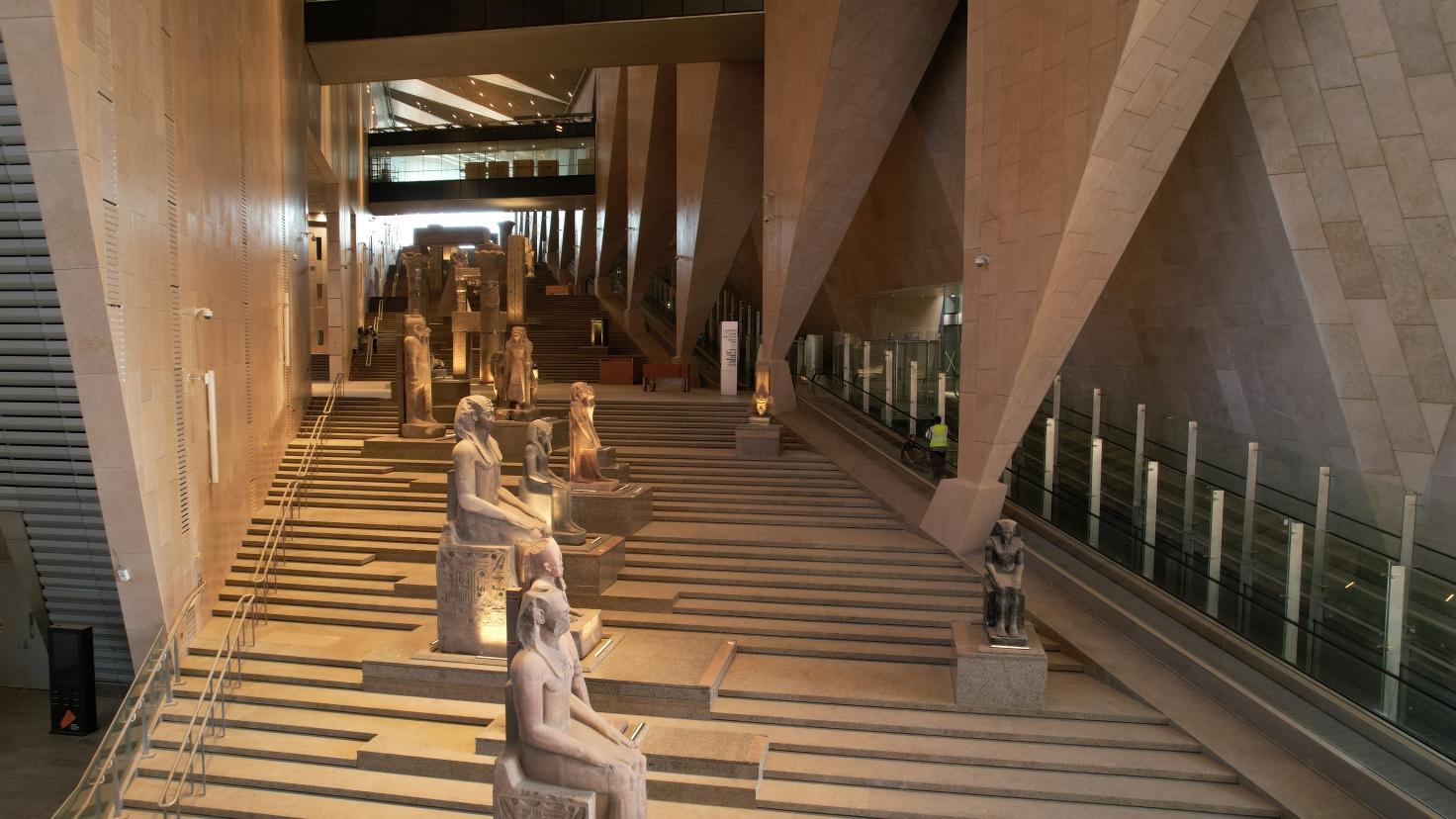
If you want to be present for something that has been happening on the same bearing for over three thousand years, and you accept that you will experience it as part of a crowd, then yes. It is a genuine piece of astronomical theatre, and the collective intake of breath when the light lands is not something an empty temple can give you. Cairo now offers a domestic echo of it: on the same two dates the sun is directed onto the face of the colossal Ramesses II in the atrium of the Grand Egyptian Museum, an effect built into the design rather than inherited from it.
Planning Around 22 October
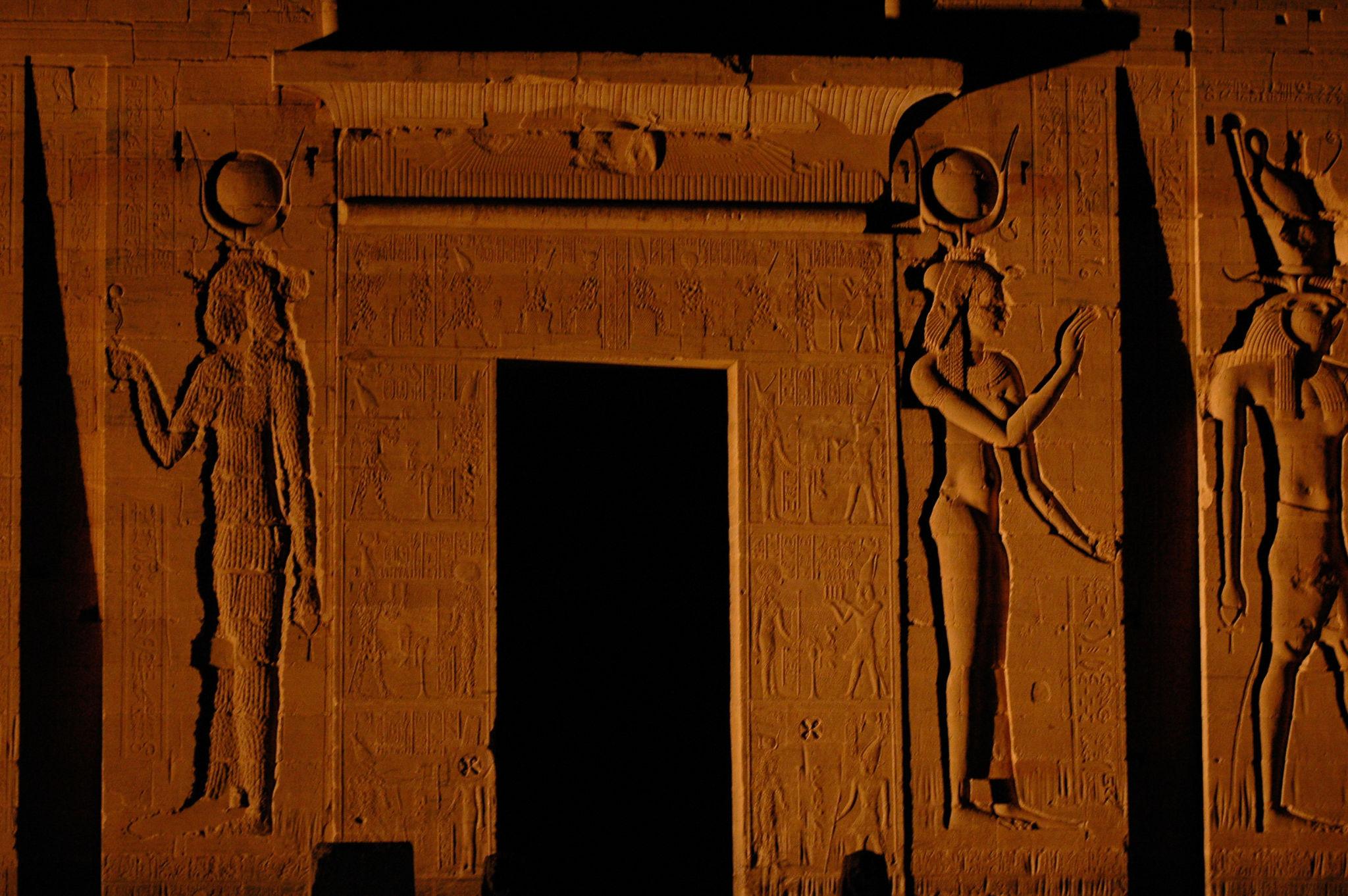
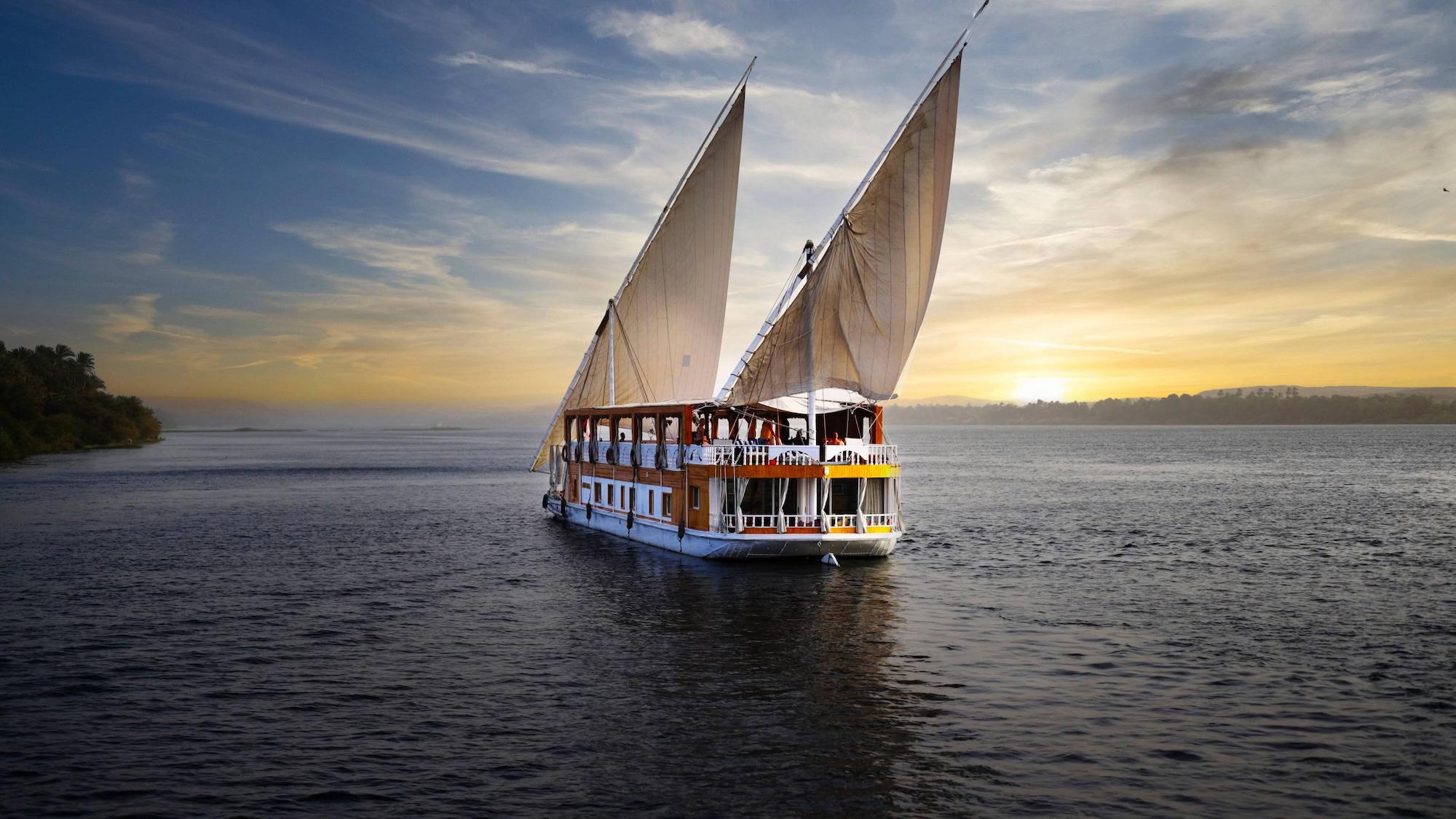
Work backwards from the date. Book beds in Abu Simbel or Aswan two to three months out, fix your vehicle before you fix anything else, and decide early whether you are going for the 22nd or for the quiet version on the 21st or 23rd. Around the fixed point, the rest of the south assembles easily: a morning on Philae and the High Dam needs half a day, and a dahabiya between Aswan and Luxor turns the alignment into the opening act of a week on the river rather than the whole reason for the trip.
One practical note on the desert either side of that road: current advisories from several governments still warn against travel west of the Giza to Luxor to Aswan to Abu Simbel line. The highway itself and the site are not in that zone and need no permit, but off-road travel out there does need a licensed operator and paperwork arranged in advance. If you are shaping a trip around either alignment date, our team runs this road most weeks and is happy to talk through the timings.