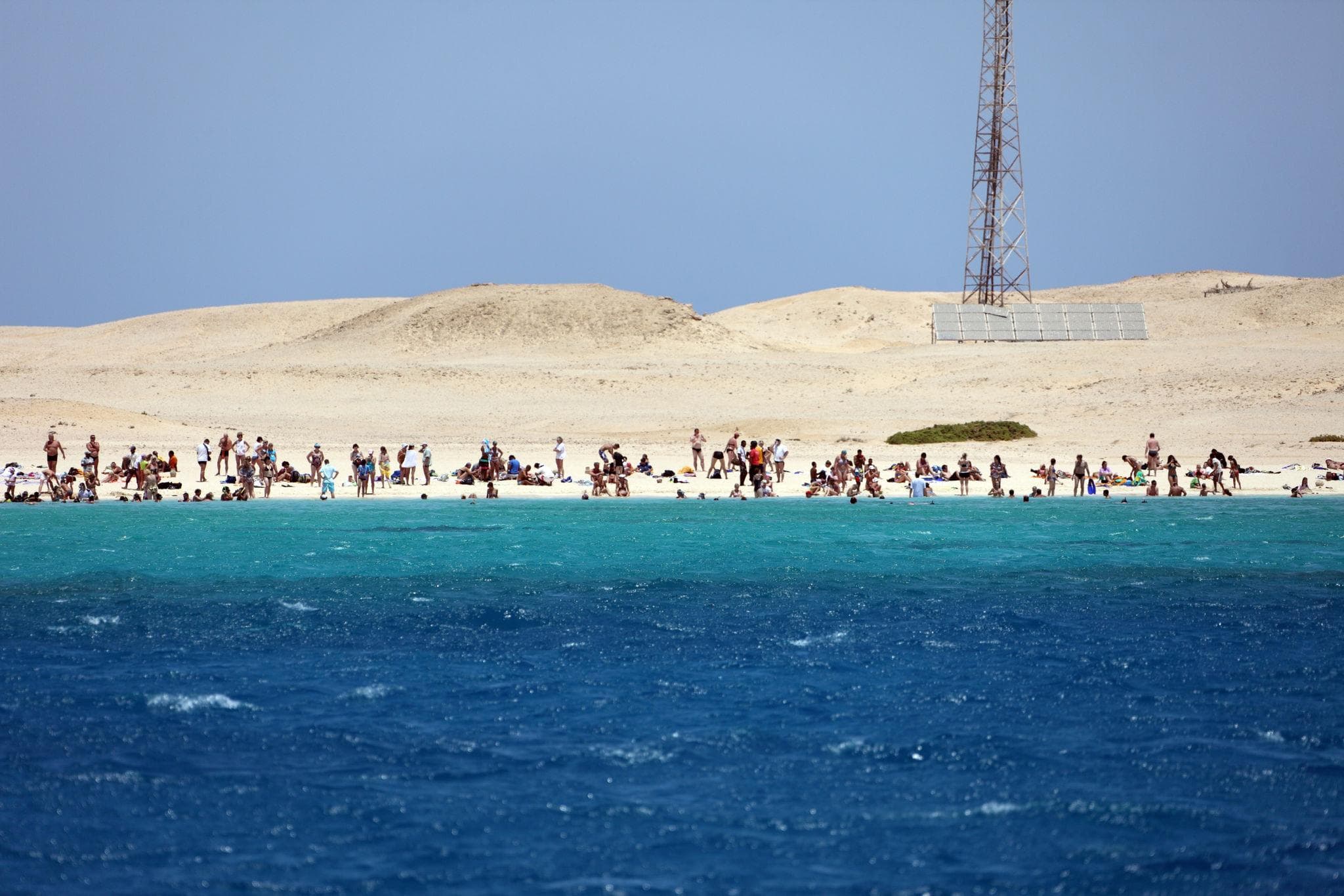
Marsa Alam is the Egyptian Red Sea destination most people book without quite knowing where it is. The airport sits roughly 60 kilometres north of the town it is named after. The hotels are strung along more than a hundred kilometres of otherwise empty coast. The town itself is a working port of around nine thousand people with a fish market, a mosque and a petrol station. Everything that brings visitors here is offshore: seagrass meadows grazed by dugongs, bays where green turtles surface within easy swimming distance of the beach, and a lone pinnacle in open water where oceanic whitetip sharks gather each autumn.
The name is مرسى علم. Marsa means anchorage or bay, and this stretch of the Red Sea coast is a long chain of them, shallow sheltered notches in an otherwise straight shoreline, each with its own reef and its own name. Serious development began only in the mid-1990s, and the airport took its first commercial flights in 2001. Hurghada had a forty-year head start, and that single fact explains most of the difference: the reefs here have simply had less done to them.
At a Glance
Where: Egypt's southern Red Sea coast, 274 km south of Hurghada and 134 km south of El Quseir
Airport: Marsa Alam International (RMF), about 60 km north of the town, alongside Port Ghalib
Transfer times: 15 minutes to Port Ghalib, up to two hours to the southernmost resorts
Best months: October, November, March and April, for warm water without punishing land heat
Sea temperature: Around 23 to 24°C (73 to 75°F) in January, 29 to 30°C (84 to 86°F) in August
Signature wildlife: Dugongs, green turtles, spinner dolphins, oceanic whitetip sharks
Wadi el-Gemal entry: Around 40 EGP at the park offices, though operators usually bundle it at about 10 USD, as of 2026
Two-dive boat day: Roughly 40 to 80 EUR as of 2026, equipment included
Cash: Prices are quoted in euros almost everywhere; ATMs are scarce outside Port Ghalib
Getting There and How Long the Transfer Takes
Marsa Alam International has one 3,000-metre runway and a seasonal European charter schedule, heaviest from Germany, Italy and Austria, thinner in high summer. Some itineraries sold as Marsa Alam still land you at Hurghada with a three to four hour road transfer south, so check the airport code on your ticket before anything else.
The terminal sits beside Port Ghalib, a purpose-built marina town with a promenade, shops and a cluster of hotels, so the northern resorts are fifteen to twenty-five minutes away. From there the coast unrolls southward: Marsa Mubarak just below the airport, Abu Dabbab at about 35 km, Marsa Alam town at roughly 60 km, then the thin southern strip toward Hamata. A hotel described as "Marsa Alam" can be anywhere in a two-hour range, and arrivals here has no taxi rank worth the name. Booking a fixed-price Marsa Alam airport transfer is not an upsell in this particular place; it is how the transfer happens at all.
By road, Hurghada is 274 km north, about three and a half hours. Inland, the desert road to Edfu is roughly 220 to 230 km, though operators sometimes route via Safaga instead depending on current rules, so confirm which way you are being driven.
The Seagrass Bays: Abu Dabbab and Marsa Mubarak
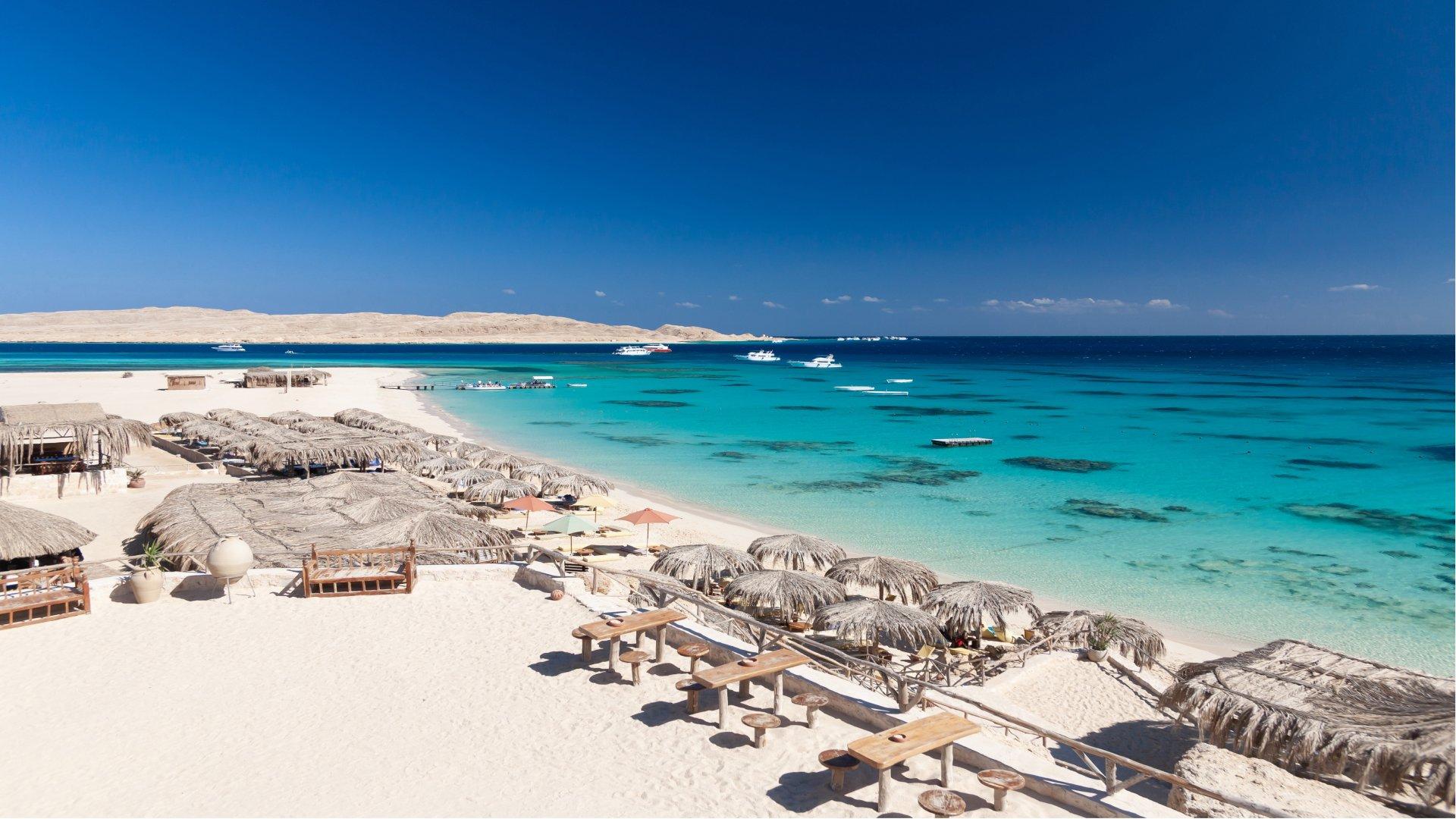
Two shallow bays north of the town are the reason many people choose this coast over anywhere else in Egypt. Both have extensive seagrass meadows on sandy bottoms, which is dugong habitat, and both hold resident green turtles.
Abu Dabbab lies about 34 km north of Marsa Alam town, down a short branch road off the coastal highway. Beach entry runs around 20 EUR per adult as of 2026, with a sunbed and umbrella included, and there are toilets, showers and food. The bay averages roughly 15 metres deep and shelves gently. Visibility is often only four to ten metres because the bottom is sand rather than coral, which surprises people expecting the glass-clear water of the brochures.
Turtles are close to a daily certainty. Dugongs are not. Guides put the odds on any given day at well under fifty-fifty, and the bay's two semi-resident animals have been photographed so often that visitors arrive expecting a guarantee. Marsa Mubarak, a similar seagrass bay near the airport usually reached by boat from Port Ghalib on a half-day trip from around 40 EUR, offers the same lottery with fewer people.
Dugongs are listed as Vulnerable on the IUCN Red List, and one recent survey put the population along Egypt's Red Sea coast at roughly 85 animals, with a plausible range of about 73 to 97. Estimates vary widely because these animals are hard to count, but every figure is small enough that individual encounters carry weight.
Warning: Getting Wildlife Encounters Wrong
A dugong driven off its feeding ground does not eat that day. A dolphin pod followed through its resting lagoon does not sleep. The rules exist because the damage is measurable.
- Keep at least two metres from any turtle or dugong, and never touch, ride or block one. Marine wildlife is protected under Egyptian Law No. 102 of 1983.
- Do not stand or kneel on seagrass and coral. The seagrass is the food, not the scenery.
- Motorboats are prohibited inside Abu Dabbab bay, with mooring buoys marking the line.
- The conservation code used by Red Sea operators asks boats to hold at least 30 metres from dolphins and travel parallel to them rather than into them.
- Enter the water without splashing, swim with fins only, and never swim toward a pod. If dolphins want contact, they will come.
- Use reef-safe sunscreen or, better, a long rashguard, and turn the camera flash off.
Samadai, and the Rules That Rescued It
Shaab Samadai is a horseshoe reef roughly 1.4 km long and 1 km wide, lying a few kilometres offshore south of Marsa Alam town, about an hour by boat from the harbour. Sources give the distance as anywhere between 5 and 9 km. It is universally sold as Dolphin House, because a pod of spinner dolphins uses the sheltered lagoon as a daytime resting area, feeding offshore at night. Daytime is their sleep.
By the early 2000s the reef was receiving up to 30 boats and between 500 and 800 people a day. The Hurghada Environmental Protection and Conservation Association signed an agreement with Egypt's environmental agency in 2001 to establish Samadai as a protected area, and a zoning scheme followed. In its usual description there are three zones: Zone A, the inner lagoon, closed entirely; Zone B, where permitted snorkellers enter from anchored boats along the reef line; and Zone C, the outer reef, where diving takes place. Some accounts describe a four-zone version, so treat the exact boundaries as something your crew will explain rather than something to memorise. Daily caps on boats and swimmers are set by the marine park authority, snorkelling is generally confined to a window in the middle of the day, and there is a government fee of around 10 EUR per person on top of the trip price as of 2026.
Estimates of the resident pod run from about 40 to 80 animals. Do not confuse Samadai with Shaab Sataya, more than 100 km further south in the Fury Shoals off Hamata, which is also marketed as Dolphin House, holds larger aggregations, and is roughly two hours away by boat.
Elphinstone and the Limits of Recreational Diving
Elphinstone, known locally as Shaab Abu Hamra, is a narrow reef about 300 metres long lying roughly 12 km offshore, opposite a stretch of coast some 30 km north of Marsa Alam town. Its walls fall vertically past 70 and 100 metres. Both plateaus are swept by current, often strongly, and there is no shelter if conditions turn.
Operators expect demonstrable drift-diving experience and comfort at depth, and the site is regularly cancelled for weather. The much-photographed arch at the southern tip sits at around 55 metres, beyond any recreational limit, and the persistent story that it holds a pharaoh's tomb has no archaeological basis. Oceanic whitetips are present year-round but aggregate here in autumn, which is exactly when the site is busiest.
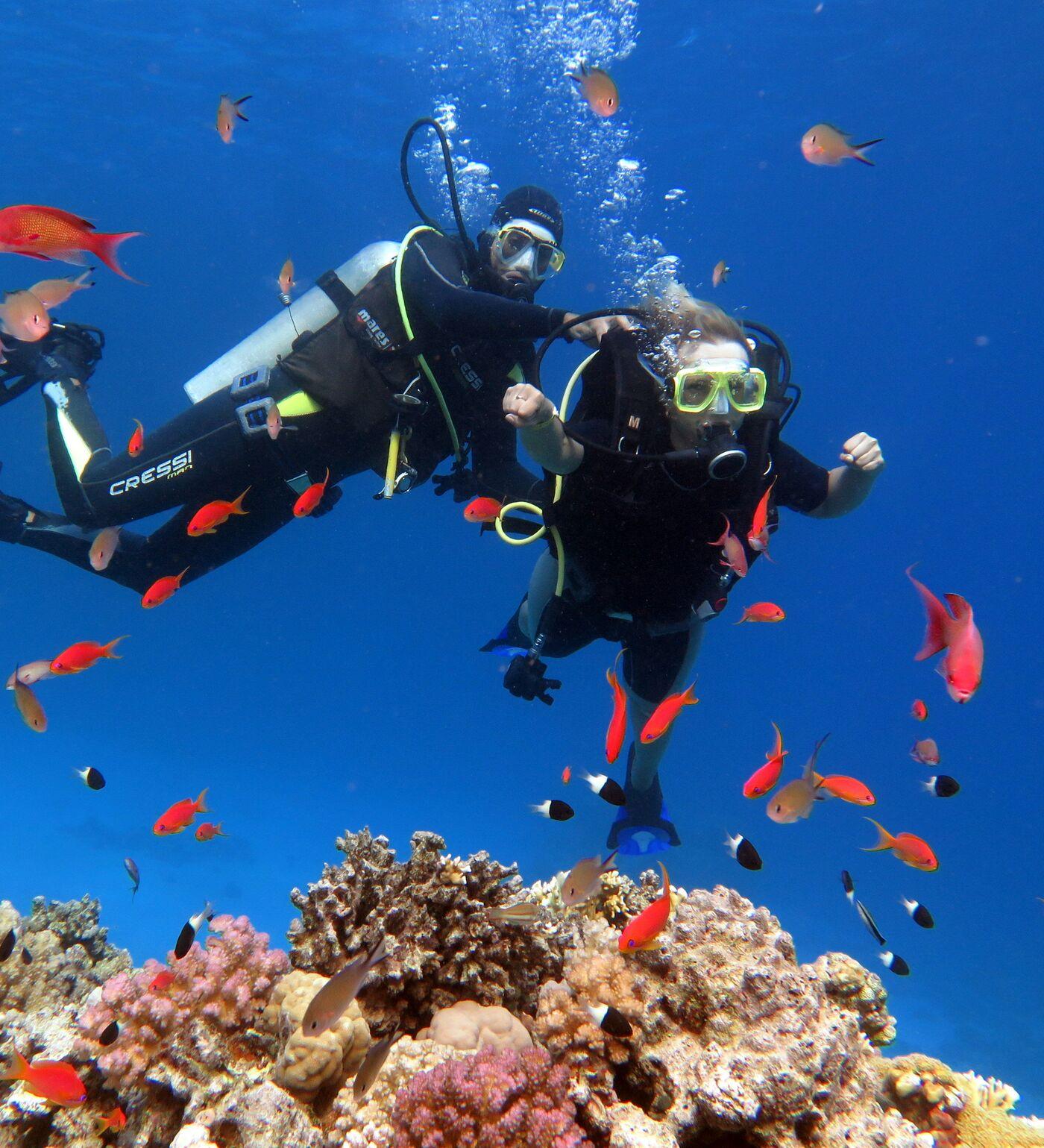
Divers not yet ready for it have plenty to work with along the coast, and anyone starting from zero would do better to complete a course before arriving, whether locally or on something like a beginner scuba experience in Hurghada. Open Water certification in Egypt runs roughly 280 to 380 EUR as of 2026. Our Red Sea diving and snorkelling guide covers gear, seasons and certification in more depth.
House Reefs You Can Swim To
The real luxury here is that you can often walk into world-class reef from a beach. The bays at Marsa Shagra and Marsa Nakari, the latter about 18 km south of the town, are the best known, each with a fringing reef a short fin from shore and a shelf dropping into open water. Several other bays offer the same arrangement.
Shore access changes the economics of a diving holiday. You are not paying for boat days, you are not tied to a departure time, and a poor-visibility morning costs nothing. Three unhurried dives from the beach and an afternoon in the shade beats two rushed dives and four hours on a boat.
Wadi el-Gemal and the Ababda Coast
Behind the beach is a national park most visitors never register. Wadi el-Gemal, the Valley of the Camels, was declared in 2003 as an IUCN Category II protected area covering both desert and sea. Published areas vary and do not always add up: the commonly quoted total is around 7,450 km², with about 4,770 km² of land and 2,100 km² of marine space. The main coastal entrance is roughly 50 km south of Marsa Alam town, with a second gate further north at Sheikh Malik, and the visitor centre operates between sunrise and sunset.
The park protects some 450 coral species and more than 1,200 fish species, along with the largest mangrove stands anywhere in the Red Sea, concentrated around the Qulaan lagoons near Hamata about 90 km below the town. Inland there are Nubian ibex, Dorcas gazelle and Barbary sheep in country almost nobody walks. Wadi el-Gemal island is capped at twenty visitors at a time, for a maximum of three hours, in daylight only. Do not attempt the interior alone; the wadi system is large and unsigned, and off-road travel in the Eastern Desert requires a permit as well as a licensed guide.
The park is also home to the Ababda, an arabized Beja people whose territory historically ran between the Nile and the Red Sea from Qena southward, and who number more than 250,000 across Egypt and Sudan. Their coffee ritual, the jabana, is the centre of hospitality here, and it is worth understanding what is being offered rather than treating it as a photo stop; our guide to desert hospitality and the etiquette around it is a useful primer.
The Emerald Mines and the Port of Berenike
Around 24 km inland lie the ruins of Sikait, known in antiquity as Mons Smaragdus and the only source of emeralds in the Roman Empire. Excavations by the Berenike Project from the 1990s, and by a Spanish and Polish team in 2020 and 2021, uncovered a temple, administrative buildings and the first register inscription ever found in an ancient emerald mine.
About 140 km south is Berenike itself, founded in 275 BCE by Ptolemy II Philadelphus and named for his mother. It landed war elephants before becoming a gateway to the Indian Ocean trade, and digs since 1994 have produced Indian textiles, Tamil inscriptions and 7.55 kg of black peppercorns, the largest concentration recovered anywhere in the classical Mediterranean world. It is an active excavation on a sensitive stretch of coast, not a ticketed site. Our guide to the Roman quarries and ancient roads of the Eastern Desert sets both in their wider network.
Boat Safety and What Changed After 2024
Two events in late 2024 shaped how this coast is now discussed. On 25 November the liveaboard Sea Story capsized near Shaab Sataya with 44 people aboard; eleven died. On 29 December an oceanic whitetip killed an Italian visitor and injured another in deep water outside the marked swimming area near Port Ghalib, and beaches were briefly closed. An Egyptian environment ministry committee attributed the shark incident primarily to overfishing depleting natural prey.
The lessons are unglamorous. Standards among Red Sea boat operators genuinely vary, a point the British foreign office makes explicitly in its Egypt advice. Ask to see current safety certification, ask where the muster points and exits are, and read a crew that finds those questions irritating as your answer. Stay inside marked swimming zones, keep out of the water at dawn and dusk, and never swim where fish are being cleaned or fed.
Pro Tip: Choose the Bay Before the Hotel
On this coast the bay matters more than the hotel. A five-star resort on a sand beach with no reef access means every snorkel is a boat trip; a modest place on a bay with a fringing reef means you swim out before breakfast. Before booking, find the property on a satellite map and look for the dark band of reef close to shore, and for a sand channel to swim out through.
Then check the drive time from RMF honestly rather than trusting the hotel's estimate. Ninety minutes each way at the start and end of a week is a real cost, and it decides whether you can reach Samadai, Abu Dabbab and the Hamata boats without a pre-dawn start.
When to Go
January averages a high near 24°C (75°F) and a low around 13°C (56°F), with the sea at 23 to 24°C, comfortable in a 5mm wetsuit but brisk for casual snorkelling. August averages a high of about 36°C (96°F) and a low of 26°C (79°F), with the sea at 29 to 30°C; the record high here is 45°C, set in May 2010.
The shoulders are the answer. October and November bring warm water, calmer seas and the whitetip season at Elphinstone. March and April bring warming water and the lightest crowds of the year. Midsummer is best treated as a water-only holiday, with anything on land done before nine in the morning or after five in the afternoon.
How Marsa Alam Compares with Hurghada and Sharm
Hurghada has more flights, more hotels, more nightlife and cheaper everything, and its reefs are mostly reached by boat, as on the classic run out to the Giftun Island snorkelling grounds. Sharm el-Sheikh has the drama of Ras Mohammed and the Tiran straits plus the polish of a mature resort city. Marsa Alam has neither the flight frequency nor the nightlife, and that is the trade.
What it has instead is healthier coral, shore-accessible reefs and the only realistic chance in Egypt of seeing a dugong. It is quieter and more spread out, and you eat where you sleep far more than you would further north. Our comparison of the four Red Sea bases works through the detail if you are still deciding.
Our Recommendation for a First Trip
Give it seven nights. Spend the first two settling into a house reef, book Samadai for a mid-week morning and Abu Dabbab or Marsa Mubarak for another, keep one day free for weather to cancel something, and leave Wadi el-Gemal and the Qulaan mangroves to the second half of the week.
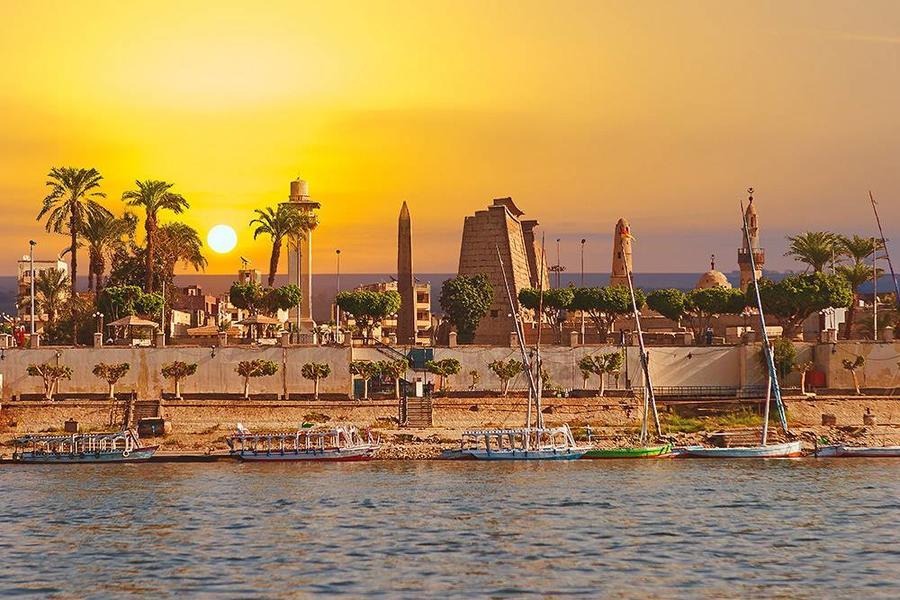
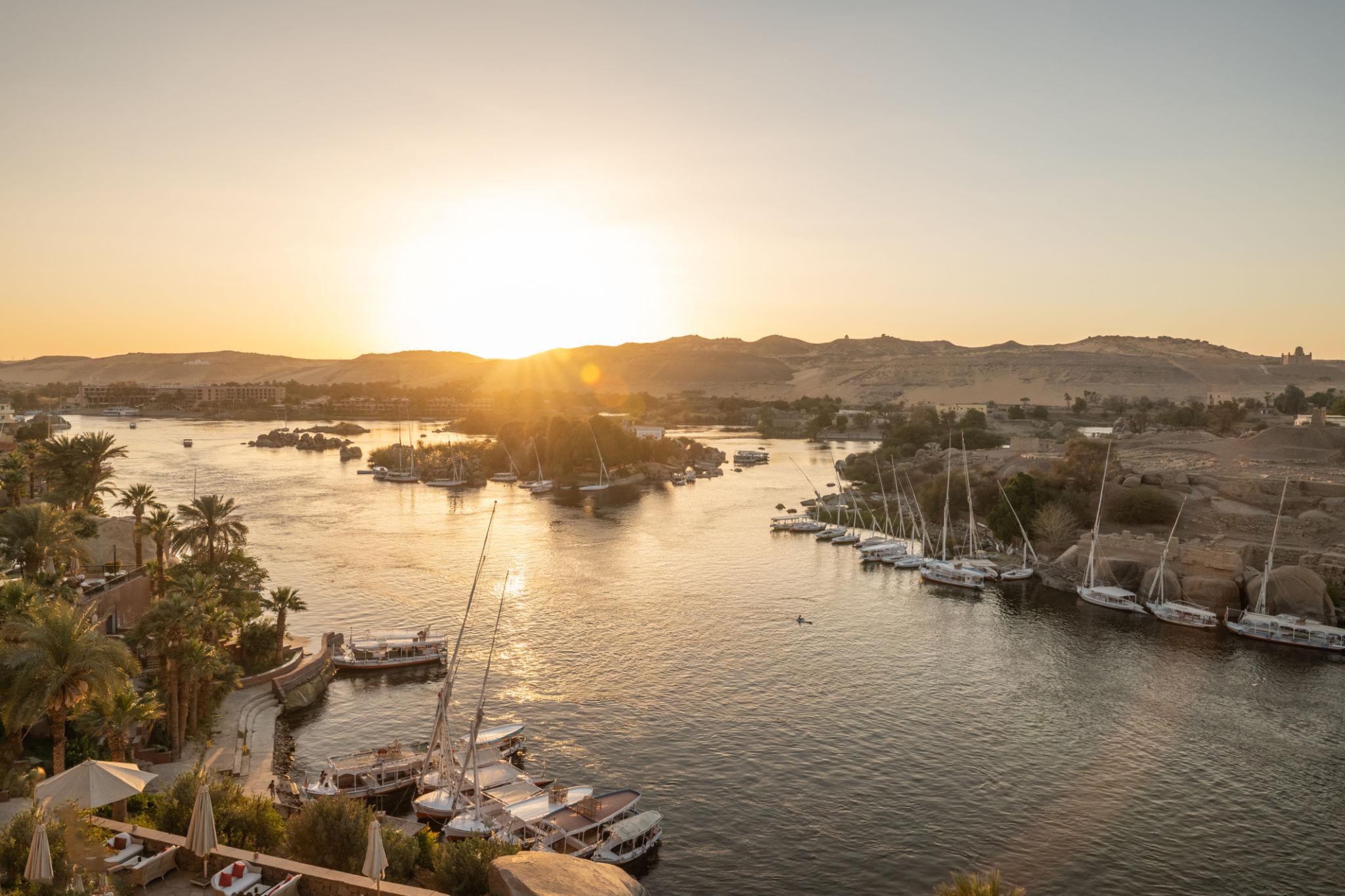
If you want pharaonic Egypt in the same trip, head inland by road rather than attempting a same-day round trip. A private transfer up to Luxor pairs well with two nights in Luxor, and the temple of Horus at Edfu sits close to where the desert road meets the Nile, so a stop is easy to arrange alongside a day at Edfu and Kom Ombo. Do the reefs first, though. Nobody has regretted starting a trip underwater.