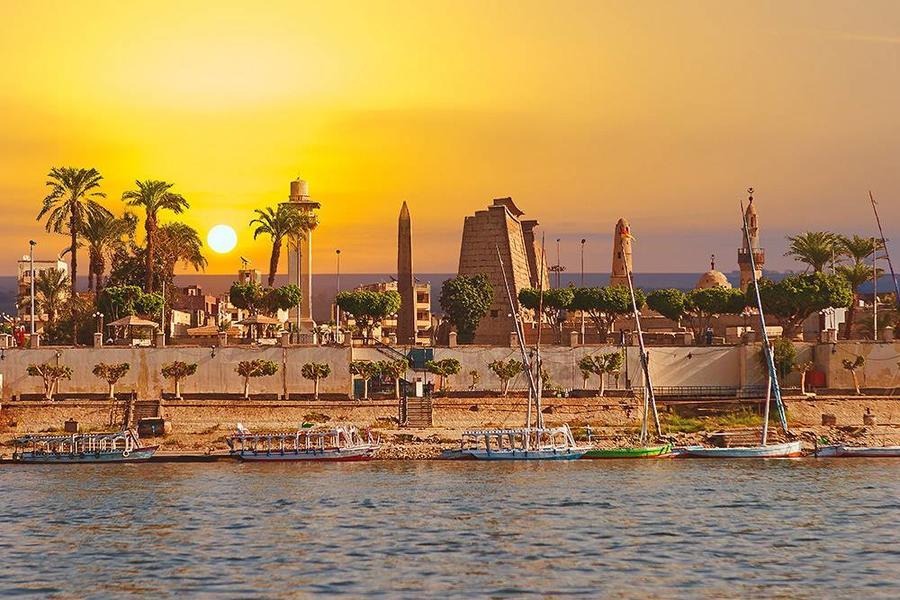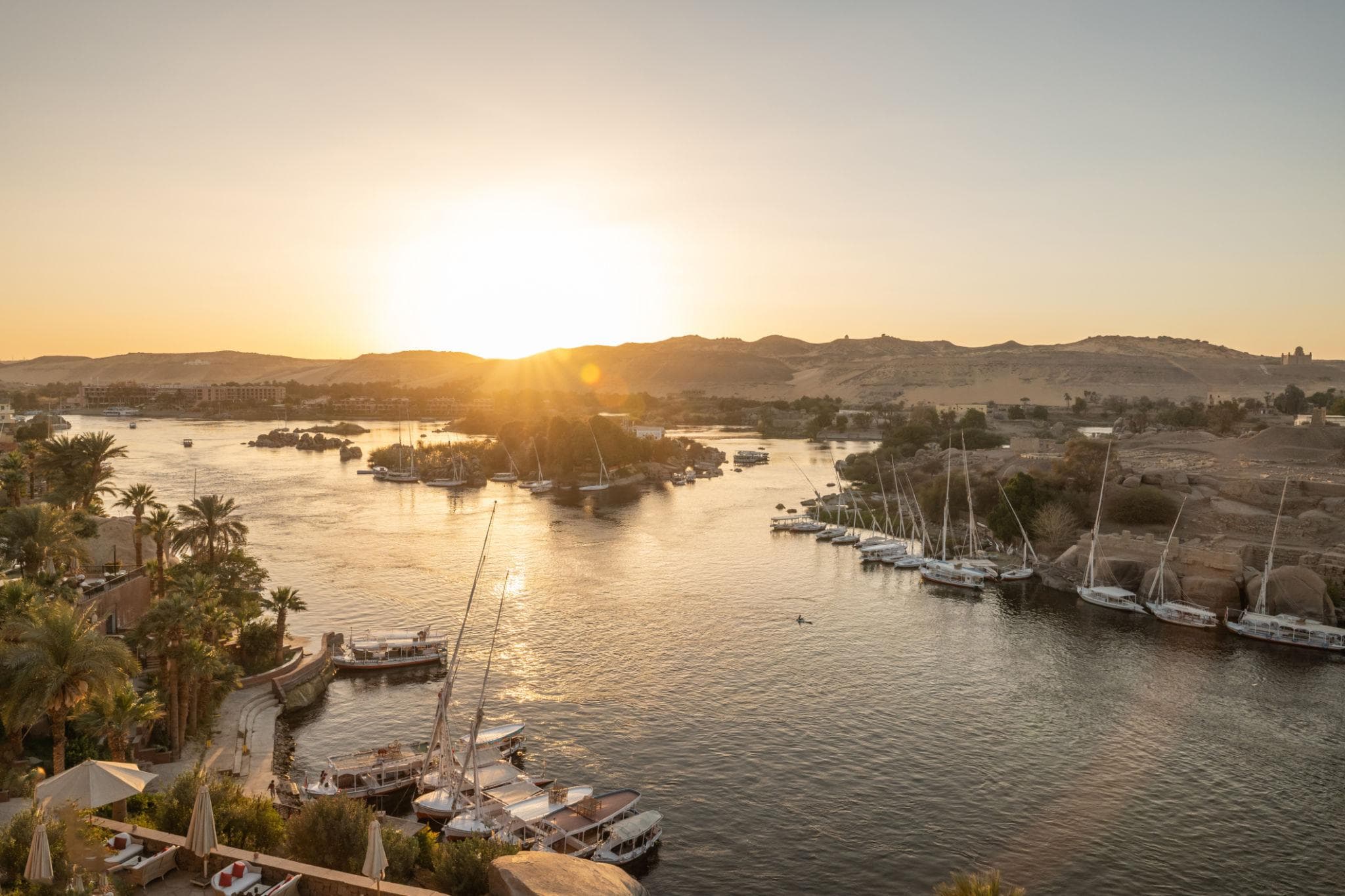
About 210 km south of Luxor the sandstone gives out and granite takes over. It surfaces in the riverbed as rounded black boulders, splits the Nile into channels around a scatter of palm-topped islands, and for most of pharaonic history it marked the end of Egypt. This is the First Cataract, and the town beside it — Swenet to the Egyptians, Syene to the Greeks, Aswan today — was a customs post, a garrison, a quarry and a river port long before anyone came simply to look.
Most visitors get about eighteen hours of it: cruise boat in from Luxor, Philae and the High Dam before lunch, an hour under sail at sunset, flight north in the morning. That works, and it is also the most common way to misread the place. Aswan is a frontier town with five thousand years of unbroken occupation on a single island, a Nubian population whose homeland lies under the lake to the south, and the one stretch of the Egyptian Nile where the river is the headline rather than the transport.
This guide treats Aswan as a destination in its own right: what is on the islands, what things cost as of 2026, and how many days the city repays.
Quick Facts
Where: Upper Egypt at the First Cataract, roughly 880 km south of Cairo by rail, 210 km south of Luxor
Ancient names: Swenet in ancient Egyptian, Syene to the Greeks and Romans — the source of the rock name syenite
Getting there: 1 hour 20 minutes by air from Cairo, 12 to 14 hours on the overnight sleeper, about 3 hours by day train from Luxor
Airport: Aswan International (ASW), 16 km southwest of the city
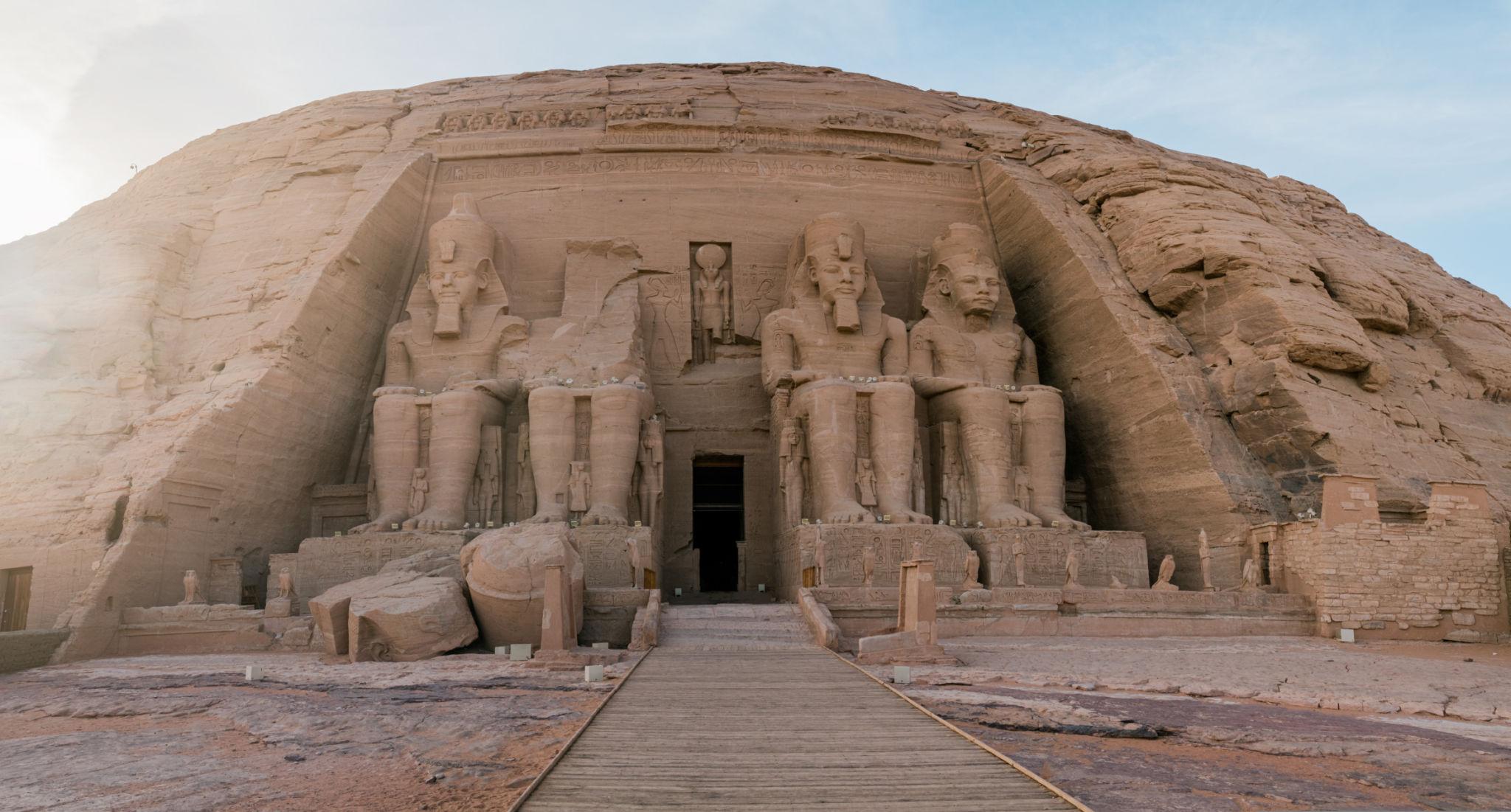
Abu Simbel: 280 to 300 km by road, three to four hours each way, or a 45-minute flight
Best months: November to March, average highs of 23 to 30C (74 to 86F)
Hardest months: June to August, averaging 41.9C (107F) with nights barely below 28C (82F)
Sample tickets in 2026: Philae 550 EGP, Nubia Museum 400 EGP, Unfinished Obelisk 220 EGP, Elephantine 200 EGP, St Simeon 100 EGP
Getting There by Plane, Train and River
EgyptAir, Air Cairo and Nile Air fly daily from Cairo, about an hour and twenty minutes in the air, into an airport 16 km southwest of the Corniche. A taxi or a pre-booked Aswan airport transfer reaches a riverside hotel in well under an hour.
The overnight sleeper saves a hotel night, and two recent changes catch people out: the service changed operator in 2023 and now runs under the Abela name, and since the new Cairo Upper Egypt station at Bashtil opened in October 2024 the sleepers leave from there rather than Ramses. Cabins are sold per compartment in dollars for foreign passengers, and the trip takes twelve to fourteen hours. Day trains from Luxor cover the 210 km in about three hours for a fraction of the price.
The third route is the river. A Nile cruise between Luxor and Aswan is the only way to arrive with Edfu and Kom Ombo already behind you, and our comparison of Luxor and Aswan is worth reading if you are still weighing the two cities.
How Many Days Aswan Deserves
Two nights is the floor: one day for the mainland circuit of quarry, museum, dams and Philae, one for the river, the islands and the west bank. Three lets you add Abu Simbel without cutting anything. The mistake is to compress Aswan into a half-day of monuments. They are good monuments, but the river is why the city is worth the journey, and the river takes time.
Elephantine Island and the Botanical Garden
Elephantine is 1.6 km long and 450 metres across at its widest, and people have lived on it continuously for close to five thousand years. Its ancient name, transliterated abu or yebu, means elephant or ivory, most likely for the trade that passed through the customs post here. The southern third is an open archaeological site worked by German and Swiss missions for over a century: the ruined Temple of Khnum, the ram-headed creator god of the cataract; a Temple of Satet whose earliest shrine goes back to around 3000 BCE; and a corridor nilometer of ninety steps cut down to the water, marked in hieroglyphic, Roman and Arabic numerals and still read as a flood gauge in the nineteenth century.
The island's strangest chapter is not pharaonic. Aramaic papyri found here document a Judean garrison living on Elephantine under Persian rule in the fifth century BCE, with its own temple to the god Yahu a short walk from the shrine of Khnum. That temple was burned down in 410 BCE, and the surviving archive is one of our richest sources for Jewish life outside Judah.
The site ticket is around 200 EGP (roughly 4 USD), gates about 8am to 4pm. The small island museum, set up in 1912, has opened and closed repeatedly over the past decade, so treat it as a bonus. The northern two-thirds of the island are residential Nubian villages, Koti and Siou among them, with dirt lanes, no cars and a few guesthouses on the water.
Immediately west lies Geziret el-Nabatat, Plant Island, better known as Kitchener's Island. Kitchener was given it while he was British Consul-General between 1911 and 1914 and planted it with specimens shipped from India and further east. It is now a public garden about 750 metres long, entirely shaded and loud with birds — the coolest hour you will spend in Aswan.
The Nubian Villages
The best known is Gharb Soheil on the west bank, where the houses are painted cobalt, ochre and rose and the lanes are lined with stalls. It is worth going, and it is also the most commercial version of the experience; the villages on Elephantine are quieter and less staged. A felucca and Nubian village tour is the standard way to reach it.
Context matters here more than at almost any Egyptian site. When the High Dam closed, the rising lake drowned the Nubian homeland upriver. Figures differ: Egyptian Nubian accounts commonly speak of around forty-five villages and some fifty thousand people resettled inland near Kom Ombo, while estimates covering Egypt and Sudan together run past 100,000. That loss runs through Nubian music, painting and storytelling, which is why the Nubia Museum is not an optional extra. Built into the hillside by the architect Mahmoud El-Hakim, it opened in November 1997 and won the Aga Khan Award for Architecture in 2001. Entry is around 400 EGP (about 8 USD), open 9am to 5pm with an extra evening session on Thursdays and Fridays. We go deeper into the culture in our guide to Nubian life.
Qubbet el-Hawa and the Monastery of St Simeon
The cliff opposite the city is honeycombed with rock-cut tombs. Qubbet el-Hawa, the Dome of the Wind, named for the shrine on its summit, holds around a hundred tombs spanning the Fourth Dynasty to the Roman period, most of them burials of the men who ran Egypt's southern frontier.
Two repay the climb on their own. The Sixth Dynasty tomb of Harkhuf carries his autobiography, an account of four trading journeys into Nubia and the land of Yam, and quotes a letter from the boy-king Pepi II demanding that a dancing dwarf be brought north to the palace unharmed. The Twelfth Dynasty tomb of Sarenput II, a governor under Amenemhat II and Senusret II, is architecturally the finest thing on the hill. Entry is about 200 EGP, hours roughly 7am to 4pm, and getting up means a boat crossing and a stiff staircase up an unshaded sand slope.
South along the same bank stands the Monastery of St Simeon, properly Deir Anba Hadra: a fortified stone and mudbrick settlement on two terraces with surviving wall paintings, one of the best-preserved early monastic complexes in Egypt. Sources differ on the centuries of its foundation and abandonment, but it was empty well before Ottoman times. The ticket is 100 EGP, open 7am to 5pm, and you reach it by boat plus a walk or camel ride of about a kilometre across open sand.
The Unfinished Obelisk and the Granite That Built Egypt
Aswan stone went everywhere: sarcophagi at Giza, colossi at Luxor, obelisks that now stand in Rome, Paris, London and New York. The Unfinished Obelisk, lying in the northern quarry inside the modern city, is where you see how the work was done.
Finished, it would have stood about 41.75 metres and weighed close to 1,090 tonnes, larger than any obelisk ever successfully raised. It is usually attributed to Hatshepsut, though the attribution is probable rather than proven, and it was abandoned where it lay when cracks opened in the granite. Because the workers walked away mid-job, the site preserves what a completed monument never can: the trenches pounded out around the shaft, the pounder marks, the ochre working lines still on the stone. Tickets are around 220 EGP (roughly 4.50 USD) and half an hour is enough. Come early, because the quarry is a bowl of bare rock with no shade at all.
Two Dams and the Island Temple Between Them
Aswan has two dams and they belong to different centuries. The Low Dam went up between 1898 and 1902, opened on 10 December 1902 and was raised twice in the decades after. Its immediate effect was to drown the rapids of the First Cataract, so the whitewater that made this a frontier no longer exists; the granite islands are what remain of it.
The Aswan High Dam a few kilometres upstream is the one that rewrote the country. Work began in January 1960 and finished on 21 July 1970. It stands 111 metres high with a crest 3,830 metres long, and its twelve turbines are rated at 2,100 megawatts. Behind it, Lake Nasser holds some 132 cubic kilometres of water, its length quoted anywhere between 479 and 550 km depending on how the Sudanese arm is measured. As a visit it is a viewpoint rather than a spectacle and twenty minutes is honest; a Lake Nasser cruise is the way to grasp what the water covered.
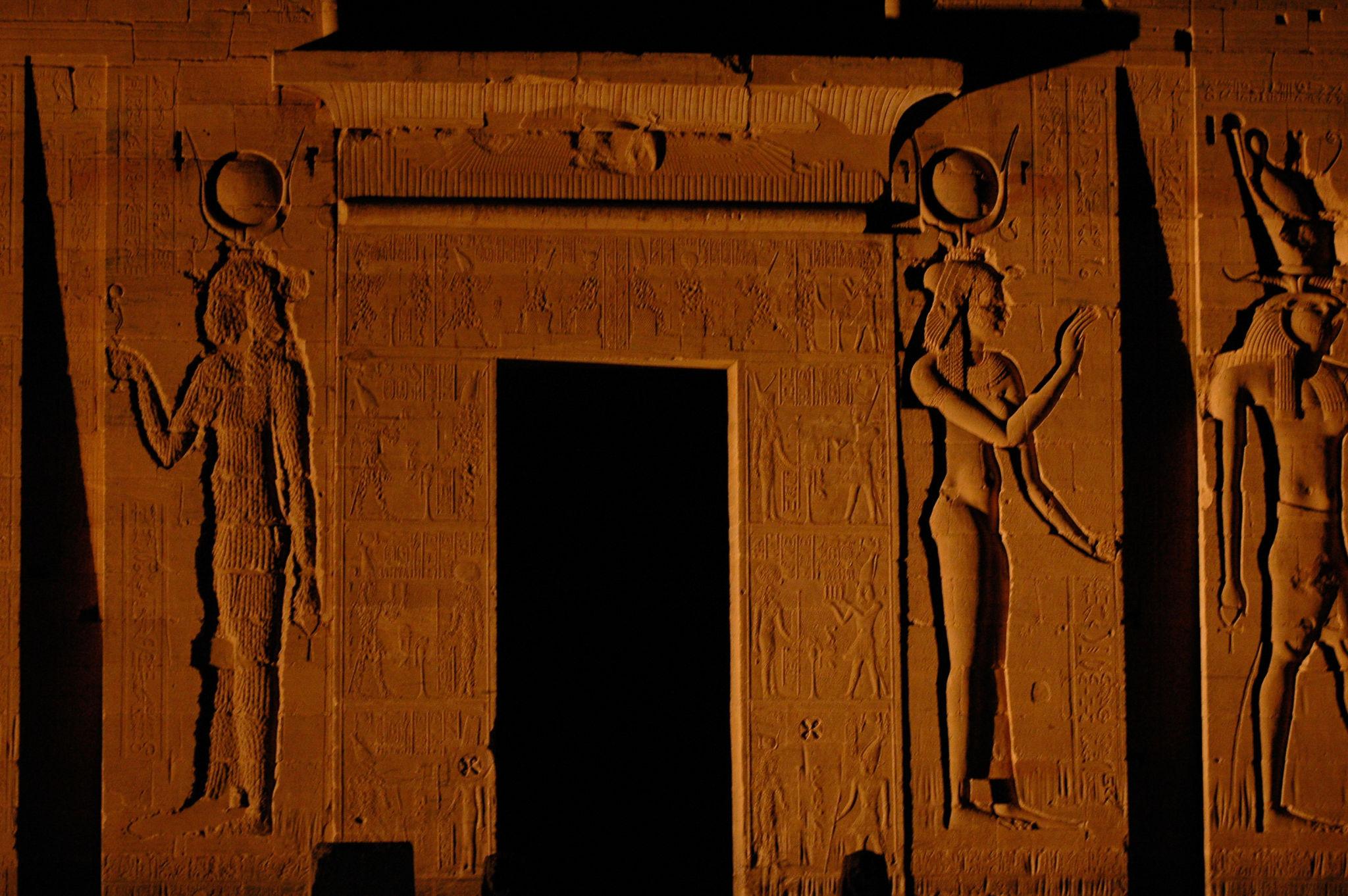
Philae sits between the two dams, rebuilt on the island of Agilkia some 500 metres from its original home, the block-by-block transfer running from 1977 to 1979. Boats cross from a jetty below the Low Dam in about ten minutes. The ticket is 550 EGP (around 11 USD), gates 7am to 4pm, plus a boat fare charged per boat rather than per head. Our Philae and High Dam tour covers both plus the obelisk in a morning, and the temple gets full treatment in our guide to Philae.
Felucca or Motorboat
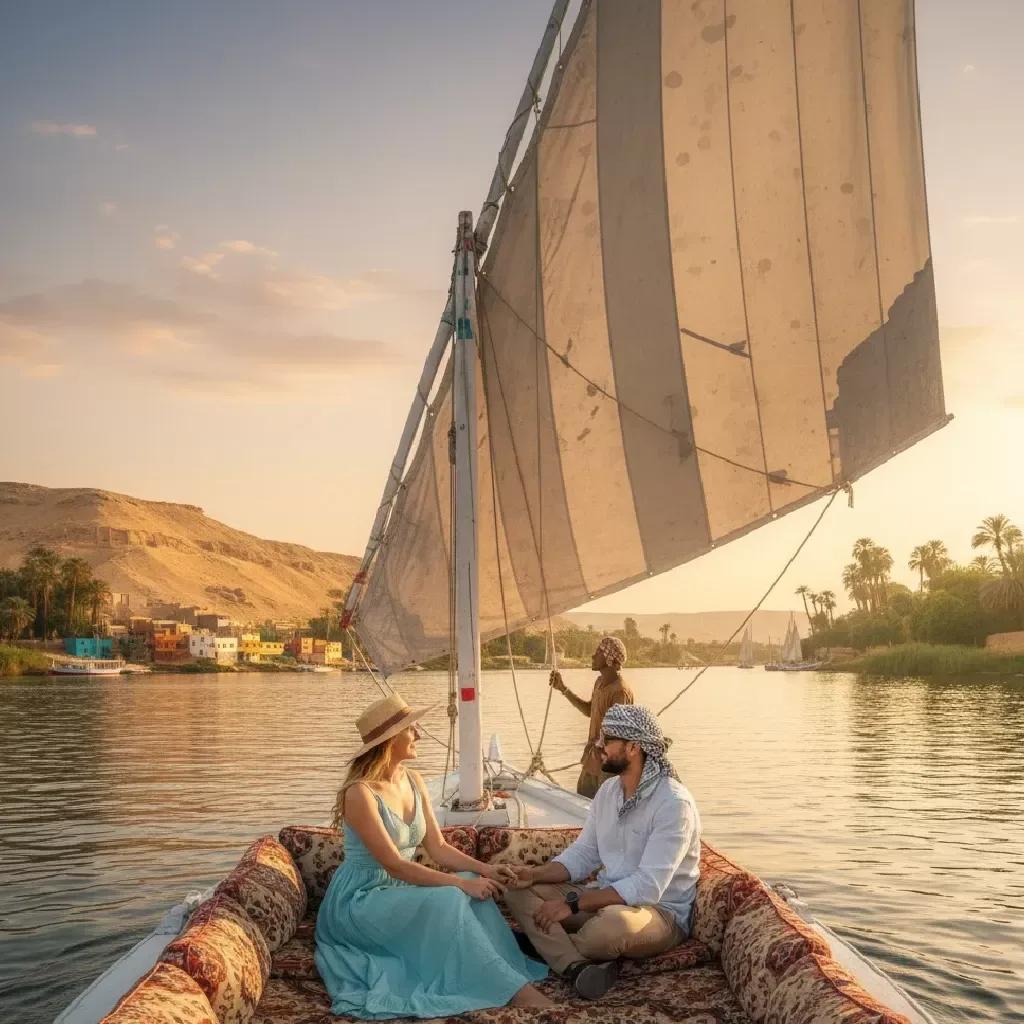
A felucca is a lateen-rigged sailing boat with no engine, which means it is silent, slow and at the mercy of the wind. The Corniche to Gharb Soheil takes twenty to forty minutes under sail, and rates run around 300 to 500 EGP an hour for the whole boat as of 2026, not per person.
A motorboat does the same run in ten to fifteen minutes, with return trips to a west-bank village typically quoted at 400 to 700 EGP. Take the motor if you are pushed for time, travelling with small children or moving against the wind late in the day. Otherwise take the felucca, in the last two hours of daylight when the granite turns copper. The local ferry to Elephantine costs a few pounds and runs all day.
Good to Know: Tickets, Cards and Closing Times
Egyptian antiquities tickets have risen repeatedly and third-party websites are full of prices two or three increases out of date. The figures here follow the Ministry of Tourism and Antiquities tariff current in 2026, converted at a rough 50 pounds to the dollar; check the rate before you travel. More ticket offices now take bank cards only, so bring a card that works abroad plus a backup, and keep cash for boatmen, taxis and the souq. Several Aswan gates also close at 4pm rather than 5pm, including Philae, Qubbet el-Hawa, Elephantine and the Unfinished Obelisk.
Insider Tip: Cross to the West Bank in the Afternoon
Almost every group does the west bank in the morning, which means the villages, the tombs and the monastery are busiest before noon in the flattest light of the day. Reverse it. Take the mainland sites early, rest through the heat, then cross from about 2pm with those 4pm closures in mind. You will have the painted lanes largely to yourself, the tomb doorways face the afternoon sun so the interiors are actually lit, and you sail back into a sunset over the cataract instead of watching it from a hotel terrace. Fix your return boat in advance, because traffic thins fast once the day groups have gone.
Warning: Agree the Whole Boat Price Before You Step Aboard
The most common way to be overcharged in Aswan is not a ticket, it is a boat. The recurring pattern is a low quote for the outbound leg followed by a separate demand for the return, or a waiting charge that materialises once you are ashore on an island. Settle four things before you get in: the total price, whether it is per boat or per person, how long the boatman will wait, and that the fare includes bringing you back.
Where to Stay and When to Come
Three areas, three different trips. The east bank Corniche puts you within walking distance of the souq, the museum and the ferry landing, and covers everything from backpacker rooms to the grand old Nile-view hotels. Elephantine means small guesthouses, no cars and a ferry to catch every time you want dinner. The west bank villages offer family-run rooms with terraces facing the water.
November to March is the season: highs of 23 to 30C (74 to 86F) and January nights near 10C (50F), cold enough on the water after dark to want a jacket. April, May and October are hot but workable if you start at dawn. June to August averages 41.9C (107F), with a record of 51C on the books, and both the quarry and the Qubbet el-Hawa staircase are wholly unshaded. Rates collapse in summer for a reason.
Building Your Aswan Days
With three nights, the shape that works is mainland monuments and the museum on day one, Abu Simbel on day two starting before dawn or on the short morning flight, then the islands, the west bank and a sunset sail on day three. With two nights, drop the High Dam before you drop the river. Aswan and Abu Simbel sit outside the areas covered by Western Desert travel advisories, but off-road desert travel in the far south still needs a qualified guide and a Ministry of Interior permit arranged in advance.
Aswan rewards travellers who slow down more than anywhere else in Egypt, which is the opposite of how most itineraries treat it. If you are shaping a southern trip and want a second opinion, our team plans these routes every week and is happy to talk it through.