While thousands of travelers crowd the Nile between Luxor and Aswan each week, a quieter and arguably more dramatic voyage waits to the south. Lake Nasser cruises trace the flooded valley behind the Aswan High Dam, gliding past temples that were sawn apart and rebuilt stone by stone to escape the rising water. This is desert sailing in its purest form: vast horizons, almost no other boats, and the unforgettable approach to Abu Simbel by water.
Why Lake Nasser Is So Overlooked
Most first-time visitors to Egypt build their itinerary around the classic Luxor-to-Aswan Nile cruise, and tour operators rarely volunteer the alternative. Lake Nasser sits beyond Aswan, requires its own small fleet of ships, and carries fewer than a tenth of the passengers the northern Nile does. The result is a journey that feels almost private.
The lake itself is one of the largest man-made reservoirs on Earth, stretching roughly 480 kilometers (about 300 miles) south from the High Dam, with around 150 km crossing into Sudanese territory where it is called Lake Nubia. When the dam was completed in 1970 it drowned ancient Nubia, displacing tens of thousands of people and submerging dozens of monuments. The temples you visit on a Lake Nasser cruise are precisely those that international teams raced to rescue in the 1960s, making the whole region a monument to one of the greatest archaeological salvage operations in history.
A Brief History of the Drowned Valley
Understanding the lake means understanding the High Dam. President Gamal Abdel Nasser's government, with Soviet engineering and funding, built the dam to control the annual Nile flood, generate hydroelectric power, and expand farmland. The reservoir that filled behind it bears his name.
The cost was the heartland of ancient Nubia. UNESCO launched an unprecedented campaign from 1960 to 1980, and the most famous outcome was the relocation of Abu Simbel, lifted some 65 meters higher and set back from the original riverbank between 1964 and 1968. Smaller temples were also moved to safe headlands you sail past today: Kalabsha, Wadi es-Sebua, Dakka, Maharraqa, Amada, and Derr among them. Knowing this history transforms each stop from a pretty ruin into a survivor.
The Cruise Route, Day by Day
Most itineraries run three or four nights, sailing either northbound (Abu Simbel to Aswan) or southbound (Aswan to Abu Simbel). The southbound direction is the more common and builds toward Abu Simbel as the climax.
### Day 1 - Embarkation near the High Dam
You typically board in the afternoon at a jetty near the High Dam, south of Aswan. Many cruises include a stop at the temple of Kalabsha, relocated to a rocky island near the dam. Kalabsha is a large, late-period Nubian temple dedicated to the god Mandulis; nearby stand the smaller Beit el-Wali rock-cut chapel and the kiosk of Qertassi. The afternoon usually closes with the ship casting off into open water as the sun drops.
### Day 2 - Wadi es-Sebua, Dakka and Maharraqa
This middle day visits a cluster of relocated temples grouped together on the western shore. Wadi es-Sebua ("Valley of the Lions") is approached along an avenue of sphinxes and was built largely under Ramesses II. A short walk away sit Dakka, with its tall pylon you can climb for views over the lake, and the small unfinished temple of Maharraqa. Afternoons on the upper deck, watching the empty shoreline slide by, are part of the appeal.
### Day 3 - Amada, Derr and the Tomb of Pennut
The temples of Amada and Derr, plus the rock-cut tomb of Pennut, form the next group. Amada is one of the oldest surviving Nubian temples and retains remarkably vivid painted reliefs precisely because it was buried and protected for centuries. Derr, dedicated by Ramesses II, also preserves color. These are intimate, uncrowded sites where you may be the only group present.
### Day 4 - Abu Simbel
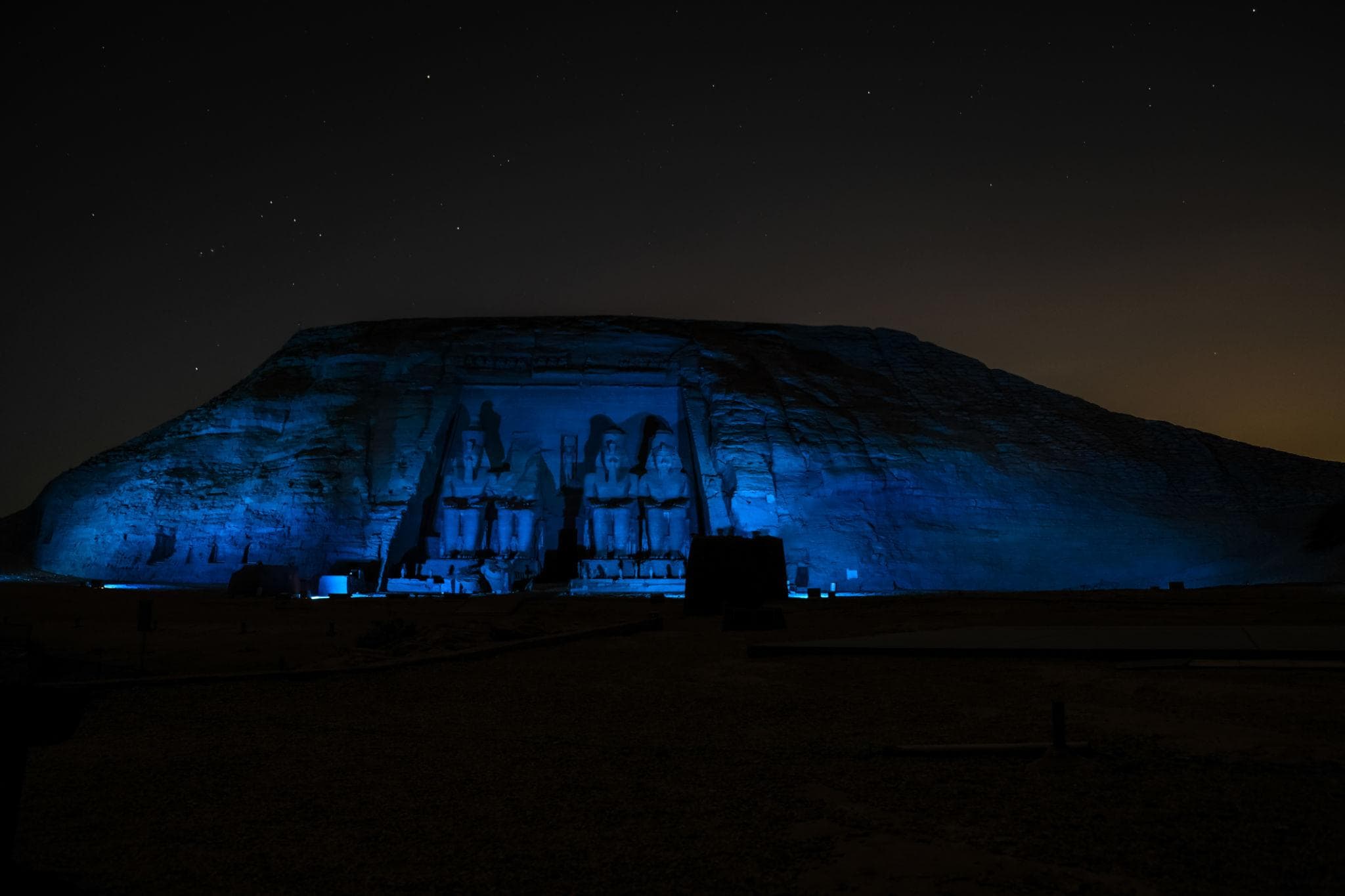
The finale is the approach to Abu Simbel. Arriving by water, with the four colossal seated figures of Ramesses II gradually resolving on the cliff face, is a sight the bus-bound day-tripper never gets. Ships usually moor overnight so you can visit both temples in the calm of late afternoon and again at dawn, well before the convoys arrive from Aswan around mid-morning. Many cruises include the evening Sound and Light show before disembarking the following morning.
The Temples You Will See
### Abu Simbel
The Great Temple of Ramesses II and the smaller temple of his queen Nefertari are the undisputed stars. The four seated colossi guarding the Great Temple stand about 20 meters tall. Inside, the long hall of Osiride pillars leads to a sanctuary aligned so that, on roughly 22 February and 22 October each year, the rising sun illuminates the gods within - a solar event that draws crowds (the relocation shifted the dates by about a day). Photography of the exteriors is free; check current rules for interior photo permits, which periodically change.
### Kalabsha, Amada and the lesser temples
Do not skip the smaller temples as "filler." Amada's preserved paint and Kalabsha's sheer scale reward attention, and because so few people reach them, your guide can explain reliefs without competing voices around you.
When to Go: Climate and Crowds
The high season runs October to April, when daytime temperatures are pleasant and the desert light is at its best. December and January can be cool, even chilly after dark on the open deck, so pack a layer. From May to September the heat is severe - frequently above 40C (104F) at Abu Simbel - and many of the smaller ships reduce sailings, though prices drop. February draws extra visitors around the sun-alignment dates.
Crowds are simply not the issue they are on the northern Nile. Even in peak season the lake feels empty, and the few cruise ships coordinate so that sites are rarely visited by two groups at once.
Costs, Ships and What's Included
As of 2026, expect a four-night Lake Nasser cruise to cost roughly USD 600 to 1,200 per person (very approximately EGP 30,000 to 60,000 at prevailing rates), depending on the ship and cabin. The fleet is small - only a handful of vessels operate, and a few historic ships are styled like vintage steamers. Cabins are generally comfortable rather than ultra-luxurious.
Most fares are close to all-inclusive: cabin, full board, guided temple visits, and the services of an Egyptologist. Typically excluded are drinks, tips (budget perhaps USD 8 to 15 per day for crew and guide combined), the entrance fee to Abu Simbel if not bundled, and the Sound and Light ticket. Always confirm in writing whether temple entrance fees are included, as policies vary by operator.
Getting There and Practical Logistics
Cruises begin near Aswan, so you first need to reach Aswan - most travelers fly in (about 1 hour 20 minutes from Cairo) or arrive by overnight sleeper train or the Luxor-Aswan Nile cruise. From central Aswan it is roughly a 30 to 45 minute drive to the High Dam embarkation area.
If a multi-night cruise does not fit your schedule, you can still see Abu Simbel as a long day trip. The road journey from Aswan is about 280 km each way, historically run in security convoys; allow three to three and a half hours of driving in each direction, with an early start. A simple Aswan to Abu Simbel transfer lets you visit the temples and return the same day, though you miss the magic of the water approach and the dawn light.
### A few insider tips
- Bring a hat, high-SPF sunscreen and a refillable water bottle; shade is scarce at the temples.
- The upper deck at sunset is the best vantage on the whole trip - claim a chair early.
- Carry small cash in Egyptian pounds for tips and any local photo fees; card payments are unreliable this far south.
How Lake Nasser Compares to the Classic Nile Cruise
The Luxor-to-Aswan stretch packs in famous temples - Karnak, Luxor, Edfu, Kom Ombo - and the riverbanks are green, busy and full of life. Lake Nasser offers the opposite: emptiness, scale and solitude, with Abu Simbel as the reward. Many seasoned travelers do both, using the Nile cruise as the cultural deep-dive and Lake Nasser as the contemplative finale.
For a fuller picture of the region before you commit, read more about Aswan and its setting, the engineering story of the Aswan High Dam that created the lake, and the monument itself in our guides to Abu Simbel and the wider Abu Simbel destination.
Planning Your Lake Nasser Adventure
A Lake Nasser cruise rewards travelers who have already ticked off the headline sights and want something rarer and more reflective. If you are weaving it into a larger itinerary, a classic Luxor to Aswan Nile cruise pairs beautifully as the first half of your journey, leaving the southern lake as a serene grand finale. Whichever way you sail, arriving at Abu Simbel across open desert water is one of the most memorable approaches to any monument on Earth.