The ramp down into the hall is deliberately dark. The noise of the main gallery fades behind you, and the cases come out of the gloom one by one. In one lies a king of the seventeenth dynasty with his skull visibly broken, the wounds still open after more than three and a half thousand years. Nearby lie Thutmose III, the warrior who carried Egypt's borders to the Euphrates, Seti I with the calmest face in the ancient world, and Ramesses II, who outlived many of his children and ruled for some 66 years.
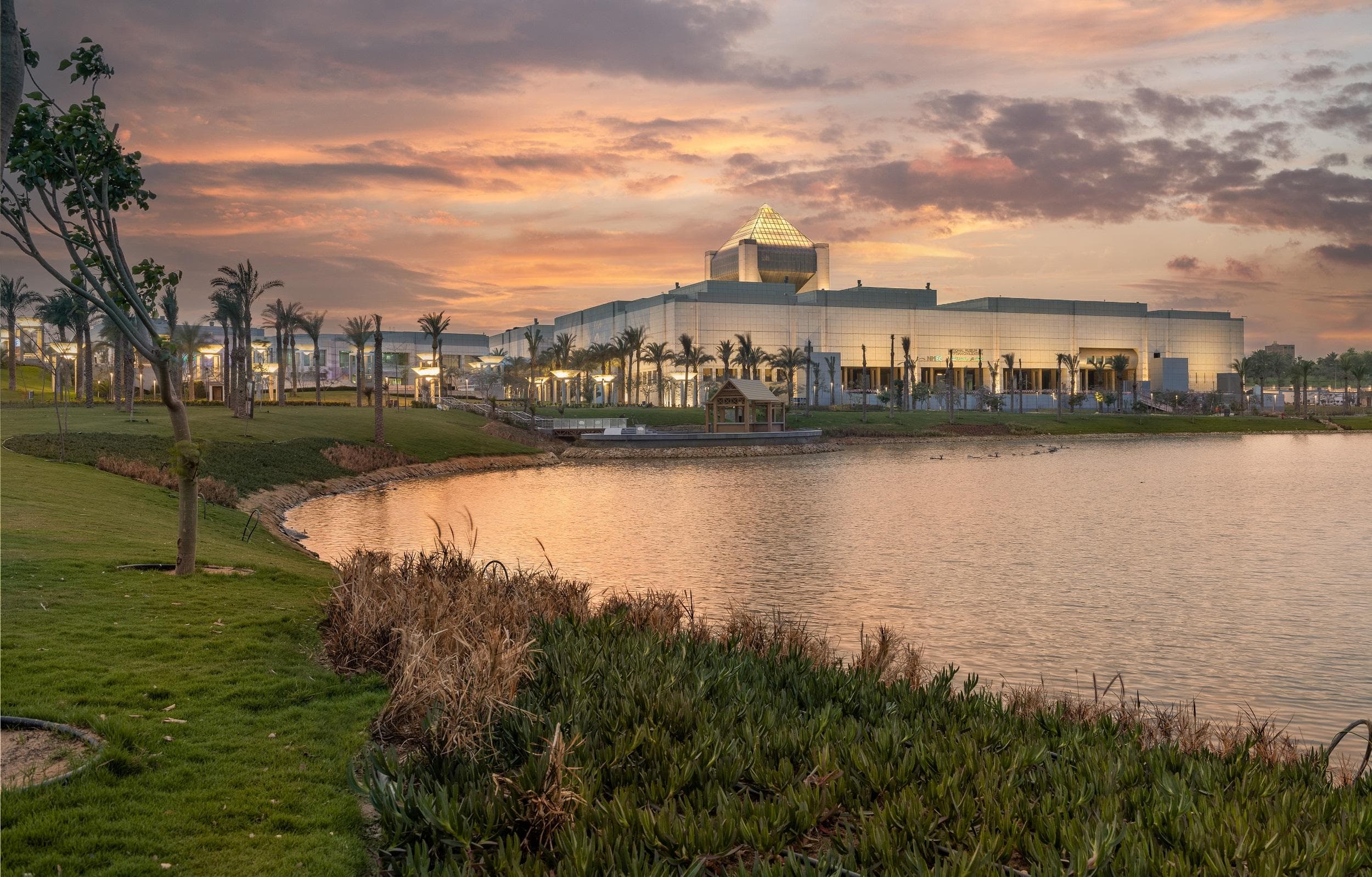
These are the royal mummies NMEC has displayed since April 2021, when they left the old museum on Tahrir Square in a televised night procession and came to rest beneath the National Museum of Egyptian Civilization at Fustat, in the oldest part of Cairo. For anyone who wants to stand face to face with the pharaohs rather than their statues, this is the place to go: the mummies are not at the Grand Egyptian Museum and they are no longer at Tahrir. This guide covers what you will see, how the hall works, tickets and opening hours as of autumn 2026, the rest of the museum, and how to pair it with Old Cairo.
At a Glance
Location: Fustat, Old Cairo, beside Ain el-Sira lake, about 5 to 10 minutes from the Coptic quarter
Opened: main hall on 4 April 2021; the Royal Mummies Hall to the public on 18 April 2021
Opening hours: 9am to 5pm daily, last tickets at 4pm, plus an evening session from 6pm to 9pm (confirm which days), as of autumn 2026
Tickets: 550 EGP for foreign adults and 300 EGP for students (about 10 and 5.50 USD), mummies hall included
Price change: the board approved a rise from April 2027, reported at 700 EGP for foreign adults and 350 EGP for students
In the hall: the royal mummies moved from Tahrir in 2021, kings and queens of the 17th to 20th Dynasties
Photography: allowed in the main galleries on payment of a fee, no flash; not permitted in the mummies hall
Time needed: two to three hours, or about 90 minutes if the mummies are your priority
Nearest metro: El Malek El Saleh on Line 1, a short walk away
The Night the Pharaohs Crossed Cairo
On the evening of 3 April 2021, 22 royal mummies, 18 kings and four queens, left the Egyptian Museum on Tahrir Square for the last time. Each travelled in its own vehicle, built for the occasion, decorated in gold in the style of an ancient funerary boat, and fitted to cushion the bodies against every jolt. They moved in chronological order of reign, along a route lined with performers and lit for television, past the Nile and down to Fustat, where the president received them at the new museum. The organisers called it the Pharaohs' Golden Parade.
It was spectacle on a scale Cairo rarely attempts, with an orchestra, a choir and a hymn sung in a reconstruction of ancient Egyptian. It was also serious conservation: the mummies had been at Tahrir since the building opened in 1902, latterly in two small display rooms on the upper floor, and the move gave them new cases and a hall designed around them. The museum, which had run a first temporary exhibition in 2017, opened its main exhibition hall the day after the parade, and the mummies went on public display on 18 April 2021.
Where These Mummies Came From
Almost none of these kings were found where they were buried. Around 1000 BC, priests of the 21st Dynasty, confronting a wave of tomb robbery in the Valley of the Kings, gathered the royal dead, rewrapped many of them, labelled them, and hid them in groups. One cache, in a shaft in the cliffs at Deir el-Bahari near Hatshepsut's temple, was quietly being looted by a local family in the 1870s before the Antiquities Service traced it in 1881 and emptied it in a matter of days. A second cache turned up in 1898 in the tomb of Amenhotep II in the Valley of the Kings.
That history explains why the mummies have the labels they have, and why a few identifications are still debated. It also explains the faces. Rewrapped and moved, they were spared the worst of the robbers' damage, and they are the most important group of royal remains to survive from ancient Egypt. Our guide to mummification in ancient Egypt explains the process that preserved them, and our Valley of the Kings guide describes the tombs they were taken from.
The Royal Mummies NMEC Holds, King by King
The hall is laid out to suggest a walk through the Valley of the Kings: dim, quiet, with each mummy in its own climate-controlled case under a soft pool of light, and a panel beside it giving the ruler's dates, family and what scientists have learnt from the body. Sources differ slightly on how many of the 22 are on show at any one time, so expect around twenty. These are the ones most visitors stop for.
- Seqenenre Tao, a Theban king of the 17th Dynasty who fought the Hyksos rulers of the north. His skull carries the wounds of the weapons that killed him, and a CT study published in 2021 suggested he was captured on the battlefield and executed.
- Ahmose-Nefertari, wife of the king who expelled the Hyksos, venerated for centuries afterwards as a protector of the Theban workmen.
- Thutmose III, the great campaigning king of the 18th Dynasty, whose body was broken by ancient robbers and splinted back together by the priests who rewrapped it.
- Hatshepsut, the woman who ruled as pharaoh, whose identification is a story in its own right.
- Seti I, father of Ramesses II, whose face is so well preserved that he appears to be asleep. His tomb in the Valley of the Kings is one of the finest there.
- Ramesses II, the builder of Abu Simbel and the Ramesseum, who lived to about ninety. In 1976 his mummy was flown to Paris for conservation treatment and greeted there with honours fit for a visiting head of state.
- Ramesses III, the last great warrior king of the New Kingdom, whose throat, scans showed in 2012, had been cut.
- Queen Tiye, wife of Amenhotep III and grandmother of Tutankhamun.
Did You Know: How Hatshepsut Was Found Again
For a century Hatshepsut's mummy was missing. A small tomb in the Valley of the Kings, known as KV60, was opened by Howard Carter in 1903 and found to hold two female mummies, neither named. One was taken to Cairo; the other, an obese older woman, was left lying on the floor of the tomb.
In 2007 that second mummy was brought to Cairo, and an Egyptian team led by Zahi Hawass announced it was Hatshepsut. The key evidence was a wooden box inscribed with her name, found in the 1881 cache, which held a liver and a single molar. CT scans showed that the tooth fitted a gap in the woman's jaw. Most scholars accepted the match, though some still regard it as unproven, which is worth knowing when you stand in front of her case. Our guide to Hatshepsut's temple at Deir el-Bahari covers her reign and her monument.
Insider Tip: Go Down Last, or Go at Night
Most groups rush the mummies first and then drift through the rest of the museum with their attention spent. Do it the other way round. Walk the main chronological hall first, so that by the time you go down the ramp you know who these people were, what they built, and roughly where they sit in three thousand years of history.
If your schedule allows, the evening session from 6pm to 9pm is the most atmospheric time to visit. The museum is usually quieter after dark, and the mummies hall, rarely crowded at the best of times, can be almost empty. Official listings since 2021 have presented the evening session as a Friday fixture, while some recent guides describe it as daily, so check before you plan around it.
Beyond the Mummies: The Galleries Upstairs
Most visitors come for the hall below and are surprised by the museum above it. The central exhibition hall, under a circular skylight, runs through the whole of Egyptian history, from prehistory to the present day, in a single loop. It begins with the Nazlet Khater skeleton, one of the oldest complete modern human skeletons found in Egypt, and runs on through Pharaonic, Greco-Roman, Coptic and Islamic material to the modern era. The Coptic and Islamic material is a real strength, which surprises visitors who think of the museum as purely pharaonic.
Themed displays cover the Nile, writing, the state and society, material culture and belief, and there is a textiles gallery with some 600 pieces of linen, wool and silk from many periods. The building also preserves the remains of a dye house from the early Fatimid period, rare evidence of the industries that once filled Fustat. The museum's holdings are put at around 50,000 objects, of which several thousand are on display.
Tickets, Opening Hours and Rules
As of autumn 2026, entry costs 550 EGP for foreign adults and 300 EGP for foreign students, and children under six are free. Egyptian visitors pay 90 EGP. The Royal Mummies Hall is included in the standard ticket. In September 2026 the museum's board approved a rise from 1 April, which in practice means spring 2027, and Egyptian press reported in October 2026 that the foreign ticket will go to 700 EGP (350 EGP for students), so check the official Ministry of Tourism and Antiquities site if you are travelling next spring. Our guide to Egypt ticket prices keeps the figures for all the main sites in one place.
The museum opens daily from 9am to 5pm, with the ticket window closing at 4pm. There is also an evening session from 6pm to 9pm, last tickets at 8pm, which the ministry lists for Fridays and some guides describe as daily. During Ramadan the day hours shorten to 9am to 4pm. Tickets are sold at the door, and you can also book online through the official portal.
Photography in the main galleries is allowed once you have paid the photography fee, and flash, tripods and video cameras are not allowed without special permission. Bags larger than about 40 by 40 cm go to the cloakroom, as do umbrellas, and food and drink stay outside.
Warning: Respect in the Mummies Hall
These are human remains, and the museum treats them that way. Keep voices low, do not lean on the cases, and keep your phone in your pocket: visitors are told that photography is not allowed in the hall, and guards watch for it. Guides tend to keep their commentary short and quiet down here, so if you have one, ask for the full story before you go down rather than inside. Seeing the royal mummies NMEC protects is a privilege that depends on visitors treating them as people.
Some visitors, particularly children, find the faces more affecting than they expected. The hall is short enough to walk through quickly, and it is perfectly reasonable to skip it and spend longer in the galleries upstairs; our guide to travelling in Egypt with children has more on pacing museum days.
Ain el-Sira Lake and Getting There
The museum stands beside Ain el-Sira, a lake whose surroundings were redeveloped around 2022, after years of neglect, into a public park with walkways, restaurants and an open-air theatre. It is a good place to sit after a visit, and the view back across the water to the museum is a fine one.
The easiest way in is the metro: take Line 1 to El Malek El Saleh and walk. Ride-hailing apps take about 20 to 35 minutes from Downtown, traffic permitting, and drivers know the museum as Mathaf el-Hadara. From Giza allow 45 to 75 minutes, which is the main reason not to try to combine it with the pyramids on the same day. Parking costs 20 EGP for a private car.
Pairing the NMEC With Old Cairo
The museum is five to ten minutes from Coptic Cairo by car, or one stop on the metro to Mar Girgis, which makes it a natural half-day pairing. Spend the morning in the old Roman fortress of Babylon, among the Hanging Church, the church of Abu Serga, the Ben Ezra Synagogue and the Coptic Museum, then lunch nearby and take the afternoon at the museum. Our Coptic Cairo guide covers the quarter, and our Old Cairo and Coptic quarter tour links the two with an Egyptologist.
From Fustat, the Mosque of Amr ibn al-As, founded in 641 or 642 and the first mosque built in Egypt, is close by, and the Citadel of Saladin is a short drive. Our guide to the Cairo Citadel explains how to see it in an afternoon, and our Islamic Cairo, Citadel and Khan el-Khalili tour continues into the medieval city.
Planning a Visit to See the Royal Mummies NMEC Displays
The museum fits easily into any Cairo stay. On a short trip, give it the afternoon of the day you spend in Coptic Cairo; on a longer one, take it in the evening session after a day elsewhere in the city. It complements the other two great collections well: Tutankhamun and the Grand Staircase at Giza, the Old Kingdom statues and the Tanis gold at the Egyptian Museum in Tahrir, and the people themselves here at Fustat. Our plan for three days in Cairo shows how they fit together.
If you would like one of our Egyptologists to bring the kings to life before you go down the ramp, we can add the museum to an Old Cairo day or build it into a longer itinerary. Tell us when you are travelling and what interests you most, and we will suggest the best way to see the royal mummies NMEC keeps beneath Fustat.