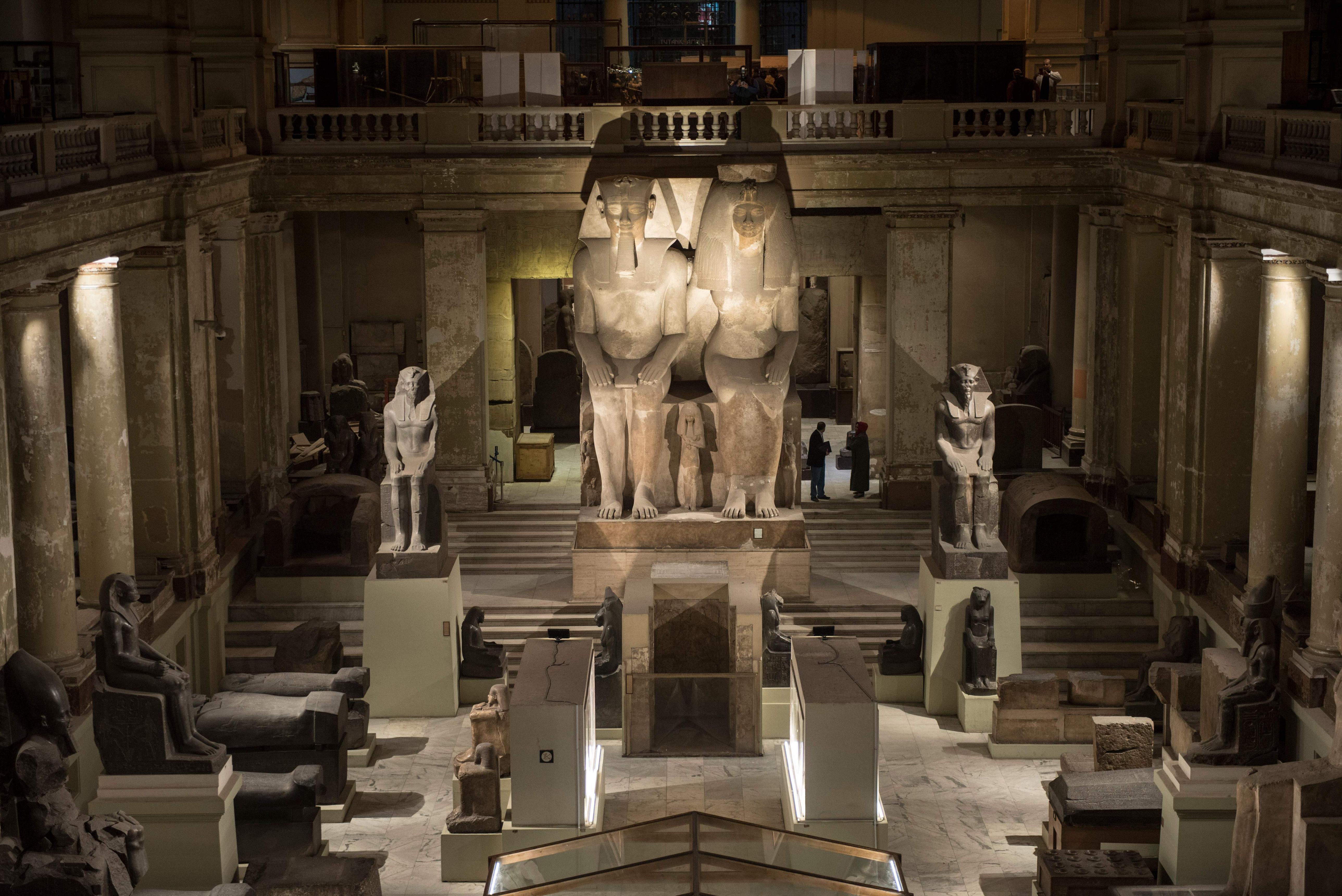
Walk into an Egyptian temple and you step into a deliberate machine for cosmic order. Every wall, column, and shaft of light was engineered to dramatize the daily rebirth of the sun and the meeting of the human and divine. Once you learn the grammar of these buildings, sites like Karnak, Luxor, and Edfu transform from confusing stone mazes into legible, breathtaking stories.
What an Egyptian Temple Was For
An Egyptian temple was not a place of public worship like a church or mosque. It was the literal house of a god, a controlled environment where priests performed daily rituals to sustain the cosmos. Ordinary Egyptians rarely entered beyond the outer courts. The deeper you went, the smaller, darker, and more exclusive the spaces became, mirroring increasing holiness.
The two great categories were cult temples, dedicated to a god (like Amun at Karnak), and mortuary temples, built to maintain the cult of a deceased pharaoh (like Hatshepsut's at Deir el-Bahari). Both share a common architectural logic, refined over roughly 2,000 years from the Old Kingdom into the Greco-Roman period. A temple was also a vast economic institution, owning land, granaries, herds, and thousands of workers; the great temple of Amun at Karnak was effectively the wealthiest landholder in the country at the height of the New Kingdom. Understanding this dual role, part cosmic engine and part economic powerhouse, explains why these complexes grew so enormous over the centuries, each pharaoh adding courts, pylons, and obelisks to outdo his predecessors.
The Processional Axis: A Journey from Light to Dark
The defining principle of temple design is the axis. Most temples are organized along a straight processional route running from a grand entrance toward a hidden sanctuary. As you advance, the floor level subtly rises, the ceilings drop, and the light fades, compressing space and heightening anticipation.
This gradient was theological. The bright, open forecourt represented the accessible, earthly realm; the dark inner sanctuary was the primeval mound of creation, the most sacred and restricted point. Walking the axis was a symbolic passage from the chaos of the outside world toward divine order. At Karnak Temple and Luxor Temple, this axis is on a monumental scale.
The Pylon: Gateway to the Sacred
The first thing you meet is the pylon, a pair of massive trapezoidal towers flanking the entrance. These sloping, battered walls symbolized the akhet, the horizon hieroglyph between two hills where the sun rises. Passing through the gate was, conceptually, walking into the sunrise.
Pylons were canvases for royal propaganda, carved with colossal scenes of the pharaoh smiting enemies and making offerings to the gods. Tall grooves on their faces once held towering cedar flagpoles with bright pennants. In front often stood obelisks, colossal statues, and an avenue of sphinxes leading the way in.
### How to read a pylon
- Look for the "smiting scene": the king grasping enemies by the hair, club raised
- Spot the vertical slots that held flagpoles
- Note the cavetto cornice, the curved lip along the top edge
The Open Courtyard (Peristyle Court)
Beyond the pylon lies an open, sun-filled courtyard, usually ringed by a colonnade. This was the most public part of the temple, where, on festival days, a wider population might gather. The columns around the edges created shaded walkways while the center remained open to the sky.
During great festivals like the Opet Festival at Thebes, which could last for weeks, the god's statue was carried in a sacred barque from Karnak to Luxor along the processional way, pausing in these courts amid music, dancing, and offerings of food and beer to the crowds. These were the rare moments when the ordinary population came closest to their gods. The courtyard is where the temple still feels welcoming before the spaces tighten ahead. Look for the difference in column styles between courts added by different rulers, a quick way to read the building's growth over time.
The Hypostyle Hall: A Stone Forest
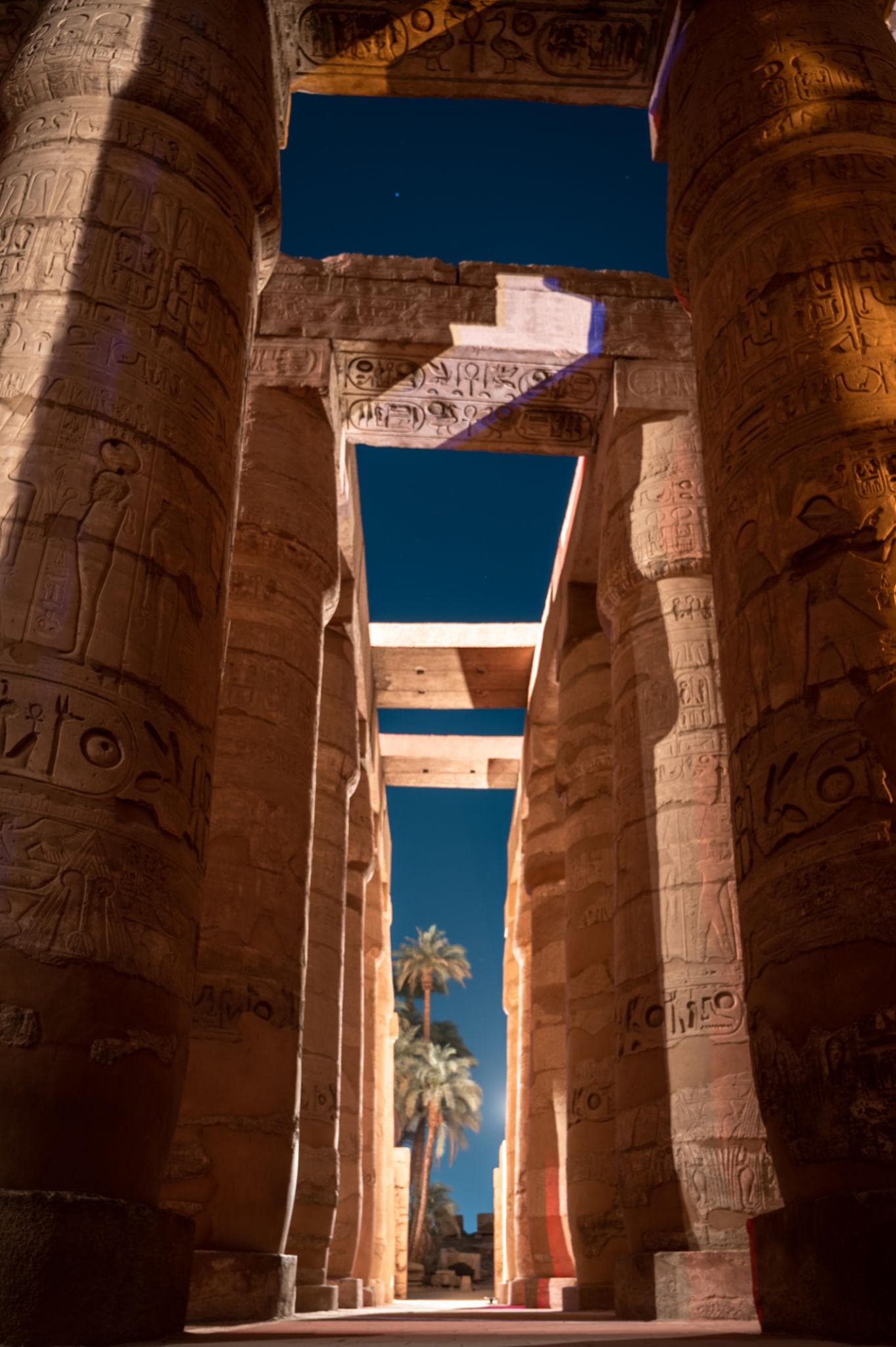
The architectural climax for most visitors is the hypostyle hall, a vast roofed chamber packed with closely spaced columns. The undisputed masterpiece is Karnak's Great Hypostyle Hall, covering around 5,000 square meters with 134 columns, the central twelve rising roughly 21 meters high.
The columns were shaped like papyrus and lotus plants, either with closed bud capitals or open, flaring blossom capitals, evoking the marsh of creation from which the first land emerged. The hall was deliberately dim. A clerestory, where the taller central columns lifted the roof above the side aisles, let slanting light filter in through stone window grilles, so beams would catch the painted reliefs in a shifting, otherworldly glow.
The Sanctuary: Home of the God
At the heart of the temple, on the highest floor and in near-total darkness, sat the sanctuary. Here stood the naos, a shrine of stone or precious wood holding the cult statue of the god. Only the pharaoh, or the high priest acting in his place, could enter.
The daily ritual was intimate and domestic: at dawn the statue was awakened, washed, clothed in fresh linen, anointed with oils, and presented with food offerings, then put to rest at dusk, as though caring for a living being. The Egyptians believed the god's spirit, or ka, actually inhabited the statue, so this care literally kept the cosmos in balance. The smallness and darkness were the point, the concentrated holy core toward which the entire vast structure pointed. Around the sanctuary clustered storerooms for ritual equipment, side chapels for associated deities, and a shrine for the portable sacred barque used to carry the god in procession.
Walls, Reliefs, and Color
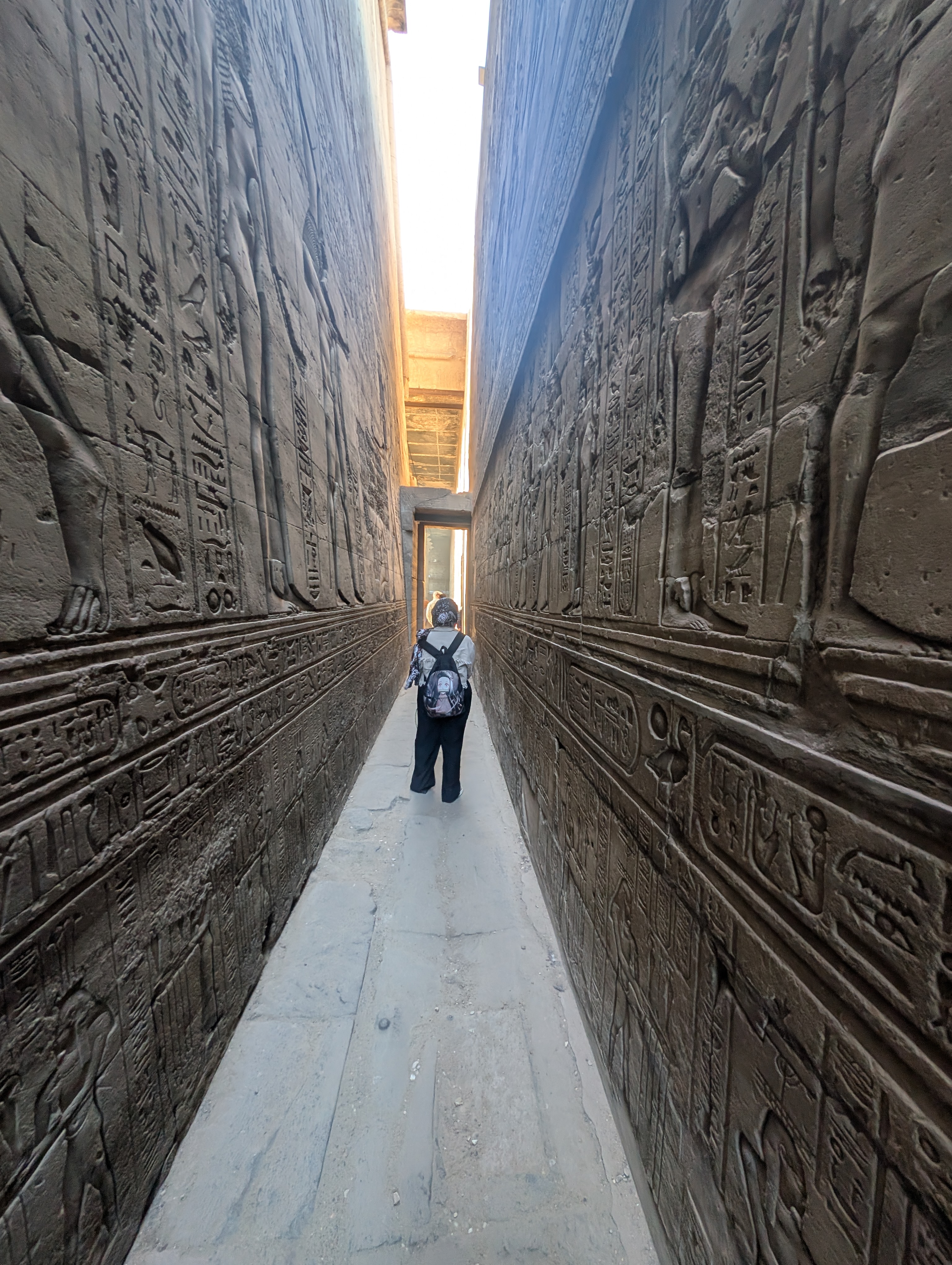
No surface was left blank. Walls, columns, and ceilings were covered in carved reliefs and hieroglyphic texts, originally painted in vivid colors that have largely faded but survive in protected spots, as at Edfu Temple.
The imagery follows strict conventions. Ceilings were painted deep blue with golden stars or vultures, representing the sky goddess Nut. Lower walls often showed the marshy world of plants; upper registers depicted the king before the gods. There are two carving techniques to spot: raised relief (figures stand proud of the background) used in protected interiors, and sunk relief (figures cut into the surface) used on sunlit exteriors where harsh shadows make it more legible.
Other Essential Elements
Beyond the main axis, temples included supporting features that complete the picture:
- **Sacred lake**: a rectangular pool, as at Karnak, used by priests for ritual purification
- **Mammisi (birth house)**: a small temple celebrating the divine birth of a god or the king, common in later temples like Edfu and Dendera
- **Nilometer**: a stair or shaft to measure the Nile flood, vital for predicting the harvest
- **Enclosure wall**: a massive mudbrick wall, often undulating in wavy courses to represent the waters of chaos held back
- **Avenue of sphinxes**: ceremonial approach roads, like the recently restored Luxor-Karnak avenue stretching nearly 3 km
How Temples Evolved Over Time
Temple design was remarkably conservative, yet it did develop. Old Kingdom temples were simpler; the New Kingdom (around 1550 to 1070 BCE) produced the grand pylon-court-hypostyle template at its most ambitious at Karnak and Luxor.
The best-preserved temples, however, are the later Ptolemaic and Roman ones such as Edfu (dedicated to Horus and built between 237 and 57 BCE), Kom Ombo, Philae, and Dendera. Because they are younger, they survive almost complete, with intact roofs and crisp reliefs, making them the ideal places to actually experience the full sequence of spaces. Edfu in particular lets you walk the entire axis from pylon to sanctuary essentially intact.
Practical Tips for Visiting Temples
A little preparation makes temple visits far richer:
- **Timing**: arrive at opening (typically around 6 to 7 am) or late afternoon to dodge heat and crowds; midday sun is brutal at open sites
- **Tickets**: most major temples cost roughly 200 to 600 EGP (around 4 to 12 USD) as of 2026; carry cash
- **Direction of travel**: walk the axis inward as the ancients intended, from pylon to sanctuary, to feel the light fade
- **Light**: the low sun of early morning and late afternoon rakes across reliefs and brings them to life for photography
- **A guide pays off**: an Egyptologist decodes the reliefs and the ritual logic you would otherwise miss
- **Look up**: ceilings often hold the best-preserved color, easy to overlook
Seeing It All Come Together on the Nile
The single best way to understand temple architecture is to visit several in sequence and watch the same vocabulary repeat and vary, from the colossal New Kingdom statements at Karnak and Luxor to the intact later perfection of Edfu and Kom Ombo. The classic route between Luxor and Aswan strings these together exactly as the river always did.
Our Luxor to Aswan Nile cruise glides between these temples over a few unhurried days, with expert guides on board to bring the stone forests and dark sanctuaries to life. By the time you reach Aswan, you will read any Egyptian temple at a glance, recognizing the pylon, the court, the hall, and the holy heart at its core.