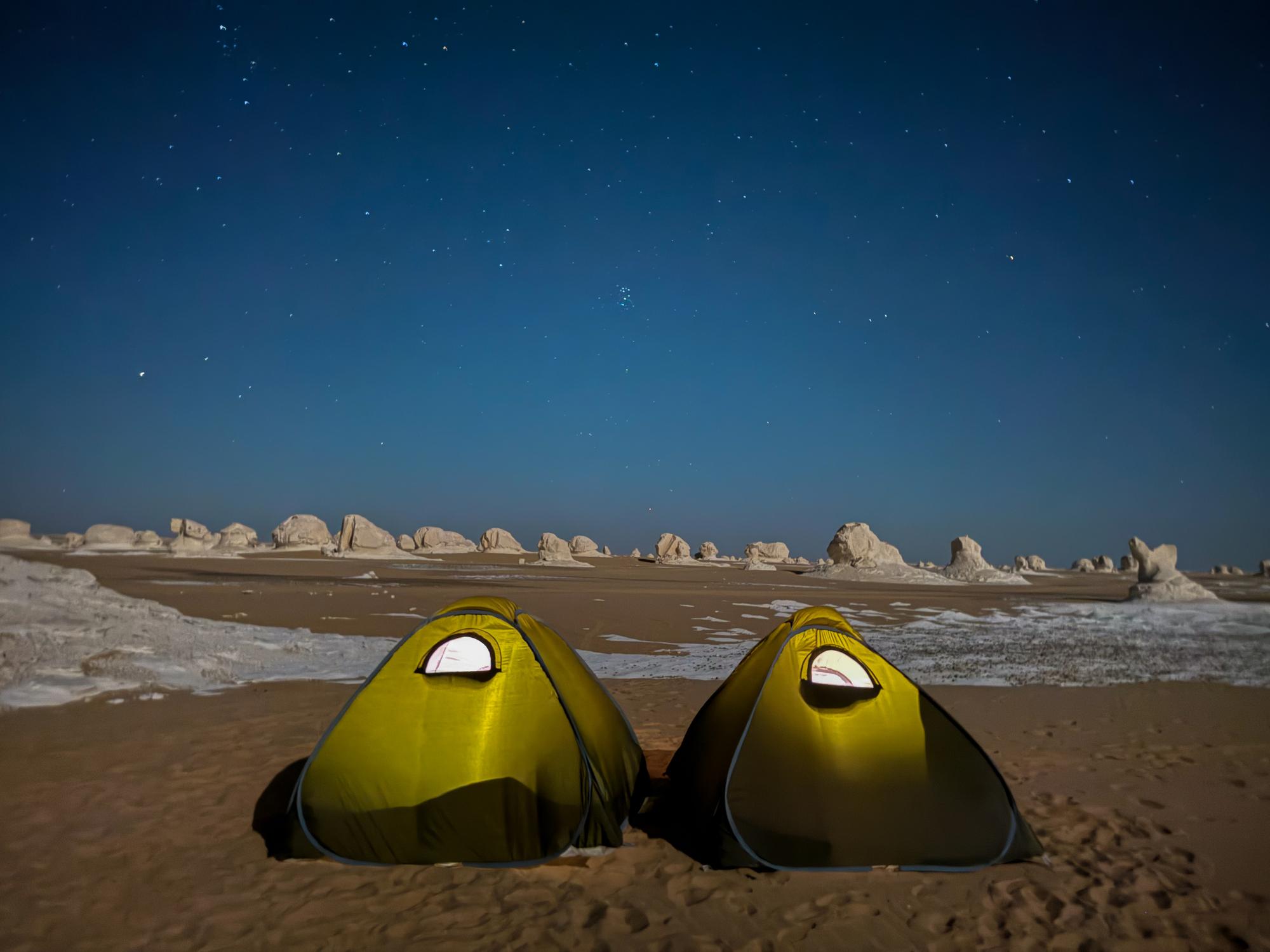
The first thing you find in the Egyptian desert is not the animal but the writing. An hour after sunrise on the sand flats of the Fayoum, the previous night's traffic is still legible: the paired punches of a jerboa landing and pushing off, the drag-line of a darkling beetle, the cloven slots of a gazelle that came down off an escarpment to browse. Rise early enough at a desert camp and you sometimes find the soft prints of a fennec fox that crossed the track a few metres from your tent while you slept.
By ten o'clock the wind has wiped all of it flat, which is why visitors come home from the Western Desert convinced nothing lives there. Egypt is roughly ninety-six percent desert, and that desert is not empty. It is shift-worked. Almost everything with fur has moved its working day into the dark, and much of what has feathers is only passing through.
At a Glance
Best months for mammals: October to April, when nights are survivable and animals range more widely
Best months for birds: late September to November and February to April for migration; December to February for wintering waterbirds
Best time of day: the first and last ninety minutes of daylight, without exception
Highest-odds sites: Wadi El Rayan and Lake Qarun in the Fayoum, White Desert National Park, the high wadis of Sinai's St Katherine Protectorate
Fayoum protected-area entry: roughly 450 to 600 EGP (about 9 to 12 USD) per foreign visitor as of 2026, plus vehicle fees, cash only
Recorded in Egypt: around 480 bird species, roughly 30 snake species, about 200 migratory species passing through twice a year
Realistic expectation: tracks, birds and lizards are near-certain; a fox is a good night's work; a sand cat is a career sighting
Why the Desert Reads as Empty
Nothing here can afford to be visible at noon, so the community goes underground. Fennec dens can run to something like 120 square metres of tunnels. The desert monitor, a lizard averaging about a metre and occasionally approaching two, hibernates from roughly September to April. Water drives the rest: the lesser Egyptian jerboa never drinks at all, taking what it needs from seeds and insects, while the rhim gazelle lets its own body temperature swing by as much as 20 degrees Celsius across a hot day rather than spending water on cooling. These animals are budgeting, not hiding, which is why timing matters more than luck.
The Foxes: Fennec, Rüppell's and Red
Three foxes share the Western Desert. The fennec (Vulpes zerda) is unmistakable: an adult weighs one to 1.9 kilograms, less than many housecats, with ears 9 to 10 centimetres long on a body barely 35 to 40 centimetres. It is strictly nocturnal, omnivorous, listed as Least Concern by the IUCN and legally protected in Egypt.
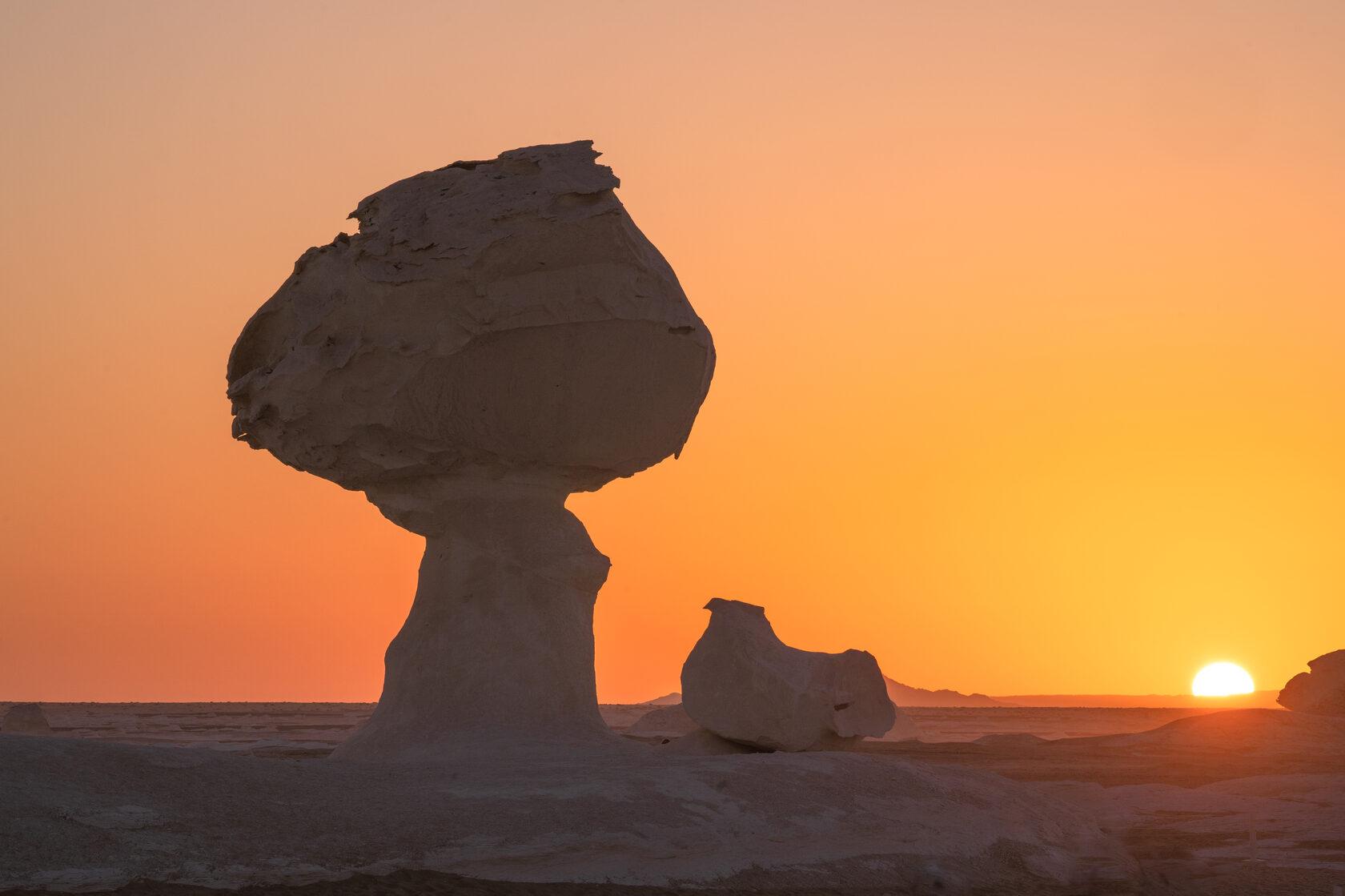
Rüppell's fox (Vulpes rueppellii) is the one most people actually photograph — bigger at around 1.7 kilograms and 66 to 74 centimetres including tail, sandy above and white below. It favours the margins of the Sahara over its dead centre, exactly where tourist routes run, and has been recorded inside White Desert National Park alongside red foxes, jackals, gazelles and sand cats. These foxes learn campsites fast, and a guide who has run the same route for years usually knows which chalk formation has a resident.
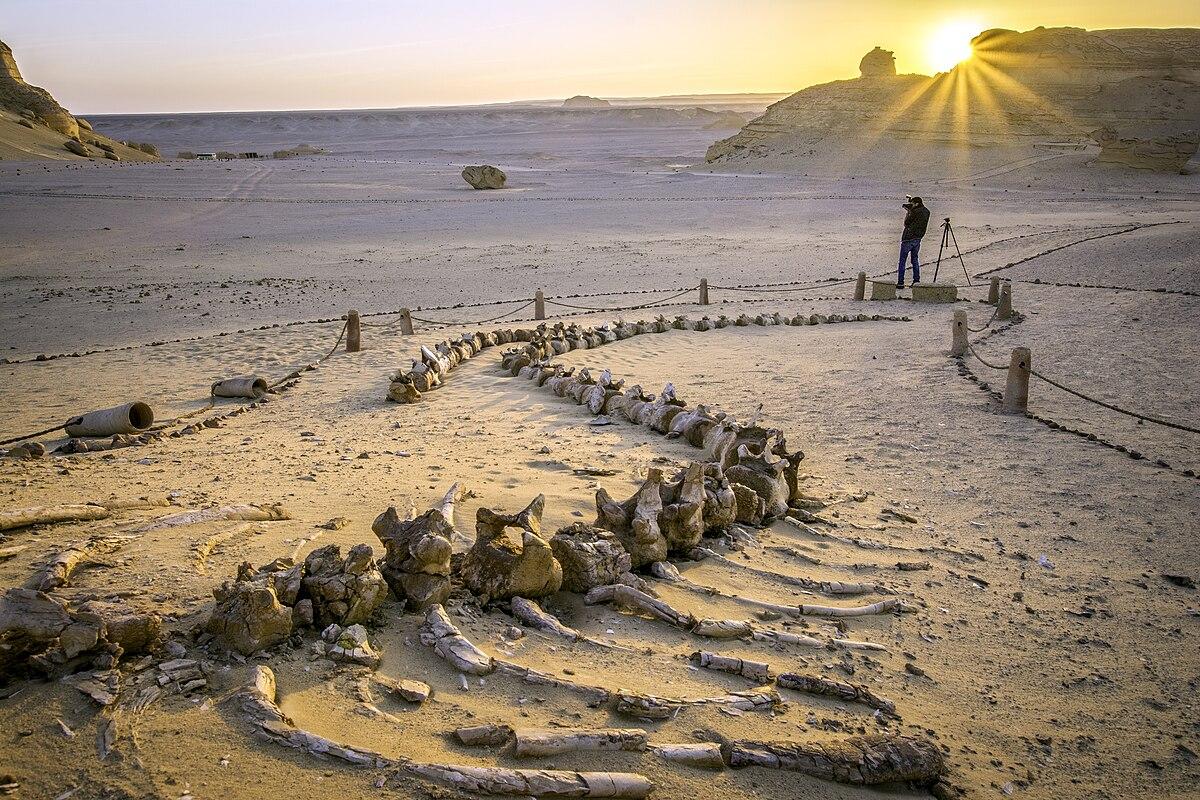
Your best mammal odds in Egypt are, oddly, at a fossil site. UNESCO's description of Wadi Al-Hitan names the fennec as the most commonly observed mammal in the protected area, which makes an early-start Fayoum and Wadi Al-Hitan day trip a genuine wildlife proposition and not only a palaeontological one.
Gazelles: Dorcas and Rhim
Two gazelles remain, and they are not equally troubled. The dorcas gazelle (Gazella dorcas) is the smaller and more widespread, 55 to 65 centimetres at the shoulder, 15 to 20 kilograms, crepuscular, able to live on succulents but not indefinitely without drinking. The IUCN classes it Vulnerable, with roughly 35,000 to 40,000 left across its whole African and Arabian range.
The rhim, or slender-horned gazelle (Gazella leptoceros), is the serious case: pale to the point of looking bleached, adapted to the dune fields themselves, Endangered and on CITES Appendix I, with an IUCN estimate of only 300 to 600 mature individuals worldwide. Both appear on the species list for Wadi El Rayan. You are far likelier to find slots in the sand than the animal that made them, and that is not a failed day.
Barbary Sheep, Ibex and the Animals No Longer Here
The Egyptian desert has an honest gap in it. The addax, the scimitar-horned oryx and the Barbary lion are gone from the Western Desert, and no amount of careful looking will produce them. What remains at the large end is mountain fauna rather than dune fauna.
Barbary sheep (Ammotragus lervia), the aoudad, holds on in the Red Sea Hills and appears on the White Desert list. It is IUCN Vulnerable, ranges from 30 to 145 kilograms, and clears standing jumps of over two metres. Sources genuinely conflict here: the ornate subspecies is described in some accounts as extinct in the wild while simultaneously being reported from Egypt's eastern desert, which tells you how thin the survey data is.
The Nubian ibex (Capra nubiana) is easier to pin down and no more reassuring. Perhaps 4,500 mature animals survive globally; Egypt's share is put at 600 to 1,250 and declining under poaching, concentrated in the Eastern Desert and South Sinai. Its southern stronghold, Gebel Elba, sits inside the disputed Halaib Triangle and is not realistically visitable.
The Night Shift: Jerboas, Sand Cats and the Mongoose
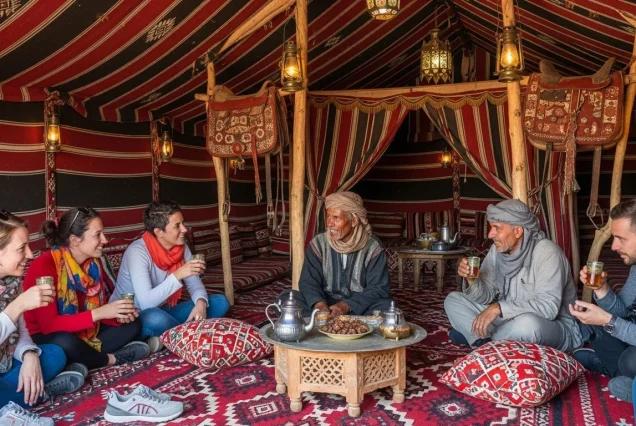
The lesser Egyptian jerboa is the animal you will actually see, usually as a bouncing blur in the headlights: three toes on each hind foot, a long balancing tail, a three-metre bound, and up to ten kilometres of foraging in a night. On a White Desert and Black Desert overnight safari they come to the edge of the firelight with some regularity once camp goes quiet.
The sand cat (Felis margarita) is the prize and almost nobody gets it. At 1.5 to 3.4 kilograms it is barely larger than a housecat, dens underground by day, and the long hair on the soles of its paws both insulates it and blurs its tracks, so even indirect detection is hard. Egyptian records from the Western and Eastern Deserts date from the mid-1980s, and from Sinai from the mid-1990s. The caracal, with its 4.5-centimetre black ear tufts, is likewise nocturnal and rare.
Two more matter for their history. The Egyptian mongoose hunts venomous snakes with real resistance to their venom, and mummified mongooses were excavated from the catacombs at Saqqara. The African wolf (Canis lupaster) was filed as a golden jackal until genetic work published in 2015 moved it decisively closer to the grey wolf; the large, grey, short-eared Egyptian form is almost certainly the animal behind Anubis and Wepwawet.
Insider Tip: How to Actually See a Desert Mammal
Sit still and switch off. The commonest mistake is treating a desert night as a driving activity. Ask your guide to park, kill the engine and lights, and give it forty minutes of silence somewhere with vegetation or a rocky edge rather than open dune, which most species shun because there is nothing to eat there.
Carry a red-filtered headlamp rather than a white one. Red light preserves your night vision, disturbs animals far less, and keeps you welcome among photographers on any trip where desert stargazing is part of the appeal. For stars, go near new moon; for mammals a half moon is better, because you see further and so do they. Then walk the same fifty metres of track at first light. Tracks are data, and a good guide will read them and tell you what to wait for tonight.
A Warning About Vipers and Scorpions
Honest and calm are both required here. Egypt has roughly 30 snake species, and the two that matter in the desert are the Saharan horned viper (Cerastes cerastes) and the Egyptian saw-scaled viper (Echis pyramidum). The horned viper, known locally as el-torisha, runs 30 to 60 centimetres, sidewinds, and ambushes prey while buried in sand beside rocks or vegetation; the horns above the eyes are absent in some individuals. Saw-scaled vipers are the genus responsible for more snakebite deaths worldwide than any other. Both are nocturnal.
The deathstalker scorpion (Leiurus quinquestriatus) is yellow, 30 to 77 millimetres, and common. A sting on a healthy adult is intensely painful but very rarely fatal; young children, the elderly and the immunocompromised are at real risk and need hospital care.
The mitigation is unglamorous and effective. Shake out boots and sleeping bags every single time. Never put bare hands or feet where you cannot see. Wear closed shoes after dark and carry a torch to the edge of camp. Know how far the nearest hospital is before you leave the asphalt, which is one of several reasons to read up on desert safety and permits first.
Lizards, Tortoises and One Very Small Butterfly
Reptiles are the reliable daytime wildlife: agamas basking and changing colour on rocks, geckos working the walls of every rest house after dark, and the desert monitor if the season is right. Counts differ between sources — the Ramsar listing for Wadi El Rayan gives 11 reptile species while UNESCO's description of the neighbouring whale valley cites 19 — a fair indication of how patchy Egyptian survey coverage still is.
The Egyptian tortoise (Testudo kleinmanni) is the saddest entry in the book. The smallest tortoise in the Northern Hemisphere, it is Critically Endangered and effectively gone from Egypt; a 2006 survey found perhaps ten wild individuals near Lake Bardawil. Around 7,500 survive overall, mostly in Libya, and the pet trade did most of the damage.
Sinai holds the strangest endemic. The Sinai baton blue is among the smallest butterflies on earth, Critically Endangered, restricted to the mountains around St Katherine and entirely dependent on Sinai thyme. Adults fly from April to June, so a spring Mount Sinai sunrise trek coincides with the only window in which it exists as an adult insect.
The Migration Overhead
Egypt's real spectacle is not on the ground. The country sits astride one of the busiest migration corridors on the planet, and around 200 migratory species pass through twice a year out of roughly 480 recorded nationally.
Soaring birds cannot cross open water, because thermals form only over land, so storks and raptors funnel down the Levant and squeeze around the head of the Red Sea. About 530,000 white storks use this eastern route, bypassing the Sahara by following the Nile valley south; they move in August and September and return in late March and April. Steppe eagles, now Endangered, cross near Suez in spring — a 1981 count logged up to 65,000 birds there — with the autumn peak in late October. The Egyptian vulture, famous for cracking ostrich eggs by throwing stones with its bill, passes in far smaller numbers than it once did: European and Middle Eastern populations in 2001 were about half their 1980 level.
Flamingos and Winter Waterbirds in the Fayoum
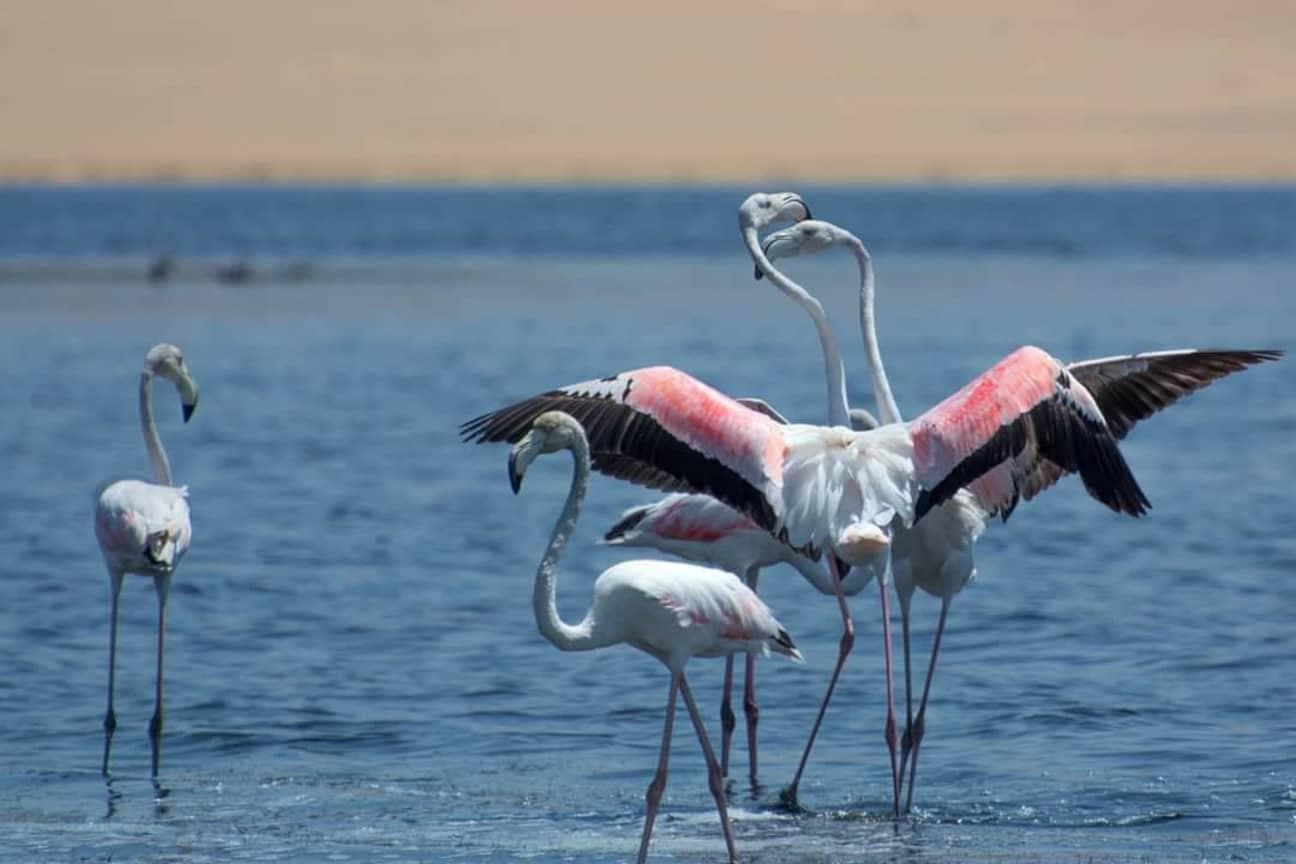
For most visitors the practical birding is in the Fayoum depression, about 100 kilometres south-west of Cairo. Lake Qarun is 202 square kilometres of hypersaline water sitting 43 metres below sea level, a Ramsar site since June 2012, with something like 88 waterbird species recorded. Winter brings grebes, egrets, shelduck, teal, wigeon, pintail and shoveler; collared pratincoles, Kentish plovers and little terns breed there.
Greater flamingos (Phoenicopterus roseus) are what people come for, standing 110 to 150 centimetres and filter-feeding the brine shrimp and algae that give them their colour. Be realistic: numbers on Egypt's saline lakes swing hard from winter to winter, so treat them as a probability rather than a guarantee. December to February gives the best chance, in the first hour of light, from the quieter southern and western shores.
Where to Go and When
The Fayoum: best all-round option, two hours from Cairo, pairing waterbirds at the lakes with fennec and gazelle country at Wadi El Rayan. January highs sit near 21 degrees Celsius (70 Fahrenheit) with lows around 6 (43); by August the high is 36 (97) and wildlife watching becomes pointless.
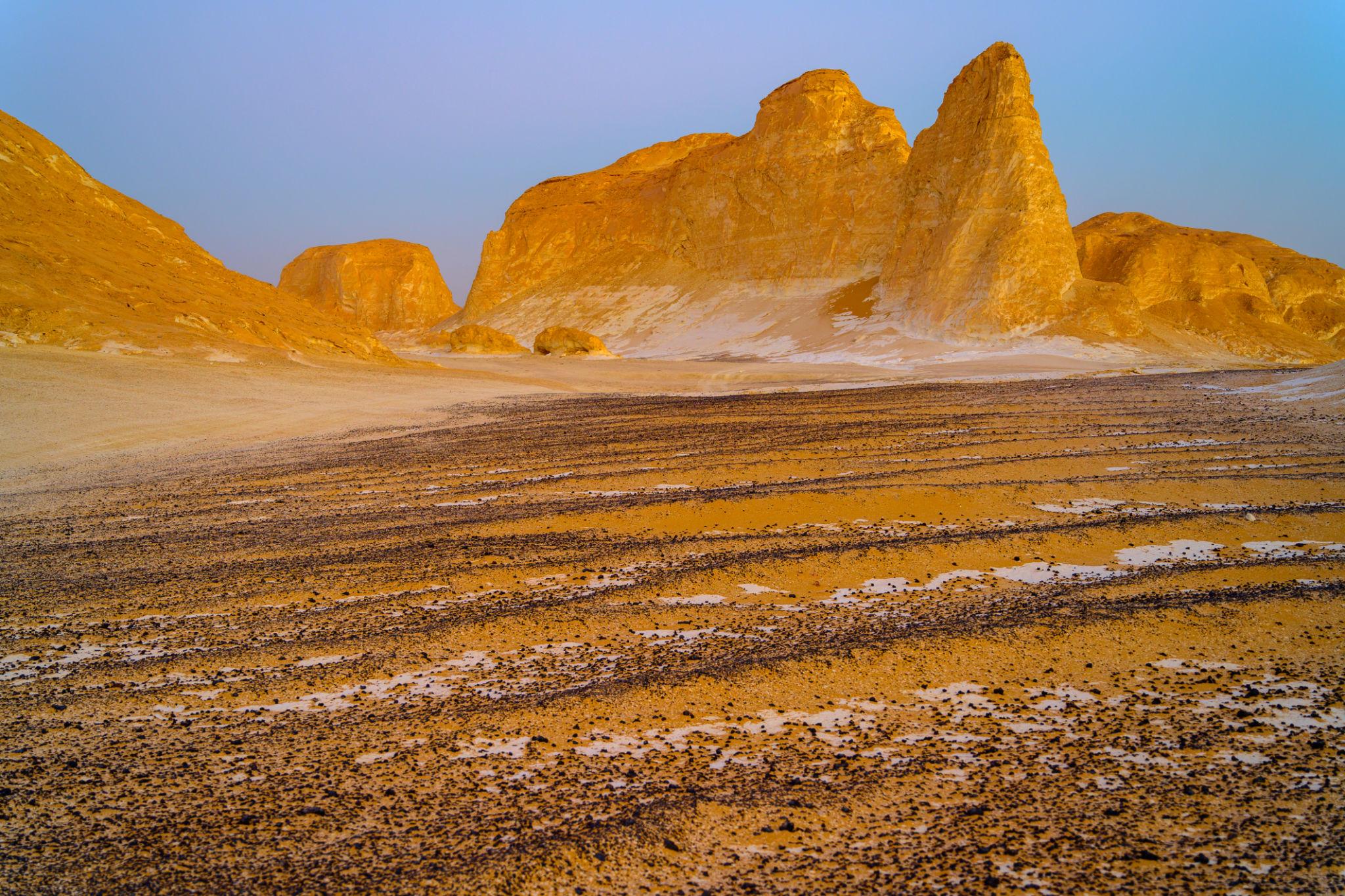
White Desert and Farafra: best for nocturnal mammals and the cleanest tracking substrate. Farafra averages a January high of 20 degrees (68) against a low of 4 (39), a July high near 38 (100), and about 2 millimetres of rain a year.
Siwa: salt lakes, springs and the edge of the Great Sand Sea, 560 kilometres from Cairo. A Siwa Oasis overnight safari reaches dune country where rhim gazelle sign turns up.
South Sinai: the only realistic ibex habitat a visitor can reach, inside a 640-square-kilometre protectorate holding 27 mammal species and 46 reptile species, 15 of them found nowhere else in Egypt.
Timing: our month-by-month weather guide has the full picture, but November to March covers comfort and wintering birds.
The Conservation Reality
Egypt's protected-area network is real, but enforcement is thin and the pressures are large. The clearest example is the trapping of migrants along the Mediterranean coast, where mist nets are strung across the shoreline each autumn. Published estimates for the 2012 season put around 3.4 million birds taken in northern Sinai alone, with a plausible Egypt-wide figure as high as 12.9 million for that single autumn. Quail are the target; songbirds and turtle doves die in the same nets.
Inland, the pattern is poaching of gazelle and ibex, competition from livestock and habitat conversion at oasis margins. Lake Qarun has its own slow crisis of rising salinity, agricultural runoff and an invasive parasitic isopod hitting the fishery. None of this is a reason to stay away: entry fees are one of the few funding streams these reserves have.
Planning a Wildlife-Minded Desert Trip
Build the trip around dawn and dusk rather than distance covered, and give any single area two nights instead of one. A Fayoum weekend pairing the lakes at first light with an afternoon in Tunis village and a full day at the whale valley will show you more living animals than a week of long transfers; our guide to Wadi Al-Hitan covers the fossil side of that day.
Bring binoculars — almost nobody does, and they are the difference between a distant pale shape and a rhim gazelle. Ask your operator whether the guide knows the local fauna or only the route, because those are not the same skill. Most nights the desert gives you tracks, a sky full of stars and a jerboa. A few nights it gives you a fox sitting fifteen metres from the fire, looking straight back at you, and that is worth going out for.