Almost everything that goes wrong in the Egyptian desert goes wrong slowly and predictably. A vehicle buries itself to the axles in soft sand at two in the afternoon. Somebody who has been sipping half a litre an hour in 43C (109F) heat stops sweating and becomes confused. A group without paperwork is turned around at a checkpoint 200 km from anywhere. None of it is dramatic, and almost all of it is decided before you leave Cairo, by who you booked with and what they loaded into the vehicle.
The Egyptian state takes a firmer view of its deserts than most visitors expect. Large parts of the Western Desert, the Sinai interior and the far southwest are restricted, patrolled and, in places, genuinely dangerous for reasons that have nothing to do with the terrain. Off-road travel anywhere requires a permit and a qualified guide, and the requirement is not a formality that a confident driver can quietly ignore.
This is the unglamorous half of desert travel: which permits exist and who issues them, how long they take, what belongs in a properly equipped vehicle, how heat actually injures people, what your insurance almost certainly excludes, and the specific questions worth asking an operator before money changes hands.
At a Glance
Permit for off-road travel: required. UK government advice states plainly that if you are travelling off road you should use a qualified guide and get a permit from the Ministry of Interior
Lead time: a day or two for the standard oases and the White Desert, since passport details are filed in advance; three months or more for the deep southwest
Vehicle: 4WD with an experienced local driver, and two vehicles for anything beyond a well-travelled day route
Water: at least 4 to 5 litres per person per day for drinking, plus a separate vehicle reserve nobody touches
Hardest months: June to September, when Kharga averages around 42C (108F) by day and has recorded 50.3C (122.5F)
Advisory status as of 2026: the FCDO advises against all but essential travel to the Western Desert, with the main oases and the Giza to Farafra corridor specifically excepted
Closed without special clearance: within 20 km of the Egypt-Libya border, North Sinai, and the deep southwest near the Libyan and Sudanese frontiers
Operator check: a Ministry of Tourism licence, verifiable against the Egyptian Travel Agents Association register
Emergency numbers: 112 unified, 123 ambulance, 122 police, 126 tourist police, none of which work without signal
Three Kinds of Desert Trip, Three Levels of Risk
Almost all desert travel in Egypt falls into one of three brackets, and conflating them is the root of most bad decisions.
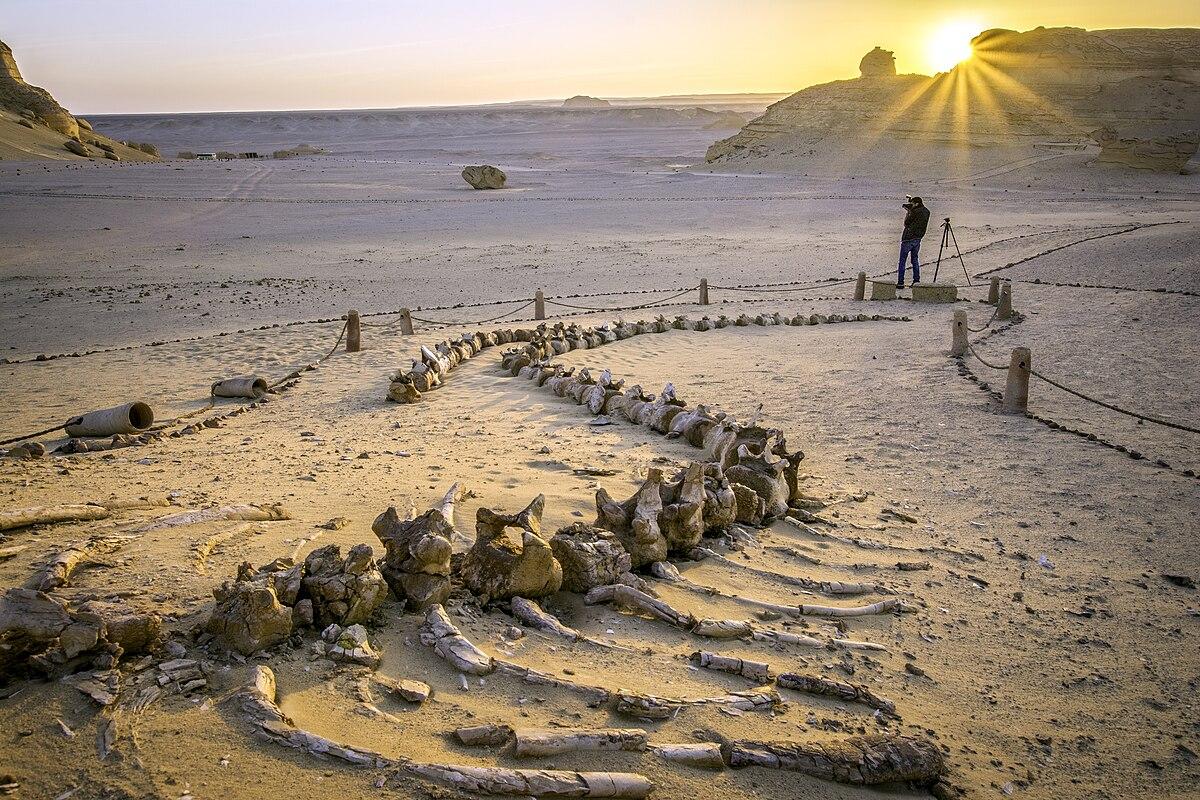
The first is a day trip on tarmac with a short excursion onto sand: the Fayoum lakes, a run to the Bahariya hot springs, a couple of hours in the dunes outside Siwa. Our Fayoum and Wadi El-Hitan day trip sits here. You are never more than an hour from a road, a phone signal and a hospital.
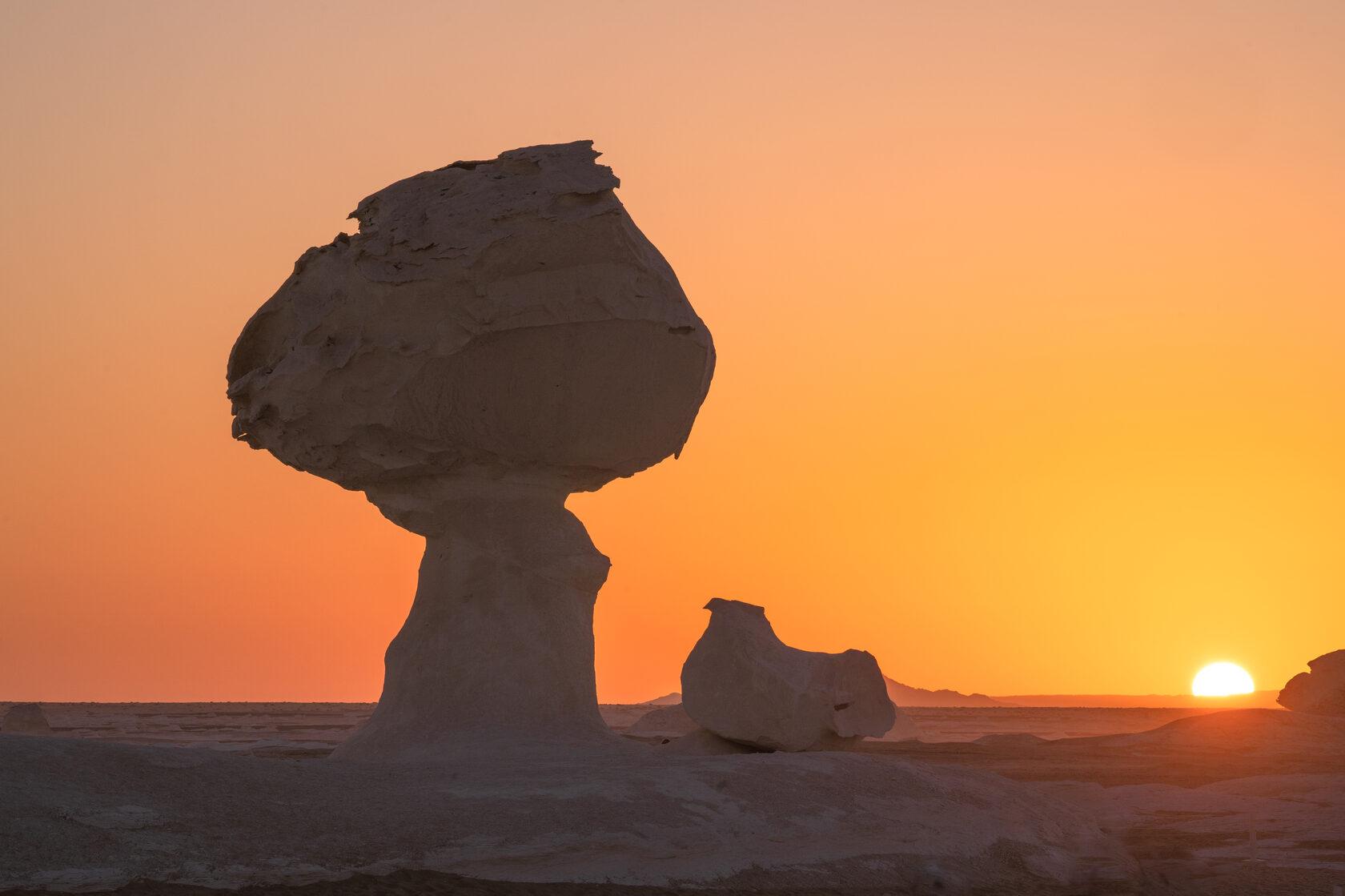
The second is the standard overnight safari: a night camping in the White Desert National Park or in the sand sea west of Siwa Oasis. This is what most visitors mean by a desert trip, and it is genuinely low risk when run properly, which is what our White Desert and Black Desert overnight safari and the longer three-day Siwa adventure are built around. It still involves being hours from help with no mobile coverage.
The third is expedition travel: multi-day crossings of the Great Sand Sea, the Gilf Kebir plateau, Jebel Uweinat. Different permits, different vehicles, different money, and no realistic rescue if things go wrong. Our guides to the Great Sand Sea and Gilf Kebir cover what those journeys involve.
Who Issues Desert Permits, and For What
There is no single desert permit. What you need depends on where you are going and which authority controls it.
Ministry of Interior: the general permit for off-road travel, filed by a licensed operator using passport scans. Also the body issuing permits for 4WD movement through the Suez crossing into Sinai
Ministry of Tourism and Antiquities: licences the tour company and the guide; ticketed archaeological sites in the oases are separate, at around 100 EGP for foreign visitors in Bahariya as of 2026, roughly 2 USD
National park administration: the White Desert has its own protected-area fee, most recently reported at around 5 USD per person per day with a similar charge per vehicle and a small extra levy for overnight camping. Figures published by different sources vary, and tours normally bundle this into the price
Ministry of Defence and the Border Guard Force: required for Gilf Kebir, Jebel Uweinat and anything near the Libyan or Sudanese frontiers, usually alongside an environmental permit
Tribal permission: not a government document, but real. The Red Sea Mountain Trail, a 170 km circuit of about 14 days in the Eastern Desert, requires the agreement of the Khushmaan sheikh and a Khushmaan guide. Bedouin guides are mandatory, not advisory
In South Sinai the rule is enforced at the trailhead rather than on paper. A licensed Bedouin guide is required for the ascent of Mount Sinai and is hired at the St Catherine checkpoint; nobody is permitted on the mountain alone at night, which is why our Mount Sinai sunrise trek runs with local guides throughout.
Warning: Border Zones, Closed Roads and Why the Rules Are Strict
Check your own government's current advice before you book, because these designations move. As of 2026 the UK Foreign, Commonwealth and Development Office advises against all travel to within 20 km of the Egypt-Libya border, excepting the town of El Salloum, and against all travel to North Sinai. It advises against all but essential travel to the Western Desert, then carves out the parts most visitors actually want: the road between Giza and Farafra and the land within 50 km either side of it, the oasis towns, the White and Black Deserts, Siwa and Faiyum. It also advises against all but essential travel on the road between Al Bawiti and Siwa, so the two flagship desert destinations cannot be chained together by driving west. Siwa is reached from the Mediterranean coast, which is what a Cairo to Siwa transfer does.
The US State Department keeps Egypt at Level 2 overall while designating North and Middle Sinai and parts of the Western Desert as do-not-travel, citing remoteness and smuggling, and advising that anyone going should use a professionally licensed tour company.
The strictness has a specific cause. On 13 September 2015, Egyptian security forces attacked a tourist convoy in the Western Desert, killing eight Mexican visitors and four Egyptians and injuring ten more. Accounts still conflict: Egyptian authorities said the group was in an off-limits area, survivors and the Mexican government said the party held permits and was expecting a police escort, and a subsequent Egyptian investigation placed responsibility on the travel agency and local officials. Whichever version you accept, the lesson is the same. Being where your paperwork says you will be is not bureaucracy. It is how the people with aircraft know you are not a smuggler.
How Much Lead Time Permits Require
For the ordinary oasis and White Desert circuit, operators file passport details in advance and the process takes a day or two. Same-day requests routinely fail, which is the single most common reason a walk-up booking in Bawiti or Siwa collapses. Send scans of your passport photo page when you book, not when you arrive.
The deep southwest is a different order of magnitude. Military and border-guard clearance for Gilf Kebir and Jebel Uweinat takes at least three months, expedition operators typically begin planning six to twelve months out, and a military liaison officer is collected before the party heads deeper, partly to ensure nobody strays into Sudan or Libya. Requirements shift with the regional political climate, so a route approved last season is not automatically approved this one.
Why Self-Drive Into the Deep Desert Goes Wrong
People do hire a car in Cairo and drive to Bahariya. That part is legal, easy and paved. The trouble starts at the sand line.
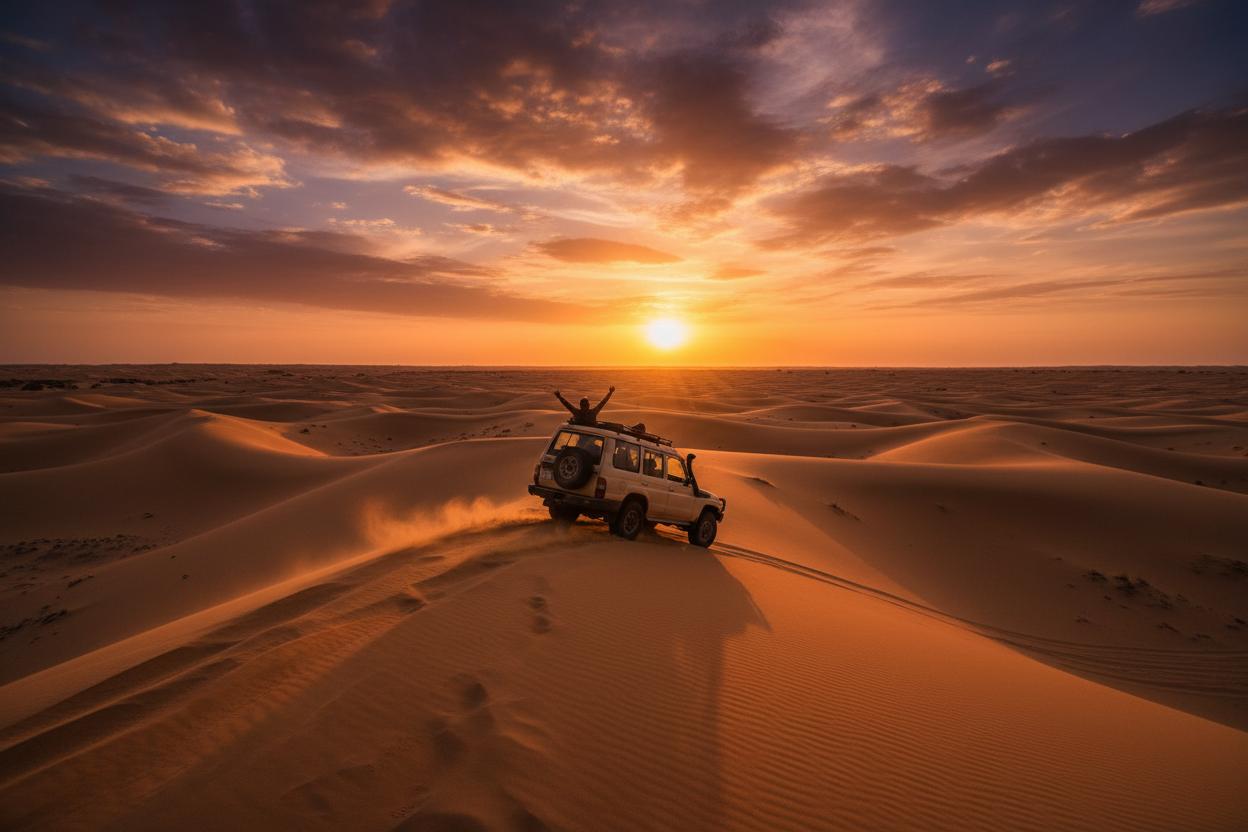
Soft sand punishes small errors. Tyres are deflated to float the vehicle rather than dig in, which makes the compressor that reinflates them the piece of kit that gets you home, not an accessory. Fuel consumption in soft sand can approach double the road figure, so range calculations made on tarmac are wrong. Cresting a dune ridge without knowing whether the far side drops two metres or twenty is how vehicles roll, and 4WD collisions with dune faces produce exactly the injuries you would expect: whiplash, chipped teeth, concussion. Ridge lines also move, so a line driven last month may not exist now.
Then there is the arithmetic of being stuck. One vehicle alone, with no second vehicle to recover it, converts a two-hour inconvenience into a survival situation. Every serious desert operator travels in pairs or has an explicit written plan for what happens when one vehicle fails.
What a Properly Equipped Desert Vehicle Carries
This is the checklist worth running past an operator. None of it is exotic, and its absence is diagnostic.
- A long-handled shovel, sand ladders or recovery boards, a rated tow strap and proper recovery points
- A working compressor and a tyre pressure gauge, plus two spare wheels and puncture repair kit
- A jack with a base plate wide enough not to sink into sand
- Spare fuel in secured jerricans, calculated for the route with a genuine reserve
- Water well beyond the plan, carried separately from what people are drinking that day
- GPS with the route loaded, and a paper map and compass as backup, because electronics fail
- A satellite phone or satellite messenger, and a route plan left with somebody not on the trip
- A comprehensive first aid kit including oral rehydration salts, and a stated evacuation plan
- Seatbelts that work in every seat, and a driver who insists they are used
Pro Tip: Look at the Kit Before You Hand Over Money
Ask to see the vehicle the day before, not the morning of. Open the back. If there is no shovel, no compressor and no recovery boards, the price you were quoted is cheap for a reason, and the reason is that the operator has priced in getting lucky. Ask how many vehicles are going and what happens if one breaks. Ask how much water is aboard and where the reserve is kept. A good driver will enjoy the questions and show you everything; anyone who bristles has told you what you needed to know. This five-minute check is worth more than any online review, and it costs nothing.
Heat Illness and How Much Water Is Enough
Heat is what actually puts travellers in hospital, and it is seasonal in a way the scenery is not. Kharga averages around 42C (108F) in June and July against roughly 22C (72F) in midwinter; Siwa averages 37.5C (100F) in July with a record of 48.2C (119F). Most visitors arrive unacclimatised, having flown in from a temperate summer three days earlier, and acclimatisation takes several days of graded exposure that a two-night safari does not provide.
Learn the difference between the two conditions. Heat exhaustion presents as heavy sweating, weakness, dizziness, nausea, headache and cool, clammy skin, and responds to shade, rest lying down, and fluids containing salt and sugar. Heat stroke is a medical emergency: a core temperature above 40C (104F), skin that may be hot and dry, and above all confusion, irritability or irrational behaviour. Mental change is the signal that matters. Cool the person aggressively and get them out, and do not wait to see whether it passes.
On water, the US National Park Service figure for desert conditions is at least one gallon, roughly 4 litres, per person per day, with around half a litre per hour during activity. In the Western Desert in shoulder season, 4 to 5 litres per person per day is a sensible planning number, more in summer, and water alone is not enough when you are sweating hard for hours. Add electrolytes or salty food. Our health and medical guide to Egypt covers rehydration salts and what to carry. The other half of the answer is scheduling: move early and late, rest between roughly 11am and 4pm, and treat any itinerary that has you walking dunes at midday in July as badly designed.
Good to Know: Satellite Phones, Drones and Customs
Two categories of equipment cause trouble at Egyptian airports. Satellite phones and radio equipment can be confiscated on arrival without prior clearance from the telecoms authority, which is why expedition operators generally hold their own licensed units rather than expecting clients to bring one. If you own a satellite messenger and want to bring it, raise it with your operator well in advance rather than discovering the rule at customs.
Drones are stricter still. Importing or operating one without Ministry of Defence approval is a criminal offence, approval for tourists is effectively unobtainable and reviews run to months, and confiscation at Cairo, Hurghada and Sharm airports is routine even when the device is declared. Officers issue a receipt and store the drone until departure, usually for a fee. Penalties on paper run to imprisonment and fines of 5,000 to 50,000 EGP, roughly 100 to 1,000 USD at the August 2026 rate of about 50 EGP to the dollar. Leave it at home.
Navigation, Old Ordnance and Ground to Leave Alone
Navigation failure in the Western Desert is rarely about getting lost in the romantic sense. It is about a track that forks four times in 30 km, none of the forks being signed, and a phone that lost signal an hour ago. Carry a paper backup and a driver who has driven the corridor before, and do not rely on a single device.
The unexploded ordnance problem is real but geographically specific, and it is worth being precise because vague warnings cause people to discount the accurate ones. Egypt's Second World War contamination is concentrated in the northern coastal belt: the ground between the Qattara Depression and El Alamein, and the areas around Marsa Matruh, Sidi Barrani and Sallum near the Libyan border. Estimates commonly cited put around 17 million mines and items of unexploded ordnance in the Western Desert, with Egyptian government figures for the whole country running higher still, and there have been more than 8,000 casualties since 1945. The maps are poor. Britain handed over its wartime minefield records in 2016, and Egyptian engineers described them as sketch maps with much of the ground mined at random; German and Italian records are equally incomplete.
What this means in practice is narrow. The White Desert, the oasis circuit and the Siwa sand sea are not in the mined belt. The coastal route between Alexandria, Marsa Matruh and the Libyan frontier is. On that stretch, stay on made surfaces, do not walk into fenced or signed ground, and do not pick up metal objects, however interesting. The same instinct applies anywhere in the desert to shell casings and rusted fragments from the 1940s campaigns.
What Travel Insurance Usually Excludes
Read the policy rather than assuming. Three exclusions catch desert travellers.
The first is activity-based. Off-road 4WD excursions, quad biking and sandboarding are frequently outside standard cover; industry surveys have found only a tiny minority of single-trip policies include quad biking as standard. An adventure-activities upgrade is usually cheap and usually necessary.
The second is territorial, and it is the one that voids everything. Most policies exclude claims arising in areas your own government advises against travelling to. If the FCDO advises against all but essential travel to the Western Desert, cover in the excepted zones is often fine and cover outside them is often not, and the boundary matters. Ask your insurer in writing which side of the line the White Desert falls on.
The third is the evacuation limit. Repatriation from a desert camp is a road journey of several hours to an oasis clinic before any question of an air ambulance arises. Check the medical evacuation and repatriation ceiling on your policy, not just the medical expenses figure.
Questions to Ask Before You Book
- Is the company licensed by the Ministry of Tourism, and what is its licence number? The Egyptian Travel Agents Association, established by presidential decree in 1968, maintains a searchable register of licensed companies, and inbound tour operators sit in the top category, which carries a financial guarantee of 200,000 EGP
- Who files the permit, and by when do you need my passport details?
- How many vehicles travel together, and what is the plan if one fails?
- What recovery equipment is carried, and can I see it?
- Is there satellite communication, and who holds the emergency contact for this trip?
- Is the guide a licensed guide or a driver? Both are legitimate roles, but they are not the same qualification
- How much water per person is carried, and what is the reserve?
- What is the cancellation policy if the permit does not come through, or if a khamsin closes visibility?
Getting the Balance Right
None of this should read as a reason to stay on the Nile. A properly run overnight in the White Desert is one of the safest adventurous things you can do in Egypt, and the Valley of the Whales is reachable on a day trip that never leaves easy ground. The risk in Egyptian desert travel is concentrated almost entirely in two decisions: going somewhere your paperwork does not cover, and going with somebody who has not equipped for the day when things do not work.
Get those two right and the rest is packing, which our desert safari packing guide covers in detail. If you are weighing a route and are unsure which permits it needs or how much lead time to allow, tell us where you want to go and we will tell you plainly what is possible in the time you have and what is not.