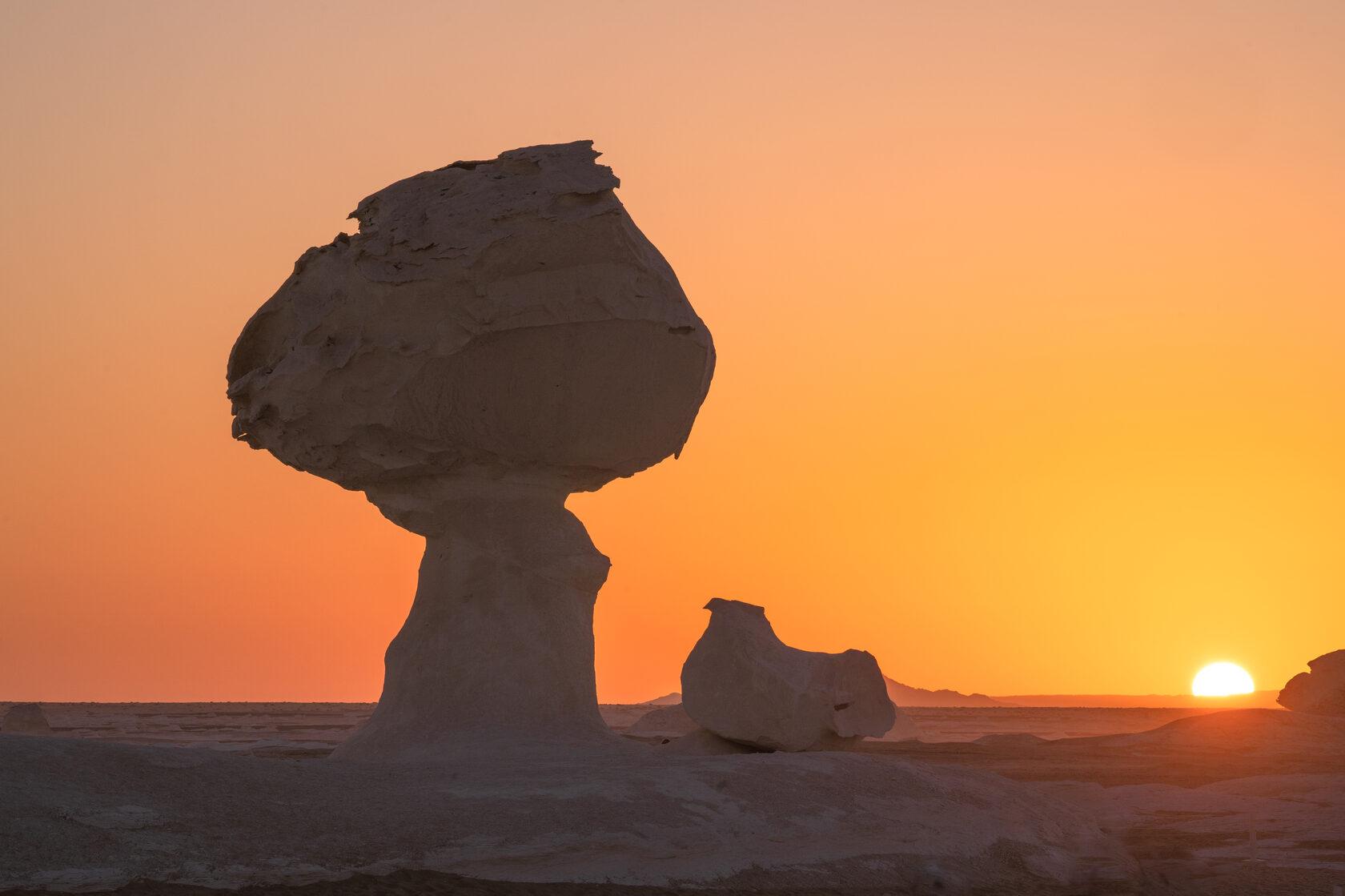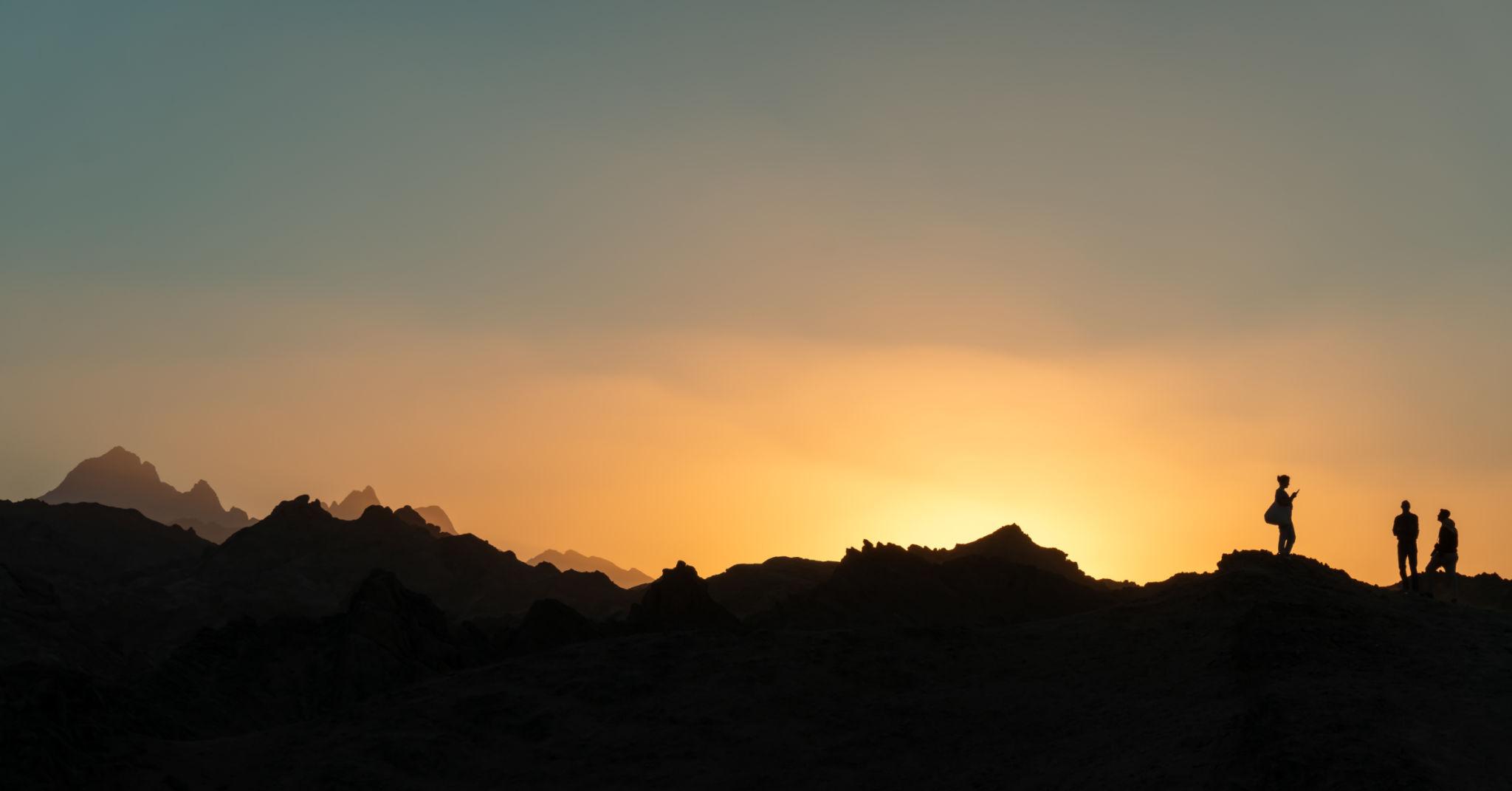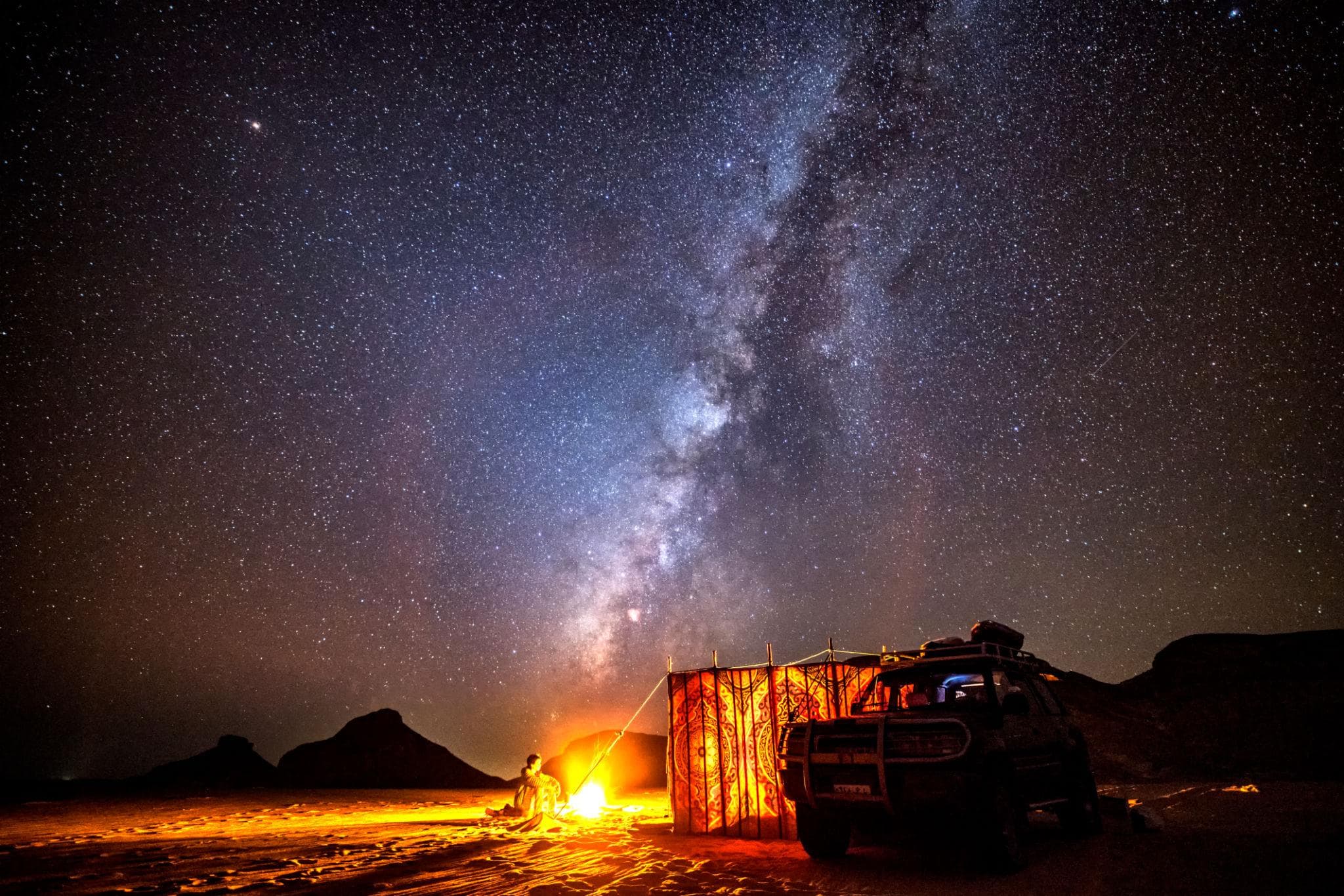
The moment that converts most people to the Egyptian desert is not the chalk formations. It is the moment the driver switches off the headlights. Inside White Desert National Park, whose boundary begins about 45 km north of Qasr al-Farafra and some 570 km southwest of Cairo, there is no permanent electric light for an hour's drive in any direction. When the engine stops and your eyes adjust, the sky acquires texture: the Milky Way becomes a structured band with dark rifts and bright knots, and on the best nights it throws a shadow on white ground.
Egypt is not marketed as a stargazing destination. There is no certified dark-sky reserve here that we could trace, and no astro-tourism industry. What it has instead is a land area roughly 96 per cent desert, a latitude of 27 to 29 degrees north that lifts the centre of our galaxy clear of the horizon, and cloudless nights most of the year. The infrastructure exists already; it is simply sold as a desert safari, which means the whole skill lies in choosing the date.
At a Glance
Darkest accessible skies: White Desert National Park, and the Great Sand Sea west of Siwa
Closest dark sky to Cairo: Wadi El Rayan and the Fayoum dunes, around 3 hours out
Best months for comfort: October to April
Best months for the Milky Way core at a civilised hour: March to May, September to early October
Core altitude: about 34 degrees above the southern horizon at White Desert latitude, against under 10 from London
Moon: the four or five nights either side of new moon
Typical cost: roughly 120 to 220 USD (about 6,000 to 11,000 EGP) per person for a one-night White Desert safari from Cairo, at about 50 EGP to the dollar in August 2026
Non-negotiable kit: a red-mode headlamp, warm layers, a tripod
Why the Western Desert Is So Dark
Light pollution is a function of population, and the Western Desert has almost none. Farafra has an estimated 5,000 inhabitants; Bahariya Oasis, 370 km southwest of Cairo, holds around 33,000, nearly all in El Bawiti. Between them lies about 200 km of nothing.
Nobody publishes sky-quality-meter readings out here, so any Bortle claim you read, ours included, is inference, not measurement. But the conditions for a Bortle 1 or 2 sky are present: no settlement within tens of kilometres, no industry, no highway lighting, almost no moisture. On that scale the naked eye reaches magnitude 7 and beyond, and the White Desert is the best place in Egypt to catch the Milky Way casting a shadow, because the ground is white.
Where to Go
The White Desert: the easiest very dark sky in Egypt to reach. The park covers about 300 km² and has been protected since 2002. The usual route in is an overnight White Desert and Black Desert safari staged out of Bahariya Oasis, four to five hours from Cairo.
The Great Sand Sea, west of Siwa: some 72,000 km² of dune ridges straddling the Egyptian and Libyan sides of the border. Siwa lies 560 km from Cairo, 50 km from the frontier and 19 m below sea level, and a Siwa overnight desert safari usually camps at the sand sea's edge.
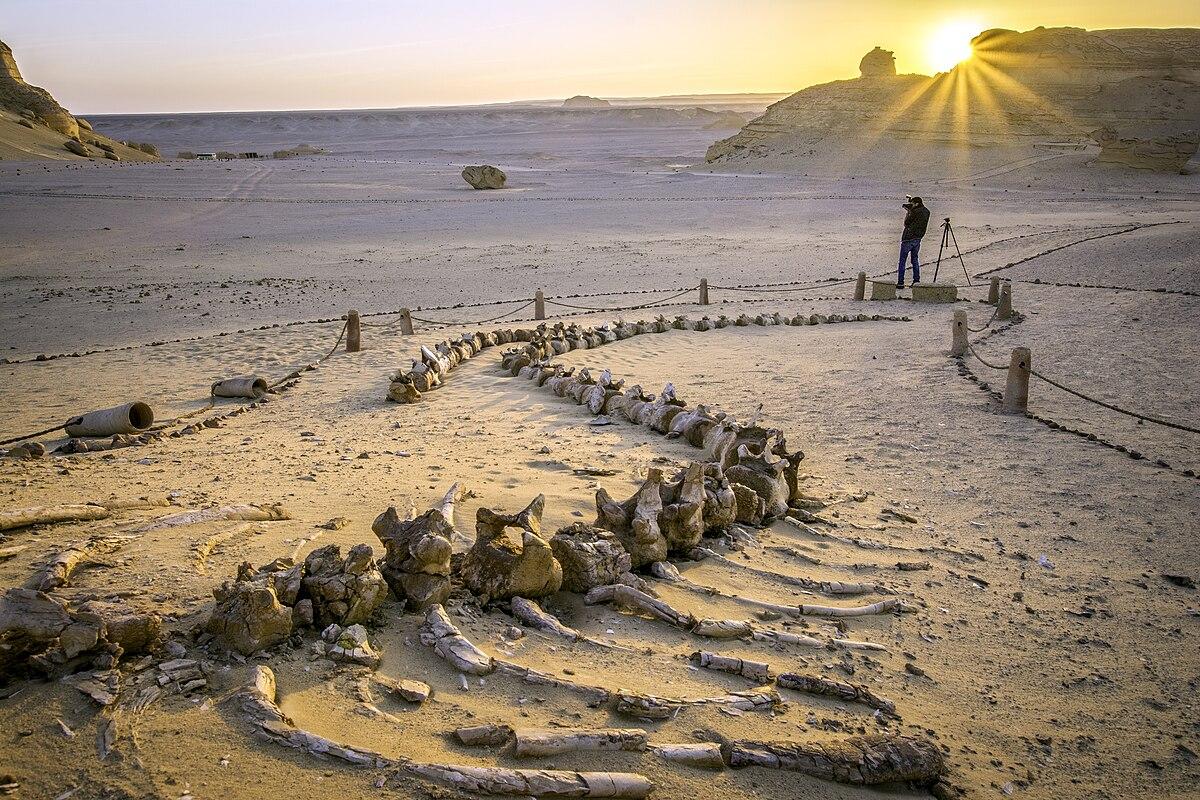
Wadi El Rayan and the Fayoum dunes: the closest dark sky to Cairo. Faiyum city sits 100 km southwest of Cairo, and the Wadi El Rayan protected area, 1,759 km² of desert around two lakes, begins about 65 km beyond. Cairo's light dome sits to the northeast, so this is not White Desert dark, but you can leave after lunch and be back next afternoon. A Fayoum and Wadi El-Hitan day trip can often be stretched into an overnight, and there is a small campsite at Wadi Al-Hitan, inscribed by UNESCO in 2005 for whale fossils 40 to 41 million years old.
The Sinai high desert: St Catherine sits at 1,586 m, high enough for better transparency, and correspondingly cold. January averages a low of 1.7°C (35°F), the record low is −6°C (21°F), and snow falls some winters. The Mount Sinai sunrise trek is not sold as stargazing, but you climb for hours in the dark.
Planning Around the Moon
This variable matters more than location. A full moon over the White Desert is beautiful, the chalk turns luminous, but it erases the Milky Way. You want the moon under about 30 per cent illumination, or below the horizon during the hours that matter.
New moons over the coming season, computed for Egyptian local time, fall on 11 September, 10 October, 9 November and 9 December 2026, then 7 January, 6 February, 8 March and 7 April 2027. Book so your camping night lands within four days either side of one; a four-day-old crescent sets within about four hours of sunset and leaves you the rest of the night. Write off the nights around each full moon, a fortnight after each date above. Full darkness arrives roughly 80 to 90 minutes after sunset here, usually just as dinner in camp finishes.
When the Milky Way Core Is Actually Up
The galactic centre sits at right ascension 17h 45m, declination −29 degrees, in Sagittarius, some 26,000 light years away. At the White Desert's latitude of about 27.3°N it culminates roughly 34 degrees above the southern horizon; from Siwa or Fayoum, near 29°N, about 32; from London it barely clears 9. That is why Egyptian desert Milky Way photographs look the way they do, and it stays up close to ten hours a night in season.
- Late February: the season opens, with the core rising around 02:30 and still low at dawn.
- March to May: the sweet spot. In March it clears the horizon soon after midnight and reaches 30 degrees by 04:00; by May it transits around 02:00.
- June to August: transits between roughly 20:00 and midnight, perfect timing paired with impossible weather. Farafra averages a July high of 37.8°C (100°F).
- September to early October: transits at or just before dusk, giving two to three hours of core low in the southwest, standing almost upright above a foreground.
- Mid-October to January: out of season for the core, though the winter Milky Way through Orion repays the drive.
Good to Know: What the Naked Eye Can Do Out There
Give your eyes 20 to 30 minutes without white light and the list runs long. The Milky Way shows its dark lanes, including the Great Rift through Cygnus and Aquila. Andromeda is an obvious elongated smudge, and M33 in Triangulum, a real test of sky darkness, becomes possible. The Orion Nebula below the belt reads clearly as something other than a star, and Orion dominates evenings from January to April. The zodiacal light, a cone of sunlight scattered off interplanetary dust, is a genuine spring and autumn object here. A pair of 10x50 binoculars adds more than a cheap telescope, and weighs less than a spare lens.
Camera Settings That Actually Work
Phone: any recent flagship with a night or astro mode produces a usable Milky Way frame provided it is truly still. Brace it on a rock; these modes stack 15 to 60 seconds and any wobble ruins the stack.
Lens: fast and wide, 14 to 24 mm at f/2.8 or faster on full frame.
Shutter: the 500 rule gives a starting point, dividing 500 by focal length times crop factor. That is 20 seconds at 24 mm on full frame, about 9 seconds for a 35 mm lens on APS-C. It is rough; pixel-level scrutiny needs the NPF calculation.
ISO: begin at 3200 and adjust from the histogram, not the rear screen.
Focus: manual, on a bright star, live view at maximum magnification, then tape the ring down. Autofocus will hunt all night.
Format: raw, with spare frames for stacking.
Pro Tip: Light the Foreground Once, Not Constantly
What separates a photograph of a place from a snapshot of stars is the foreground, and the chalk formations are the best natural night subject in Egypt because they are pale enough to hold starlight unaided. Rather than sweeping them with a head torch, take one dedicated frame lit for a couple of seconds by very dim light raked in from the side, then blend it with your sky frame. And bring a red-mode headlamp: dark adaptation takes 20 to 30 minutes to build, and one careless white beam destroys it for everyone in camp.
Cold, Dew and the Rest of the Night
Farafra's January mean low is 4.1°C (39°F), Bahariya's 5.2°C (41°F), Siwa's 5.6°C (42°F). Those are averages, and a clear, dry desert night routinely undercuts them; at St Catherine's altitude, plan for freezing. Standing at a tripod for three hours is far colder than walking: bring gloves you can work a shutter button in. Fuller kit detail is in our guide to what to pack for an Egyptian desert safari.
Dew is where Egypt departs from temperate stargazing. In the deep Western Desert the air is so dry that lens fogging is rarely an issue. In Fayoum, beside the Wadi El Rayan lakes, and on the Sinai or Red Sea coast, it very much is, and two chemical hand warmers round the lens barrel solve it cheaply. Batteries also fade in cold, so keep spares in an inside pocket and bring a power bank: there is no mains power in a desert camp.
Warning: Border Zones, Permits and What Your Insurer Thinks
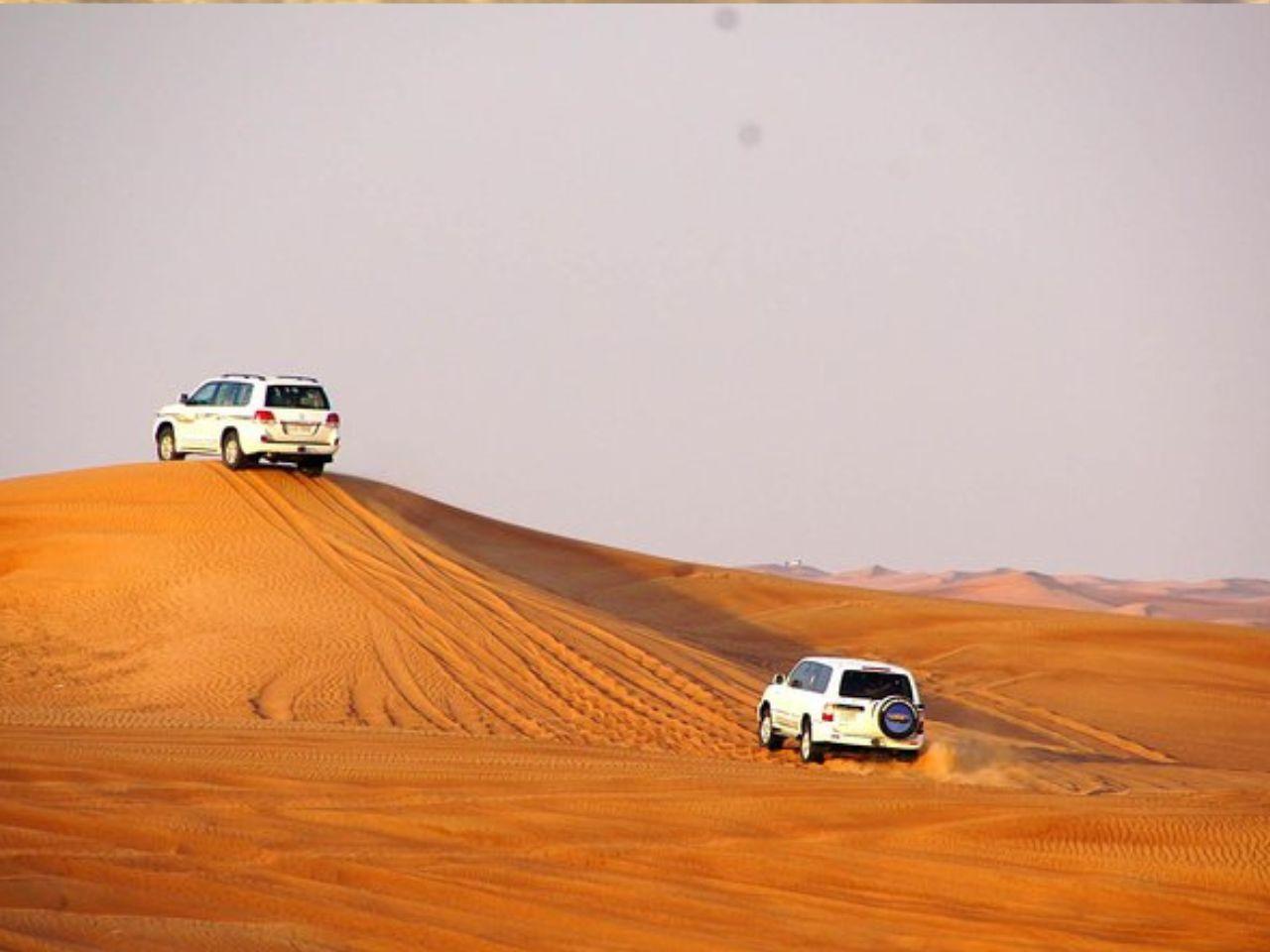
The Western Desert is not a free-roaming area. Off-road travel requires a qualified guide and, formally, a permit from the Ministry of Interior, which an operator arranges. As of August 2026 the UK FCDO advises against all but essential travel to the Western Desert as a region while explicitly excepting Faiyum, Siwa, Bahariya, Farafra, Dakhla and Kharga; against all but essential travel on the Al Bawiti to Siwa road; and against all travel within 20 km of the Egypt-Libya border, which bears on any deep push into the Great Sand Sea. It also advises against all travel to North Sinai, and against all but essential travel in parts of northern South Sinai beyond the St Catherine to Nuweiba road.
Other governments word their advice differently, so check your own before booking. This is not only a safety question: standard travel insurance is generally void in an area your foreign ministry advises against. Our guide to desert safety, permits and choosing an operator covers what to ask before you pay.
How the Ancient Egyptians Read the Same Sky
Sirius, the brightest star in the sky at magnitude −1.46 and only 8.6 light years away, was Sopdet, Sothis to the Greeks. Its heliacal rising, the first dawn it reappears after weeks lost in the sun's glare, coincided with the start of the Nile inundation and anchored the year. Because the civil calendar ran a flat 365 days with no leap day, it slipped by about a day every four years, realigning only every 1,460 Julian years: the Sothic cycle, reported by Censorinus in 238 CE. Egyptologists disagree sharply over how much chronology this can carry, since none of the surviving observations names the reigning king.
Orion was Sah, later merged with Osiris. The decans were a working clock: 36 star groups rising ten days apart, 36 times 10 giving 360 days plus five epagomenal days to reach 365. Because each new decan marked a fresh division of darkness, the system produced a night split into twelve parts, the distant ancestor of our twelve-hour night.
Over all of it arched Nut, the sky as a woman stretched above the earth god Geb, swallowing the sun each dusk and giving birth to it each dawn; some Egyptologists read the Milky Way itself as her body. She is painted on the astronomical ceiling in the tomb of Ramesses VI in the Valley of the Kings, around 1140 BCE. The stars that never set were the ikhemu-sek, the imperishable ones, and the Pyramid Texts send the dead king up to join them.
Meteor Showers Worth Timing a Trip Around
The Geminids peak on the night of 13 to 14 December at up to 120 an hour, radiant near Castor, and are unusual in coming from an asteroid, 3200 Phaethon, rather than a comet. In 2026 the moon at peak is a four-day crescent that sets early evening, close to ideal.
The Quadrantids peak around 3 January at a comparable rate, but the maximum is famously narrow, above half strength for only about eight hours, so the timing gamble is real; the new moon on 7 January 2027 at least removes the moon. Two to skip: the Orionids on 21 to 22 October 2026 run into a gibbous moon days before the 26 October full moon, and the Lyrids in late April 2027 collide with a full moon on 21 April.
Building a Night Into a Real Trip
Very few people should plan a whole Egyptian holiday around the sky. Almost everyone should plan one night around it. Nearly every desert overnight already puts you under a first-rate sky by accident; what turns it into a stargazing trip is choosing the date deliberately, then asking for three things when you book. Ask for a departure inside a new-moon window. Ask whether the crew will let the campfire die down after dinner. Ask them to keep vehicle lights off once camp is set.
Good operators agree without blinking; their drivers have been reading this sky their whole lives. For the ground-level experience, our guide to camping in the White Desert covers the food, the tents and the reality of a night out there, and our Egypt photography tips cover the daytime half of the same trip.