The most alarming part of a camel ride happens before you have moved a metre. The animal is couched on folded legs, you swing a leg over a saddle piled with blankets, and then it stands. Back legs first, which tips you sharply forward over its neck, then the front legs, which throws you back. Riders who were not warned grab at whatever is nearest.
Egypt sells camel riding at both ends of a very long spectrum. At one end is the twenty-minute loop on the sand beside the Pyramids of Giza, bought on impulse, priced by negotiation, and responsible for more bad-tempered arguments than any other transaction in Egyptian tourism. At the other is a week in the South Sinai mountains with a Bedouin family, where the camels carry the water, the flour and the bedding, and you spend most of the day walking beside them.
Both are worth doing, they do not cost remotely the same, and the questions worth asking before money changes hands are different. This is a guide to the whole range: what the riding feels like, what a fair price looks like in 2026, how the classic Giza price ambush is constructed, and what to look at on the animal before you get on.
At a Glance
Short ride at Giza: roughly 400 to 700 EGP (about 8 to 14 USD) for half an hour and 800 to 1,200 EGP (16 to 24 USD) for up to two hours, as widely quoted in 2026
Official tariff: several Egyptian listings cite 400 EGP per hour for Egyptians and 1,000 EGP per hour for foreign visitors, but this does not appear on the Ministry's published ticket schedule, so treat it as a benchmark rather than a posted rate
Giza plateau entry: 700 EGP adult foreigner, 350 student, 60 EGP for Egyptians as of 2026; the camel is extra and is not sold by the Ministry
Plateau hours: the Ministry's ticket list gives 7:00 to 17:00, its own plateau page gives 8:00 to 16:00, so plan around the earlier close
A sensible day in the saddle: four to six hours of riding, covering 20 to 25 km at a walking pace of about 4 km/h
Rider weight limit: operators commonly cap riders at around 120 kg (265 lb), and many will not take children under five
Trekking season: September to May in Sinai, October to April in the Western Desert
Cash: small Egyptian notes, roughly 50 EGP to 1 USD as of August 2026
How a Camel Moves, and How to Get On One
The dromedary, Camelus dromedarius, was domesticated in the southern Arabian Peninsula around 4000 to 3000 BC and reached the Saharan caravan routes as a pack animal in the last few centuries BC. A male stands 1.8 to 2.4 m at the shoulder, so a saddled hump puts your head above two metres. That height is the first surprise, and it is why the mounting sequence matters.
The second surprise is the gait. Camels pace: like a giraffe, they move both legs on one side of the body at the same time, which produces a slow lateral roll rather than the up-and-down bounce of a horse. At a walk that is about 4 km/h and pleasantly soporific. Pushed to a jog it reaches 8 to 12 km/h and stops being soporific immediately.
The mechanics are simple once someone tells you. Wait until the animal is fully couched, put your weight on the saddle rather than its neck, keep both hands free for the pommel, and let the handler hold the head rope. As it rises, lean well back, then forward; when it kneels at the end, reverse the order. Do not carry a bag in your hand or take a photograph mid-transition. Almost every camel injury a tour operator hears about happens in those ten seconds.
The Hour at Giza: Where the Rides Now Happen
The plateau itself has changed a great deal recently, and the geography of camel rides has changed with it. Since 2025 the site has run on a new visitor system: the old Mena House entrance in Nazlet el-Semman was closed, main entry moved to the desert-side gate on the Fayoum road, private cars are no longer driven around the monuments, and a fleet of around 45 electric buses shuttles visitors between the stops. Our complete guide to visiting the pyramids covers how that works in practice.
Camel handlers still work the plateau. They cluster where crowds bunch up, which means the ticket gates, the first wide view of the three pyramids, and the panorama ridge in the south of the site. What they are selling inside the archaeological zone is generally a short loop and a photograph rather than transport.
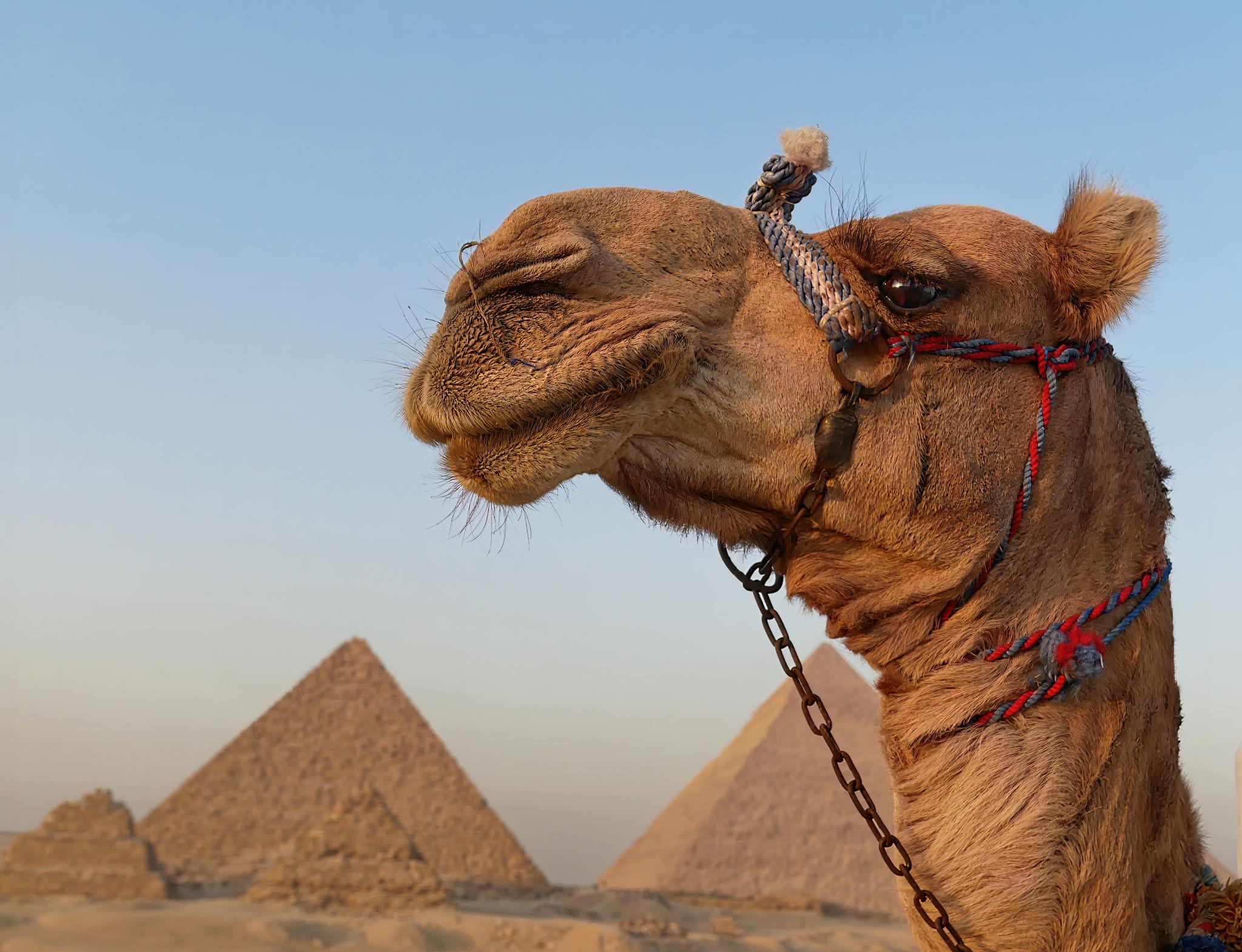
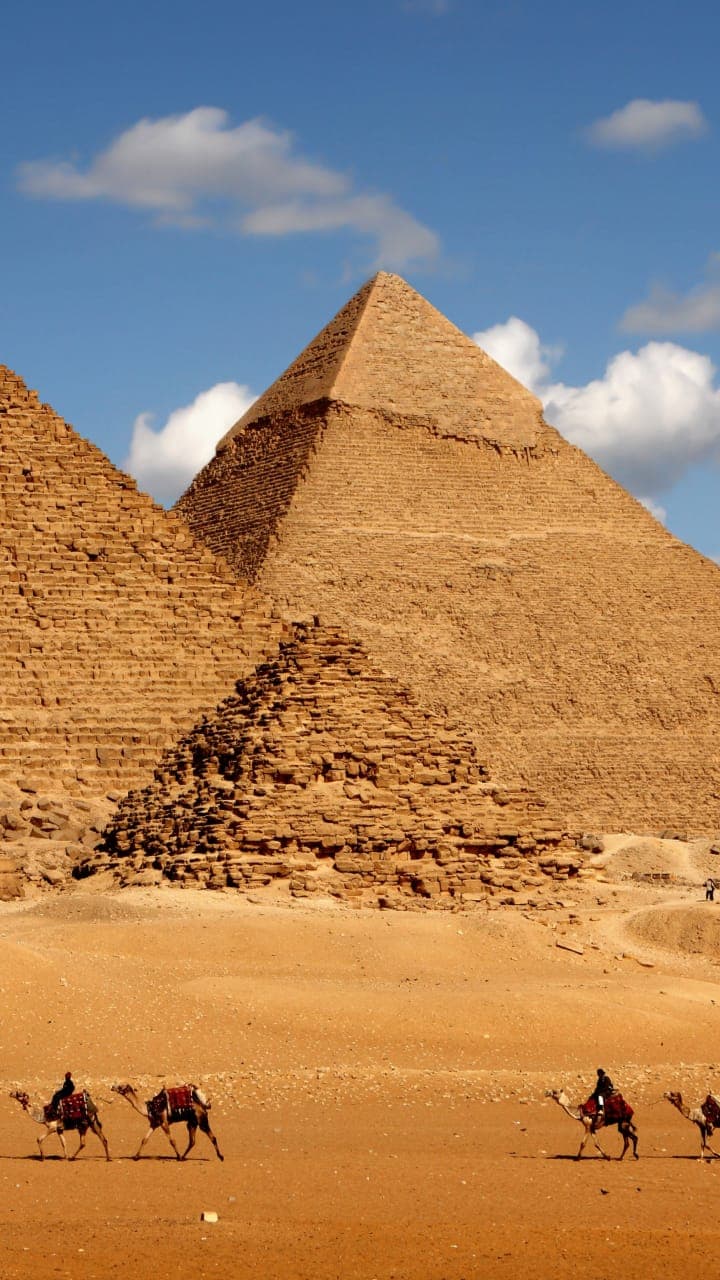
Sunset rides are a different animal. Because the plateau closes in the middle of the afternoon, a genuine golden-hour ride takes place outside the ticketed area, on the open sand west and south of the monuments, run from the stables and yards on the desert edge. That is where the light is anyway, and where the classic frame of a camel silhouetted against three pyramids is taken from. A pre-arranged sunset camel ride at the pyramids is booked on that basis, with the price fixed before you arrive.
You may have seen headlines saying camel and horse rides at Giza have been banned. They have not. Egypt's tourism ministry announced an intention to phase them out in favour of electric vehicles as far back as 2020, and in 2026 a circular from the Chamber of Tourism Establishments and Restaurants prohibited the use of animals in performances inside hotels and restaurants. That circular was widely misreported as a plateau ban. Asked directly in June 2026, PETA said no measures had been introduced to end or phase out rides at the pyramids.
How the Giza Price Ambush Is Built
The ambush is not one trick but a sequence, and it works because each step is small. A price is quoted, warmly, for "the camel". Once two of you are up, it quietly becomes per person. A photograph at the panorama ridge is extra. Going a little further, to the spot with no cables in shot, is extra. The handler waiting while you take photographs is extra.
The step that ruins afternoons is the last one. You agreed a price to get on. Nobody agreed a price to get off, and the negotiation to get down happens two hundred metres out on the sand with no one else nearby. Then a tip is requested at the far end, and again at the start point where a second man is holding the head rope.
None of this makes camel handlers villains. The plateau is a crowded, commission-driven marketplace where a family's whole income can turn on a handful of transactions a day. But you are entitled to know the shape of the deal before you are three metres off the ground, and the fix is straightforward.
Pro Tip: Settle Everything Before You Sit Down
Agree six things out loud, in Egyptian pounds, before anyone touches a saddle: the total price, that it is total and not per person, the number of minutes, that it includes photographs, that it includes the ride back to the exact spot you started from, and the tip. Type the number into your phone and show it to the handler; both of you nodding at a screen removes the later argument entirely.
Then carry the money in small notes and hand over nothing at all until you are standing on the ground again. If the price shifts mid-ride, ask to be taken back and pay only what was agreed. Our money and tipping guide sets out realistic 2026 amounts for the tip itself, which for a short ride is a matter of tens of pounds, not hundreds.
Luxor: Field Edges Below the Theban Hills
Luxor's rides are gentler in every sense. On the West Bank, stables send camels along the irrigation channels and field edges between the villages, out past the sugarcane and up to the desert margin below the Theban cliffs, with the temples in view. Rides are usually sold in blocks of one to four hours, and the two-hour version at first light or late afternoon is the one worth having.
The setting does much of the work. You pass mudbrick houses, donkeys, women cutting fodder, and then the ground turns to grit and the noise stops. Medinet Habu and the Colossi sit within this same band of cultivation. If a slow tour of the same landscape appeals more than a saddle, our West Bank cycling tour covers similar ground under your own power.
Timing is not optional here. Luxor's June to August highs run to 40 or 41 C (104 to 106 F), and no responsible stable puts an animal or a tourist out in the middle of that. From November to March a mid-morning ride is comfortable.
Dahab and the Coast North of the Blue Hole
North of Dahab, the coastal track runs out and the shoreline becomes reachable only by boat or by camel. About an hour's ride north of the Blue Hole is the Bedouin settlement at Ras Abu Galum, a protected stretch of coast with a fringing reef straight off the beach and a handful of palm-frond shelters. The camels and the guides belong to Muzeina families who live there, which makes it one of the few camel rides in Egypt that is transport rather than a photo opportunity.
Most people go for the day, ride out in the morning, snorkel, eat and ride back. Overnight versions with a night on the beach are widely sold and reported at around 3,500 EGP (roughly 70 USD) per person, though what you actually pay depends on group size. Pair it with the Blue Hole snorkelling trip and you have the two best days on that coast.
Multi-Day Treks in South Sinai
This is where camel travel in Egypt stops being an attraction and becomes a way of getting somewhere. The Sinai Trail, launched in 2015 as a 220-kilometre, twelve-day route and since extended to a 550-kilometre circuit worked by eight Bedouin tribes, is the backbone. Camels carry the water, food and kit; walkers carry a daypack; Bedouin guides are compulsory and are the point rather than a formality. The season runs from September to May.
Riding is generally optional on these routes and people ride less than they expect, partly because a camel walks at the speed of a person and partly because the ground in the high Sinai is steep and stony. The camels earn their keep as the reason you can be out for six days without a vehicle. Our Sinai desert guide covers the routes and permits in detail, and the guide to Bedouin hospitality covers what happens around the fire once the animals are unloaded.
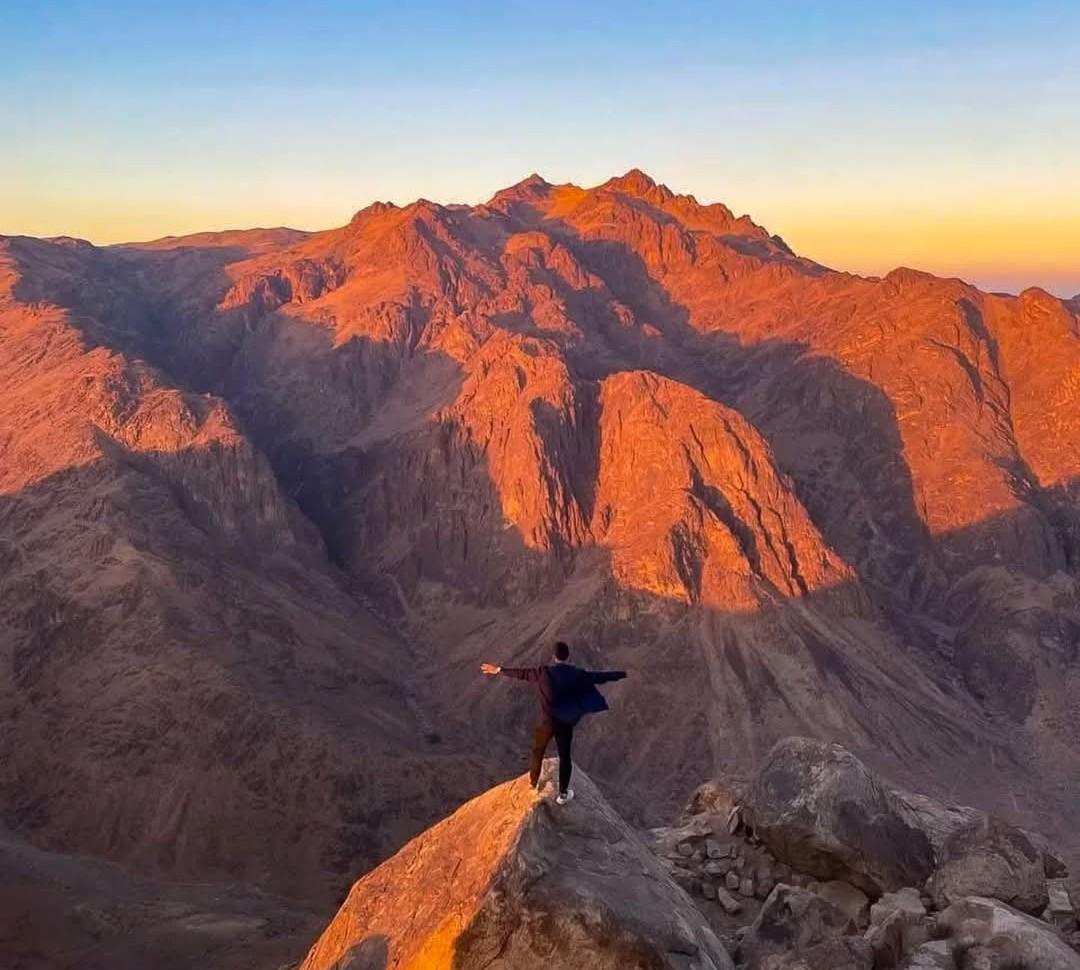
The shortest version of the same idea is the camel path up Mount Sinai, Siket El Bashait, a graded track you can ride for most of the ascent before dismounting roughly a kilometre below the top, where the last flight of around 750 rough steps is on foot only. A sunrise trek up Mount Sinai is the usual way to do it. Note that the animals climb in the dark on a busy track, and that walking the same path takes about two and a half hours.
Siwa and the Western Desert: Where Camels Give Way to Land Cruisers
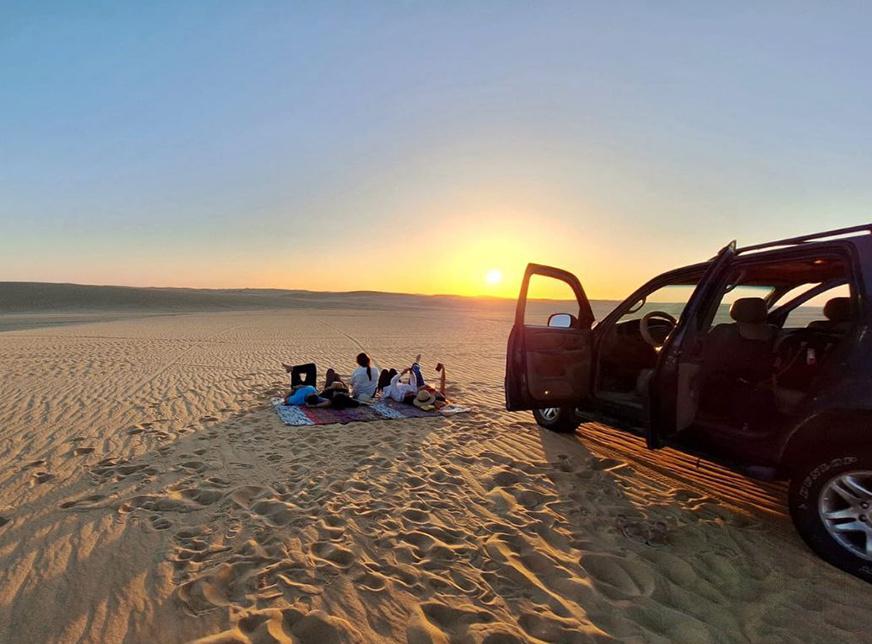
It is worth being honest about the west. The great dune fields beyond Siwa Oasis are Land Cruiser country, and the Great Sand Sea expeditions sold from Siwa and the oases run on 4WD convoys, not caravans. Distances are simply too great and water too scarce for a commercial camel trek to make sense there.
What Siwa does have is short riding among the palm gardens, out to the salt lakes and up towards Gebel Dakrur, which is a lovely hour and no more than that. On an overnight Siwa safari the camel is a component of the day rather than the transport, and the vehicles do the heavy lifting. Anyone imagining a week of dunes on camelback in the Western Desert is imagining a nineteenth-century expedition, not a modern trip.
Did You Know: The Road Egypt's Camels Still Walk
The Darb el-Arbain, the Forty Days Road, runs roughly 1,800 km from Kobbei in North Darfur to Asyut on the Nile, by way of Bir Natrun, Wadi Howar, Selima Oasis and Kharga. The name records a classical estimate; the crossing usually took closer to sixty days. Roman garrisons protected it, Ibn Hawqal described it in the tenth century, and it carried gold, ivory, ostrich feathers and, until the Anglo-Egyptian administration suppressed the traffic in the late nineteenth century, enslaved people.
It has never entirely stopped. Herds are still driven north out of Darfur and Kordofan along the old line, then loaded onto trucks somewhere north of Abu Simbel for the last leg to the market at Daraw, 6 km south of Kom Ombo and 38 km north of Aswan, which trades from about six in the morning, mainly on Tuesdays. Egypt's largest camel market sits at Birqash, some 35 km northwest of Cairo, where it moved in 1995. Both are working livestock markets selling animals for meat, and both are hard to watch. Go only if you want the reality behind the postcard.
How Long a Day in the Saddle Should Be, and What to Wear
Working camels should not be under load for much more than about six hours a day, and neither should you. Four to six hours of riding covers 20 to 25 km, which on a trek means most groups walk substantial stretches and ride the rest. If an operator proposes eight hours on an animal in one day, they are not doing you or the camel a favour.
The soreness is real and it arrives on day two, not day one. It concentrates in the inner thighs and knees, where the saddle spreads your legs wider than a horse does, and along the tailbone from the roll. Standing in the stirrups occasionally helps, as does swapping to walking for half an hour every couple of hours.
- Long, loose trousers. Shorts guarantee chafing, and bare calves rub against the saddle frame.
- Closed shoes you can walk in. Sandals fall off and offer nothing when you dismount onto stony ground.
- A brimmed hat that will stay on and a scarf for wind, sun and dust.
- Sunscreen on the backs of your hands, your neck and your ears, all of which face upward for hours.
- Sunglasses, lip balm and at least two litres of water per person for a half day.
- A small bag that clips or straps to you rather than one you hold.
Warning: Welfare Red Flags Worth Walking Away From
Camel welfare at Egypt's tourist sites is a genuine problem, not a rumour. PETA Asia investigations in 2019 and again in 2023 and 2024 documented exhausted animals being beaten at Giza and Luxor, camels used as photo props in extreme heat without shade or feed, and worn-out animals sold on to slaughter. Egypt also has serious animal welfare organisations working on exactly this: the Brooke, founded in Cairo in 1934 by Dorothy Brooke and still running its original hospital, and Animal Care in Egypt, a British charity hospital in Luxor treating working animals free of charge.
Check the animal in front of you before you agree to anything, and be willing to walk to the next handler.
- Raw patches, open sores or scabbing under the saddle blanket or where the girth sits, and flinching when the blanket is lifted.
- Sharply visible ribs and hip bones, a dull staring coat, or an animal that will not stand square.
- A nose peg being yanked to steer, rather than steering by voice and head rope.
- Sticks, whips or kicks used routinely, on the animal or in front of it.
- No shade, no water and no rest line at the waiting point, especially between noon and three in summer.
- Animals hobbled tightly at the front legs and left standing in full sun for hours.
Planning a Trip Around the Camels
If you want one good camel experience on a first trip to Egypt, take it at Giza and take it late in the day, pre-arranged, with the price settled and the light doing the work. If you want camel travel rather than a camel ride, the answer is South Sinai between late September and May, on a route where the animals are carrying gear and Bedouin families are running the trip.
The two things worth deciding in advance are the season and the length of the day, because those decide how much you enjoy it and how hard the animal works. Both point the same direction: cooler months, shorter hours, earlier starts. If you would like help fitting a ride or a trek into a wider itinerary, get in touch and tell us which end of the spectrum appeals.