Drive far enough into the bone-dry desert southwest of Cairo and you reach a place that defies every expectation of Egypt: a fossil valley where the skeletons of ancient whales lie scattered across the sand, exactly where they fell some 40 million years ago. Wadi Al-Hitan, the Valley of the Whales, is Egypt's only natural UNESCO World Heritage Site, and it tells a story far older than the pharaohs. This is a guide to reaching it, understanding what you are looking at, and planning a trip that does justice to one of the strangest landscapes in the country.
Why Wadi Al-Hitan Matters
Most visitors to Egypt come for human history measured in thousands of years. Wadi Al-Hitan deals in tens of millions. Roughly 40 to 41 million years ago, during the late Eocene epoch, this entire region lay beneath the warm, shallow waters of the Tethys Sea. The valley preserves hundreds of fossil skeletons of early whales, most importantly *Basilosaurus* and *Dorudon*, captured at a pivotal moment in evolution: the transition of whales from land-dwelling mammals to fully aquatic creatures.
What makes the site scientifically priceless is that many of these skeletons still show small hind limbs, feet, and toes, vestigial legs that prove whales descended from four-legged land animals. UNESCO inscribed Wadi Al-Hitan on the World Heritage list in 2005 precisely because no other place on Earth displays this evolutionary record so clearly, in such density, in its original setting. You are not looking at a museum reconstruction; you are walking among fossils still embedded in the rock and sand that entombed them.
Where It Is and How Far
Wadi Al-Hitan sits inside the Wadi El-Rayan Protected Area in the Fayoum Governorate, roughly 150 to 170 kilometres southwest of Cairo and about 80 kilometres from Fayoum city. The valley is part of the broader Fayoum oasis region, though it lies well beyond the cultivated farmland in genuine desert.
From central Cairo, expect a drive of around 3 to 3.5 hours one way, depending on traffic leaving the city and the final stretch of desert track. The last 35 to 40 kilometres from the Wadi El-Rayan area to the whale valley itself is unpaved or roughly graded in places, so a 4x4 or a high-clearance vehicle with an experienced driver is strongly recommended. Ordinary sedans can become stuck, and there is no fuel, no reliable phone signal, and no roadside help once you leave the asphalt.
Getting There: Your Realistic Options
### By organised tour
The simplest and safest approach is a full-day trip from Cairo with a driver who knows the desert tracks. A private day tour typically runs a long day, leaving Cairo by 7 to 8 a.m. and returning after dark. This option removes the navigation risk and usually bundles the protected-area fees and a knowledgeable guide.
### Self-driving
If you hire a 4x4 and drive yourself, plan carefully. Carry extra water and fuel, download offline maps in advance, and tell someone your route. The desert section is not signposted in any reassuring way, and getting lost here is genuinely dangerous in summer heat.
### From Fayoum
If you are already staying in Fayoum or Tunis Village, the drive shrinks to roughly 1.5 to 2 hours, making a half-day or relaxed full-day visit far more comfortable than the round trip from Cairo.
Tickets, Hours and Fees
The protected area generally operates during daylight hours, roughly 8 a.m. to 5 p.m., though desert sites keep loose schedules and it is wise to arrive by mid-morning. As of 2026, foreign-visitor entry to the Wadi El-Rayan protected area plus the Wadi Al-Hitan zone runs roughly 450 to 600 EGP per person (about 9 to 12 USD), with separate, lower rates for Egyptians and students. Vehicle fees may apply on top. Prices for Egyptian heritage and protected sites are revised periodically, so treat these as approximate guidance rather than fixed figures.
There is usually a modest extra charge for cameras, and drone use is restricted and typically requires advance permission. Bring cash in Egyptian pounds; card payment cannot be relied upon out here.
What You Will See on the Trail
Wadi Al-Hitan is laid out as a self-guided walking circuit, a marked footpath of roughly 3 kilometres that loops past the major fossil displays. Take your time; the full loop with stops can occupy 1.5 to 2 hours.
### The whale skeletons
The stars are the *Basilosaurus* skeletons, serpentine early whales that grew up to 18 metres long. Several are displayed in situ, some partially reconstructed, their long vertebral columns snaking through the sand. *Dorudon*, a smaller cousin around 5 metres, also appears, along with the telltale tiny hind limbs that rewrote our understanding of whale evolution.
### Other fossils
Beyond whales, the valley holds fossilised sharks, sawfish, sea turtles, crocodiles, rays, and mangrove roots, an entire vanished marine ecosystem. Interpretive signs along the trail explain each find.
### The Fossils and Climate Change Museum
Near the entrance, the visitor museum (opened in 2016, partly funded by Italian cooperation and the UN) shelters the site's centrepiece: a remarkably complete *Basilosaurus isis* skeleton over 18 metres long, displayed indoors with clear, multilingual panels on evolution and climate. It is the single best place to grasp what you are seeing outside.
### The desert landscape
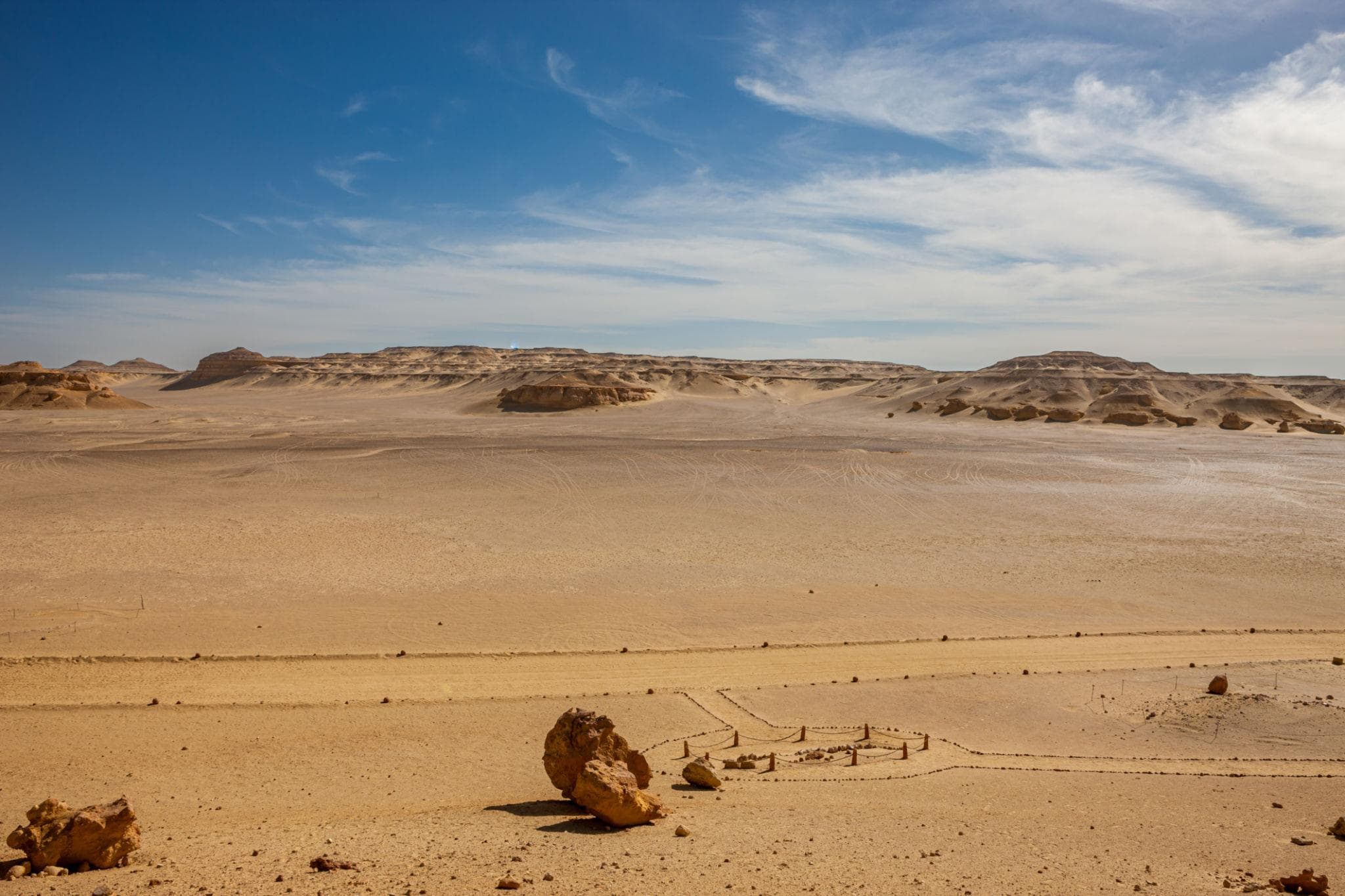
Do not overlook the scenery itself. Wind-carved sandstone formations, mushroom rocks, and yardangs rise from a sea of golden sand, sculpted over millennia. At dawn and dusk the colours turn extraordinary.
Best Time to Visit
Go between October and April. Daytime temperatures in winter are pleasant for walking, often 18 to 25 degrees Celsius, while summer (June to August) regularly exceeds 40 degrees and makes the exposed, shadeless trail genuinely hazardous. Early morning or late afternoon offers the softest light for photography and the coolest walking conditions. Spring sandstorms (the khamaseen winds) can occasionally blow through between March and May, so check conditions before committing to a long drive.
Staying Overnight: Desert Camping
One of the great rewards of Wadi Al-Hitan is camping. The protected area maintains a designated camping zone with basic facilities, simple shelters and toilets, where you can spend the night under one of the darkest skies near Cairo. The stargazing is exceptional, and waking among the fossils at sunrise is unforgettable. Bring your own gear, food and plenty of water, or arrange a tour that supplies a desert camp. Note that this is true wild camping in spirit: minimal services, no shops, and you must carry out all your rubbish.
Practical Tips and What to Bring
- **Water**: at least 2 to 3 litres per person; there is little or none for sale on site.
- **Sun protection**: hat, high-SPF sunscreen, sunglasses, and a light long-sleeved layer. The trail has almost no shade.
- **Footwear**: closed walking shoes for the sandy, uneven path.
- **Cash**: enough Egyptian pounds for entry, camera fees and tips.
- **Snacks**: there are no cafes or restaurants inside the protected area.
- **Insider tip**: combine Wadi Al-Hitan with the nearby Wadi El-Rayan waterfalls and Lake Qarun on a two-day Fayoum trip rather than a brutal single-day dash from Cairo. You will see far more and enjoy it more.
- **Respect the fossils**: never touch, climb on, or remove anything. These are irreplaceable, protected specimens, and rangers do enforce the rules.
Common Questions
### Is it worth the long drive?
For anyone with an interest in natural history, palaeontology, photography, or genuinely unusual landscapes, yes. If your priority is purely pharaonic temples and tombs, the long desert journey may feel like a detour. Set expectations accordingly: this is quiet, remote, and contemplative, not a grand monument.
### How crowded is it?
Very lightly visited compared with Giza or Luxor. On weekdays in winter you may share the trail with only a handful of others. Egyptian weekends (Friday and Saturday) bring more local visitors to the wider Wadi El-Rayan area.
### Is it accessible for those with limited mobility?
The walking circuit is sandy and uneven, which makes wheelchair access difficult, though the indoor museum and the area near the entrance are easier to manage.
Plan Your Fayoum Adventure
Reaching Wadi Al-Hitan comfortably means having reliable transport for the long desert run, which is exactly where a private vehicle pays off. Our Cairo and Giza full-day private transfer gives you a knowledgeable driver and a flexible itinerary that can be tailored toward Fayoum and the Valley of the Whales, so you spend the day exploring rather than worrying about the road. For more ideas on escaping the capital, read our guide to Cairo day trips and, if you are craving the coast afterward, our laid-back guide to Dahab. However you arrive, Wadi Al-Hitan rewards the journey with a glimpse of Egypt 40 million years before the first pyramid.