Two trips get sold under the same phrase, "the Egyptian desert", and they are almost nothing alike. One is a four-hour drive from Cairo to a chalk seabed eroded into white towers, where you sleep on the ground and are back in the city the next evening. The other is a full day on the road to a depression below sea level near the Libyan border, where the local language is Berber, the old town was built out of salt, and you could stay five days without repeating yourself.
The question we are asked most is not which is better but which fits the days actually left in the itinerary. That is the right question, because the deciding factor is arithmetic rather than taste. Bahariya Oasis and the White Desert are 330 to 370 km from Cairo depending on where you start counting; Siwa is 750 to 800 km by road. Almost every other difference follows from that gap.
At a Glance
White Desert, from Cairo: 330 to 370 km to Bawiti, four to five hours on paved desert highway
Siwa, from Cairo: 750 to 800 km by road, eight to ten hours via El Alamein and Marsa Matruh
Minimum trip: two days for the White Desert; three for Siwa, four to do it justice
Permits: required in advance, with an official guide, for Bahariya, Farafra, the White Desert and Black Desert; Siwa town is not on that list, though off-road travel from it is
Sleeping: open sky or a simple tent in the White Desert; kershef lodges and guesthouses in Siwa
Tickets: 100 to 120 EGP for foreign visitors at either area's antiquities sites, about 2 to 3 USD as of 2026
Alcohol: not sold in Siwa
The Distance Problem
The Cairo to Bawiti road is the easiest long desert drive in Egypt: asphalt the whole way, a standard car handles it, and the spread in the sources is a disagreement about whether you start at Tahrir, the ring road or the edge of 6th of October City. Four to five hours, one fuel stop, and nothing to look at until the oasis appears as a green trench below the road.
Siwa is a different order of commitment. Reference works give it as 560 km from Cairo, but that is the map distance; there is no route west across the desert you are permitted to use, so the drive runs north to the Mediterranean, west past El Alamein to Marsa Matruh, then inland for a final 300 to 310 km. Eight to ten hours, the Matruh leg alone about four. A seasonal EgyptAir service links Cairo and Marsa Matruh roughly June to September, which sounds like a shortcut until you notice it runs only in the months nobody should visit Siwa. Otherwise the drive is the route, self-organised or as a one-way Cairo to Siwa private transfer.
What a Night in the White Desert Actually Gives You
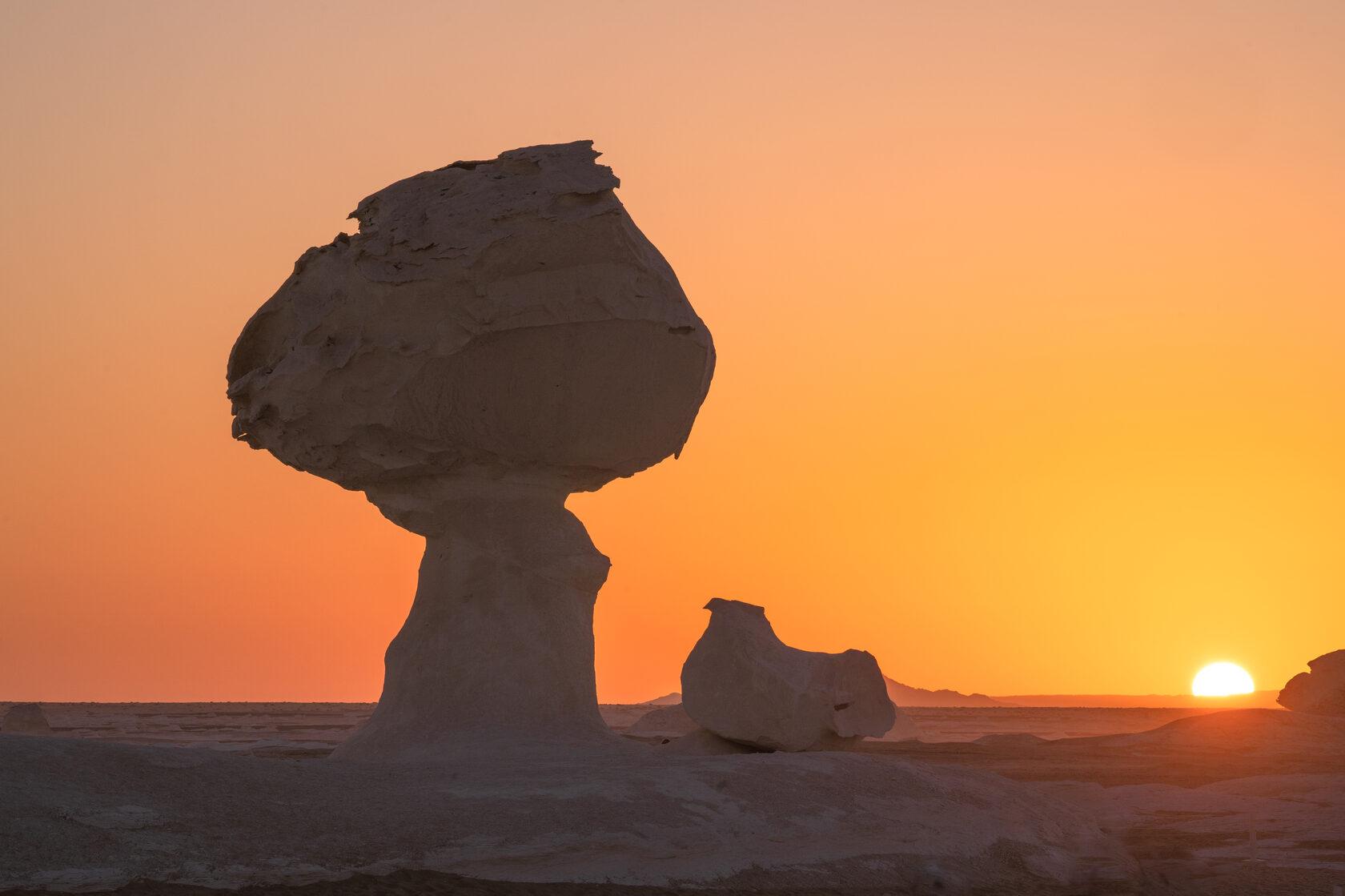
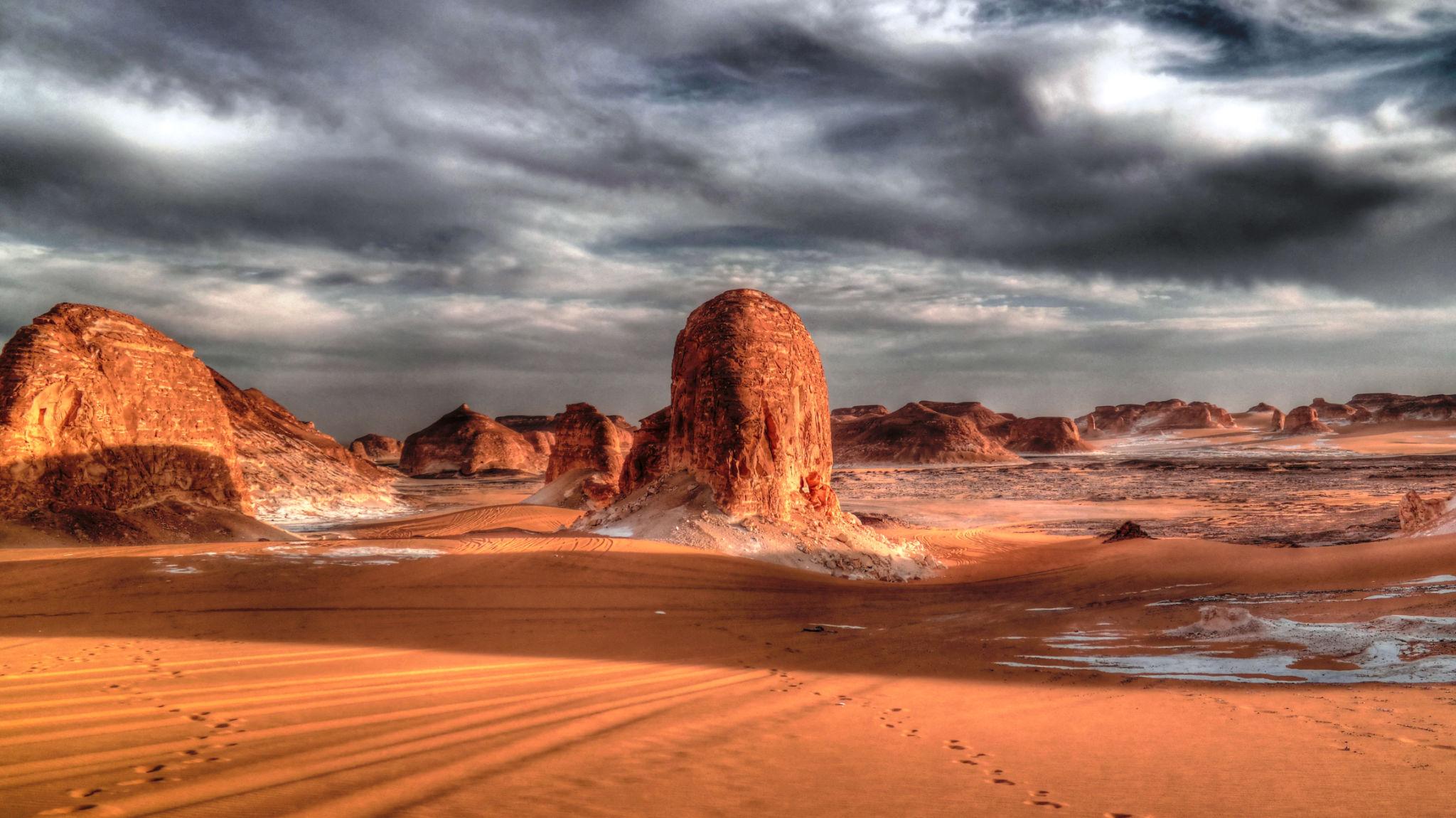
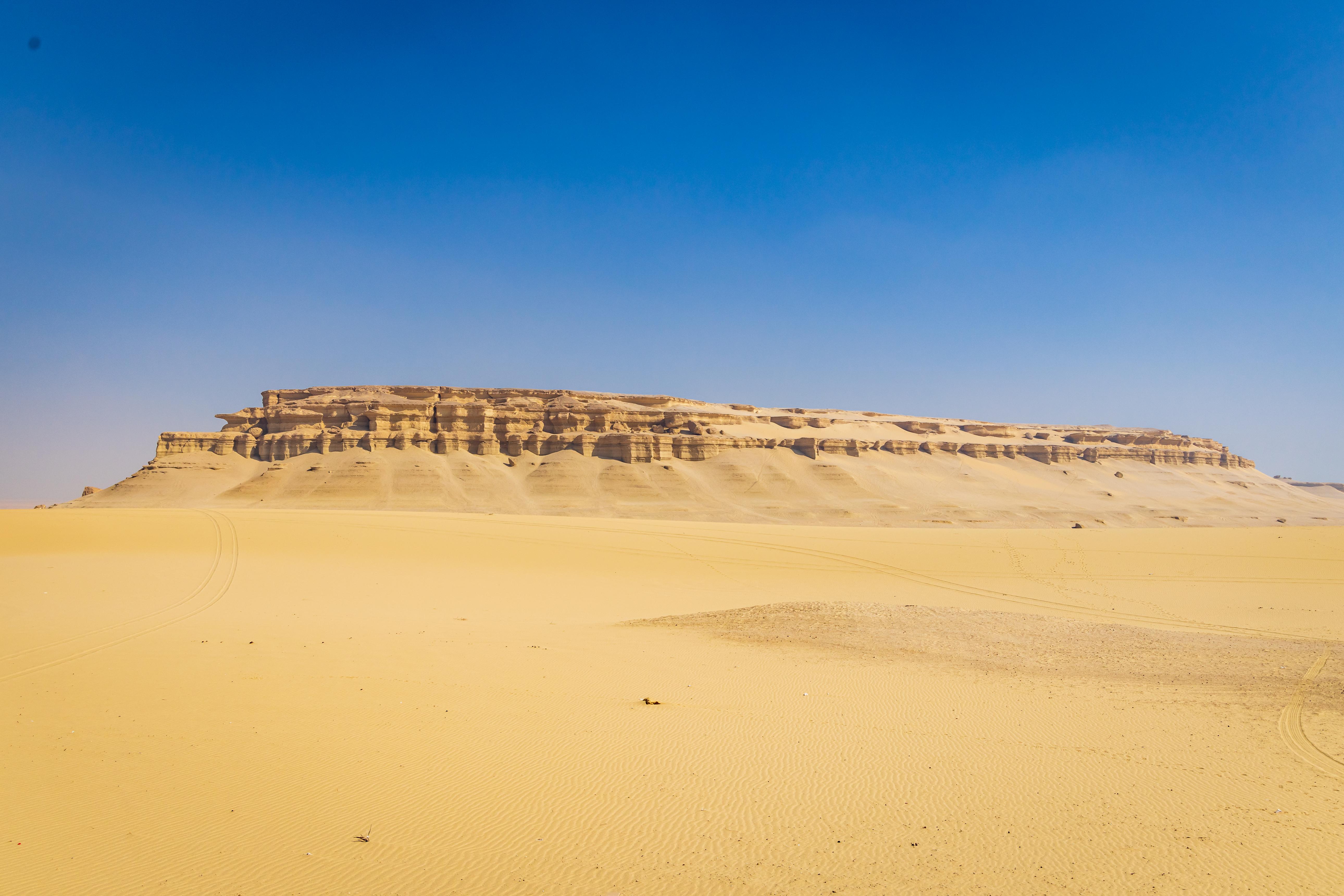
White Desert National Park was gazetted in 2002. Its area is given as 300 sq km in some sources and around 3,010 sq km in others, so treat it as approximate. The rock is not in dispute: the Khoman Formation, a snow-white chalk laid down in the Campanian and Maastrichtian stages of the Late Cretaceous, when this was the floor of the Tethys Sea. Wind has cut it into mushroom pillars, inselbergs and low tower karst, densest about 45 km north of Qasr al-Farafra.
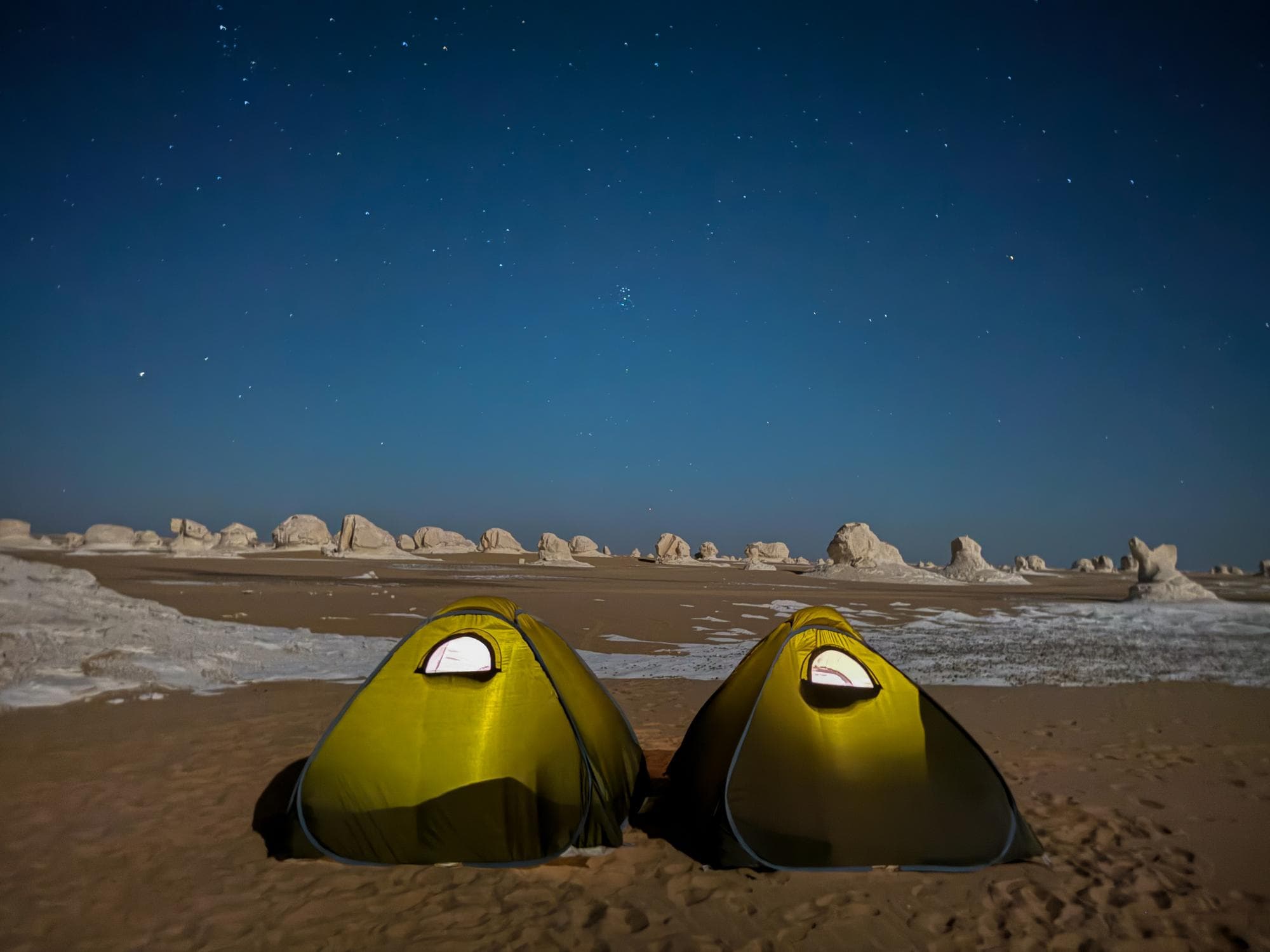
The trip is one long afternoon and one extraordinary night. You leave Cairo in the morning, reach Bawiti near midday, transfer into a 4WD, and cross the Black Desert with its dolerite-capped cones some 20 km south of town, then the Agabat valley, then into the chalk as the light turns. Your driver builds a fire, cooks, and the sky does the rest: no settlement for tens of kilometres, no light dome on any horizon. Desert foxes come in for scraps; the gazelles, Barbary sheep and sand cats on the park's protected list are far rarer sightings.
Then you drive home. That is the whole product, and our White Desert and Black Desert overnight safari is built to that shape: the highest ratio of astonishment to time invested anywhere in Egypt. Our White Desert camping guide covers what the night is like, down to the cold.
What Siwa Gives You That One Night Cannot
Siwa is not a landscape you visit; it is a place people live. The depression runs about 80 km end to end and up to 20 km wide, its floor sits around 19 metres below sea level, roughly 200 springs feed the palm and olive groves, and some 25,000 people live here. Most speak Siwi, called Isiwan by its speakers, the only Berber language still spoken in Egypt.
The sights are close together and varied. Shali Fortress is the ruined old town, built in 1203 CE from kershef, a mix of salt rock, clay and palm beams that is superb in the dry and catastrophic in the wet. Days of freak rain finished it as a habitation, though sources give the year as either 1926 or 1936. The Temple of the Oracle at Aghurmi went up under Amasis II of the 26th Dynasty, who reigned around 570 to 526 BC. Alexander crossed from the coast in 331 BC to ask the oracle of Amun whether he was the son of a god, and was, by every surviving account, told what he wanted to hear.
Beyond those the days fill themselves: the Roman-era rock tombs of Gebel al-Mawta, the stone basin of Cleopatra's Spring, the sunset spit at Fatnas, salt pools cut into old quarries where the brine floats you like a cork, and a 4WD run into the Great Sand Sea from Bir Wahed. Our Siwa travel guide covers the oasis site by site. The texture is the real difference: you get around by bicycle or in a caretta, the four-seat donkey cart still used as local transport, and you sleep in a kershef lodge among the palms.
Minimum Realistic Trip Length
Two days and one night is a complete White Desert trip, not a compromised one; a third day adds the Valley of the Golden Mummies and the tombs around Bawiti.
Siwa does not compress: two days means sixteen to twenty hours in a vehicle for one usable afternoon. Three days is the honest floor, and what our three-day Siwa desert adventure is built around: travel day, full day in the oasis and the sand sea, travel day. Four is better, and the first length at which Siwa stops feeling like a long drive with sightseeing attached. From the Mediterranean coast, the shorter two-day Siwa overnight safari becomes viable in a way it never is from Cairo.
Good to Know: Where the Advisories Draw the Line
As of 2026 the UK Foreign, Commonwealth and Development Office advises against all but essential travel to the area west of the Nile Valley and Delta, then carves out a list of exceptions. Both trips sit inside it: the exceptions name the White Desert and Black Desert, the oasis towns of Bahariya, Farafra, Dakhla and Kharga, the oasis town of Siwa, and the Marsa Matruh to Siwa road.
The permit rule is where they differ on paper. The FCDO states that tourists entering Bahariya Oasis, Farafra, the White Desert and the Black Desert must apply for permits in advance and use an official guide. Siwa town is not covered by that requirement, which is why independent travellers reach it by bus far more often. Off-road travel out of Siwa is another matter: the Great Sand Sea needs a licensed driver and a permit. Our guide to desert permits, heat and choosing an operator covers the paperwork.
Warning: You Cannot Drive Between Them
The map shows a road running west from Bawiti to Siwa, and travellers keep planning around it. That road is closed, there are military checkpoints on it, and the FCDO advises against all but essential travel on it and on the desert near its Bahariya end.
So these are two separate journeys, and doing both means returning to Cairo in between. Anyone selling one itinerary that runs Bahariya straight through to Siwa is either describing something they cannot legally deliver or has not checked in years. Carry your original passport, not a copy, and allow time at every checkpoint.
What Each Trip Costs
The White Desert is the cheaper adventure by a wide margin, and the reason is nights and fuel: two days of vehicle, guide, kit and food against four days of vehicle, hotels and a far longer drive. Bahariya's antiquities sites are 100 EGP for foreign visitors, half that for students, open 8am to 4pm. In Siwa, the Temple of Aghurmi and the tombs of Gebel al-Mawta are 120 EGP each, 60 for students, open 9am to 5pm, on the Ministry's last published list. Call it 2 to 3 USD apiece as of 2026, and expect rises after the broad increases of 2025.
A White Desert night also carries a national park fee, modest and normally paid by your operator, with published figures inconsistent enough that we would not quote one. In Siwa the Bir Wahed safari is usually sold separately at roughly 700 to 1,500 EGP per person, around 14 to 30 USD as of mid-2026, while the salt pools and Cleopatra's Spring cost nothing. Multi-day Siwa packages from Cairo are advertised in the low hundreds of dollars and vary enormously with group size, so compare inclusions, not headline figures.
Best Months, and the Temperature Gap
October to April for both, and outside that window the White Desert is the harsher proposition. Bahariya's mean temperature runs around 13C (55F) in January against 30C (86F) in July, and Farafra is hotter still, with July means near 33C (91F). Afternoon peaks go well above those averages, and there is no shade anywhere in the park.
Siwa's published averages give January highs near 19C (66F) with lows around 6C (43F), and July highs near 37.5C (100F). Its records run from 48.2C (119F) in June to minus 2.2C (28F) in January, on about 9 mm of rain a year. What makes Siwa more forgiving in the shoulder months is not the air temperature but the shade: palm groves, cold springs and salt pools give you somewhere to be at two in the afternoon, which the chalk does not.
Winter cuts the other way: desert nights from December to February fall close to freezing, which campers routinely underestimate, while Siwa in the same weeks is cold after dark but you are indoors. For the most comfortable version of either, aim for late October, November or March. Siwa's Siyaha festival, three days of feasting and reconciliation at the foot of Gebel Dakrour, falls around the October full moon, which in 2026 lands in the last week of the month, though dates are set locally and announced late.
Our Pick for Families, Couples and Photographers
For families with children under about ten, Siwa wins on everything except the drive. Bicycles, donkey carts, warm springs, a pool you float in and a proper bed beat a night on cold ground, and if a child is unhappy you can retreat to a room. Older children usually prefer the White Desert, where sleeping outdoors is the entire point.
For couples with limited time, the White Desert is the strongest single night in Egypt; for couples with a week, Siwa is the better week.
For photographers the split is clean. The White Desert is a low-sun landscape, rewarding the first and last forty minutes of the day plus night work under a sky with no artificial light in it. Siwa gives variety rather than drama: salt pools at midday, Shali's mudbrick in the last light, dune ridges at sunset, and people, of which the White Desert has none.
Pro Tip: Put the Desert Night at the End
Schedule the desert night late in a trip rather than early. You will sleep badly, you will be gritty, and the next day is best spent doing nothing demanding, so the White Desert sits far better before a flight home than before a full day of temples. The same logic applies within Siwa: take the Bir Wahed run on your second day, not on the evening you arrive after ten hours in a car.
Doing Both in Ten Days
Ten days covers both if you accept the return to Cairo in the middle.
- Days one and two: Cairo to Bawiti, the Black Desert and Agabat, a night in the White Desert, back to Cairo
- Day three: a recovery day in Cairo, which is also the day for the museums
- Days four to seven: Cairo to Siwa via Marsa Matruh, two full days in the oasis including the sand sea, then the drive back
- Days eight to ten: Giza and Cairo, or fly south to Luxor
With seven days and an appetite for both deserts, do the White Desert and add Farafra and Dakhla rather than Siwa, the logic laid out in our guide to the Western Desert oasis circuit. Siwa shares a road with nowhere else worth visiting, and that isolation is why it still feels the way it does.
Deciding
Two spare days and an appetite to be genuinely astonished: take the White Desert. Four or more days and a wish for somewhere still in your head a year later: take Siwa. If someone in the group cannot face a night on the ground, that decides it too.
Tell us how many days are actually free, what month you are travelling, and whether anyone is under twelve or over seventy. That is usually enough for us to answer in one line.