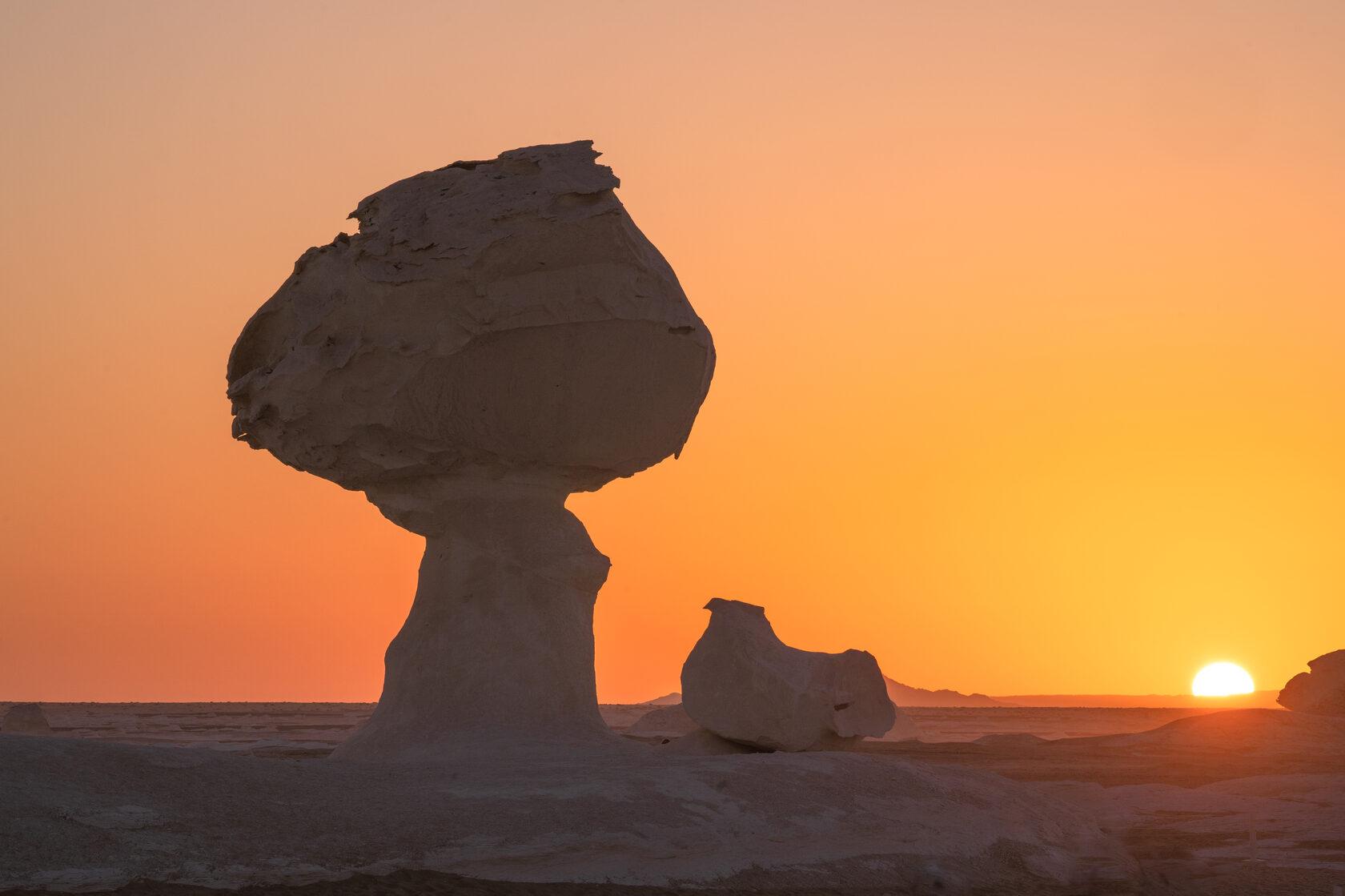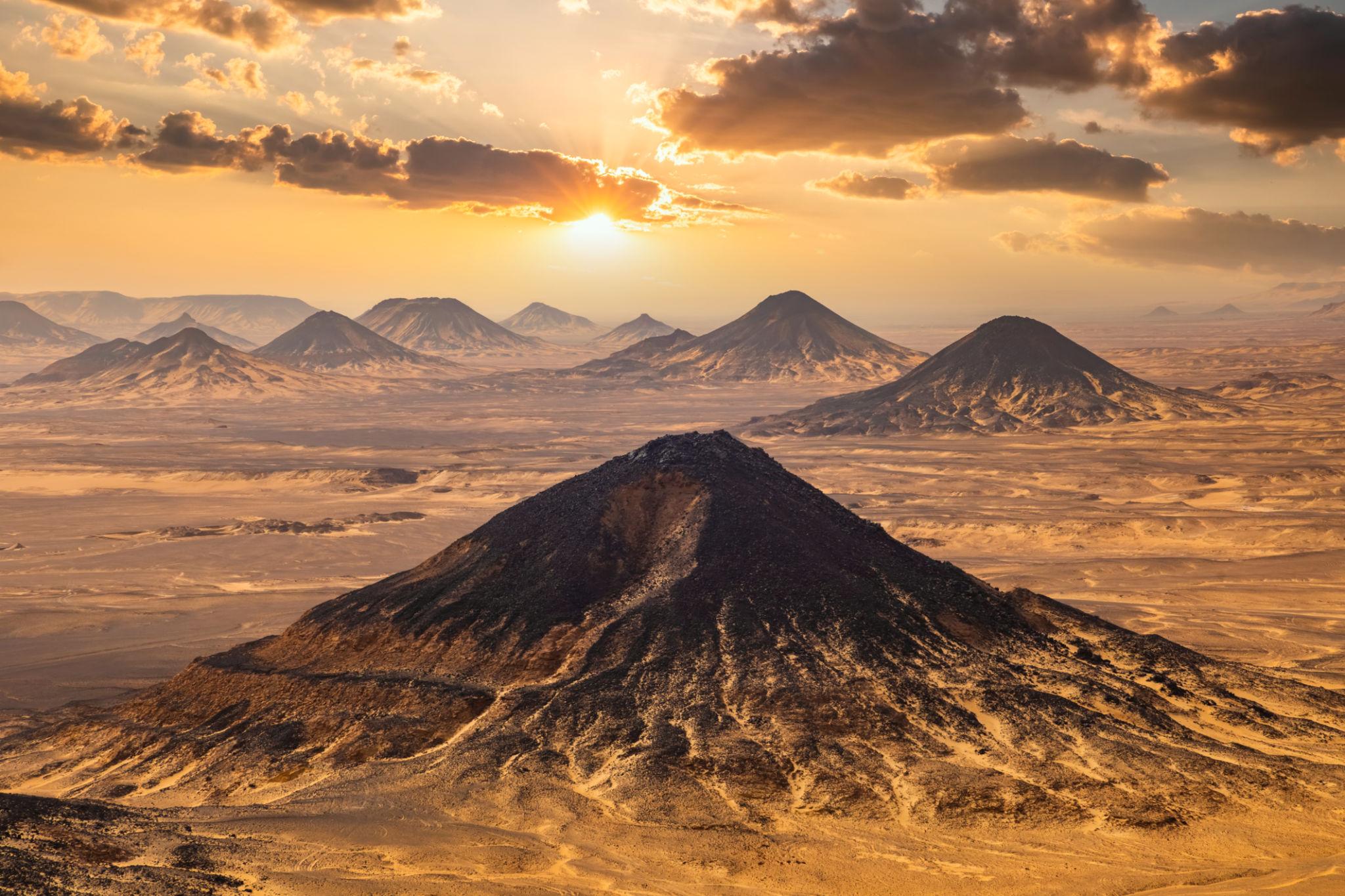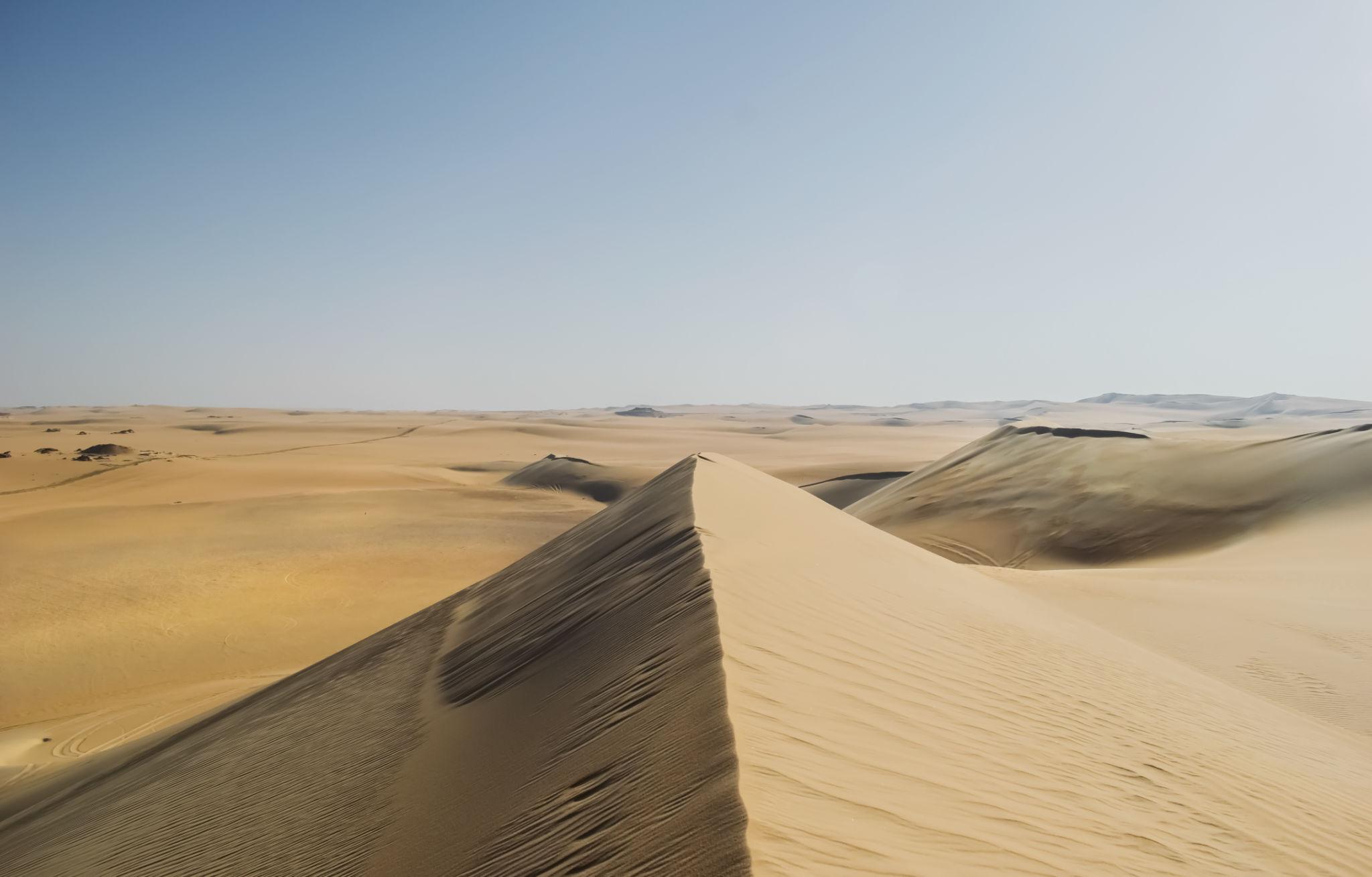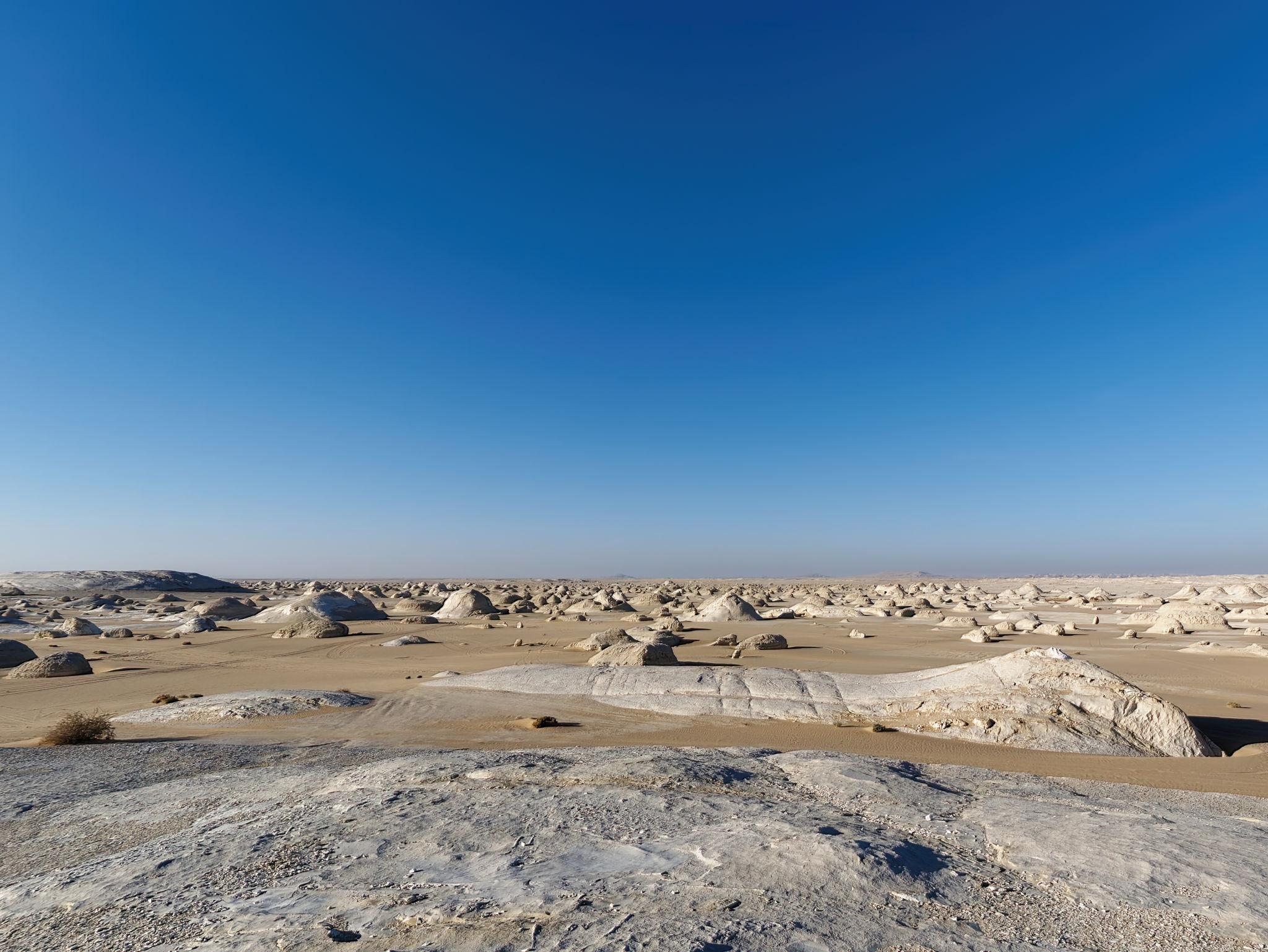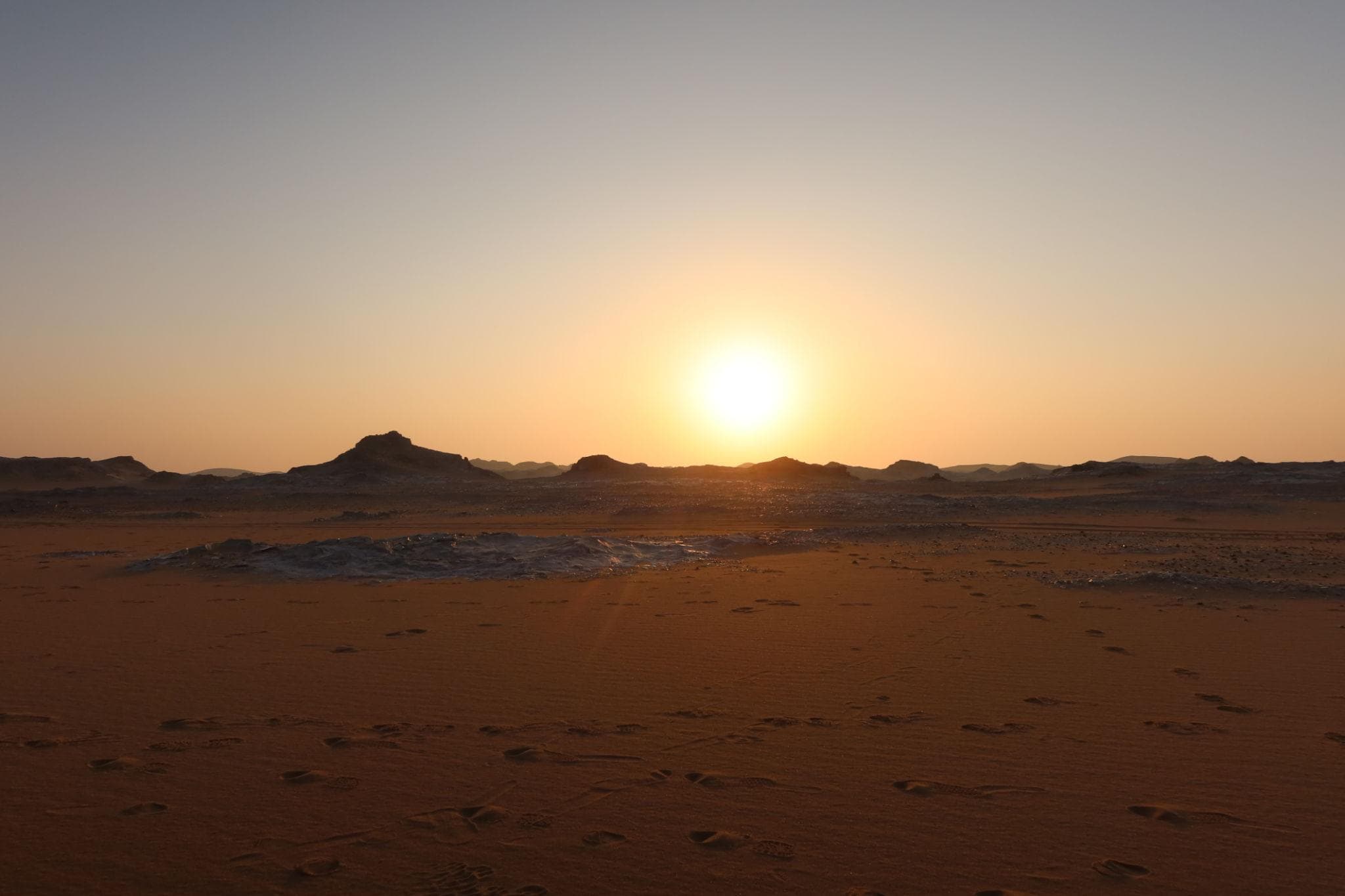
Four great depressions sit in a rough arc southwest of Cairo, and a single ribbon of two-lane asphalt now connects all of them: Bahariya, Farafra, Dakhla and Kharga, something in the region of 900 km of road with almost nothing in between. Drive the whole thing and you cross a chalk seabed eroded into white towers, a field of black volcanic cones, a Roman temple built under Nero, a mudbrick town you can genuinely get lost inside, and one of the few substantial temples surviving from Egypt's Persian period.
Most visitors do one night in the White Desert and fly home. That is a perfectly good trip and we run it constantly. The circuit is a different proposition: long empty driving, small family-run hotels, sites where a custodian has to be found before a gate opens, and stretches where the only other vehicle for an hour is a truck heading for the phosphate works at Abu Tartur. It rewards people who like the road as much as the destinations.
This is a route-level guide: what each leg costs in kilometres and hours, where the surface drifts with sand, when a 4WD is required, and how to build a realistic seven-day or ten-day version.
At a Glance
Full loop: roughly 900 km of asphalt from Cairo through Bahariya, Farafra, Dakhla and Kharga, plus 230 km out to Asyut or a little over 200 km to Luxor
Realistic length: seven days minimum for all four oases, ten to do it properly
Best months: October to April, with the coldest desert nights December to February
Vehicle: an ordinary 2WD car handles every paved leg; a 4WD and licensed driver are required off the asphalt
Permits: needed in advance for Bahariya, Farafra, the White Desert and the Black Desert
Tickets: 100 to 180 EGP for foreign visitors on the Ministry's last published list, roughly 2 to 4 USD
Fuel: Bawiti, Qasr al-Farafra, Mut and Kharga; the Farafra to Dakhla leg is the thin one
Mobile signal: patchy in the towns, absent a few kilometres outside them
Four Depressions and a Very Old Road
The names tell you how Egyptians have always thought about this landscape. Bahariya is al-Wahat al-Bahriyya, the northern oases. Dakhla is al-Dakhla, the inner one. Kharga is al-Kharga, the outer one, which the Romans knew as Oasis Magna, the Great Oasis. Three of the four now fall inside al-Wadi al-Gadid, the New Valley Governorate, while Bahariya belongs to Giza.
None of this is new ground. The Darb al-Arba'in, the Forty Days Road, ran roughly 1,800 km from Kobbei in Darfur to Asyut on the Nile, passing through Kharga as its last major watering point. Caravans carried gold, ivory, ebony, salt, natron, spices, livestock and enslaved people along it from pharaonic times into the nineteenth century. The name was optimistic: the crossing more often took nearer sixty days. Modern asphalt follows a similar logic, hopping from aquifer to aquifer, because water is still the only reason any of these places exist.
Leg One: Cairo to Bahariya, 330 to 370 km
Sources genuinely disagree here, and both are right. Rough Guides gives roughly 330 km, Wikipedia and most operators 365 to 370 km, and the gap is where you start counting: central Cairo, the Giza ring road, or the edge of 6th of October City. Either way, budget four to five hours on a well-surfaced desert highway first paved in the early 1970s.
There is nothing to see for the first three hours. The oasis then appears as a green trench below the road, and Bawiti is where you regroup. This leg also works as a standalone two-day return trip, which is what our Bahariya Oasis golden mummies tour is built around. The Bahariya Oasis depression runs about 94 km long and 42 km at its widest, so allow more local driving than the map suggests.
Leg Two: Bahariya to Farafra, 185 km
This is the famous stretch and the shortest of the four: about 185 km, two to two and a half hours if you drove straight through, which nobody does. The Black Desert begins around 20 km south of Bawiti, where dolerite caps have weathered into dark rubble over ochre cones. Further south a ridge of barite and calcite known as Crystal Mountain sits a few metres off the road, and beyond it the Agabat valley opens into cliffs and dunes.
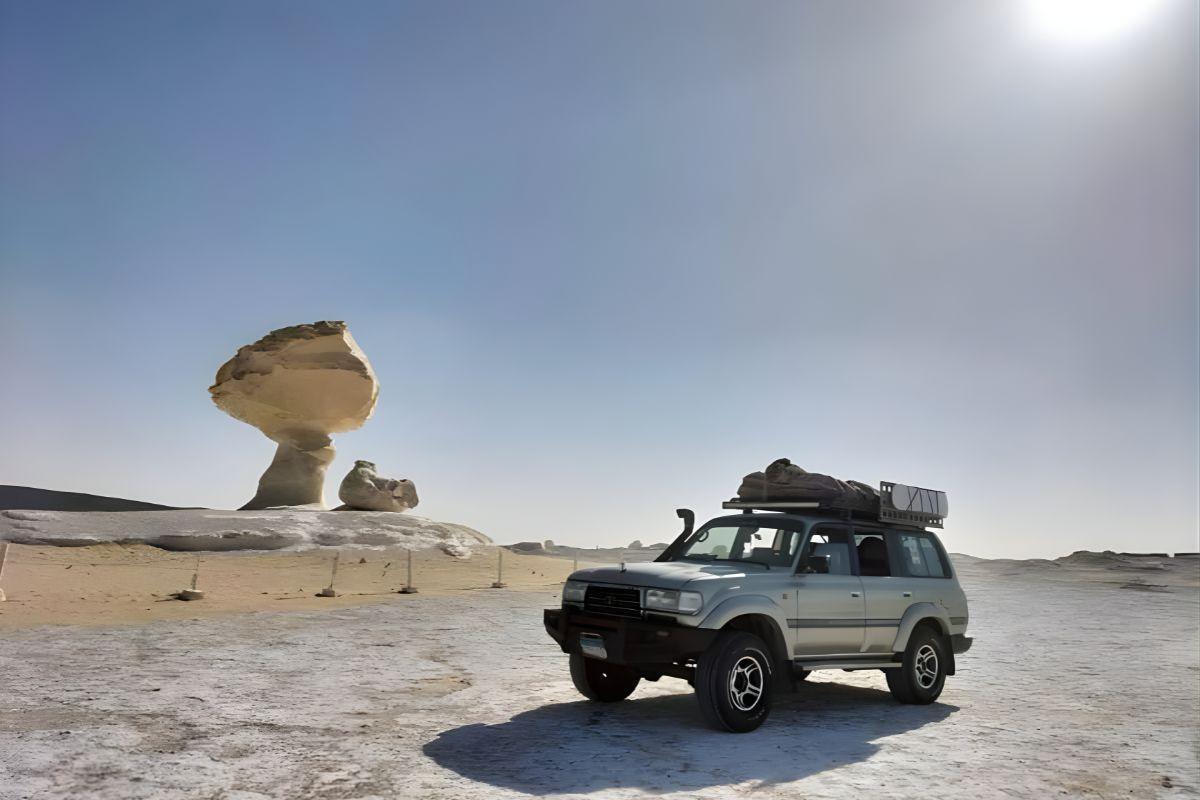
White Desert National Park was declared a protected area in 2002 and covers around 300 km2, with the densest chalk formations roughly 45 km north of Qasr al-Farafra. You cannot enter in your own vehicle: park access means a 4WD, a licensed driver and a permit. Almost everyone spends a night inside, which our White Desert and Black Desert overnight safari covers, and our White Desert camping guide goes further into what that night is actually like.
Leg Three: Farafra to Dakhla, the Long Empty Stretch
Here the sources disagree more seriously. Rough Guides puts Farafra to Dakhla at about 200 km; Wikivoyage and several regional guides give 300 to 310 km. The straight-line distance is close to 200 km, so the lower figure looks like a map measurement rather than a road one. Plan for nearer 310 km and around four hours.
The surface is tarmac throughout, but it crosses the Abu Muharrik dune belt and sand drifts across it regularly. Graders clear it, though not instantly, so after a windy spell expect to weave around tongues of sand at low speed. The old caravan descent into the oasis, Naqb al-Qasr, is unpaved, littered with limestone blocks and strictly for experienced off-road drivers. The modern road brings you in past Mut, where the hospital, banks and most accommodation are. Dakhla is the leg most people wish they had given an extra day.
Leg Four: Dakhla to Kharga, and Out to the Nile
Mut to Kharga town is about 190 to 200 km and two and a half to three hours, the easiest driving of the circuit. Two Ptolemaic and Roman fortress temples, Qasr al-Ghuweita and Qasr al-Zayyan, sit roughly 20 km south of Kharga and make an obvious first afternoon.
From Kharga you have three exits. North to Asyut is roughly 230 km of gravel desert climbing the escarpment, and puts you on the Cairo to Luxor railway. Southeast to Luxor is a good highway of a little over 200 km, usually three hours, and it is the most satisfying finish because you go straight from empty desert to the Theban temples. Straight back to Cairo is possible but a very long day. If you are ending on the Nile rather than doubling back, a one-way Cairo to Luxor transfer at the start saves an awkward internal flight. Our Kharga guide covers Hibis, Bagawat and the southern temples.
Warning: Permits, Checkpoints and One Road You Cannot Use
Read the current advisories before you commit. As of 2026 the UK Foreign, Commonwealth and Development Office advises against all but essential travel to the area west of the Nile Valley and Delta, but explicitly excepts the White Desert, the Black Desert and the oasis towns of Bahariya, Farafra, Dakhla (Mut) and Kharga. The circuit itself is carved out of the warning; the empty desert either side of it is not. The FCDO adds that tourists entering Bahariya, Farafra, the White Desert and the Black Desert must apply for permits in advance and use an official guide. The US State Department keeps Egypt at Level 2 overall while flagging parts of the Western Desert as do-not-travel unless you are with a licensed tour company.
One point catches people out. The direct desert road between Bawiti and Siwa is closed, with military checkpoints, and the FCDO advises against all but essential travel on it. You cannot chain Siwa onto this loop by driving west from Bahariya. Siwa is reached from the Mediterranean coast instead, making it a separate journey: either a dedicated Siwa three-day desert adventure or a long Cairo to Siwa transfer via Marsa Matruh. Expect passport checks at every oasis entrance, carry your original passport rather than a copy, and allow fifteen to twenty minutes at each. Our guide to desert permits and choosing an operator covers the paperwork.
Vehicles, Fuel, Cash and Phone Signal
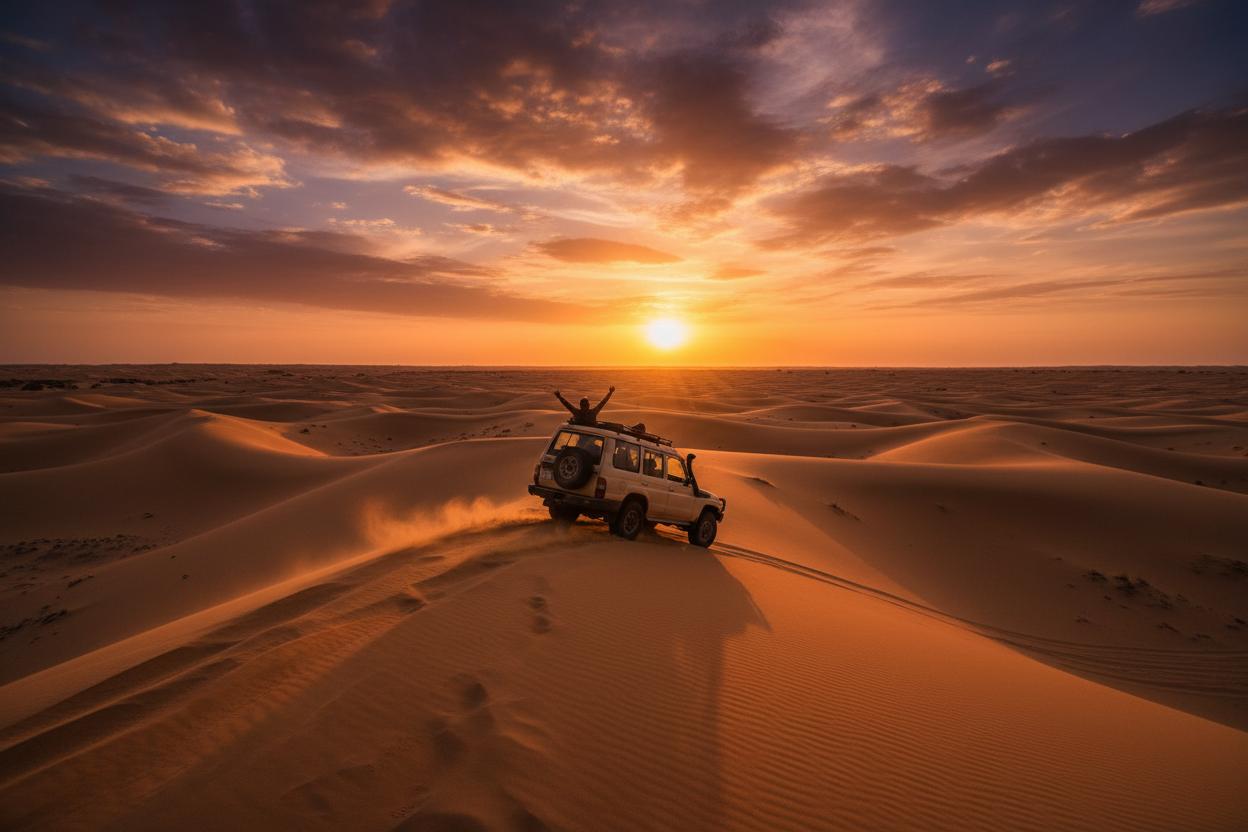
Every leg above is paved and a standard 2WD saloon will drive all of it. The 4WD is for what happens off the road: the White Desert, the Black Desert cones, the dunes around Farafra, and any track called a shortcut. Do not treat a hire car as a desert vehicle; people get stuck in soft sand within sight of the tarmac every season.
Fuel exists at Bawiti, Qasr al-Farafra, Mut and Kharga, usually at the town entrances, but stations run dry and the Farafra to Dakhla leg is the one to start full. Fill up whenever you pass a working pump rather than when the gauge tells you to. Carry more drinking water than you think you need; Kharga and Dakhla draw on fossil groundwater from deep aquifers, and most travellers stick to bottled water for drinking.
Cash is the other trap. Egypt has moved most major ticket offices to card-only payment, but the small New Valley sites are inconsistent and ATMs in Bawiti and Farafra are unreliable. Carry enough Egyptian pounds for the whole circuit plus a working Visa or Mastercard.
Good to Know: What the Sites Cost and When They Open
These come from the Ministry of Tourism and Antiquities' last published English price list. Egypt raised entry prices broadly during 2025, so treat them as a floor rather than a quote.
Bahariya Oasis sites: 100 EGP for foreign visitors, 50 for foreign students, open 8am to 4pm
Dakhla sites (Muzawwaqa, Qila al-Dabba and Ayn Asil, Deir al-Hagar, Al-Qasr, Ezbet Bashendi): 100 EGP, 50 for students, 8am to 5pm
Temple of Hibis, Kharga: 180 EGP, 90 for students, 8am to 5pm
Al-Bagawat necropolis, Kharga: 120 EGP, 60 for students, 8am to 5pm
Qasr al-Ghuweita, Qasr al-Zayyan and Dush: 100 EGP each, 50 for students, 8am to 5pm
New Valley Museum, Kharga: 150 EGP, 75 for students, and note the short 9am to 3pm day
Pro Tip: Plan Each Day Backwards From the Gate
The biggest waste of time on this circuit is arriving somewhere at four in the afternoon. Bahariya's sites close at 4pm rather than 5pm, the New Valley Museum shuts at 3pm, and in December and January the sun is gone by half past five. Work out which gate closes first at your destination, subtract the drive, and leave earlier than feels necessary. At smaller sites the custodian holding the key may be somewhere else entirely, so an hour of slack is not wasted.
The Seven-Day Version
Seven days is tight but honest: one night in each oasis and one in the desert, with no room for a puncture.
- Day one: Cairo to Bawiti, four to five hours, afternoon at the golden mummies museum and the tombs of the nobles
- Day two: south through the Black Desert and Crystal Mountain, camp in the White Desert
- Day three: sunrise in the park, on to Qasr al-Farafra, afternoon in town and a soak at a spring
- Day four: the long Farafra to Dakhla run, arriving Mut in the afternoon
- Day five: Al-Qasr, Deir al-Hagar and the Muzawwaqa tombs, then drive to Kharga
- Day six: Hibis, Bagawat and the southern fortress temples
- Day seven: Kharga to Luxor, or north to Asyut for the train
The Ten-Day Version
Ten days is what we would actually recommend, and the extra three nights belong in specific places rather than spread thinly. Add a second night in the desert between Bahariya and Farafra, so you get both a sunset and a full sunrise without driving on either day. Add a second night in Dakhla, which has the richest concentration of things to look at and the worst ratio of sites to daylight. Add a buffer night at the end, because one mechanical problem otherwise eats your flight home. With more than ten days, do not add a fifth oasis; slow these four down and spend the surplus on the Nile.
When to Drive It
October to April is the season and the arithmetic is not subtle. Kharga's average daily highs run around 22C (72F) in midwinter with nights near 8C (46F), against roughly 42C (108F) in June and July; the record there is 50.3C (122.5F). Dakhla is similar, with a mean daily maximum around 21.5C (71F) in January and 39C (102F) in July. Out in the open desert, winter nights fall close to freezing, so the same trip needs both a sun hat and a fleece.
Spring brings the khamsin, the hot sand-laden wind that blows through roughly March to May. It rarely closes roads outright but it flattens visibility and makes camping unpleasant, so build a spare half-day into a March or April itinerary.
Choosing Your Version of the Loop
If you have three days and want the landscape, do Bahariya and the White Desert properly. That single leg holds the most photographed scenery in the Egyptian Sahara and it is four hours from Cairo. If you have a week or more and the appeal is the road itself and standing in a Roman temple with nobody else in it, the circuit is among the most rewarding things you can do in Egypt and still one of the least crowded.
What it is not is a trip to improvise. Permits, a driver who knows which unsigned turning leads to Deir al-Hagar, and a vehicle that will survive 900 km of desert asphalt are the difference between a great week and an expensive lesson. Tell us how many days you have and where you want to come out, and we will build the loop around that.