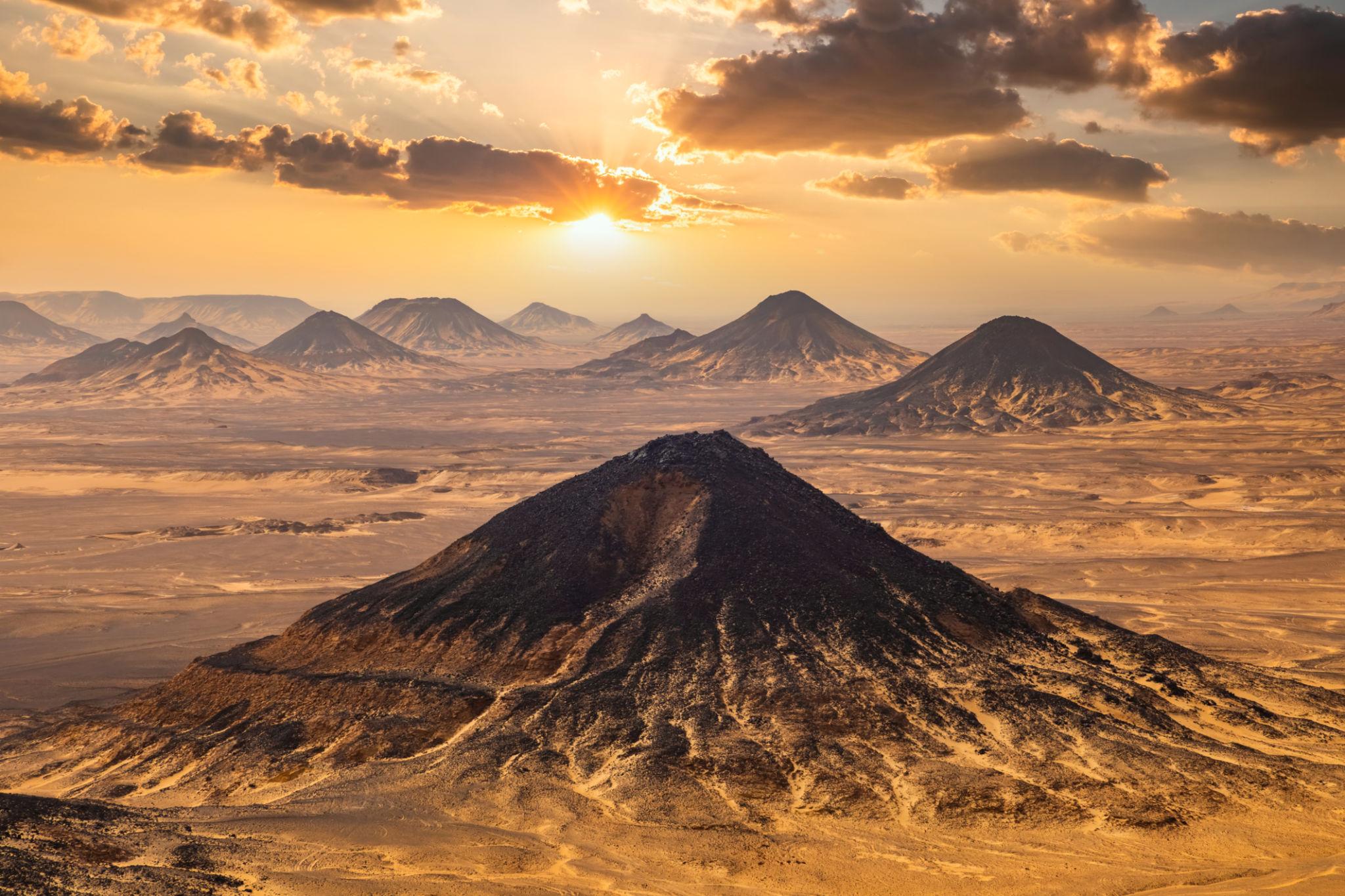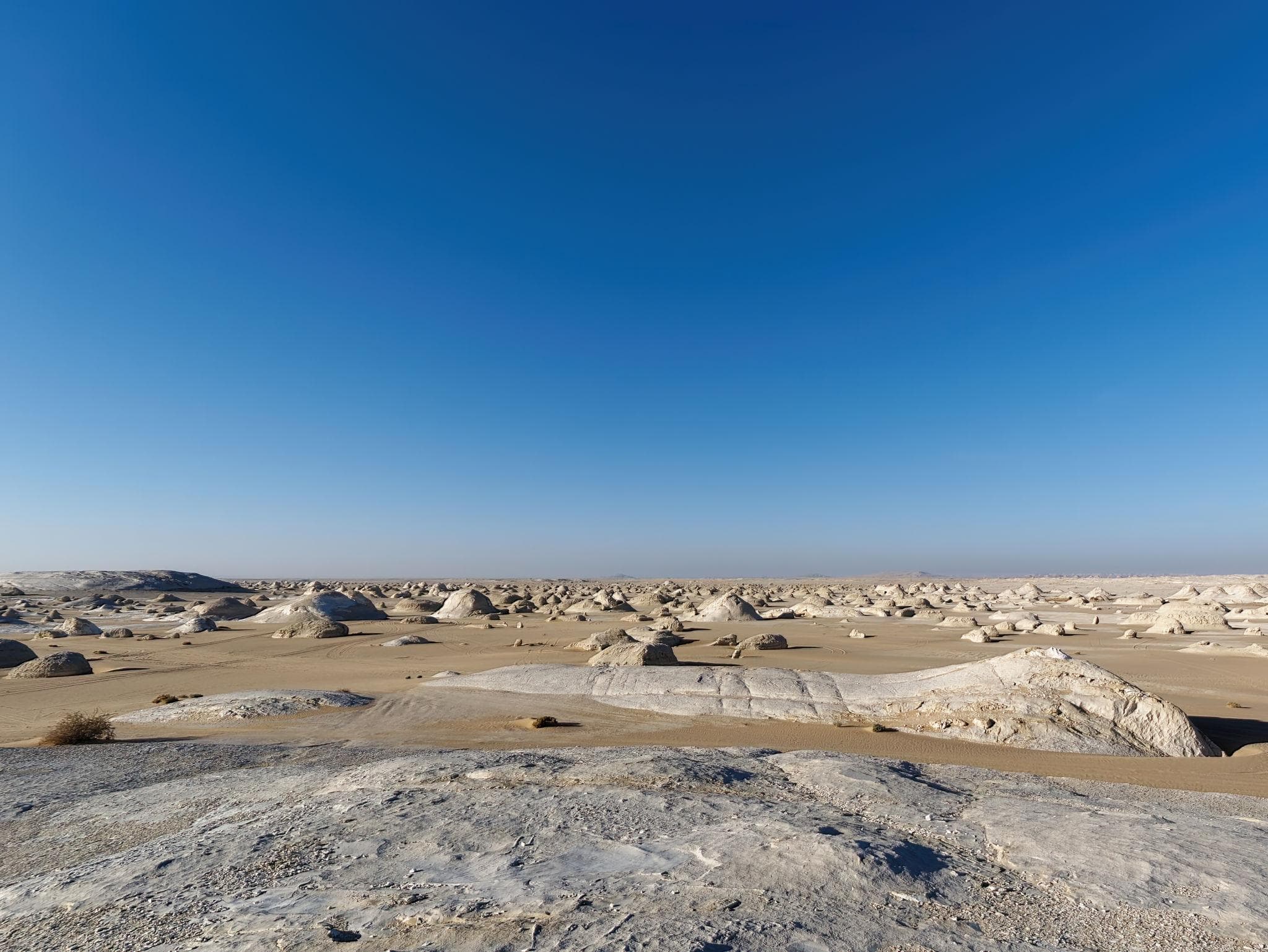
The road south from Bahariya runs for roughly 180 kilometres with almost nothing on it: black-capped hills, a police checkpoint, a rest stop that may or may not be open, then chalk country. Qasr el-Farafra arrives without ceremony. A fuel station, a mosque, a line of low sand-coloured buildings, and a crossroads where the highway from Cairo meets the road down to Dakhla. That crossroads is, more or less, the middle of town.
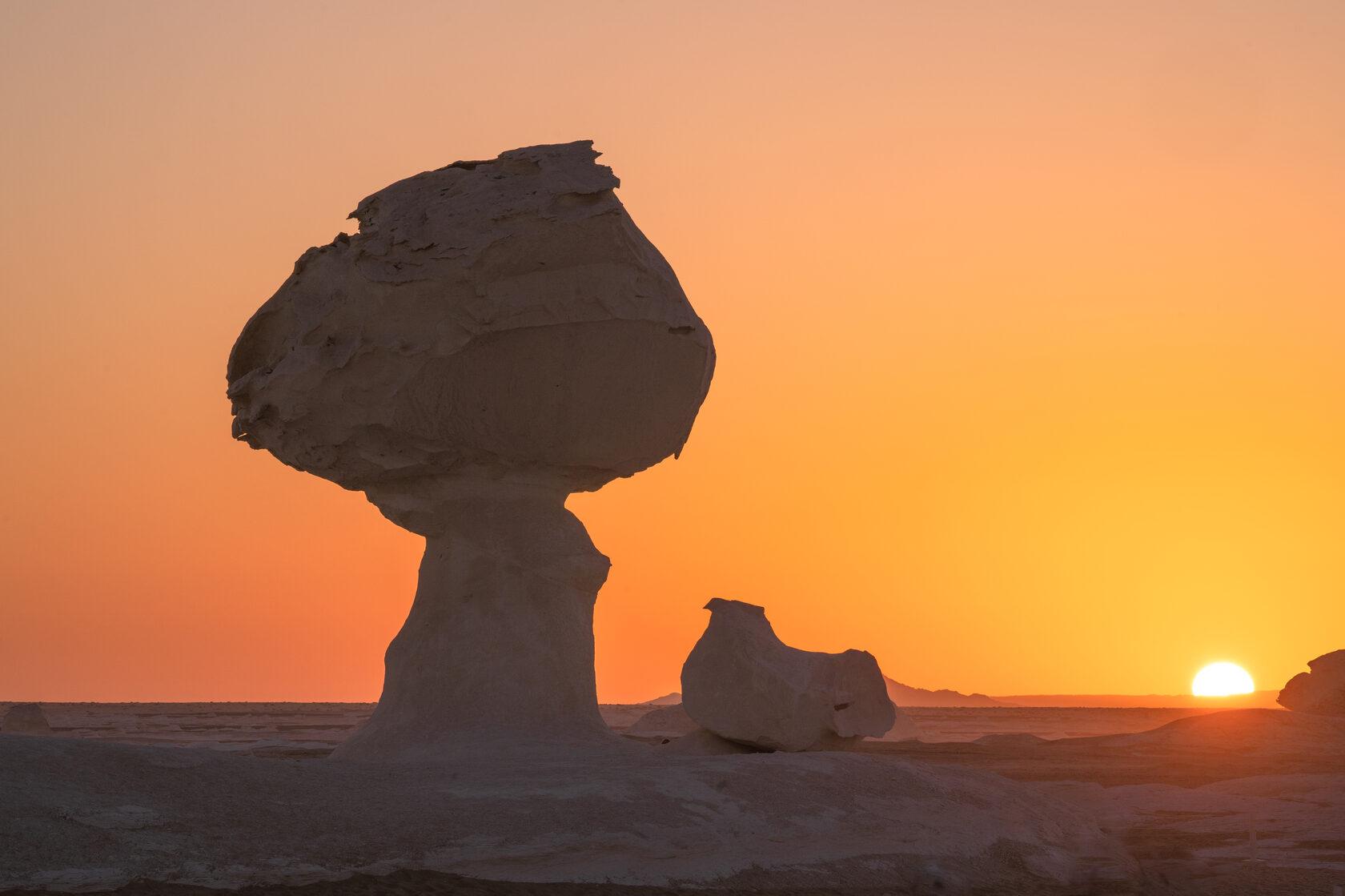
Most travellers see it at ninety kilometres an hour. Farafra is the smallest and least visited of the oases on the Western Desert circuit, and the standard White Desert package treats it as somewhere to buy water and turn around. Stopping changes the trip. You get the chalk formations at first light instead of mid-afternoon, a sulphur well to sit in afterwards, a genuinely strange mudbrick museum, and an evening in a town where the loudest sound after dark is a generator two streets away.
Set your expectations honestly, though. There is no temple here and no painted tomb. What Farafra offers is a working oasis of walled palm gardens and artesian wells at the doorstep of Egypt's most photographed landscape.
At a Glance
Where: Qasr el-Farafra, New Valley Governorate (al-Wadi al-Gadid)
From Cairo: roughly 600 km, with published figures ranging from 570 to 630 km; seven to eight hours with stops
From Bahariya: about 170 to 185 km, two to two and a half hours on good asphalt
From Dakhla (Mut): about 310 km on the modern highway, three and a half to four hours
White Desert National Park: immediately north, its boundary commonly given as about 45 km from town
Population: a few thousand in the old town, around 20,000 for the oasis, and roughly 37,500 for the wider Farafra markaz on Egypt's official 2023 estimate
Best months: October to April, with November and February to March the sweet spot
Permits: a permit and a licensed guide are required for the oases and desert parks; reputable operators arrange this
Money: assume cash. Card acceptance is minimal and ATMs unreliable
Where Farafra Sits on the Map
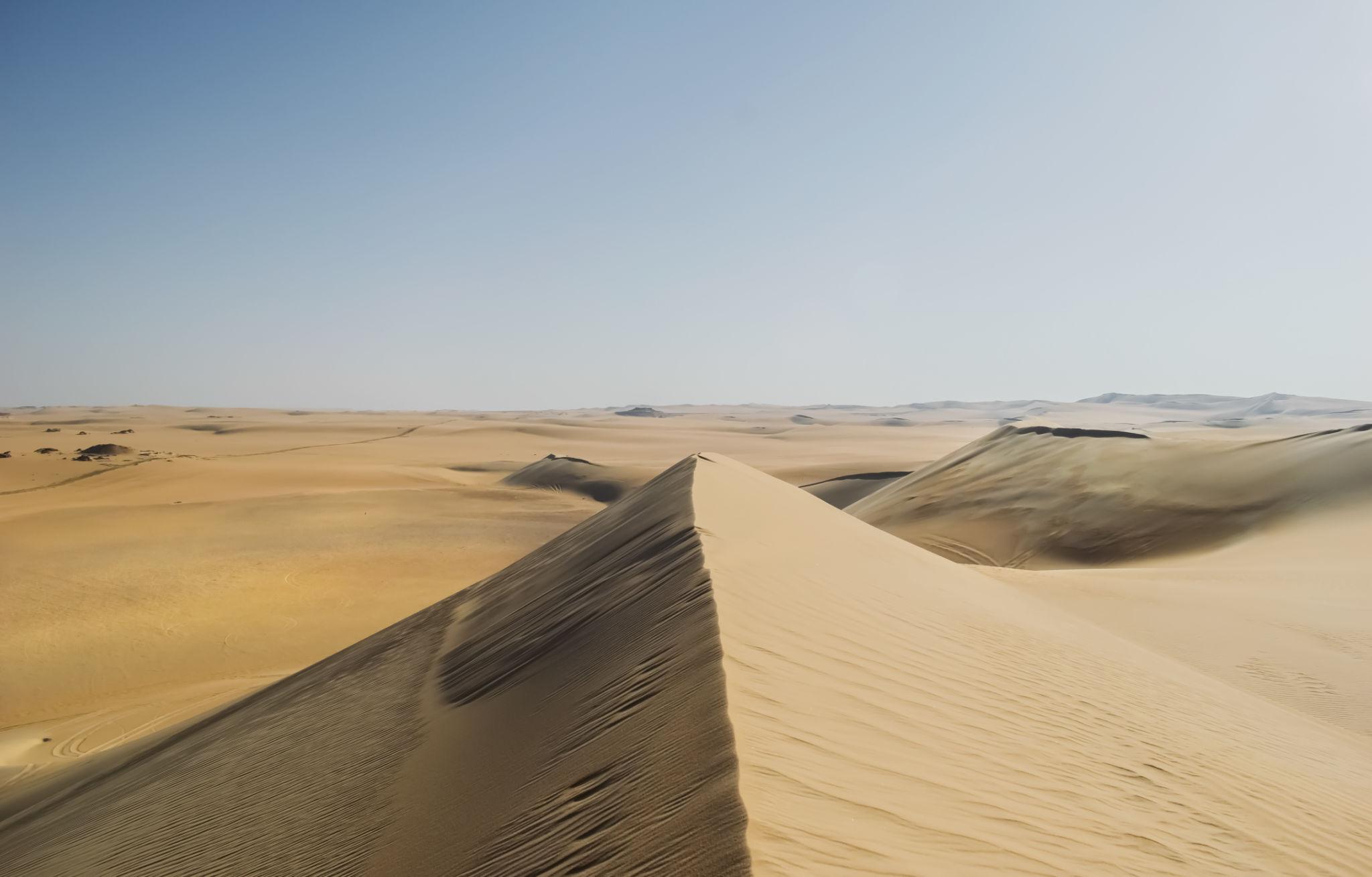
Farafra occupies a triangular depression midway between Bahariya Oasis and Dakhla, with the Great Sand Sea rolling away west toward the Libyan border. The practical point is that it is a long way from everything, reached by one single-carriageway road in from the north and one out to the south. Nobody arrives by accident. If a desert crossing is more than your itinerary can absorb, the Fayoum and Wadi al-Hitan day trip gives you desert scenery and fossil beds within a couple of hours of Cairo instead.
It works best as the middle link in a longer chain, and the Cairo to Bahariya to Farafra to Dakhla to Kharga run is covered in our guide to the Western Desert oasis circuit. This is the leg where people most underestimate the driving.
Qasr el-Farafra: The Old Town and the Palm Gardens
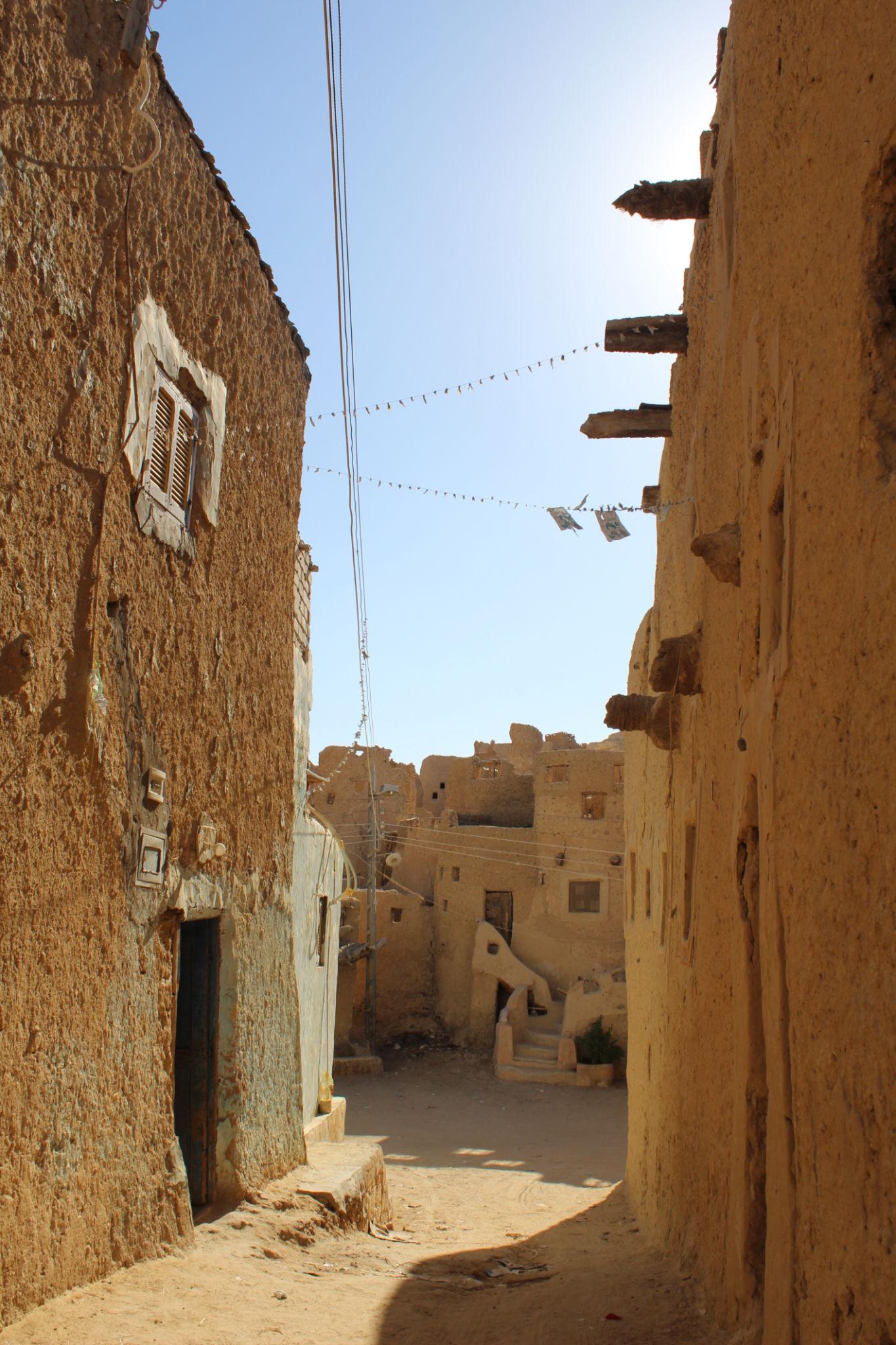
The town's name comes from its qasr, the ruined mudbrick fortress crowning the high ground where the houses cluster most tightly. Raised on the site of a Roman-era structure and enlarged in the medieval period, it is generally described as having had at least 125 rooms behind a single gate, with storerooms and a deep cistern inside. Heavy rain in the 1950s brought much of it down, and what stands is a partly collapsed warren shading into the houses around it. Several families still live in the sounder sections.
Walk down from the qasr and you are in the gardens within minutes. Farafra's agriculture is organised into small walled plots fenced with palm fronds and planted with dates, olives and fruit trees, cereals and vegetables filling the gaps. Water comes from wells rather than a river, and there are said to be more than a hundred across the oasis. That pattern has lately been overlaid by reclamation out toward Bir Qarawein, where centre-pivot circles have turned thousands of hectares of gravel into farmland.
Old gardens and new pivots draw on the same source, the Nubian Sandstone Aquifer, which holds fossil water laid down when the Sahara was wet and does not meaningfully recharge. How long that can continue is an open question among Egyptian hydrologists, and the most consequential fact about this landscape.
Good to Know: An Oasis Named in Texts but Barely Excavated
Farafra was known to the ancient Egyptians as Ta-iht, usually translated as the land of the cattle and generally linked to Hathor. Edfu lists it as the third of the Seven Oases, north-west of Kenemet, which is Dakhla. A Luxor Temple list from the reign of Ramesses II names it as a source of dates and minerals, and an inscription of his son Merenptah at Karnak records Libyan troops occupying the oasis in the Nineteenth Dynasty.
For all that, no pharaonic monument has ever been found here. The visible antiquity is Roman and Christian: at Ain Besay, roughly 12 km south-west of town, a Roman cemetery, mudbrick ruins and rock-cut tombs where hermits scratched crosses into the walls.
The deepest history is prehistoric. In Wadi el-Obeiyid, north of the oasis, an Italian mission led by Barbara Barich and later Giulio Lucarini has documented cave rock art including painted hand stencils, engraved boats, a giraffe and a bovid, first examined in 1995, alongside a Neolithic seasonal settlement in the Hidden Valley. Published dates range across the eighth to fifth millennia BC. These are not casual stops: reaching them needs official permission, an escort and a properly equipped vehicle.
The Badr Museum
The one thing worth planning a day around is the museum built by Badr Abdel-Moghny, a self-taught artist born in the oasis in 1958 who began turning his house into a gallery around 1990. The building is as much the exhibit as the contents: mudbrick throughout, with rounded openings, benches and niches shaped by hand, grown rather than built.
Inside are sculptures, sand and mud paintings, oils and watercolours, almost all depicting oasis life: women baking bread, men with camels, harvest scenes, the desert itself. Badr exhibited in Europe in the early 1990s and later in Cairo, and the work has a directness that survives being taken out of context.
Admission has been quoted at around 80 EGP in recent guidebooks, so budget 80 to 150 EGP (roughly 2 to 3 USD at the August 2026 rate of about 50 EGP to the dollar) and confirm on arrival. There are no reliable published hours; it opens when someone is there to open it, one more reason to travel with a local guide.
Bir Sitta, the Wells and the Lake to the North
Farafra's wells are numbered as well as named, and the one visitors are taken to is Bir Sitta, Well Six, about 6 km north-west of town. Water arrives hot and faintly sulphurous into a small concrete tank that spills into a larger one. Reported temperatures differ: some sources say about 32 degrees C (90 F), others 38 degrees C (100 F), both plausible depending where in the flow you sit. Bir Sab'a, Well Seven, is similar; Bir Ithnain wa Ishrin, Well Twenty-Two, is an irrigation well rather than a bathing spot.
Around 15 km north of town a brackish lake sits fed by well overflow, usually called El-Mufid, though some sources attach the name Abu Nus to the same area. It is a strange, flat, glittering thing with reed fringes and birdlife.
A Warning About the Springs, the Heat and the Silence
The wells are public and used by local families. Women should swim in leggings and a long t-shirt rather than a swimsuit, or use a hotel pool fed from a warm well. Nobody will make a scene, but Farafra is a conservative small town and visitors get remembered.
Soaking in water at body temperature when the air is already 38 degrees C is not refreshing, it pushes your core temperature up. In the warm months go at dawn or after dark, and drink more than feels necessary.
Above all, do not walk out of town into the desert alone. Phone coverage falls away once you leave the road, medical facilities are basic and anything serious means a very long transfer. Our guide to desert safety, permits and choosing an operator covers what a properly equipped vehicle should carry before it leaves the asphalt.
Farafra or Bahariya: Which Base Makes Sense
Bahariya, and specifically Bawiti, is the default. It is four to five hours from Cairo rather than seven or eight, has far more beds and operators, and has actual antiquities: the Greco-Roman gilded burials, the tombs of the nobles and the temple bearing Alexander's cartouche, all covered on our Bahariya and Golden Mummies day tour. Nearly every Cairo package, including the standard White Desert and Black Desert overnight, uses Bahariya as its springboard and camps inside the park rather than sleeping in a town.
Farafra wins on three counts: it is closest to the densest chalk formations at the southern end of the park, it is the logical overnight if you are continuing to Dakhla, and it is quieter by an order of magnitude. The trade-off is a shorter list of places to sleep and eat, and the fact that the Black Desert and Crystal Mountain both sit on the northern half of the drive, collected in passing rather than over a leisurely afternoon.
If you want a living oasis with salt lakes and a fortress town to walk around, that is Siwa, and our three-day Siwa adventure is a different trip entirely.
Where to Sleep and What to Eat
Farafra has a handful of small hotels and safari lodges, several built in adobe style on the edge of town, some with a pool fed from a warm well, plus basic guesthouses in the centre. There are no international chains. Rooms are simple and winter nights genuinely cold, so ask about heating and blankets rather than assuming.
Hotel kitchens are the practical option for dinner, and small places around the crossroads do fuul, taameya, rice and grilled chicken. Anything more specific, including most medicines and any camping gear you have forgotten, should be bought in Cairo or Bawiti.
Getting There by Road
The state bus company runs services from Cairo through Bahariya to Farafra and on to Dakhla. Farafra is roughly eight hours from Cairo and two and a half hours south of Bawiti, and fares are modest. Timetables shift, services run late and the bus will not wait, so do not build a tight connection around one.
Expect checkpoints. Passports are inspected and names and vehicle details recorded, particularly entering New Valley Governorate, so carry the passport itself, not a photocopy. As of mid-2026 the UK Foreign Office advises against all but essential travel west of the Nile Valley while explicitly excepting Bahariya, Farafra, Dakhla and Kharga along with the White and Black Deserts, and states that tourists entering these desert areas must hold permits arranged in advance and travel with an official guide. The road west from Bawiti toward Siwa is a separate matter and has been closed with military checkpoints. Check current advice before committing to a route.
Insider Tip: Enter the White Desert From the South at First Light
Groups based in Bahariya typically enter White Desert National Park in the afternoon, drive south through the formations and camp. Sleep in Farafra instead and you can be at the southern entrances at sunrise, among the densest chalk clusters while the light is low and the tracks empty, usually with an hour or two before the northern convoys arrive. The park was declared protected in 2002 and covers roughly 300 square kilometres. Entry fees have been quoted at around 5 USD per person plus a vehicle charge, and more recently near 250 EGP a head, plus a small camping fee; operators usually fold this in, but ask. Our White Desert camping guide covers what a night out there involves.
When to Go, Month by Month
The season is October to April, and the numbers explain why. January averages around 20 degrees C by day (68 F) and 4 degrees C overnight (39 F), December much the same. June and July average close to 38 degrees C (100 F) in the shade, and the record high here is 47.8 degrees C (118 F). Rainfall averages about 2 millimetres a year, effectively none, though the fallen fortress is a reminder that when it does rain it matters.
Nights are what people underprepare for. The record low is minus 3.3 degrees C, and a clear December night north of town feels far colder than the same reading at home. Bring a fleece, hat and windproof layers even in October. March to May can bring the khamsin, a hot sand-laden wind that flattens visibility and occasionally cancels desert plans, so build a spare day into a spring itinerary.
Planning a Night in Farafra
The most satisfying way to use Farafra is as an overnight in the middle of a southbound run: Cairo to Bahariya, a night in the White Desert, a second night in Farafra with the museum and Bir Sitta in the late afternoon, then the long road down to the mudbrick alleys of Al-Qasr and Dakhla. Five days minimum, seven to enjoy it.
If time is shorter, treat Farafra as a deliberate two-hour stop and spend the saved night in the park instead. Either way, tell your operator in advance that you want to stop, because left to itself the standard itinerary drives straight past the crossroads and you never know what was there.