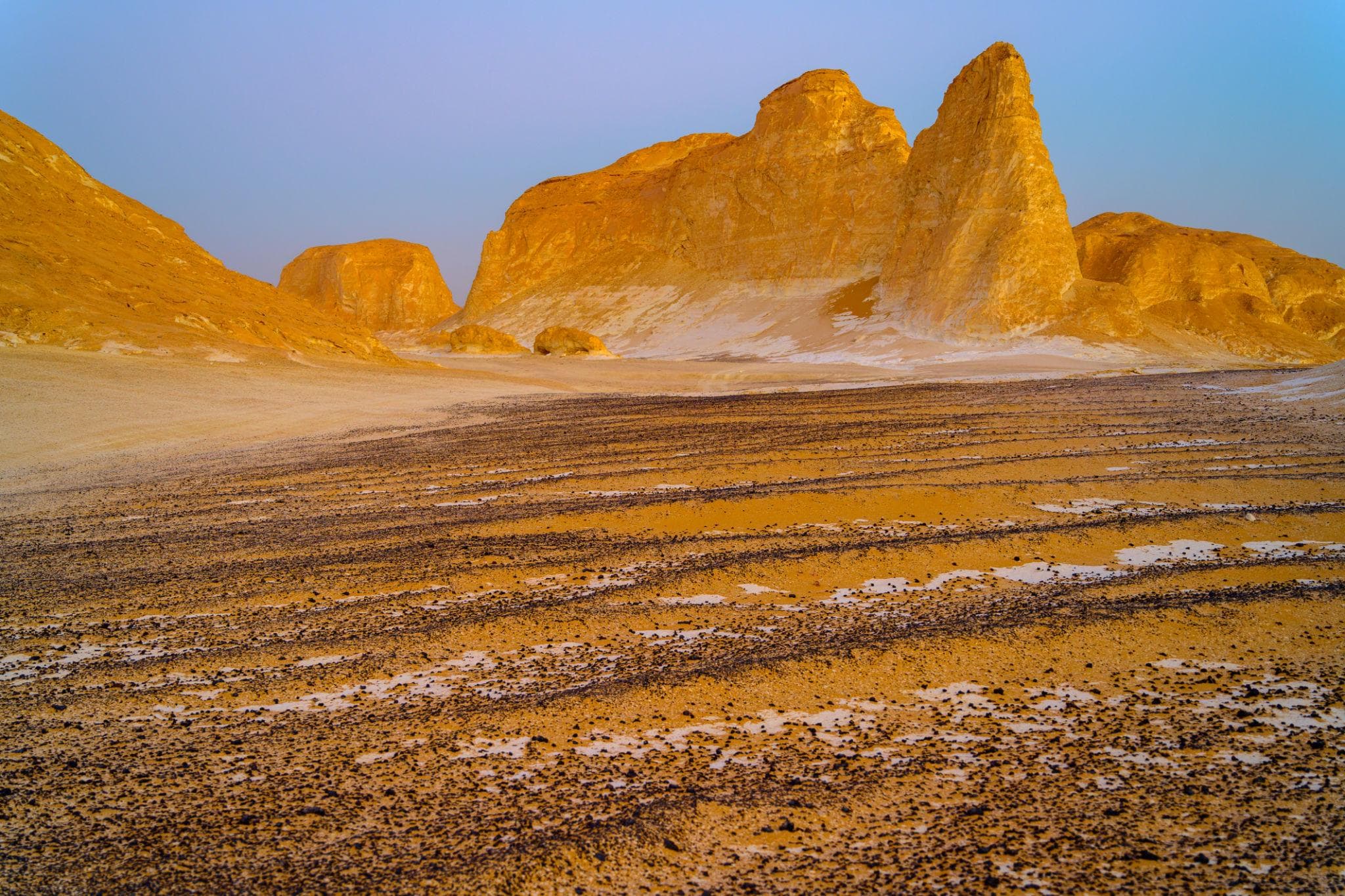
The Cairo–Alexandria Desert Road runs dead straight across flat grey gravel for about ninety minutes before the ground sags into a shallow depression of salt lakes, reed beds and date palms. This is Wadi El Natrun — Wadi al-Natrun, the Valley of Natron, named for the sodium salts the ancient Egyptians harvested here for mummification. Greek writers of the fourth century called it Scetis. Coptic tradition remembers dozens of monastic settlements scattered across this basin. Four are still working, still full of monks, and still open to visitors who arrive dressed properly and without a schedule.
Egypt is where the monastery was invented. Not the idea of religious withdrawal, which is far older and far more widespread, but the specific institutions that Europe inherited: the hermit's cell, the walled communal house with a rule and an abbot, the monastic day divided by hours of prayer, the copying of manuscripts as a form of labour. Two men in the Nile Valley in the late third and early fourth centuries set that in motion — Antony (Anba Antonius) in the Eastern Desert and Pachomius (Anba Bakhum) in Upper Egypt. Everything from Monte Cassino to Iona to the Cistercian granges of Yorkshire descends, by a traceable chain of texts, from what they did in the sand.
That makes these nine buildings among the most consequential structures in Egypt, and among the least visited. They also happen to sit in four completely different landscapes: a salt depression northwest of Cairo, the granite and limestone mountains behind the Red Sea coast, the desert edge above the Nile at Sohag, and a sandstone plateau across the river from Aswan. None of them is a museum. All of them are somebody's home.
At a Glance
Wadi El Natrun from Cairo: roughly 90 to 100 km northwest on the Desert Road; 1.5 to 2 hours each way depending on Cairo traffic
St Anthony's and St Paul's: inland from Zafarana on the Red Sea coast; roughly 300 to 330 km from Cairo (4 to 5 hours) or about 3 hours north of Hurghada
White and Red Monasteries: west bank near Sohag, around 480 to 500 km south of Cairo and about 3.5 to 4 hours north of Luxor
Deir Anba Hadra (St Simeon): Aswan west bank, opposite the southern tip of Elephantine Island
Entry: free at the Coptic monasteries, donations welcome; Deir Anba Hadra is a ticketed antiquities site
Best months: November to March; the Eastern Desert and Sohag are punishing from June to September
Permits: none needed for day visits; overnight guesthouse stays must be arranged in advance
Dress: shoulders and knees covered for everyone, no shorts, a light scarf useful for women
Who Antony Was, and Why It Happened in the Desert
Antony the Great was born around 251 in Coma, a village in Middle Egypt, to a comfortable Christian family. In his late teens or early twenties he sold his land, placed his sister with a community of virgins, and moved to the edge of the cultivation — first to a tomb, then to an abandoned Roman fort at Pispir on the east bank of the Nile, and finally, around the 310s, deep into the mountains behind the Red Sea coast. He died around 356, reputedly at 105.
He was not the first Christian ascetic in Egypt, and modern scholarship is careful about that. What made him the pivot was his biography. Athanasius, the combative bishop of Alexandria, wrote the Life of Antony shortly after his death, and it became one of the most widely read books of late antiquity: translated into Latin twice within a generation, then into Syriac, Coptic, Ethiopic and Georgian. Augustine describes in the Confessions how hearing about Egyptian monks pushed him towards his own conversion.
The desert mattered theologically. It was the place of testing, empty of the city's distractions and, in Christian cosmology, full of demons to be fought. It also mattered practically: land at the desert margin was free, unowned, and beyond the reach of tax collectors.
Pachomius and the Invention of the Communal Monastery
Antony's model was the hermit, living alone or in loose clusters of cells. The other Egyptian invention, and arguably the more influential one, was coenobitic monasticism — monks living together under a single written rule. That was the work of Pachomius, a former Roman army conscript who founded a community at Tabennesi in Upper Egypt in the 320s and by his death around 348 oversaw a federation of houses along the Nile with a shared economy, a timetable, uniform dress and an appointed hierarchy.
Pachomius's rule was translated into Latin by Jerome in the early fifth century. That translation, along with the writings of John Cassian — a monk who spent years among the fathers of Scetis in the late fourth century before founding houses at Marseille — is the direct textual bridge to the Rule of St Benedict, composed in Italy in the sixth century. Benedict names Cassian and the Egyptian fathers as authorities. Western monasticism did not evolve in parallel; it was imported.
Local Wisdom from Scetis
Go, sit in your cell, and your cell will teach you everything.
— Abba Moses, in the Sayings of the Desert Fathers
Wadi El Natrun: The Four Survivors
The four monasteries sit within about 20 km of one another, all reachable on paved roads off the Desert Road, which makes the valley the only place in Egypt where you can see four working ancient monasteries in a single day. If you are heading up to the coast anyway, the detour fits neatly into a private transfer between Cairo and Alexandria, since the turn-offs are directly on that route.
- Deir Anba Bishoy: the busiest and easiest, founded in the fourth century and associated with St Pishoy (d. around 417), whose body is venerated in the main church. Egyptian pilgrims arrive by the coachload on feast days.
- Deir al-Suryan: the Monastery of the Syrians, a compact walled enclosure a couple of kilometres from Deir Anba Bishoy. It became a centre of Syriac monasticism after Mesopotamian merchants acquired it, and its library was transformed in 927 when the monk Moses of Nisibis returned from Baghdad with some 250 manuscripts. Much of that collection was sold to European libraries in the nineteenth century; the oldest dated Syriac manuscript in existence, from 411, came from here and is now in London.
- Deir Abu Maqar: the Monastery of St Macarius, founded around 360 and historically the most powerful house in Scetis, supplying patriarch after patriarch. It is also the strictest about visitors. Reports differ on current practice — some visitors are received, others turned away — and you should assume access needs arranging in advance rather than at the gate.
- Deir al-Baramus: the most remote of the four, its Arabic name usually read as "of the Romans" in reference to the saints Maximus and Domitius. Quietest, plainest, and the one that still feels like a desert outpost.
Warning: Lent, Advent and Holy Week Close Doors
This is the single thing most independent visitors get wrong. Coptic monasteries restrict visits during the major fasts, when the community turns inward. Lonely Planet's guidance for St Anthony's, consistent with what drivers report on the ground, is that the monastery is open daily through the year except during Advent and Lent, when visits are limited to Friday, Saturday and Sunday, and that it closes completely during Holy Week.
The dates you need for the coming year: the Nativity Fast runs 25 November to 6 January, with Coptic Christmas on 7 January. Great Lent is a 55-day fast; because the Coptic Church follows the older Paschal reckoning, Coptic Easter falls on 2 May in 2027, which puts Lent from around early March, and Holy Week in the last week of April. Confirm before you commit a long drive, because the exact start of the fast is counted differently in different published calendars.
St Anthony's and St Paul's: The Eastern Desert Mountains
Deir Mar Antonios stands in an oasis at the foot of Mount Qulzum, inland from the coastal town of Zafarana, roughly 45 km up the road towards Beni Suef. Published distances from Cairo vary from around 300 to 334 km depending on whether the route goes via Suez or via Beni Suef, and the drive takes four to five hours either way. Coming from the Red Sea it is a shorter run, which is why many visitors build it around a Hurghada airport transfer and treat the monasteries as a day out from the coast rather than from the capital.
The Church of St Antony, built over the saint's tomb, holds one of the most important bodies of medieval Coptic wall painting anywhere. Most of the surviving secco paintings date to the early thirteenth century, with some elements possibly older; a long conservation programme stripped away centuries of soot and lamp grease, and the colours now read clearly. Monks guiding visitors will often walk you along a stretch of the fortified wall to the old basket-and-winch hoist, which was the only way in during raids.
Antony's own cave lies about 300 m above the monastery, up a stepped path that takes most people 45 minutes to an hour. Do it early. The view over the Wadi Araba to the Red Sea is the point.
Deir Anba Bula, the Monastery of St Paul the Anchorite, is closer to the coast, south of Zafarana. Tradition, following Jerome's Life of Paul, holds that Paul of Thebes fled the Decian persecution and lived in a cave for some eighty or ninety years before Antony found him shortly before his death around 341. Historians treat Jerome's account with real caution — the figure may be partly literary — and it is fair to say the monastery's cult is older and better documented than its founder. The cave church built into the rock is the reason to come: low, dark, hung with lamps and ostrich eggs. The two monasteries are 80 to 100 km apart by road, though the old pilgrims' footpath across the plateau is much shorter and should only be attempted with a guide.
The White and Red Monasteries at Sohag
Two of the greatest late-antique buildings in Egypt sit on the desert edge west of Sohag, about 4 km apart. Deir al-Abyad, the White Monastery, properly the Monastery of St Shenouda the Archimandrite, was founded in the late fourth century by St Pigol and expanded under his nephew Shenoute, who led it from roughly 385 until his death in 465 and whose Coptic writings are the largest body of original literature in the language. Its walls were built from limestone blocks quarried out of nearby pharaonic monuments, which is why the exterior looks unnervingly like a temple.
Deir al-Ahmar, the Red Monastery, is the more astonishing interior. Its triconch sanctuary is painted floor to vault, and a decade-long conservation project by the American Research Center in Egypt recovered the schemes beneath the grime. Dating is contested: the project's own analysis places the church in the late fifth century, while older literature, including museum sources, dates the complex broadly to the fourth. The paintings themselves are usually assigned to the sixth to eighth centuries in several campaigns.
Sohag is a long way from anywhere on the tourist map — roughly 480 to 500 km south of Cairo, and about 3.5 to 4 hours north of Luxor on the Nile-side road. Trains on the main Cairo–Luxor line stop here, but for the monasteries you need a car at the other end. Many travellers fold it into a private Cairo to Luxor transfer as a mid-route stop, which also passes the turn for Middle Egypt's other desert sites. Expect police checkpoints and be ready to hand over passport details; that is routine on Middle Egypt roads, and our guides plan the stop times around it.
Deir Anba Hadra: The Monastery of St Simeon at Aswan
Across the river from Aswan, on the plateau above the west bank, stands a ruined fortress-monastery whose walls are stone below and mudbrick above. Its Coptic name is Deir Anba Hadra; the popular name "St Simeon" appears to be a later confusion and no one has satisfactorily explained it. Epigraphy and wall painting put the foundation in the seventh century, with major rebuilding in the tenth, and the site was abandoned some time in the twelfth or thirteenth century — the standard explanation being pressure and raiding from the south.
Getting there is half the pleasure: a boat across from Aswan, then a walk of about a kilometre uphill through soft sand, or a camel from the landing. Reported opening hours cluster around 8am to 4pm, with earlier winter closing. Ticket prices are the one figure we would not stake anything on — older listings still quote 25 EGP, more recent visitor reports mention 80 to 100 EGP, and Ministry of Tourism and Antiquities prices have risen repeatedly. Budget 100 to 200 EGP (roughly 2 to 4 USD at the 2026 rate of about 48 to 50 EGP to the dollar) and carry cash. It pairs naturally with a felucca afternoon on the same stretch of water as the Nubian village tour, or with Philae and the High Dam on the day before.
Dress, Photography and How to Behave Inside
The monasteries are working communities that receive thousands of Egyptian pilgrims and a trickle of foreigners. Nobody will lecture you, which is exactly why it matters to get it right.
- Shoulders and knees covered, men and women. No shorts, no vest tops, no sheer fabric. A scarf for women is appreciated in churches even where not demanded.
- Take shoes off where you see others doing so, particularly in sanctuary areas.
- Ask before photographing monks, and never photograph during a liturgy. Some churches ban photography outright to protect pigments.
- Keep voices low, and do not walk into the sanctuary behind the iconostasis.
- Donations go in the box, not into a monk's hand. If a monk gives you a tour, a donation to the monastery is the correct thanks.
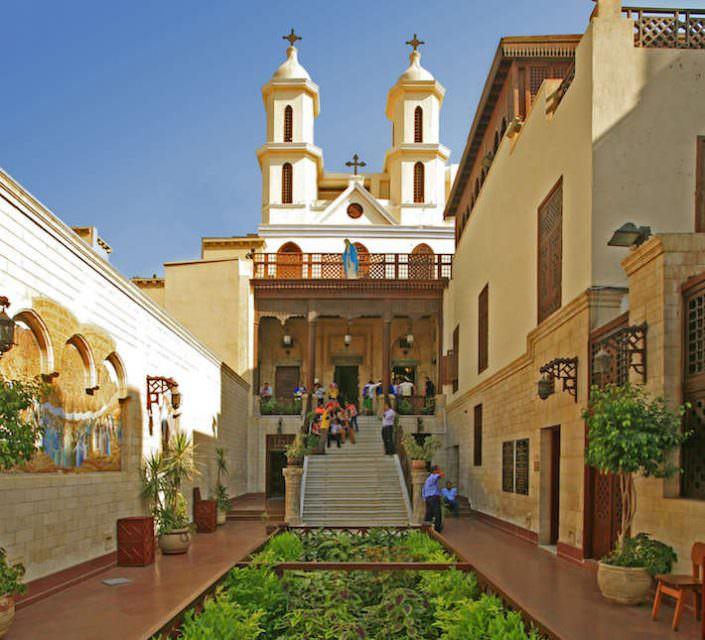
Our own briefing before any monastery day borrows heavily from the general principles in the guide to Egyptian culture and etiquette, and if you are new to Coptic Christianity the Coptic Cairo walkthrough is the best possible preparation. The churches of the Coptic quarter in Old Cairo give you the vocabulary — iconostasis, haikal, ostrich egg, Coptic script — before you reach the desert.
Insider Tip: Go Midweek and Go Early
Feast days and moulids fill these places with Egyptian families, which is wonderful to see and hopeless for looking at fourth-century architecture. Weekends are busy at Wadi El Natrun because Cairo can reach it in ninety minutes. Aim for a Tuesday or Wednesday morning, arrive by 9am, and you may have Deir al-Baramus or the Red Monastery church almost to yourself.
The other reason to go early is heat. Wadi El Natrun in July and August sits around 36 to 38°C (97 to 100°F) by mid-afternoon; the Eastern Desert interior and Sohag run hotter, regularly touching 40°C (104°F), and Aswan in June is brutal at 41 to 43°C (106 to 109°F). In January, by contrast, Cairo-area highs hover near 19 to 20°C (66 to 68°F) and desert nights drop close to single figures, so bring a fleece for early starts. The month-by-month weather guide breaks this down region by region.
What It Costs and What to Carry
Monastery entry: free at the Coptic monasteries of Wadi El Natrun and the Eastern Desert; donations expected
Sohag monasteries: no ticket reported as of 2026, with one source giving White Monastery hours of roughly 9am to 8pm — confirm locally, as hours flex with the liturgical calendar
Deir Anba Hadra, Aswan: an antiquities ticket; reports range widely, so allow 100 to 200 EGP (about 2 to 4 USD) as of 2026
Boat and camel at Aswan: negotiated separately, small cash sums, agreed before boarding
Carry: cash in small notes, water, a hat, a torch for cave churches, and modest layers you can adjust between a hot courtyard and a cold church
Prices in Egypt move quickly and the pound has been volatile, so treat every figure here as an approximation valid for 2026 rather than a fixed rate.
Building a Monastery Route That Actually Works
If you have one day, take Wadi El Natrun from Cairo and see three of the four houses properly instead of racing all four. With two, add the Eastern Desert pair as an overnight from the coast — the Red Sea end is far easier logistically than a Cairo return, and the Red Sea region has the flights and the road links. Sohag is for travellers already moving overland between Cairo and Luxor, and Deir Anba Hadra slots into any Aswan itinerary with a spare morning.
Read the desert sections alongside our Eastern Desert Roman quarries piece, since the same wadis carried both quarry traffic and monks, and if Sinai interests you, St Catherine's is a different tradition on a different mountain, covered in the Sinai desert guide. Tell us which regions you are already visiting and we will tell you honestly which monasteries are worth the drive and which are not — you can reach the team through the contact page.