Above the King's Chamber of the Great Pyramid, in a stack of low, sealed relieving chambers that no visitor is allowed into, the builders left their names. Daubed in red paint on the blocks are the names of work gangs, among them one calling itself the Friends of Khufu. Nobody was meant to read them. Ask how were the pyramids built, and those painted names are among the most honest answers we have: by organised crews of Egyptians proud enough of the job to sign it.
For a long time that question attracted more theory than evidence. That has changed. Since the late 1980s archaeologists have found the town where the builders lived, the cemetery where they were buried, the logbook of an official who shipped stone to Giza, and the traces of a lost branch of the Nile that brought it there.
This guide sets out what the evidence actually says, from the quarries and the ramps to the bread and beer, and where you can stand in front of that evidence on a visit to Giza, Dahshur, Saqqara and Aswan.
At a Glance
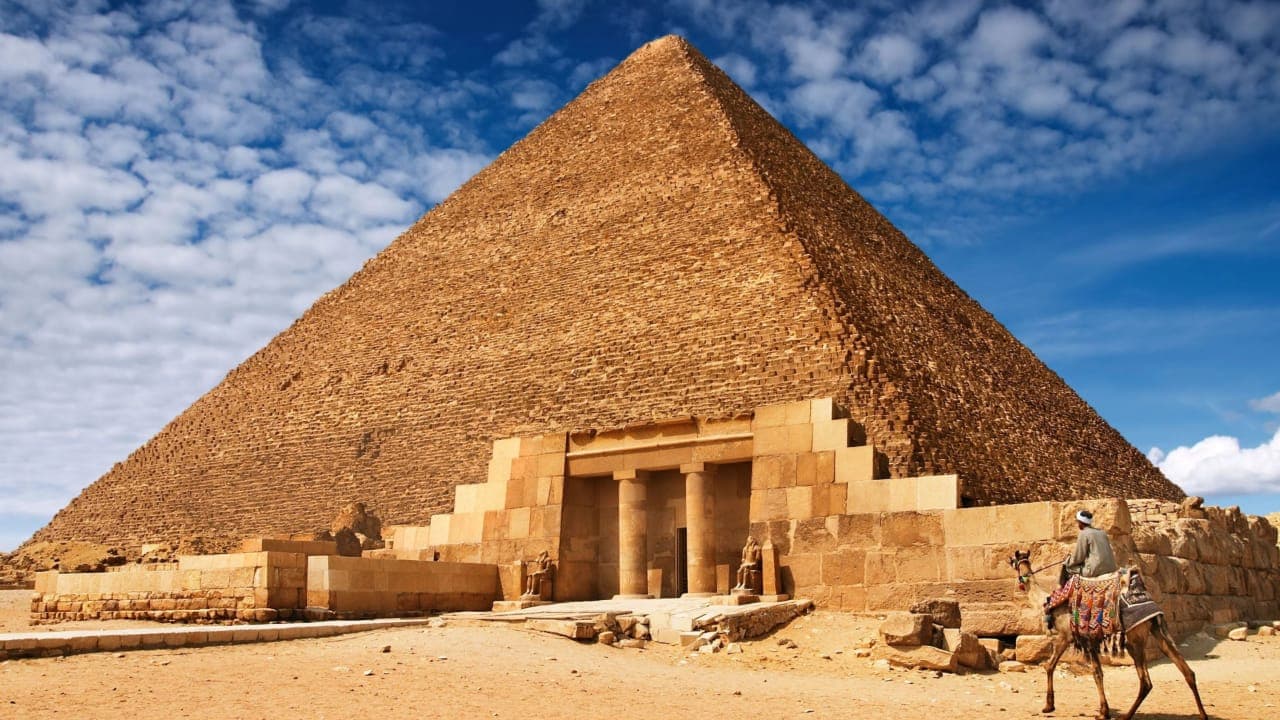
Great Pyramid: built for Khufu around 2560 BC, over two decades or more
Height: about 146 m (481 ft) when finished, about 138.5 m (454 ft) today
Blocks: roughly 2.3 million, averaging around 2.5 tonnes
Core stone: quarried on the Giza plateau itself, a few hundred metres from the pyramid
Fine casing: white limestone shipped across the Nile from Tura
Granite: from Aswan, more than 800 km (500 miles) upriver
Workforce: paid, fed, rotating crews; most modern estimates are in the low tens of thousands
Key evidence: the Wadi al-Jarf papyri, the workers' town and cemetery at Giza, the remains of ramps and quarries
Where to see it: Giza, Dahshur, Meidum, Saqqara and the Unfinished Obelisk at Aswan
From Steps to Smooth Sides: Meidum, Dahshur and Giza
The Great Pyramid did not appear from nowhere. It is the end of roughly a century of experiment, and the failures are as instructive as the successes. Around 2650 BC the architect Imhotep stacked six diminishing platforms of stone over the tomb of King Djoser at Saqqara, creating the Step Pyramid, usually described as the earliest large-scale building in cut stone anywhere in the world.
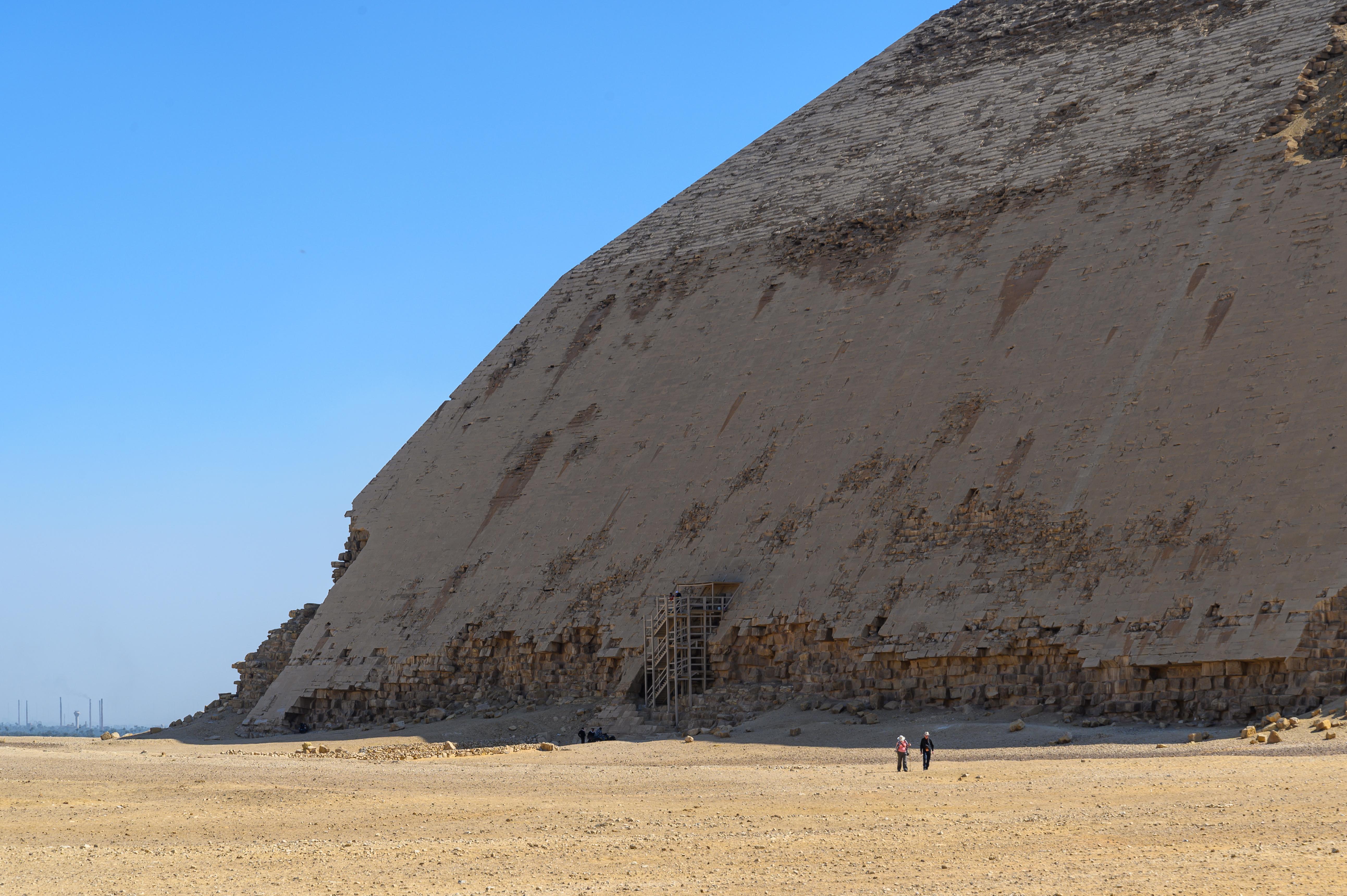
The next leap came under Sneferu, Khufu's father, who built at least three pyramids. At Meidum, a step pyramid was converted into a true pyramid by filling in the steps, and its outer casing later collapsed into the ruined tower you see today. At Dahshur, the Bent Pyramid rises at a steep angle of about 54 degrees before changing abruptly to about 43, most likely because the builders saw signs of structural trouble and lost their nerve. Sneferu's next attempt nearby, the Red Pyramid, used the gentler angle from the ground up and became the first successful smooth-sided pyramid.
Khufu inherited that experience, the workforce and the administrative machinery, and moved to a fresh site on the Giza plateau. Our guides to Dahshur's Bent and Red Pyramids and Saqqara and the Step Pyramid cover those earlier sites in detail.
The Quarry Is Right There
Much of the answer to how were the pyramids built is visible from the road. The great majority of the stone in the Great Pyramid is local limestone, cut from the plateau itself. The main quarry lies just south of the pyramid, a broad hollow you drive past on the way to the Sphinx, and the Sphinx itself was carved from a knoll of rock left standing in a quarry.
The quarrymen cut channels around each block with copper chisels and stone pounders, then levered it free along natural bedding planes. The core blocks were not finely dressed; many are rough and irregular, packed with rubble and gypsum mortar. Only the outer casing, now almost entirely gone, was finished to a smooth face.
That casing came from the finer, whiter limestone of Tura on the east bank of the Nile, south of modern Cairo. The granite beams that roof the King's Chamber, the largest weighing in the tens of tonnes, came from Aswan, more than 800 km upstream. Both had to cross or travel down the river, which is where the most important recent discovery comes in.
Merer's Diary: The Oldest Inscribed Papyri in Egypt
In 2013 a French and Egyptian mission led by Pierre Tallet was excavating an ancient harbour at Wadi al-Jarf on the Red Sea coast, the port for expeditions to the copper and turquoise mines of Sinai. In the storage galleries cut into the hillside they found fragments of papyrus. They proved to be the oldest inscribed papyri ever found in Egypt, and some of them were the logbook of a mid-level official named Merer.
Merer led a crew of perhaps 40 men. His entries, late in Khufu's reign, record a working routine over several months: loading limestone at the Tura quarries, sailing it across and downriver to Giza, unloading at a harbour basin near the pyramid, then returning for the next load, a round trip every few days. The work was supervised by Ankhhaf, Khufu's half-brother, named in the papyri as director of the harbour at Giza.
What makes the diary so valuable is that it is utterly unremarkable. There are no secret techniques, no thousands of slaves, just the routine logistics of a state project: crews, boats, schedules, a harbour and a chain of command. The timing fits the end of the build, when the fine Tura casing was being set in place.
Did You Know: The Nile Once Flowed Past the Pyramids
Today the pyramids of Giza stand on the edge of the desert, several kilometres from the river. In Khufu's time the water came much closer.
A study published in May 2024 in the journal Communications Earth & Environment, led by Eman Ghoneim of the University of North Carolina Wilmington, used radar satellite imagery and deep soil cores to map a long-vanished branch of the Nile, which the team named the Ahramat branch, Arabic for pyramids. It ran for about 64 km (40 miles) along the foot of the desert plateau, past some 31 pyramids between Lisht and Giza, and the causeways of several pyramids end close to its former banks. An earlier 2022 study of sediment cores from the floodplain below Giza had already shown that water levels in that area were high during Khufu's reign, high enough for laden boats to reach the harbour Merer describes.
Put simply, the builders brought the stone most of the way by boat, and chose their sites partly because the water could reach them.
Moving the Blocks: Sledges, Wet Sand and Copper Tools
Once ashore, blocks moved on wooden sledges hauled by teams with ropes. The most famous image of the technique comes from a Middle Kingdom tomb at Deir el-Bersha, painted for the official Djehutihotep, where well over a hundred men drag a colossal statue on a sledge while a man at the front pours liquid onto the ground in its path.
For a long time that figure was read as a ritual gesture. In 2014 physicists at the University of Amsterdam showed that it was practical. Wetting desert sand to the right degree stiffens it so that a sledge glides rather than ploughs, and in their experiments the correct amount of water roughly halved the force needed to pull a load. Too little or too much and the advantage disappears, which is exactly the kind of knowledge a skilled crew would have learned by trial.
The tool kit was simple but abundant. Copper chisels and saws handled limestone, while granite was worked by pounding with balls of harder dolerite and by sawing and drilling with copper blades fed with sand as an abrasive. Copper wore down fast, which helps explain the strategic importance of the Sinai mines and of the harbour at Wadi al-Jarf, and why a pyramid site needed its own workshops and smiths.
How Were the Pyramids Built Upwards? The Ramp Debate
This is the part with no single, settled answer. Getting blocks onto the lower courses is straightforward. Getting them more than 100 m up is the hard bit, and there are several competing models.
- A single straight ramp: simple, but to keep a workable slope it would have needed to be enormously long, with a volume rivalling the pyramid itself.
- A zigzag or switchback ramp climbing one face, or a spiral ramp wrapping around the pyramid as it rose, both of which keep the length manageable but complicate the corners.
- An internal ramp, built inside the structure, proposed by the French architect Jean-Pierre Houdin in 2007 and still unproven.
- Levers and short timbers lifting blocks course by course, close to what Herodotus described in the fifth century BC, two thousand years after the event.
The most useful physical evidence came in 2018, when a British and French team working at the Hatnub alabaster quarries in Middle Egypt announced a steep ramp from Khufu's reign, flanked by staircases and rows of post holes. The posts appear to have anchored ropes, allowing sledges to be hauled up a slope far steeper than many had thought workable.
Most Egyptologists now expect the real answer to be a combination: large supply ramps of rubble and mud brick for the lower bulk, then smaller ramps, steps and levers as the pyramid narrowed towards the top. Remains of construction ramps and embankments survive at several pyramid sites, and they were usually dismantled once the job was done.
The Town Where the Builders Lived
South of the Sphinx stands a massive stone wall known in Arabic as Heit el-Ghurab, the Wall of the Crow. Beyond it, since the late 1980s, the archaeologist Mark Lehner and his team at Ancient Egypt Research Associates have uncovered what is often called the Lost City of the Pyramid Builders.
It was a planned settlement. There are long galleries that appear to have housed rotating crews, bakeries with the heavy pottery moulds used to bake bread, storage buildings, administrative quarters and larger houses for officials. The rubbish heaps are the most eloquent part: huge quantities of bones from cattle, sheep and goats, plus fish, show that the workforce was supplied with meat on a scale that only a state could organise.
Much of the town has been carefully reburied under sand for its own protection, so there is little to see beyond the wall. What it changed is the picture of who the builders were and how they lived, which is the next question.
Who Built Them: Paid Crews, Not Slaves
In 1990 a horse stumbled over a low mud-brick wall on the slope above the town, and the excavations that followed, directed by Zahi Hawass, uncovered the cemetery of the pyramid builders. Senior overseers and skilled craftsmen were buried in larger stone tombs higher up the slope, lesser overseers and ordinary workers in mud-brick tombs and graves below, many with bread and beer for the afterlife and titles proudly recorded.
The skeletons tell their own story. They show the wear of heavy labour, arthritis and compressed vertebrae, but also healed fractures that had been set and splinted, and evidence that injured workers were cared for. Being buried in the shadow of the king's pyramid was an honour. That is not how a state treats slaves.
The modern consensus is a core of skilled permanent craftsmen, such as masons, surveyors and smiths, supported by a much larger rotating workforce drawn from villages across Egypt, serving for set periods as a form of labour obligation and fed, housed and paid in kind for it. Most estimates of the peak workforce fall in the low tens of thousands, far below the 100,000 men Herodotus reported.
Good to Know: What the Popular Myths Get Wrong
The slaves of Hollywood epics are the most persistent myth, and there is no evidence for them at Giza. The Giza pyramids were also built more than a thousand years before any plausible date for the biblical Exodus, so the story of Hebrew slaves building them does not fit either.
Claims of lost civilisations or visitors from elsewhere fall apart against the evidence on the ground: the quarries, the abandoned tools, the unfinished blocks, the workers' graffiti, the logbooks and the bakeries. The accuracy is real and impressive, with the Great Pyramid's sides aligned to the cardinal points within a fraction of a degree, but it is the accuracy of skilled surveyors with sightlines, cords and water levels, refined over generations. The arithmetic is formidable rather than impossible: 2.3 million blocks in 20 to 25 years works out at roughly one block set every two to three minutes of daylight, day after day, which is why the logistics mattered as much as the engineering.
Seeing the Evidence on a Visit
If the question on your mind is how were the pyramids built, look for the marks of building rather than the finished shape.
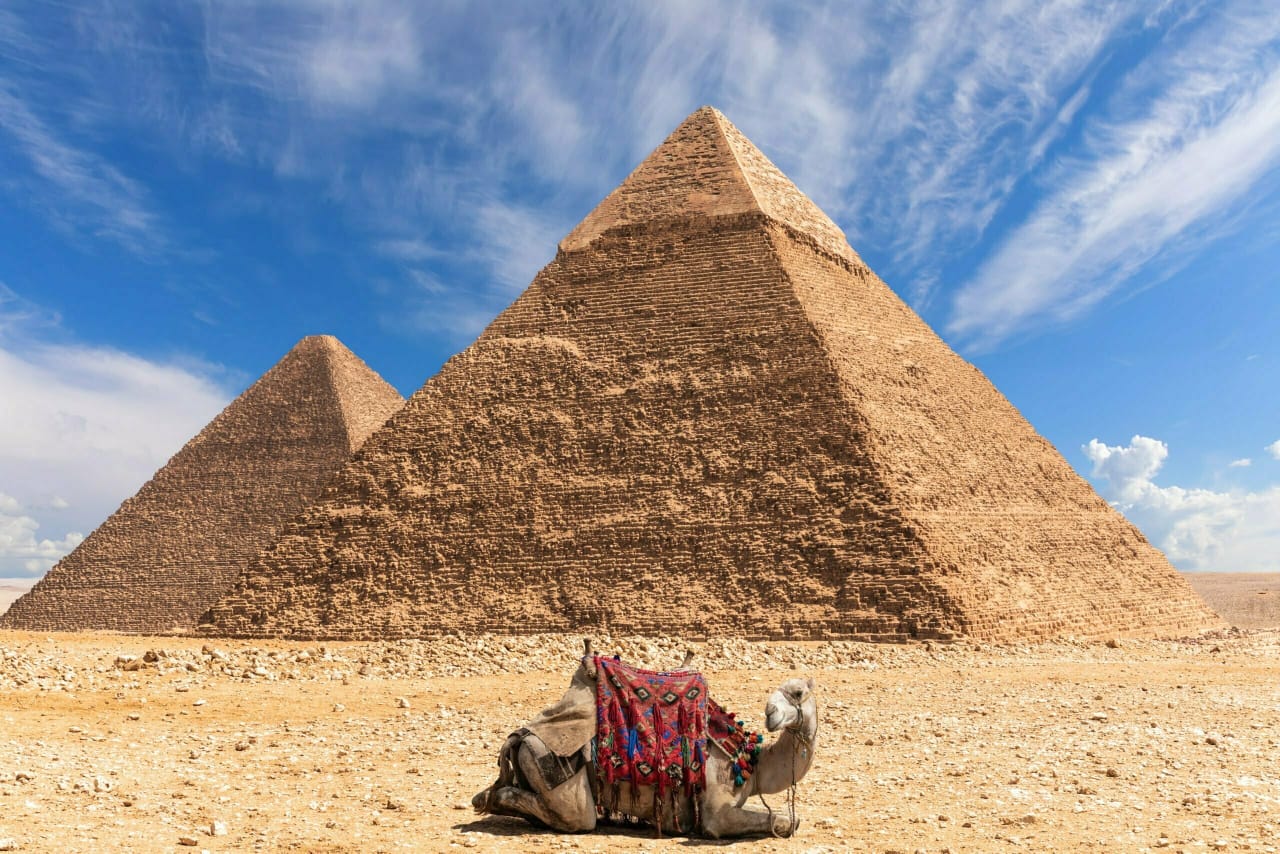
- At Giza, notice the rough, stepped core of the Great Pyramid, the cap of original casing still clinging near the top of Khafre's pyramid, and the quarry hollows south of the pyramids. The Wall of the Crow is visible on the edge of the town site.
- Inside the Great Pyramid, the Grand Gallery and the granite King's Chamber show the building at its most ambitious, on a separate ticket from the plateau.
- At Dahshur, the change of angle on the Bent Pyramid is the clearest record anywhere of builders learning as they went, and you can climb down into the Red Pyramid's corbelled chambers.
- At Saqqara, the Step Pyramid shows the beginning of the story.
- In Aswan, the Unfinished Obelisk lies cracked in its quarry, surrounded by the pounding marks of dolerite balls, a snapshot of how granite was worked.
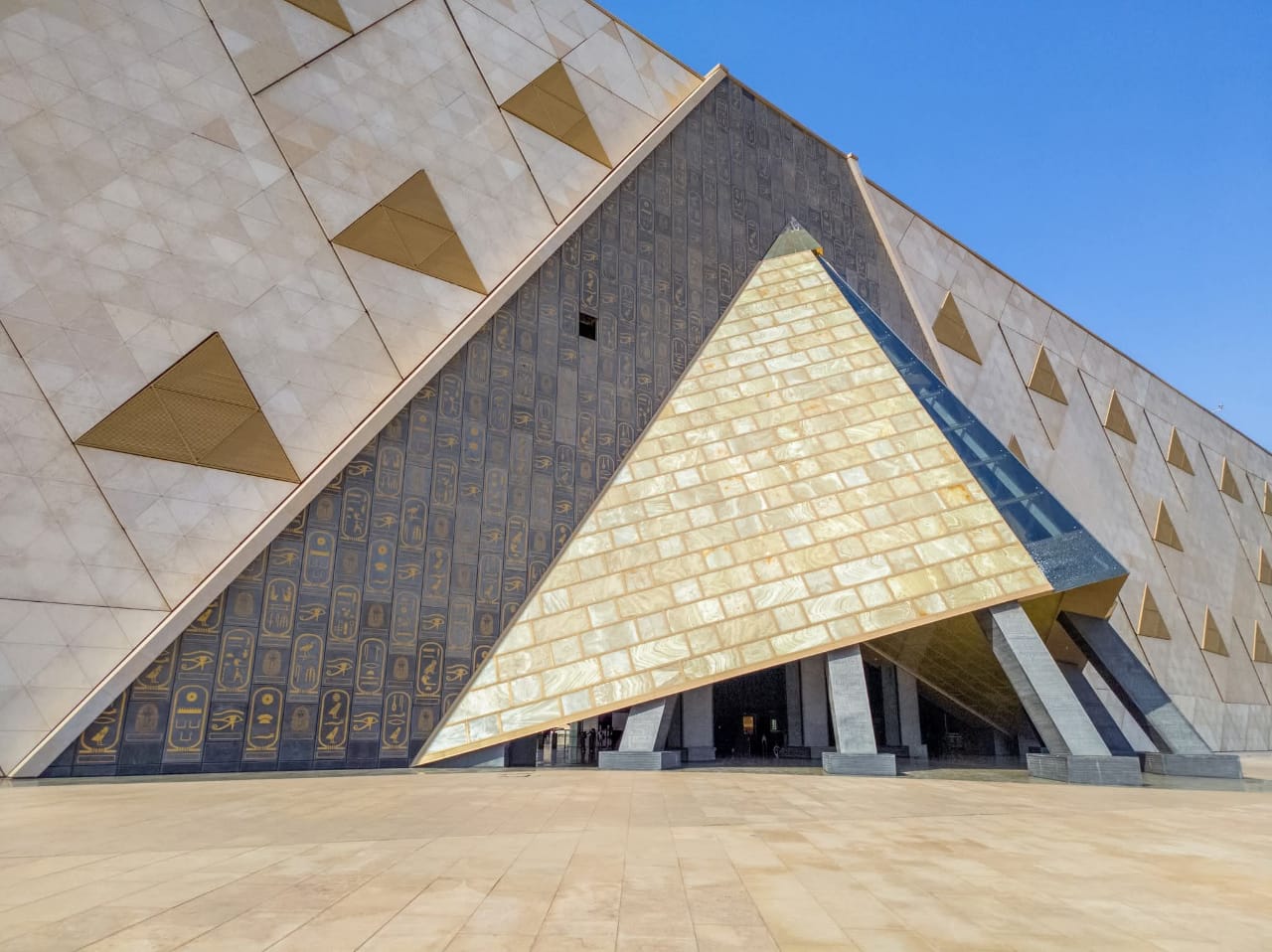
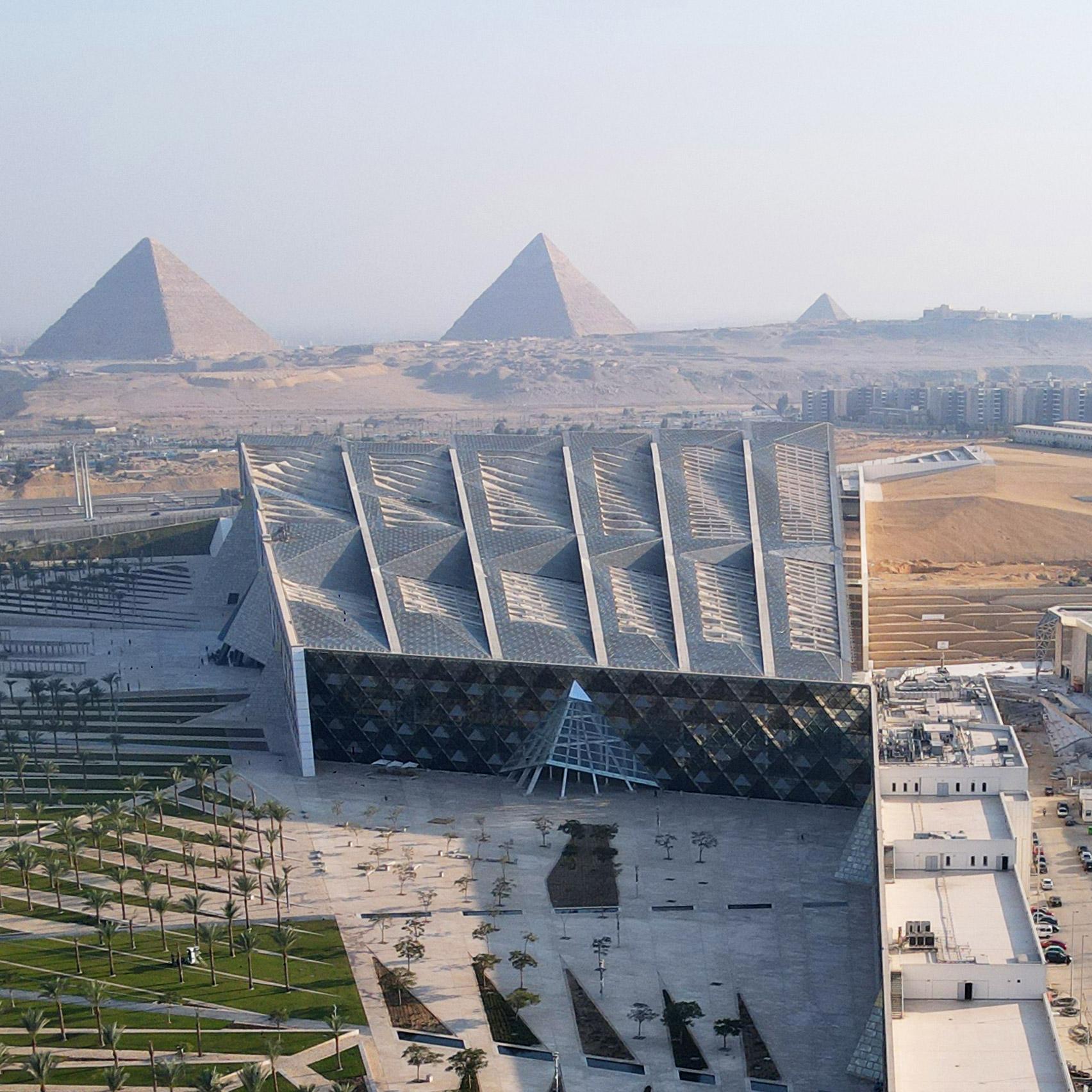
- At the Grand Egyptian Museum, Khufu's solar boat shows the same reign's mastery of timber and rope.
Ticket prices for Egypt's sites are revised often, frequently in the autumn, so check current figures shortly before you travel.
Insider Tip: Look Closely at Menkaure's Granite
The smallest of the three Giza pyramids, built for Menkaure, holds one of the best clues on the plateau. Its lowest courses were cased in red Aswan granite, and many of those blocks were never finished: their faces still bulge, rough and undressed, with only the areas around the entrance smoothed.
That tells you the casing was set in place first and dressed afterwards, working down from the top as the ramps came away. Menkaure's reign ended before the masons finished, and the job was simply left. Ask your guide to walk you along the north face to see it.
Warning: The Great Pyramid Interior Is Not for Everyone
Going inside the Great Pyramid is a real experience, but go in knowing what it involves. The ascending passage is barely more than a metre high, so you climb it bent double on a ramp with wooden slats, before the Grand Gallery opens out above you. The air is warm and humid, the passages are narrow and busy, and there is nothing to see in the King's Chamber except bare granite and an empty sarcophagus.
Anyone with claustrophobia, heart or breathing problems, or bad knees and backs should think twice. The Red Pyramid at Dahshur is a quieter alternative, though its entrance passage is also long, low and steep.
Building a Trip Around the Builders
The best answer to how were the pyramids built is one you assemble yourself, site by site, and the evidence makes the most sense seen in sequence. Start with Saqqara and Dahshur to watch the form evolve, then give Giza a full morning and finish at the Grand Egyptian Museum, where the scale of Khufu's ambition comes back into focus. Our ultimate guide to visiting the pyramids covers the practicalities on the plateau.
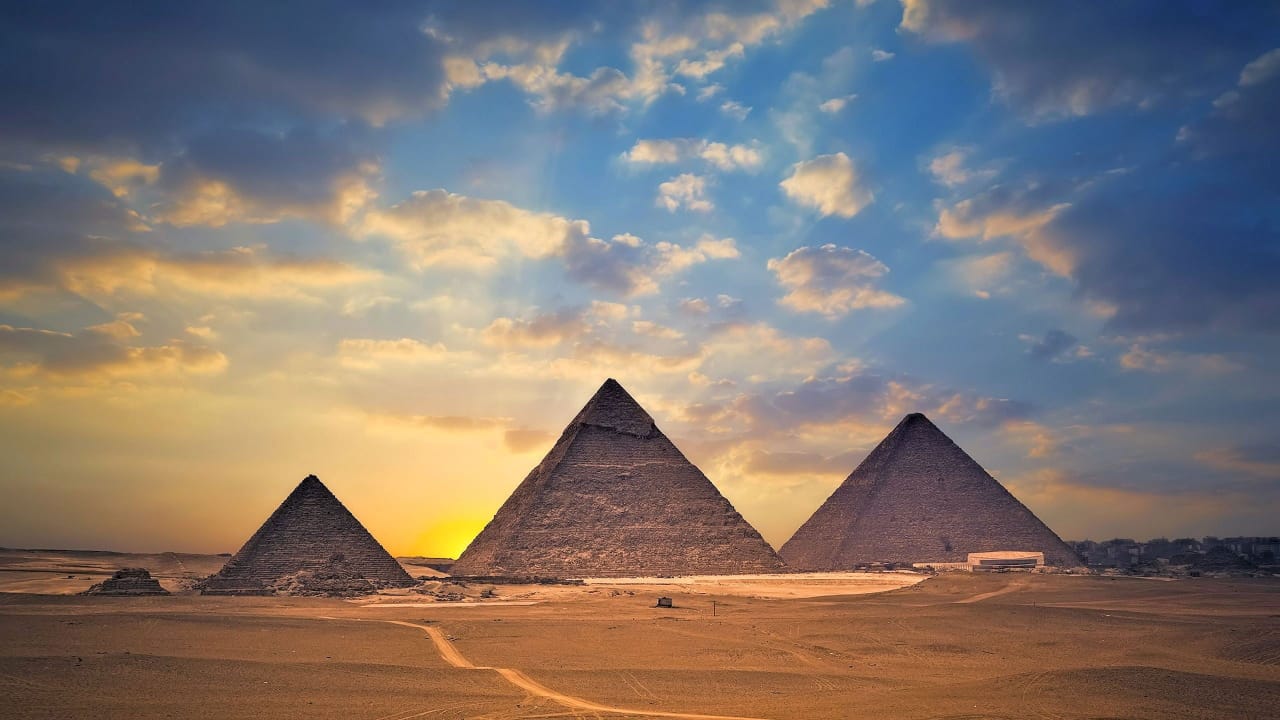
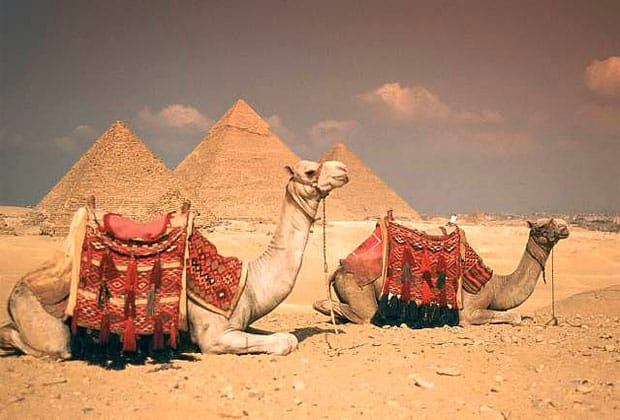
Our Pyramids and Grand Egyptian Museum combined tour pairs the plateau with the museum, with an Egyptologist who can point out the quarry and Menkaure's undressed granite as you pass. If you prefer to set your own pace across Giza, Saqqara and Dahshur, a private car and driver for the day makes that easy, and a camel ride at sunset shows all three pyramids from the open desert to the south-west, which is the best view of how they relate to each other.
If you would like a day built around the archaeology rather than the photo stops, tell us what interests you and we will shape it.