Thirty-odd kilometres south of Cairo, beyond the famous plateau, the desert opens onto a quieter royal necropolis where the very idea of the pyramid was perfected. This is Dahshur, home to the Bent Pyramid and the Red Pyramid, two colossal monuments built by a single pharaoh in a single, astonishing burst of trial and error. Almost nobody comes here, and that is precisely why you should.
Why Dahshur Matters
If the Great Pyramid of Giza is the climax of pyramid building, Dahshur is the laboratory where the formula was invented. Both pyramids here were commissioned by **Sneferu**, the first king of the Fourth Dynasty (reigned roughly 2613–2589 BCE) and father of Khufu, who would later build the Great Pyramid. Sneferu was the most prolific pyramid builder in Egyptian history, moving more stone than any other pharaoh.
Dahshur is where he learned, in real time and at enormous cost, how to make a smooth-sided pyramid stand up. The lessons baked into these two structures are why Giza was even possible. Visiting them in sequence is like reading the working notes behind a masterpiece, and unlike Giza, you can often do it nearly alone.
The Bent Pyramid: A Mid-Build Correction
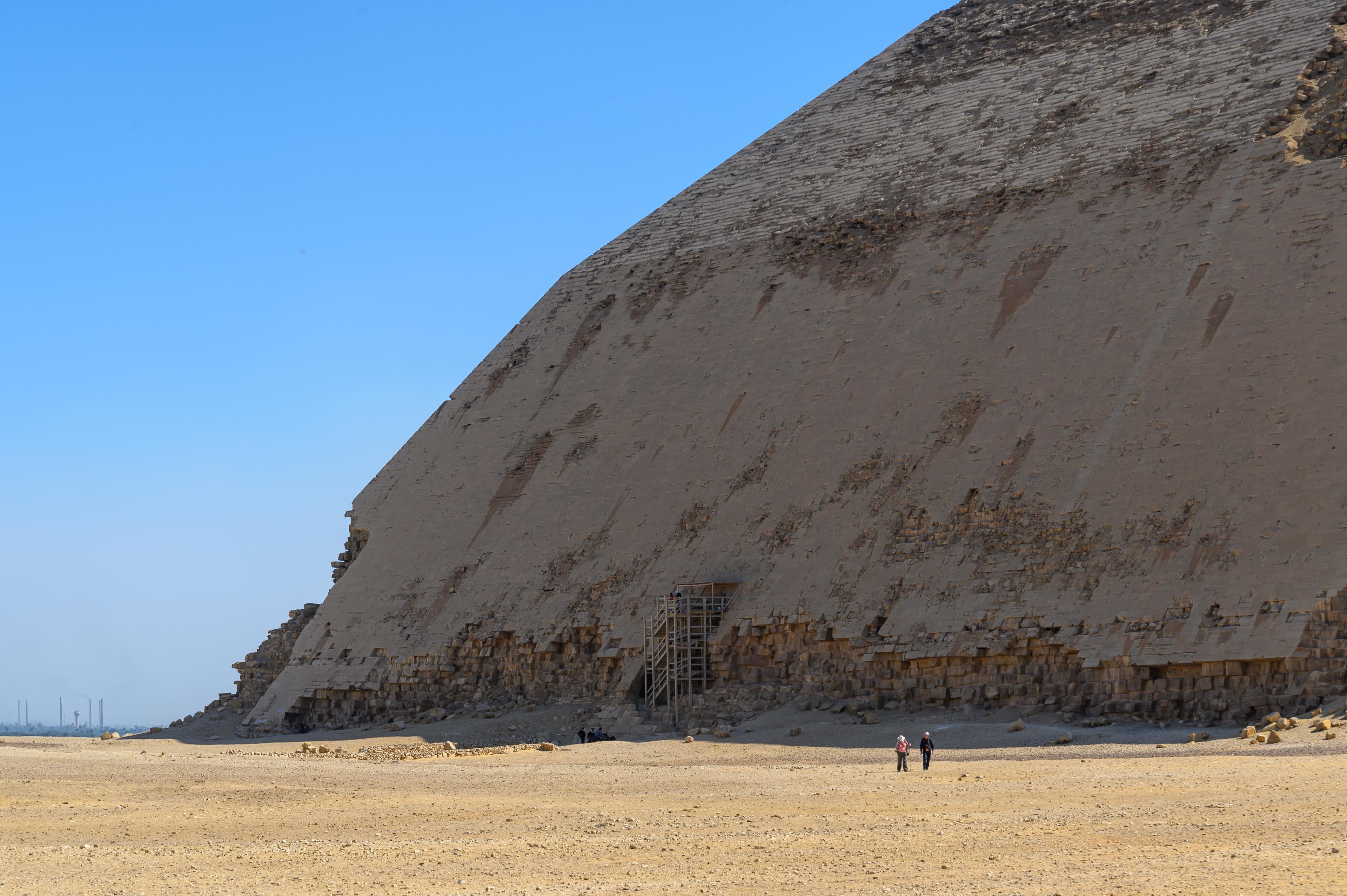
The Bent Pyramid is one of the strangest and most endearing monuments in Egypt. It rises at a steep angle of about 54 degrees for the first 49 metres, then abruptly shifts to a shallower 43 degrees, giving it the unmistakable kink that earned its name.
### What Went Wrong
Most Egyptologists believe the builders changed the angle midway through construction because the original steep design was proving unstable. Cracking and settling in the internal chambers, possibly worsened by the soft desert marl the pyramid was founded on, likely forced a hasty reduction in the slope to lighten the upper mass and prevent collapse. The result is a 105-metre-tall monument that is half ambition and half panicked compromise.
### The Best-Preserved Casing in Egypt
Here is the Bent Pyramid's quiet superpower: it retains much of its original polished **Tura limestone casing**, the smooth white outer skin that almost every other pyramid lost to stone robbers over the millennia. Standing at its base and seeing that gleaming, intact surface gives you a rare sense of how dazzling these monuments looked when new. Beside it stands a small **subsidiary pyramid** and the remains of a valley temple.
The Red Pyramid: The First True Pyramid
A short distance north stands Sneferu's triumph. The Red Pyramid, named for the reddish iron-oxide tint of its exposed limestone core, is widely regarded as the world's first successful **true (smooth-sided) pyramid**. Sneferu, having learned from the Bent Pyramid's wobble, built this one at the safe, shallow angle of about 43 degrees from the start.
At roughly 105 metres tall, it is the third-largest pyramid in Egypt after Khufu's and Khafre's at Giza, and many archaeologists believe Sneferu himself was buried here. It is a far less famous monument than its Giza descendants, yet it is arguably more important: this is the prototype that made them all possible.
The Red Pyramid also tells you something about scale and ambition that Giza, for all its fame, can obscure. By the time Sneferu finished his building campaign, including the Bent Pyramid, the Red Pyramid and the earlier collapsed pyramid at Meidum, he had moved an estimated several million tonnes of stone, more than his son Khufu would use for the single Great Pyramid. Standing in the quiet desert at the Red Pyramid's foot, with the Bent Pyramid visible across the sand, you are looking at the single most concentrated burst of monumental engineering in human history up to that point.
Going Inside: What to Expect
One of Dahshur's biggest draws is that you can usually enter the Red Pyramid, and recently the Bent Pyramid too, without the long queues and timed tickets of Giza.
### The Red Pyramid Interior
Entry is via a sloping passage on the north face that descends about 60 metres at a cramped angle. You will need to walk down bent almost double, which is hard on the back and knees and can be claustrophobic, before reaching three impressive **corbelled chambers** with soaring vaulted ceilings. The third chamber, reached by a wooden staircase, is thought to be the burial chamber. Be warned: there is often a strong ammonia smell inside from past bat activity, and ventilation is limited.
### Practical Cautions
The descent and re-ascent are genuinely strenuous. If you have a bad back, knees, heart condition, or struggle in tight enclosed spaces, consider admiring these pyramids from outside. There is no shame in skipping the interior; the exteriors are the real wonder. Bring water and a small flashlight, though the passages are lit.
Tickets, Hours and Costs
As of 2026, a general Dahshur site ticket runs roughly 200 to 250 EGP (about 4 to 5 USD) for foreign visitors, which typically includes access to enter the pyramids. Prices rise regularly, so treat this as an estimate. There is a student discount with a valid international student card.
The site generally opens around **8 a.m. and closes near 4 p.m.** (sometimes 5 p.m. in summer); hours shift seasonally and during Ramadan, so confirm locally. Photography is allowed in the grounds; a separate camera fee or a ban on photography inside the chambers may apply, and tripods usually require a special permit. Plan on roughly two to three hours to do both pyramids justice without rushing.
Getting There from Cairo
Dahshur lies about 40 kilometres south of central Cairo, roughly a 60 to 90 minute drive depending on traffic. There is no practical public transport directly to the site, so your realistic options are:
- **Private car or driver** — by far the easiest. Most visitors combine Dahshur with Saqqara and Memphis in one full day, since they sit along the same road south.
- **Taxi or ride-hailing** — workable from Cairo or Giza, but arrange the return in advance, as you will not find cars waiting at this remote site.
- **Organised tour** — the most hassle-free way, bundling transport, tickets and a guide.
The classic itinerary pairs Dahshur with the Step Pyramid of Djoser at Saqqara, just to the north, letting you trace the entire evolution of the pyramid in one morning: from Djoser's stepped tomb, to Sneferu's bent experiment, to his perfected smooth-sided masterpiece.
The Pyramid Evolution Story
What makes a Dahshur–Saqqara day so rewarding is the narrative arc you can literally walk through.
### Step One: Djoser's Step Pyramid
Around 2670 BCE, the architect Imhotep stacked six mastabas (flat-roofed tombs) to create the Step Pyramid, the world's first large-scale stone monument. It is the conceptual starting point: a stairway to the sky.
### Step Two: The Bent Experiment
Sneferu first tried for a true smooth pyramid at the Bent Pyramid (and earlier at Meidum, which partly collapsed), only to lose his nerve mid-construction. The kink is the visible scar of that learning curve.
### Step Three: The Red Pyramid Triumph
Finally, with the Red Pyramid, the smooth-sided geometric ideal was achieved. A generation later, Sneferu's son Khufu scaled the same formula up to the Great Pyramid at Giza. Dahshur is the missing middle chapter most tourists never read.
There is one more layer at Dahshur worth a glance if you have time. Beyond Sneferu's two giants stand the ruins of later Middle Kingdom pyramids, most notably the mud-brick **Black Pyramid of Amenemhat III** (around 1850 BCE), now a crumbling dark mound because its limestone casing was stripped and its brick core eroded. It is a vivid lesson in why Sneferu's solid-stone construction endured while later shortcuts did not. Most visitors skip it, but it puts the well-preserved giants in sharp context.
Crowds, Scams and Insider Tips
The single best reason to visit Dahshur is the solitude. Where Giza can feel like a theme park with persistent touts, camel-ride hustlers and crowds, Dahshur is serene. You may share the Red Pyramid with only a handful of other people, or have a chamber entirely to yourself.
A few tips. Go early, both to beat the midday heat and to enter the chambers when the air is freshest. Bring small cash for the ticket booth and any camera fees, as card payment is unreliable. Tip the guards modestly (5 to 20 EGP) if they helpfully point things out, but you do not need a paid escort inside. And combine it with Saqqara rather than Giza if you crave that empty-desert magic. Wear closed shoes; the sand and rubble are unforgiving on sandals.
When to Visit
The most comfortable months are **October through April**, when daytime temperatures are pleasant for desert walking. From May to September the heat can be punishing by late morning, making an early start essential. Mornings also give the warmest light on the Bent Pyramid's casing stones, ideal for photographs. Avoid the windiest days, when blowing sand can sting and obscure views.
Make It Part of Your Day
Dahshur rewards travellers who want substance over selfies, the real story of how the pyramid was born, told in stone and silence. Because it is off the main tourist track, the simplest way to see it comfortably is with private transport that lets you string together Dahshur, Saqqara and Memphis at your own pace. Our Cairo & Giza Full-Day Transfer gives you a private vehicle and driver for the day, so you can devote a relaxed morning to Sneferu's masterpieces before the afternoon crowds elsewhere. Pack water, a flashlight and a sense of curiosity, and you will leave understanding the pyramids in a way most Giza day-trippers never will.