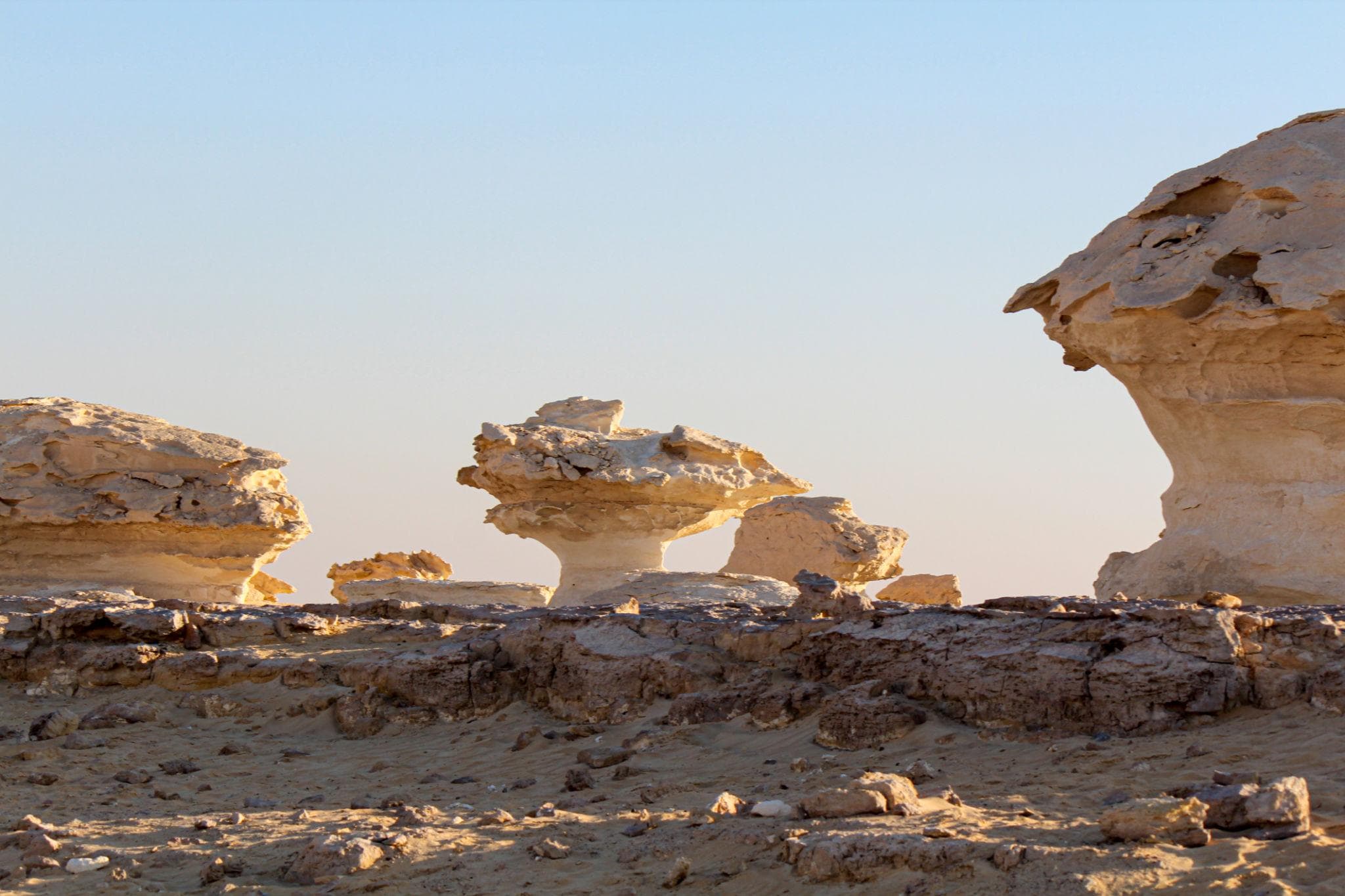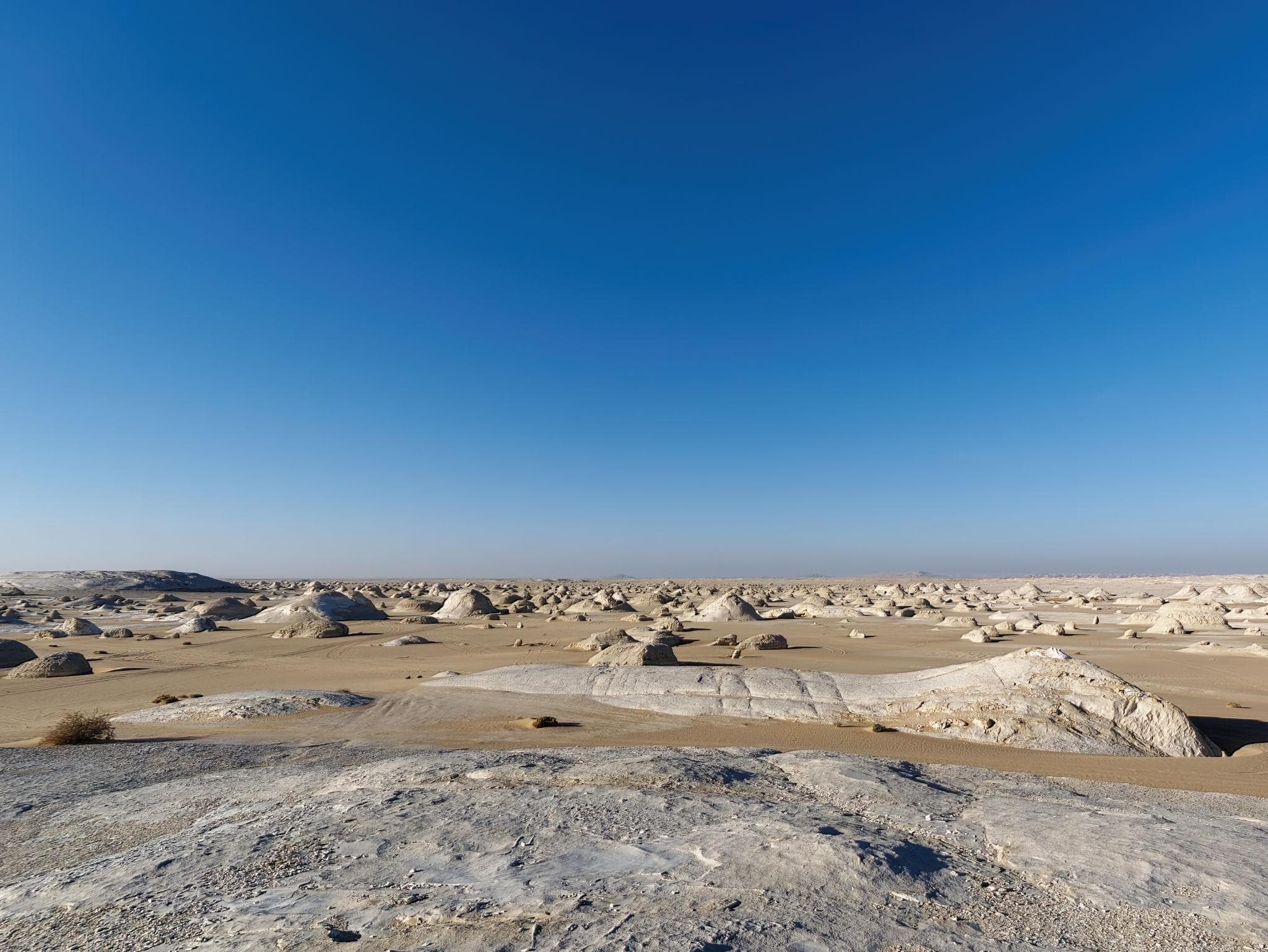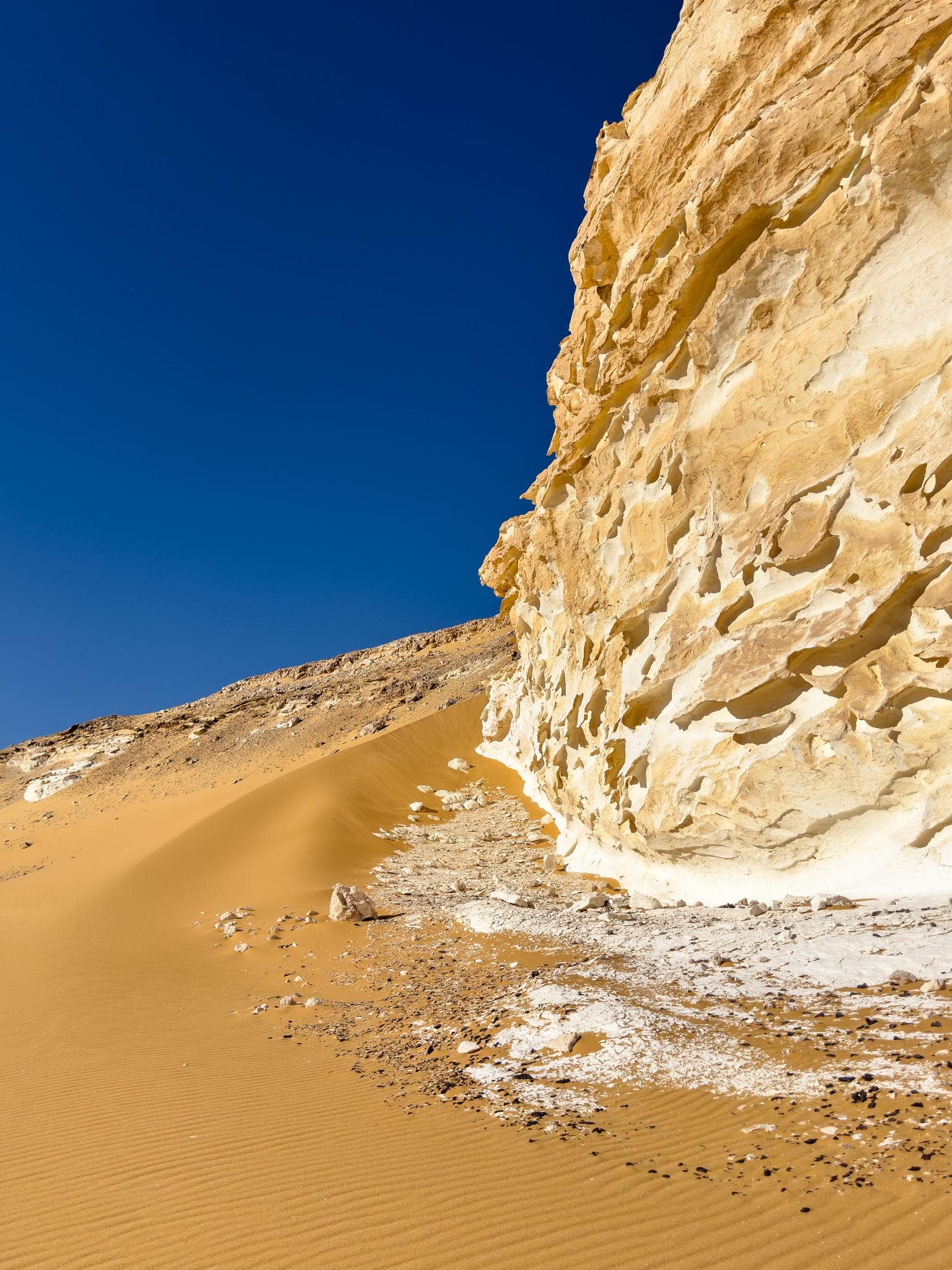
Late in the afternoon the chalk of the White Desert changes colour by the minute, from white to cream to apricot, and the wind-cut towers that looked like plaster at noon start throwing long blue shadows across the sand. Someone spots the formation everyone calls the mushroom, with the smaller shape beside it known as the chicken, and for a while nobody says much. Then the driver starts unloading the camp, and the temperature begins to drop.
Getting there is the part most people underestimate. A white desert tour from Cairo begins with roughly 370 km (230 miles) of highway to Bahariya Oasis, and the chalk formations lie another 100 km (60 miles) or more beyond it. So the real question is how long to give it: one very long day, two days with a night in camp, or three days with Farafra added.
This guide compares the three, explains what each includes, from the Black Desert to the dunes of Agabat, and covers permits, fees, night temperatures, private and shared tours and packing, as of November 2026.
At a Glance
Where: White Desert Protected Area, New Valley governorate, between the Bahariya and Farafra oases
From Cairo: about 360 to 370 km (225 to 230 miles) to Bawiti, the main town of Bahariya, 4 to 5 hours by road
Into the desert: a further 100 to 150 km (60 to 95 miles) south by 4x4 to the main chalk formations
Day trip: 15 to 17 hours door to door, around 10 of them on the road
Overnight tour: two days and one night, camping among the formations
Three days: adds Farafra Oasis, the Bir Sitta hot spring and a slower pace
Best season: October to April; December and January nights often fall to around 4 to 8C (39 to 46F)
Permits: passport details to your operator at least 24 to 48 hours ahead; several checkpoints on the way
Fees: protectorate fee for foreigners reported at around US$5; Bahariya antiquities ticket EGP 400 since 1 October 2026
Driving yourself: not an option off the asphalt; licensed operators, 4x4s and desert drivers only
Which White Desert Tour Suits You
The short answer: if you can spare two days, take two days. The overnight trip is the classic white desert tour for good reason. It gives you the formations at sunset and again at sunrise, when the low light does most of the work, and a night under one of the darkest skies within reach of Cairo, with the long drive split across two days.
The day trip is for travellers who cannot spend a night away from Cairo, or who want the landscape without camping. It works, but be clear about the cost: you leave in the dark, you come back in the dark, and you spend more time on the highway than in the desert. Most day trips reach the chalk in the early afternoon and must turn north again before sunset.
Three days suits photographers, slower travellers and anyone who wants the desert without watching the clock. The extra day usually carries you on to Farafra, the quietest of the Western Desert oases, with its sulphur spring and mud-brick village, and gives the Black Desert and Crystal Mountain proper stops rather than a few minutes each.
Whatever the length, the choice between private and shared matters almost as much as the number of days.
The Route from Cairo via Bahariya
Every trip follows the same spine. From Giza the Bahariya road runs south-west across the Western Desert, a flat gravel plain for most of its length, with police checkpoints and a rest stop for tea. After four to five hours it drops into the depression of Bahariya Oasis at Bawiti, where most tours stop for lunch and transfer to the 4x4 that will take you off the asphalt.
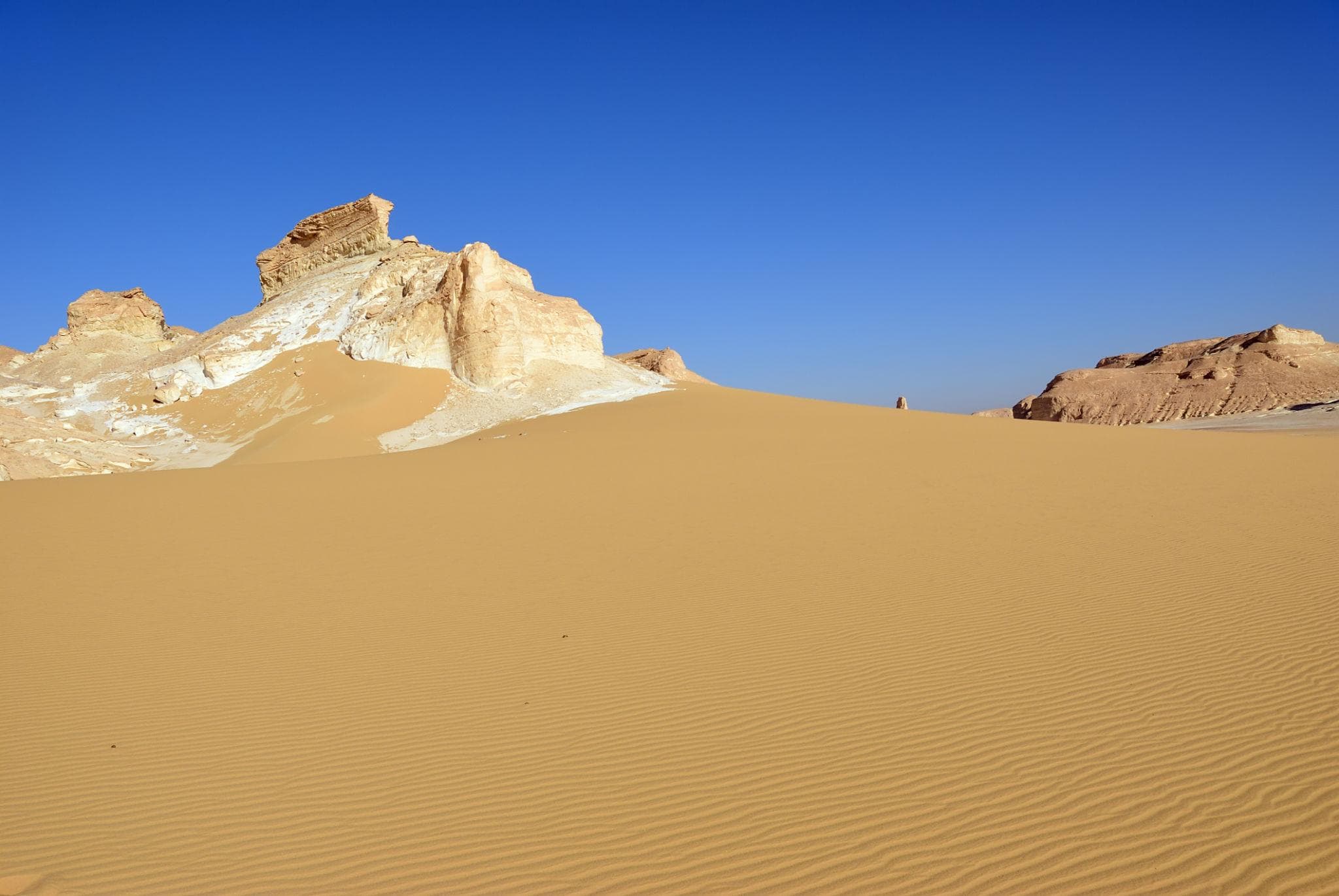
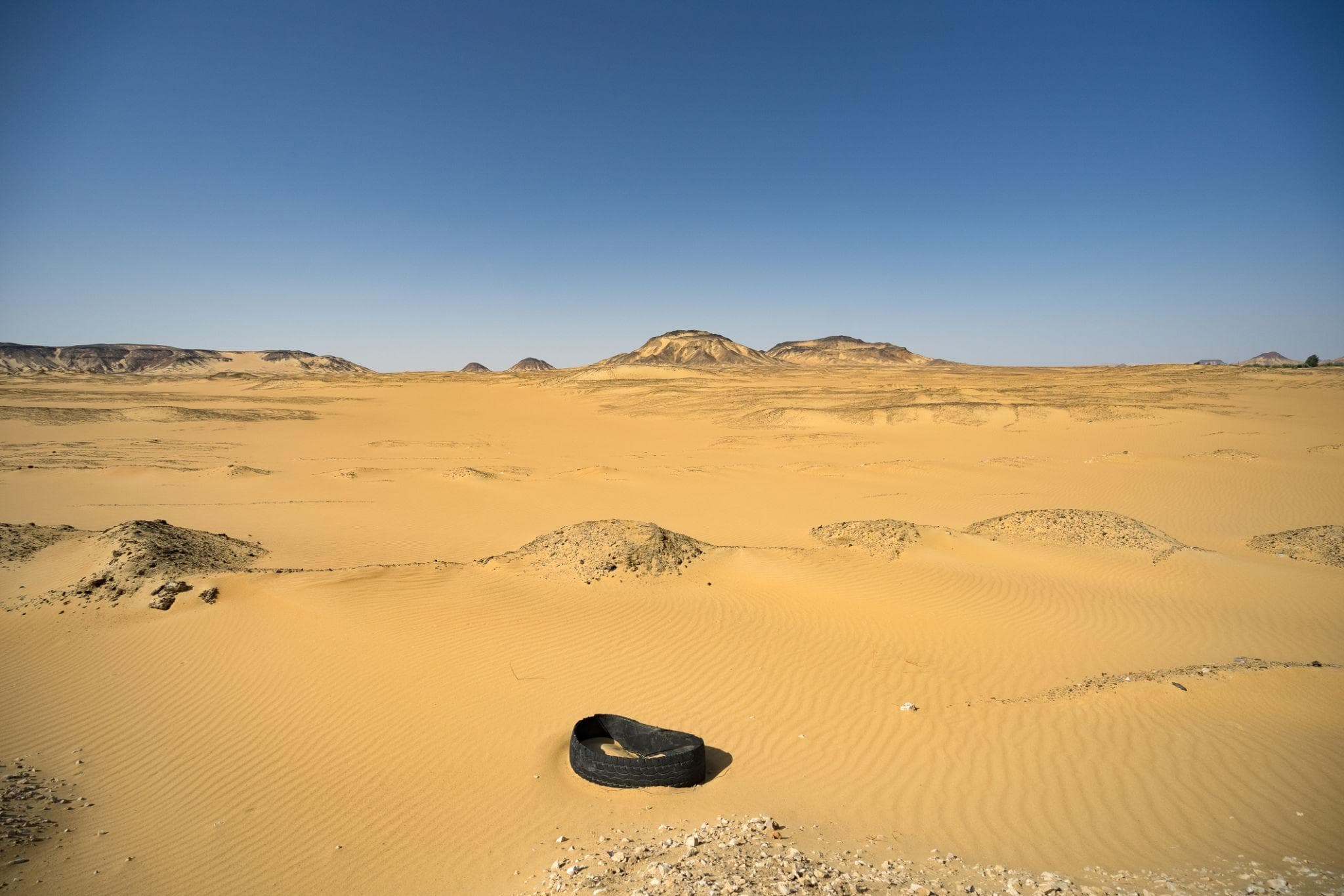
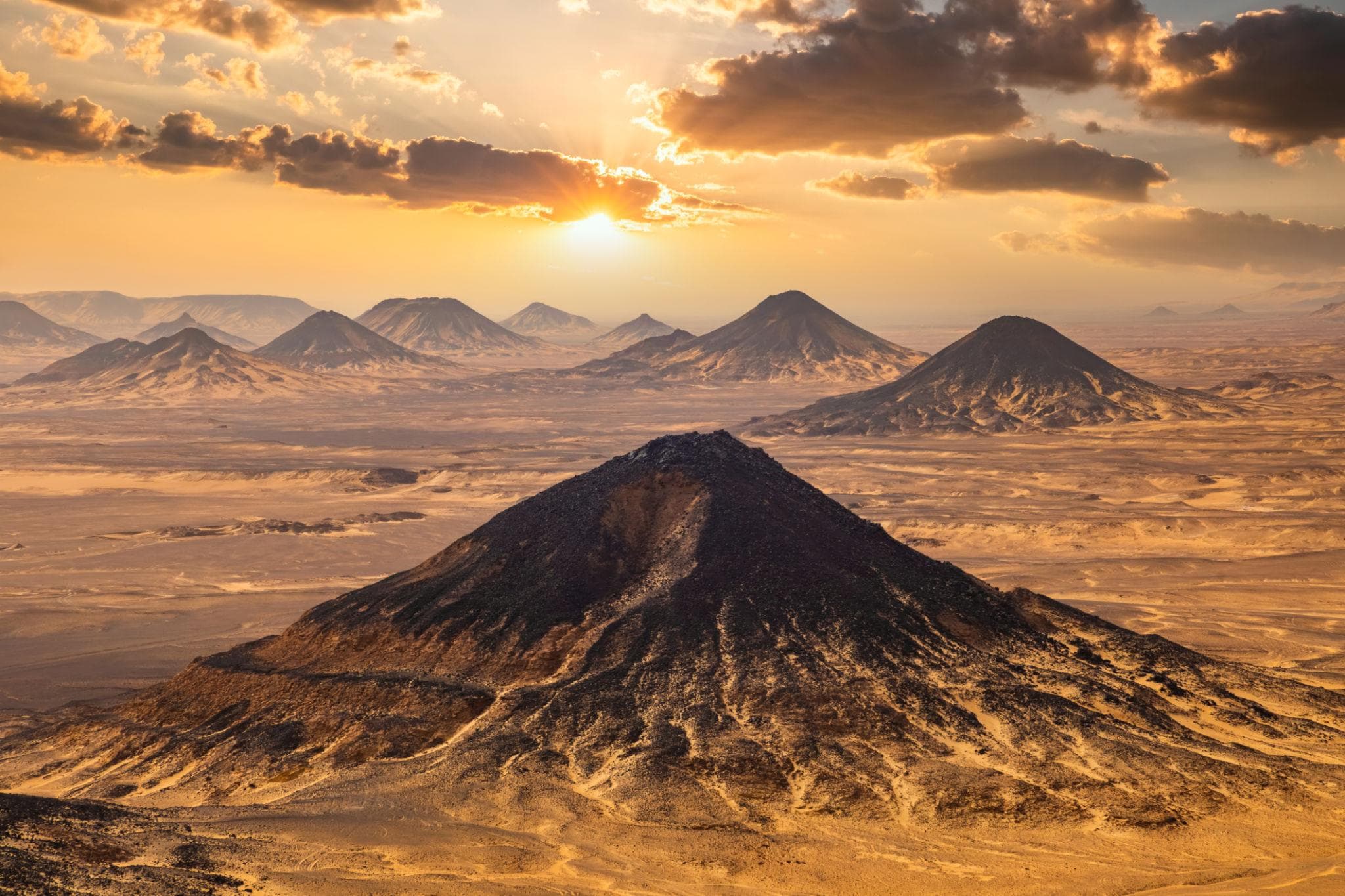
South of Bawiti the road to Farafra covers 185 km (115 miles) through some of the most varied scenery in Egypt. First comes the Black Desert, about half an hour out of town, where orange sand is scattered with dark, flat-topped hills. Then Crystal Mountain, a low ridge of glittering rock beside the road. Shortly afterwards tours leave the tarmac for the Agabat valley, soft dunes between pale cliffs, and beyond it the land turns white.
Tour programmes often speak of a "new" and an "old" White Desert. The old area holds the best-known small formations, the mushroom and the chicken among them, while the new area, closer to Bahariya, has taller chalk towers and is where many groups camp. The names are used loosely, so check any tour's day-by-day plan. The classic formations lie roughly 45 km (28 miles) north of Farafra town.
From Cairo to the heart of the White Desert is around 450 to 500 km (280 to 310 miles) each way. That single number explains the day trip.
The White Desert Day Trip from Cairo
A white desert day trip is possible, and for some itineraries it is the only way to fit the desert in. Expect a pickup between about 4am and 6am, breakfast on the road, Bawiti by late morning, then the Black Desert, Crystal Mountain and a couple of hours among the formations in the afternoon. Return is typically between 10pm and midnight, so the day runs 15 to 17 hours door to door.
What you gain is the landscape without a night outdoors, which matters to families with young children or anyone who dislikes camping. What you lose is the light. The White Desert is at its best in the hour before sunset and the hour after dawn, and a trip that must be back in Cairo tonight usually sees neither. You also spend around ten hours in a vehicle.
If it is your only option, leave as early as possible and pack snacks for the return leg. Our White Desert day trip from Cairo runs in a private vehicle so the timing can bend around you, and in winter, when days are short, we start earlier still. For most people, though, one extra day turns a marathon into a journey.
The White Desert Overnight Tour: Two Days, One Night
This is the trip most people mean when they talk about the White Desert, and the one we recommend for a first visit. Day one follows the route above at an easy pace: lunch in Bawiti, perhaps a dip in one of Bahariya's hot springs such as Bir el-Ghaba, then the Black Desert, Crystal Mountain and Agabat, timed so you reach the chalk as the light softens.
Camp is pitched in a sheltered spot among the formations. Your driver and guide cook dinner over a fire, often chicken or vegetables with rice, bread and salad, followed by sweet tea. Away from any town, the Milky Way is usually visible to the naked eye on moonless nights. Morning brings sunrise over the chalk, breakfast and a slow drive through the formations before the road back, reaching Cairo in the evening.
The White Desert and Black Desert overnight tour follows exactly this shape. For what sleeping out is really like, from mattresses to the absence of toilets, our White Desert camping guide goes into detail.
The overnight trip also gives you something the day trip cannot: time to stop wherever the light is good, rather than wherever the schedule allows. Over two days that is the difference between seeing the White Desert and photographing it well.
Three Days: Adding Farafra Oasis
A third day lets the trip breathe. The usual pattern is a night in the White Desert and a night in Farafra, with the formations seen in two different lights and more time off the road.
Farafra Oasis is the smallest and most isolated of the inhabited Western Desert oases, a palm-shaded village with a small museum of local art and the Bir Sitta hot spring, about 6 km (4 miles) west of town, where sulphurous water at around 38C (100F) fills a concrete pool beside the fields. After a night on the sand, an hour in warm water under the palms is hard to beat.
Our White Desert and Farafra three-day tour is built this way, and the private White Desert and Farafra three-day tour does the same with your own vehicle, driver and guide.
Three days also makes room for Bahariya itself. The oasis museum holds some of the Graeco-Roman mummies from the Valley of the Golden Mummies, and our guide to Bahariya and its golden mummies explains what to look for. Since 1 October 2026 the antiquities ticket for foreign adults at Bahariya's sites has been EGP 400 (about US$7.50), EGP 200 for students.
Black Desert, Crystal Mountain and Agabat
All three come on every itinerary, which is why most trips are sold as black and white desert tours, and each deserves more than a photograph from the window.
The Black Desert is a field of cone-shaped hills whose dark caps come from ancient volcanic rock, dolerite and basalt, broken up and spread across the orange sand like scattered coal. The best-known viewpoint is Gebel el-Ingleez, the English Mountain, named after a British lookout post used in the First World War to watch the movements of Senussi forces from Libya. The climb is short and steep, and the view explains the name of the whole area.
Crystal Mountain, known locally as Gebel el-Izzaz, is a low ridge studded with crystals that glitter in the sun. Tours often call it quartz, but it is more likely calcite or barite, both much softer. Look closely, but leave every crystal where it is: the site has been picked over by souvenir hunters for decades.
The Agabat valley, just beyond, is the scenic surprise of the route: golden dunes between white cliffs and yellow rock, reached off-road, and often the place where drivers let the tyres down and show what a 4x4 can do on soft sand. Our guide to the Black Desert and Crystal Mountain covers all three in more depth.
Did You Know: The White Desert Was Once a Seabed
The white rock that gives the desert its name is chalk and limestone, laid down from the remains of tiny marine organisms when this part of North Africa lay under a shallow sea. Wind and sand have done the sculpting since, cutting the softer layers faster than the harder ones. The result is the field of shapes you see today: mushrooms on narrow stalks up to 3 to 4.5 m (10 to 15 feet) tall, table mountains, towers and smaller forms that visitors have named after animals.
Look down as well as up. In places the ground is littered with small fossil shells and iron-rich nodules sometimes called flower stones. The area has been a protectorate since 2002 and covers roughly 3,000 km² (about 1,160 square miles). Take nothing home, not even a pebble.
The White Desert is at its most striking on a full-moon night, when the chalk reflects enough light to walk without a torch.
A Night at a White Desert Camp
A White Desert camp is simpler than many travellers expect, and that is much of its appeal. Operators set up a windbreak or a low Bedouin-style shelter beside the vehicle, with mattresses, blankets and sleeping bags; some also bring small tents. You can sleep in the shelter or drag your mattress into the open. There is no electricity beyond the car battery and no running water beyond what the driver carries.
There are no toilets either. You walk a discreet distance behind a rock, and good operators ask you to carry used paper out in a bag.
Evenings are quiet: dinner, tea, perhaps a little music, then the stars. Small desert foxes sometimes come to the edge of camp after dark, drawn by the smell of food; sightings are not guaranteed, and you should never feed them.
Shared tours often camp in the same general area as other groups, especially at weekends and on Egyptian holidays. A private trip gives the driver more freedom to find a quieter spot. Either way, the view when you open your eyes at dawn is the reason people come.
Good to Know: Permits, Fees and Checkpoints
The White Desert is a protected area, and travel in the Western Desert is regulated. You cannot drive off-road there on your own, and camping is only allowed with authorised operators. In practice your operator handles the paperwork: you send a copy of your passport at least 24 to 48 hours before departure, and the names are registered for the route.
On the road you pass several police checkpoints between Cairo, Bahariya and Farafra. Keep your passport itself, not just a copy, within reach; officers sometimes ask to see it, and the driver will normally do the talking. Our guide to desert safety and permits in Egypt explains how the system works.
Fees come in two layers. The protectorate charges foreign visitors an entry fee, most recently reported at around US$5 per person, and a 2025 fee system for Egypt's protectorates mentions higher rates for overnight use; we could not find a published figure for the White Desert itself, so check whether your tour includes it. Separately, Bahariya's antiquities cost EGP 400 for foreign adults.
Before you book, ask exactly what the price covers: park fees, meals, water, camping gear and the Bahariya sites are the usual variables.
Warning: Cold Nights and What to Pack
The desert is not always hot. Between December and February days are pleasant, typically around 15 to 24C (59 to 75F), but clear nights often fall to around 4 to 8C (39 to 46F), and lower on still, cloudless nights. Most people who sleep badly in the White Desert packed for Egypt, not for a desert night. From June to August the problem is reversed: daytime heat in the Western Desert regularly passes 40C (104F), and we do not recommend camping trips in high summer.
October, November, March and April are the most comfortable months, with warm days and cool but manageable nights. December and January bring the clearest skies and the coldest camps.
- A warm fleece or down jacket, a hat and socks for the night
- A head torch, a power bank and earplugs
- Sunglasses, sunscreen and a scarf against sun and blowing sand
- Wet wipes, hand sanitiser and a small bag to carry rubbish out
- Closed shoes for the climbs, and sandals for camp
Operators supply blankets and sleeping bags, but a thin liner of your own adds warmth and comfort. Our desert safari packing guide has the full list.
Private or Shared White Desert Tours
Shared tours are cheaper and suit solo travellers who enjoy company. They run to a fixed programme, often with a minibus from Cairo to Bahariya and a 4x4 from there, and they work well if your dates match theirs and you do not mind the pace of the group.
A private tour costs more but changes the experience in ways that matter in the desert. You leave Cairo when you want, so you reach the formations for the best light. The driver can choose a quiet campsite away from other groups. Stops last as long as you need, which makes a real difference for photographers and families. And if someone is unwell or tired, the plan can change without negotiation.
For most couples and families we suggest private. Our private White Desert tour from Cairo covers the overnight route with your own vehicle, driver and guide. Whichever you choose, ask how many people share each 4x4, whether the vehicle from Cairo goes into the desert, and who cooks.
Planning Your White Desert Tour from Cairo
Decide first how many nights you can give the desert, then work back from the rest of your trip. The overnight tour fits neatly between a day at the pyramids and a flight or train south, while three days sits best at the start or end of a stay in Cairo, when you are not chasing another early departure. Avoid booking the desert for the day before an international flight, in case the road back is slow or a checkpoint holds you up.
Tell us your dates, the size of your group and whether you would rather camp or come back the same night, and we will suggest the white desert tour from Cairo that fits, or build a longer Western Desert itinerary around it. Contact us when you are ready, ideally a few days ahead so the permits can be arranged without a rush; winter weekends fill first, so book earlier for December and January.