At nine in the morning on a weekday, the car park below the Step Pyramid may hold a dozen vehicles. Twenty kilometres up the road, Giza is already full. Saqqara has the oldest monumental stone building in the world and some of the finest painted reliefs in Egypt, and most visitors to Cairo never see it, or see it in forty minutes on the way somewhere else.
Doing Saqqara self-guided is more practical than at Giza in one way and harder in another. There are few crowds or touts, but the site spreads over kilometres of desert, the tickets are a menu of extras, and the open tombs change from season to season.
This guide sets out what each Saqqara ticket covers as of November 2026, which tombs are usually open, a route by car that follows the 19 stops of our Saqqara audio tour, and how to fit in Memphis and Dahshur on the same day.
At a Glance
Location: about 16 km (10 miles) south of the Giza pyramids, usually 40 to 60 minutes by road from Giza
Site ticket: 600 EGP, students 300 EGP, including the Imhotep Museum, as of November 2026
Main extras: Step Pyramid interior 280 EGP, Serapeum 340 EGP, Mereruka 200 EGP
All-inclusive ticket: 1,000 EGP, students 500 EGP
Opening hours: from 8am; the official schedule closes the site at 4pm and the Serapeum at 5pm
Payment: bank card only, at the windows or the self-service machines
Getting around: by car; the three main clusters are 1 to 1.5 km apart over sand
Time needed: 3 to 4 hours for the main monuments
Combine with: Memphis and Dahshur, both within about 15 km
Can You Visit Saqqara Self-Guided
Yes, and it is one of the most rewarding sites in Egypt to explore at your own pace. The main monuments are signposted and guardians at each tomb check tickets and open doors. What a visit without a guide needs is a plan. Saqqara is not one monument but a necropolis about 7 km (4 miles) long, the burial ground of Memphis, Egypt's first capital, used from the First Dynasty to the Roman period. Without a plan, it is easy to spend an hour driving between closed doors.
The best approach is to treat it as three clusters. The Step Pyramid of Djoser and the pyramid of Unas sit at the centre. The pyramid of Teti, the great mastabas of Mereruka and Kagemni and the rock tombs of the Bubasteion lie about a kilometre to the north-east. The Serapeum and the mastabas of Ti and Ptahhotep lie about the same distance to the north-west. A car moves you between them.
For context on the spot, our Saqqara audio guide has 19 stops with about 29 minutes of narration in English and a hand-drawn diagram for every stop, which helps here more than almost anywhere, since many tombs are underground. For the history in depth, read our Saqqara and Step Pyramid guide before you go.
Saqqara Tickets: What Each One Covers
Saqqara tickets are sold at the main ticket office by the Imhotep Museum at the entrance, at the counters or at self-service machines introduced in June 2025, and on the Ministry's official ticketing website and Experience Egypt app. Payment is by bank card only. As of November 2026, the Ministry's published prices for foreign visitors are:
- Saqqara site ticket: 600 EGP, students 300 EGP, including the Imhotep Museum and the open-air monuments
- Step Pyramid of Djoser interior: 280 EGP, students 140 EGP
- Serapeum: 340 EGP, students 170 EGP
- Mastaba of Mereruka: 200 EGP, students 100 EGP
- Noble tombs and New Kingdom tombs: 400 EGP, students 200 EGP
- All-inclusive Saqqara ticket: 1,000 EGP, students 500 EGP
The South Tomb of Djoser has had its own ticket, listed at 300 EGP. Exactly which smaller tombs fall under which ticket has shifted over the years, so tell the cashier which monuments you want and let them work out the combination. If you plan to see the Step Pyramid interior, the Serapeum and Mereruka, the all-inclusive ticket costs less than the four tickets bought separately. Keep every ticket with you, because each tomb guardian checks and tears it.
Increases have been approved for some sites from April 2027, so check our Egypt ticket prices guide before you go.
Which Saqqara Tombs Are Open in Late 2026
Saqqara rotates its tombs. To protect the paint, the authorities open some and close others for months at a time, and conservation work closes others without notice. What follows is what is usually open; ask at the ticket office what is open that day before you pay.
The anchors are reliable. The Step Pyramid interior reopened in March 2020 after more than a decade of restoration, and the South Tomb later the same year. The Serapeum, Mereruka, Kagemni and the pyramid of Teti, with its inscribed burial chamber, are open on most days. The mastabas of Ti and of Ptahhotep and Akhethotep are usually open, as are the tomb of Mehu, opened in 2018, and the New Kingdom tombs south of the Unas causeway.
The less predictable ones are the pyramid of Unas, reopened in 2016 with short morning hours and limited numbers; the Persian shaft tombs, opened only occasionally; the Tomb of the Two Brothers; and the Bubasteion tombs, including the painted tomb of Wahtye found in 2018. Saqqara is also an active excavation: in 2026 alone the Ministry announced new tombs at the Bubasteion and in north and south Saqqara, covered in our roundup of Egypt's new discoveries in 2026. Finds are rarely opened to visitors straight away, so fenced trenches are a normal part of the scenery.
Good to Know: Why You Need a Car at Saqqara
Saqqara is not walkable in the way Giza is. The three clusters are 1 to 1.5 km apart, the ground between them is soft sand and rubble with no paths or shade, and the total distance for the route below is about 6 km (4 miles) before you count the walking inside the monuments. In winter fit walkers do it on foot; for everyone else it is a car.
The site has no shuttle and no taxi rank, and a ride-hailing car that drops you at the entrance will not wait. A car with a driver for the day is the norm: the driver takes you from cluster to cluster on the site road and waits while you go in, and if you are continuing to Memphis or Dahshur the same car carries on. Agree the plan and the waiting time before you leave Cairo or Giza.
The Imhotep Museum at the entrance has toilets; beyond it, facilities are few, so bring water from the city.
Route Part One: The Step Pyramid Complex
Our audio tour runs in an order that works by car: the Step Pyramid complex first, then south to Unas, north-east to Teti, and finally north-west to the Serapeum. Start with half an hour in the Imhotep Museum, which has finds from the site and a room on the French architect Jean-Philippe Lauer, who spent most of his life rebuilding the complex.
Stop 1 is a welcome at the enclosure wall, about 10 m (33 ft) high, with fourteen gateways, only one of them real. Stop 2, the Entrance Colonnade, is a corridor of stone columns carved to imitate bundles of reeds, among the first stone columns ever built. Stop 3, the Heb-Sed Court, is lined with dummy chapels for the royal jubilee festival. Stop 4 is the South Court with the South Tomb, a second, symbolic burial for Djoser decorated with blue faience tiles and reliefs of the king running his ritual course.
Stop 5 is the Step Pyramid of Djoser itself, built around 2650 BC and credited to Imhotep: six stone steps about 62 m (203 ft) high, the ancestor of every later pyramid. Going inside the Step Pyramid of Djoser takes you along a tunnel to the central shaft, 28 m (92 ft) deep, with the granite burial chamber at its foot. Stop 6, the Serdab, is the sealed stone box on the north side where a seated statue of the king looks out through two eye holes; the one you see is a replica.
Route Part Two: Unas, the Causeway and the Southern Tombs
Walk a few minutes south-west to the Pyramid of Unas, stop 7, the last king of the Fifth Dynasty, around 2350 BC. Outside it is a heap of rubble, but its burial chamber is the first inscribed with the Pyramid Texts, spells to help the king rise to the sky, in blue-painted hieroglyphs. If it is open, the passage is low and you will stoop.
Stop 8 is the Causeway of Unas, which ran about 750 m (820 yards) from his valley temple to the pyramid. The next four stops lie along it. Stop 9, the Persian Tombs, are three deep shaft tombs of officials from around the sixth century BC, with painted burial chambers at the bottom. Stop 10, the Tomb of Mehu, an official of the Sixth Dynasty, keeps some of the brightest colour at Saqqara. Stop 11, the Tomb of the Two Brothers, belonged to Niankhkhnum and Khnumhotep, royal manicurists of the Fifth Dynasty, shown embracing nose to nose.
Stop 12 covers the New Kingdom tombs on the plateau south of the causeway, built more than a thousand years later for officials of Tutankhamun's time. The best known belonged to Horemheb, built while he was still a general, before he became king and was buried in the Valley of the Kings, and to the treasurer Maya and his wife Meryt. Most are open courtyards with relief blocks set back in place.
Route Part Three: Teti, Mereruka and the Bubasteion
Drive about 1 km north-east to the Teti cluster. The Pyramid of Teti, stop 13, the first king of the Sixth Dynasty, has collapsed outside, but a sloping passage takes you down to a burial chamber with Pyramid Texts and a star-covered ceiling.
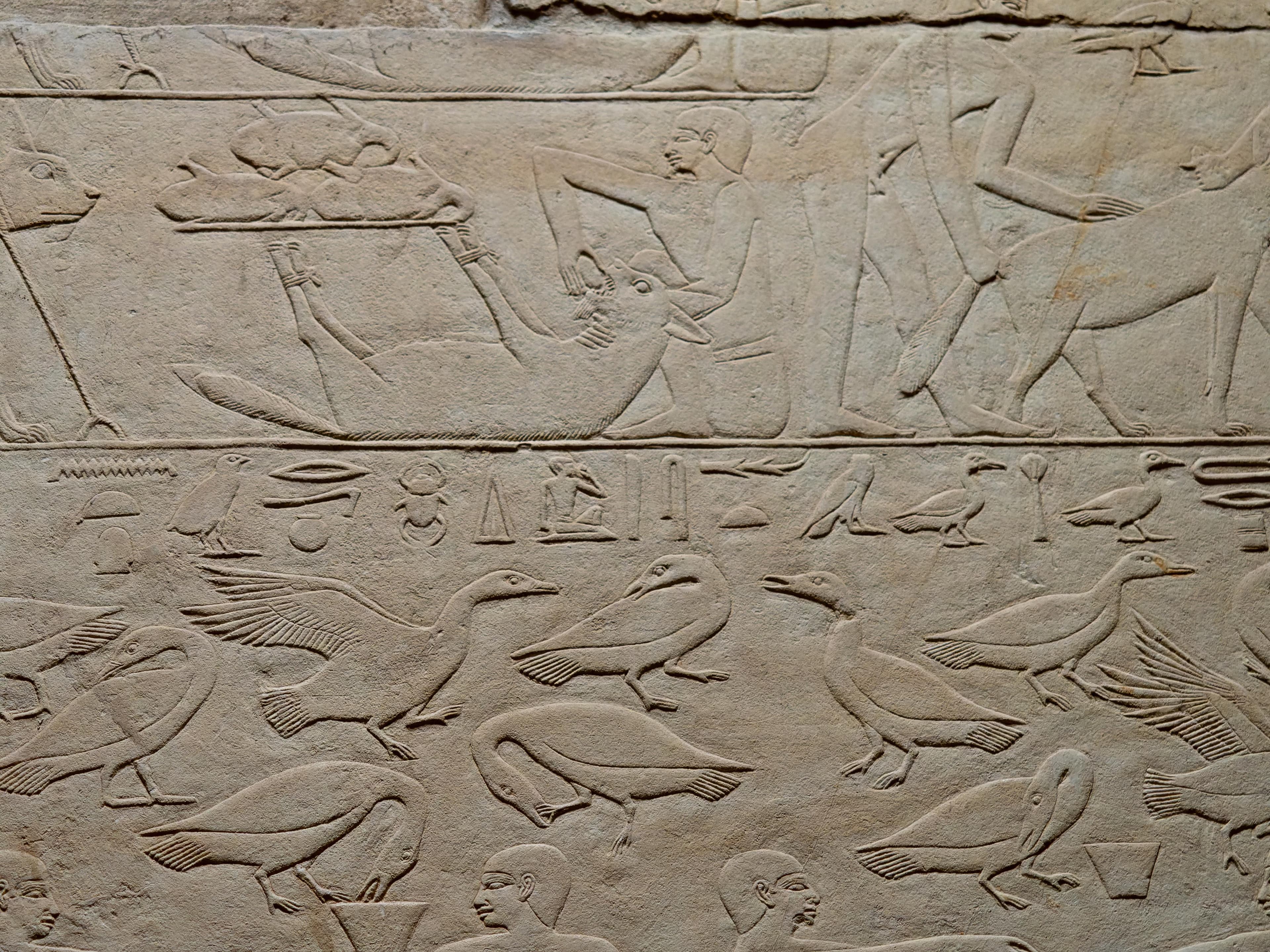
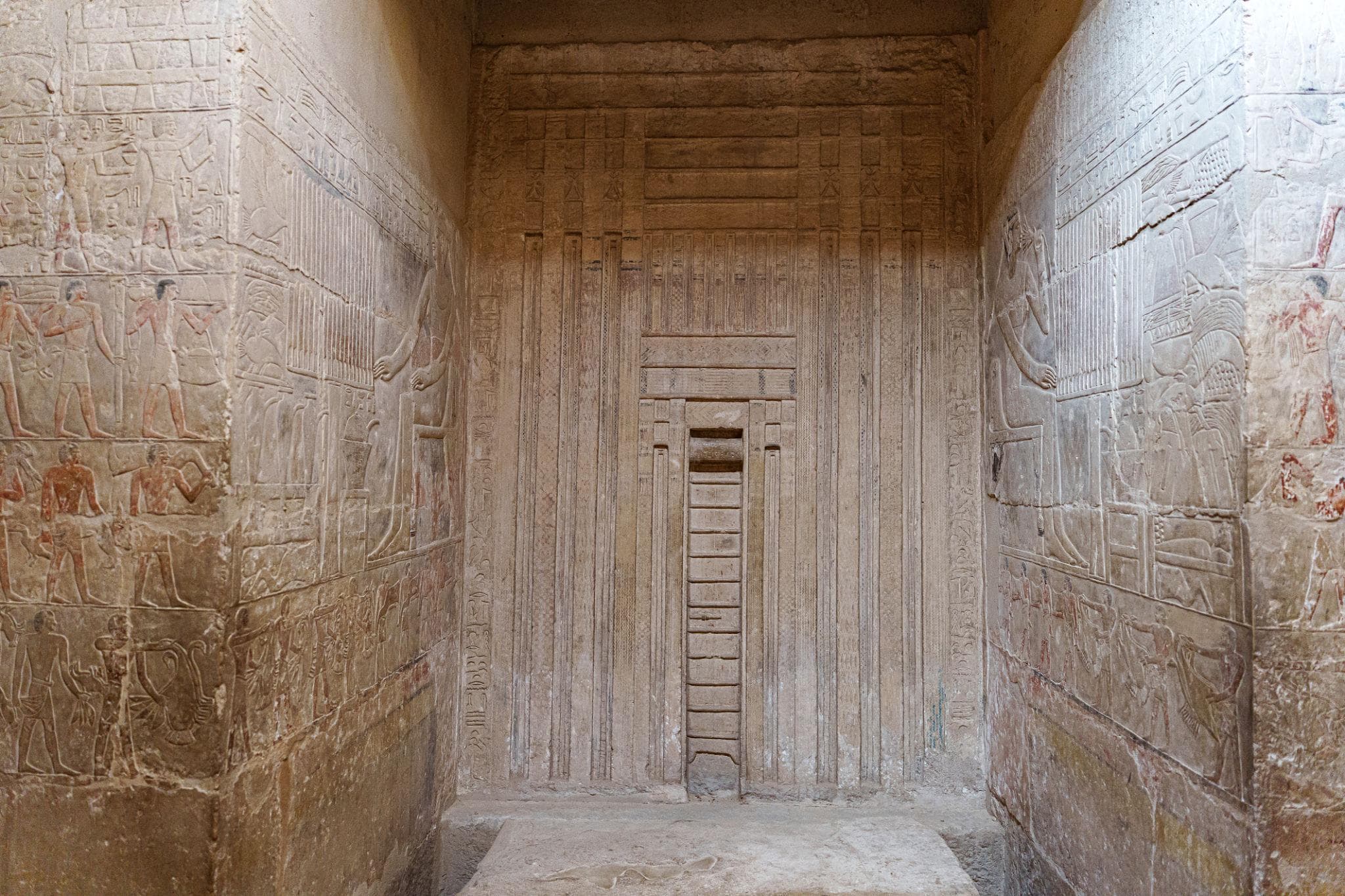
Next to it are two of the great private tombs of the Old Kingdom. The Mastaba of Mereruka, stop 14, Teti's vizier and son-in-law, has more than thirty rooms for himself, his wife and their son, and in the main pillared hall a life-size statue of Mereruka steps out of a niche towards the offerings. The walls show craftsmen, fishermen, dancers and animals in detail that repays slow looking. The Mastaba of Kagemni, stop 15, another vizier of Teti, is smaller and often quieter, with fine reliefs of fishing, farming and animals.
Stop 16, the Bubasteion and the Tomb of Wahtye, lies on the edge of the escarpment. The Bubasteion was a sanctuary of the cat goddess Bastet, and its rock tombs were reused for thousands of mummified cats. The tomb of Wahtye, a royal purification priest of the Fifth Dynasty, was found in 2018 in exceptional condition, its chapel painted and lined with rows of statues in niches. If it is closed, the view from the escarpment over the Nile valley is still worth the stop.
Route Part Four: Ptahhotep, the Serapeum and Ti
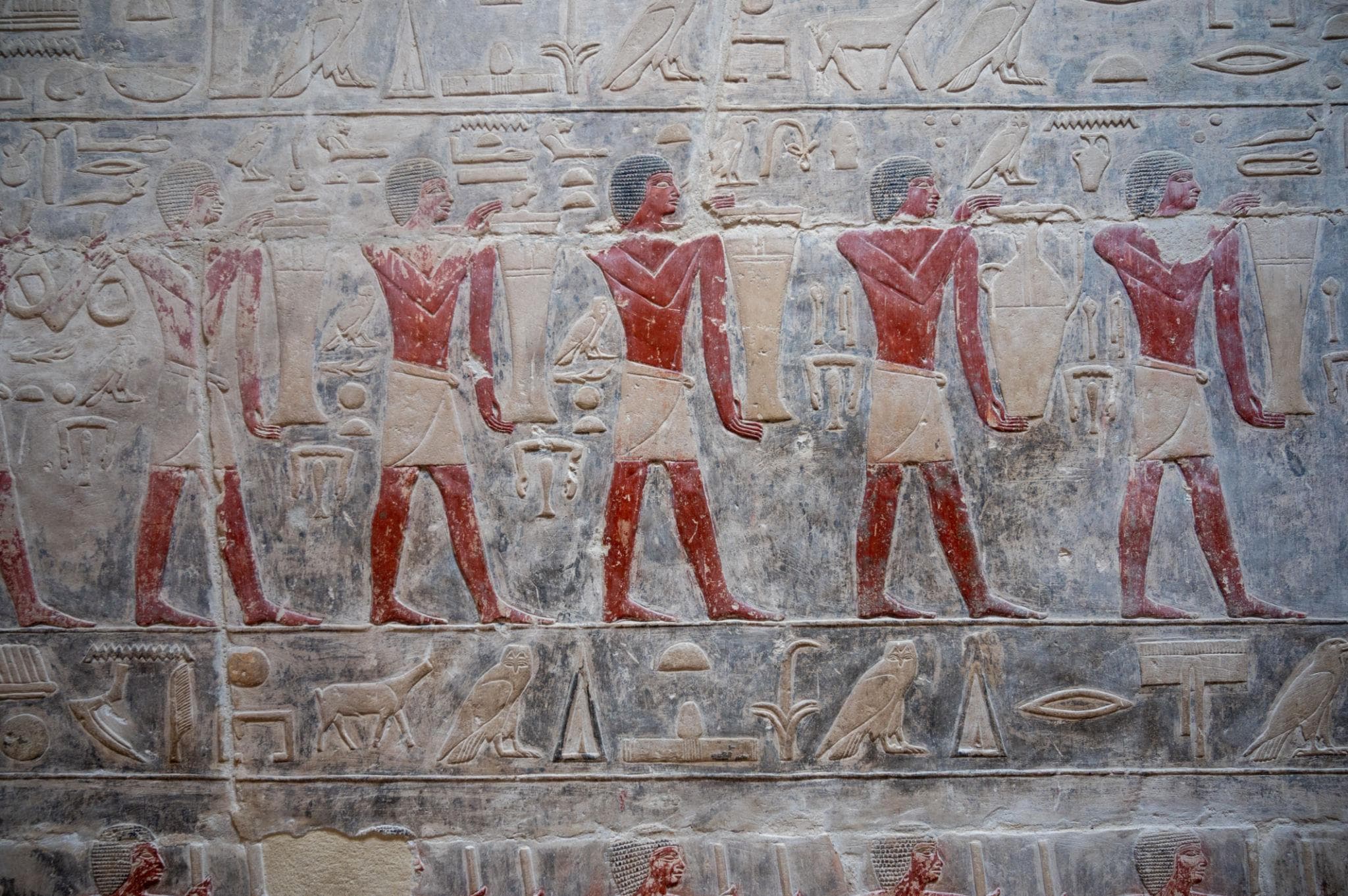
Drive west across the site to the last cluster. Stop 17, the Mastaba of Ptahhotep and Akhethotep, a father and son of the late Fifth Dynasty, has some of the finest painted relief at Saqqara: offering bearers, desert hunts and Ptahhotep at his table, in colours that have barely faded.
Stop 18 is the Serapeum of Saqqara, the underground burial place of the Apis bulls, sacred animals of the god Ptah. Long galleries cut into the rock hold more than twenty colossal stone sarcophagi, mostly granite, each weighing many tonnes, set into side chambers. The Greater Vaults were in use from the seventh century BC into the Ptolemaic period. The French archaeologist Auguste Mariette found the site in 1850 by following a line of sphinx heads in the sand. It is cool and dim, and no photograph prepares you for the size of the boxes. Allow 30 minutes and expect steps at the entrance.
Stop 19 is the Mastaba of Ti, an overseer of the royal pyramids and sun temples in the Fifth Dynasty. Its reliefs of daily life are the most complete of the period: boat building, cattle fording a canal, and Ti standing in a papyrus boat while his men hunt hippopotamus in the marsh. It makes a fine finish, and it is close to the road out.
Insider Tip: Guardians, Tips and Photography
Each tomb has a guardian who checks your ticket, unlocks the door and switches on the lights. Many will point out a detail with a torch, show you the best viewpoint or tell you which tombs are open, and a small tip for genuine help is normal; our money and tipping guide suggests amounts. Keep a few small notes in a pocket, separate from your wallet.
What you should not pay for is access. A guardian who offers to open a closed tomb or a roped-off area for a tip is asking you to break the rules, and staff in Luxor have been disciplined for exactly this. Say no politely and move on.
Photography with phones and ordinary cameras is allowed at Saqqara without a separate permit, but flash is not allowed inside the tombs, where it damages the paint. Tripods and drones need permits. Light inside is low, so hold still, brace against a wall where that is allowed, and never touch the reliefs.
Pro Tip: Saqqara in the Heat
Saqqara has even less shade than Giza, and the light bounces off pale limestone and sand. From May to September the air reaches 35C (95F) by late morning; in December and January highs are nearer 20C (68F). Arrive when the gate opens at 8am, start with the open-air monuments of the Djoser complex while it is cool, and save the underground and indoor stops for the hotter hours, since the tombs and the Serapeum are a relief from the sun.
Carry at least 1.5 litres of water each, a hat, sunscreen and sunglasses, and wear closed shoes: the paths are sand and rubble, and several tombs are reached by steep steps. If you rely on your phone for tickets, maps and the audio guide, charge it fully and carry a power bank, and use earbuds so you can listen inside the tombs without disturbing anyone.
Last tickets are sold an hour or so before closing, and some tombs lock their doors early, so do not leave the Serapeum, the most popular extra, until the end of the afternoon.
Combining Saqqara With Memphis and Dahshur
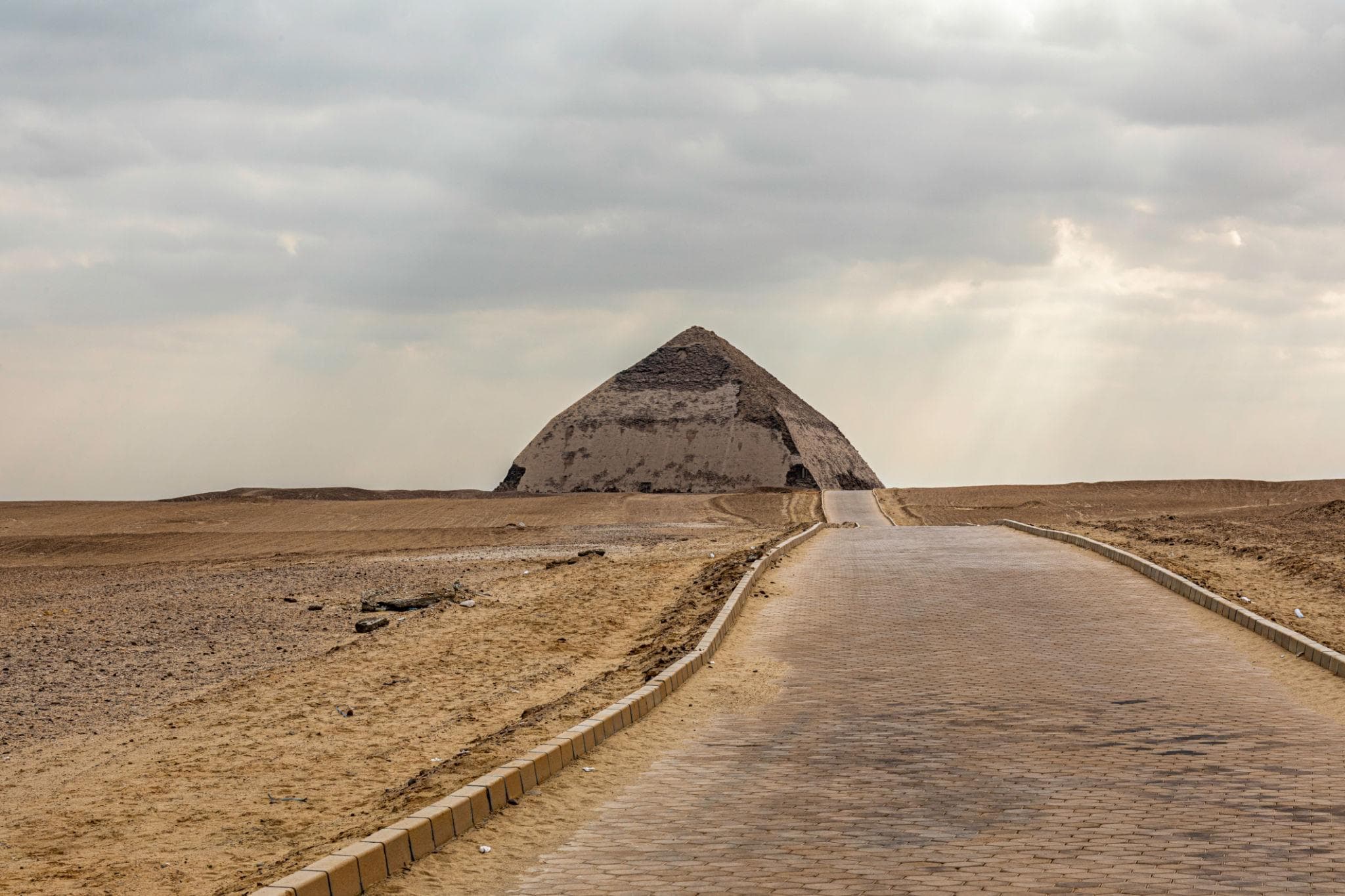
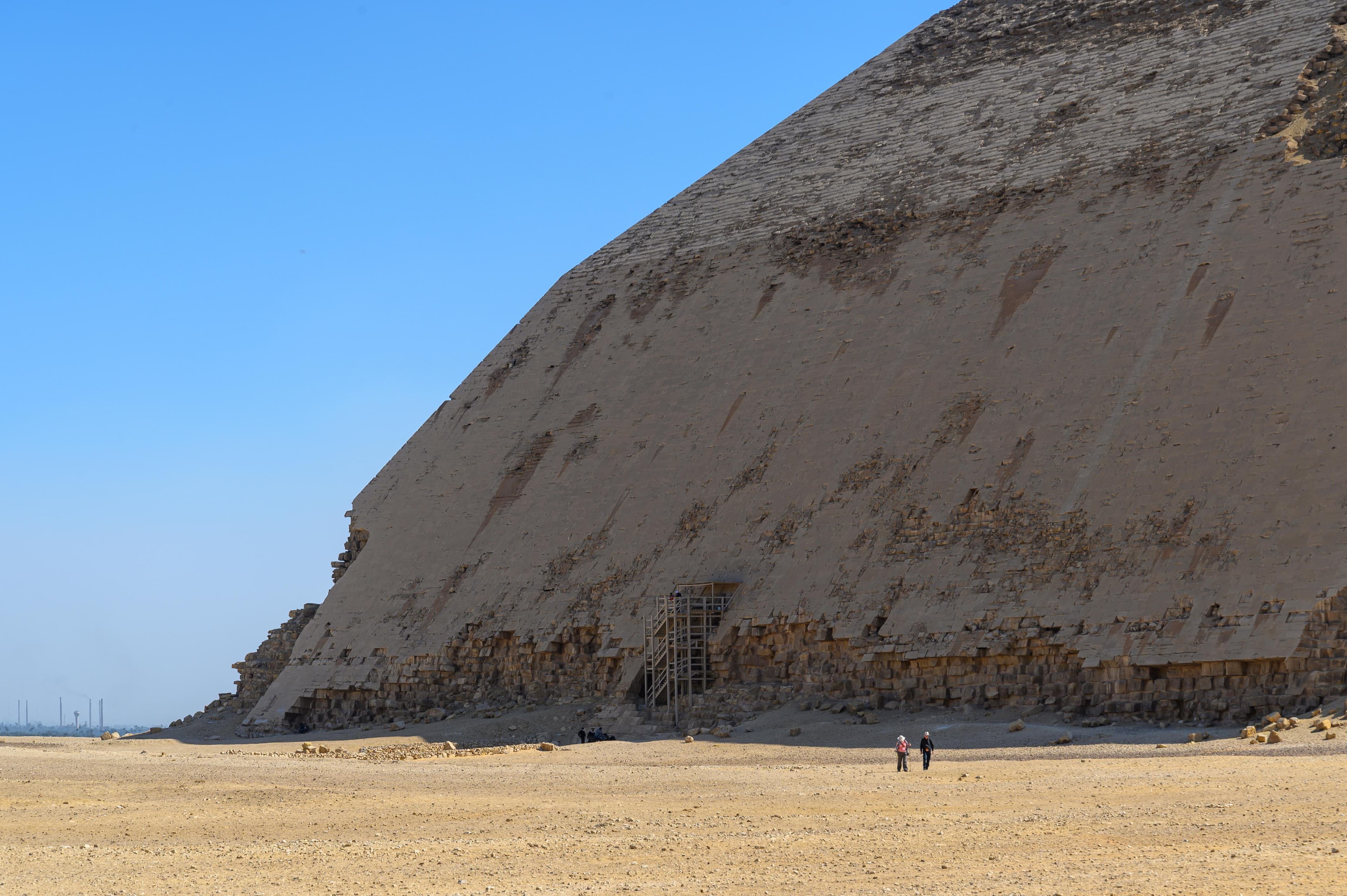
Saqqara sits between two other sites that fill the rest of a day. Memphis, at the village of Mit Rahina about 4 km (2.5 miles) east, was Egypt's first capital; little stands, but its small open-air museum holds a colossal limestone statue of Ramesses II lying in its own hall and an alabaster sphinx, an easy 30 to 45 minutes. Dahshur, about 10 km (6 miles) south, has the Bent Pyramid and the Red Pyramid, whose interior you can enter by a long descending passage. Our guide to the Dahshur pyramids covers both. Each has its own ticket.
A comfortable order is Saqqara first at opening, Memphis around midday, then Dahshur in the early afternoon when the coach groups have gone. Saqqara alone is enough for a half day from Cairo or Giza; all three make a full day of eight or nine hours, including about three hours on the road. If you have already done Giza, our guide to visiting the Giza pyramids without a guide shows how the two days fit together.
Planning Your Day at Saqqara
For a Saqqara self-guided day, the plan is a car and driver, a bank card for the tickets, an early start and the route above. Our Saqqara audio tour lets you hear its first stop free before you buy; it costs US$7, one purchase covers every language it comes in, and it works offline once opened on Wi-Fi, which matters in tombs where the signal drops. Listen to the first stop at home and you will know the layout before you arrive. On site the map shows your position, and the hand-drawn diagrams make sense of shafts and chambers you cannot see from the door.
If you would rather have an Egyptologist with you, our Saqqara, Memphis and Dahshur day tour covers all three sites with the driving and tickets arranged, and our two-day Cairo highlights tour adds Giza, Saqqara and the city. If you want a guide only at Giza, a private Giza plateau tour pairs well with a self-guided Saqqara day.