The first view of the pyramids has moved. For decades visitors drove up the hill past the Mena House hotel and found the Great Pyramid filling the windscreen. Now the main way in is the Great Gate on the Cairo–Fayoum road, south of the monuments, where a visitor centre, a car park and a row of electric buses come first, and the pyramids wait across the sand.
That makes it easier than ever to visit the Giza pyramids without a guide. Cars and coaches no longer drive between the monuments and the buses cover the longest distances. What the new system does not do is tell you where to walk or what you are looking at.
This guide covers the new entrance, every ticket you might need as of November 2026, a step-by-step route that follows the 20 stops of our Giza audio tour, and how to handle the heat, the touts and the camel men.
At a Glance
Main entrance: the Great Gate and visitor centre on the Cairo–Fayoum road, south of the pyramids
Plateau ticket: 700 EGP, students 350 EGP, as of November 2026, bank card only
Great Pyramid interior: 1,500 EGP, students 750 EGP
Khafre or Menkaure interior: 280 EGP, students 140 EGP, usually one of the two open
Getting around: electric buses from the visitor centre, included in the ticket on most reports
Opening hours: 7am to 5pm for most of the year, last entry around 4pm, shorter in Ramadan
Time needed: about 3 hours for the full loop, 4 with a pyramid interior
Best time: at opening, or the last two hours before closing in winter
Next door: the Grand Egyptian Museum, about 2 km (1.2 miles) away
Can You Visit the Giza Pyramids Without a Guide
Yes. No rule requires a licensed guide on the plateau, and the monuments stand in open desert with clear sightlines. What you lose without a guide is context. The plateau is a royal cemetery of the Fourth Dynasty, built roughly between 2600 and 2500 BC, and much of what makes it interesting, from the boat pits to the queens' tombs, is easy to walk past.
Going alone suits travellers who are comfortable saying no firmly and want to set their own pace, less so anyone with limited mobility in summer. A middle course is a self-guided audio tour. Our Giza Plateau audio guide has 20 stops with about 35 minutes of narration in English, a hand-drawn diagram for every stop and a map that shows your position on the plateau, and it plays offline if you open it on hotel Wi-Fi the evening before.
Either way, the essentials are the same: the right tickets, an early start, water, and a route that saves your legs for the climb inside a pyramid. Our ultimate guide to visiting the pyramids covers the wider picture; this post is the practical walk-through for doing the Giza pyramids self-guided.
The Great Gate, the Visitor Centre and the Electric Buses
The new entrance is part of a plateau-wide redevelopment by the Ministry of Tourism and Antiquities with Orascom Pyramids Entertainment, in daily use through 2026 after trial runs. The Great Gate stands on the Cairo–Fayoum road beside a car park reported to hold more than 1,200 cars and 200 coaches, and drivers and taxis drop you there. Online maps sometimes still send you to the old Mena House gate, so search for the Giza Pyramids Visitor Centre.
Inside are the ticket windows, self-service machines that take bank cards, toilets, a café and the bus platform. Electric buses run a loop from here to stops near the Great Pyramid, Khafre and Menkaure, the Panorama and the Sphinx. Reports disagree on the number of stops, between five and seven, but buses come every few minutes and most sources say the ride is included in the plateau ticket. Some visitors found the buses start around 8am, after the gate opens.
You can get off at any stop, explore on foot and board the next bus. Walking is still allowed, and the Great Pyramid, Khafre and the Sphinx lie within about a kilometre of one another. The visitor centre is a long way from everything and the Panorama is uphill, so most people ride those legs and walk the rest, about 5 km (3 miles) in all.
Giza Plateau Tickets in 2026
The basic plateau ticket costs 700 EGP for foreign adults and 350 EGP for students with a valid ISIC card, as of November 2026, about US$13. It covers the outside of the three pyramids, the Sphinx terrace and the Valley Temple of Khafre, the Panorama, the open cemeteries and the buses. Everything else is a separate ticket, sold at the same windows and on the Ministry's official ticketing website:
- Great Pyramid of Khufu interior: 1,500 EGP, students 750 EGP
- Pyramid of Khafre or Menkaure interior: 280 EGP, students 140 EGP, usually only one of the two open on a given day
- Tomb of Queen Meresankh III: a small extra ticket, reported at around 200 EGP
Payment is by bank card only. A rise in the Khafre interior price to 500 EGP has been approved from 1 April 2027, so check our Egypt ticket prices guide shortly before your visit.
Is the Great Pyramid worth 1,500 EGP? If you can manage a steep, humid passage bent double in places, the Grand Gallery is one of the great architectural spaces of the ancient world, and for most people that settles it. If you mainly want to have been inside a pyramid, Khafre or Menkaure gives you a descending passage and a bare burial chamber for under a fifth of the price.
Insider Tip: The Sphinx Gate for Walkers
The old gate beside the Sphinx, on the village side of the plateau, has stayed open to pedestrians according to visitor reports through autumn 2026, but it has no ticket office. If you buy your tickets online in advance, you can walk in here and stand in front of the Sphinx within minutes, which is also the first stop of the route below. For anyone staying in a hotel with pyramid views on that side, it saves the trip round to the Great Gate.
Two caveats. The streets leading to this gate are where the most persistent touts work, so walk with purpose, ignore anyone who says the gate is closed or that you need a ticket from him, and have your e-tickets ready on your phone. And gate arrangements have changed several times since the redevelopment began, so if it is shut on the day, the Great Gate is a taxi ride round the edge of the plateau.
The Self-Guided Route: The Sphinx and the Valley Temple
The route follows the order of the stops in our audio tour, which works on the ground: start low at the Sphinx, climb the causeway to Khafre, circle the Great Pyramid, then head south to Menkaure and the Panorama. From the visitor centre, take the bus straight to the Sphinx stop.
Stop 1 is a short welcome. Stop 2 is the Valley Temple of Khafre, which you walk through to reach the Sphinx terrace: enormous limestone blocks once faced with red granite from Aswan, around a roofless pillared hall. In 1860 excavators found here the seated statue of Khafre in dark stone that is now one of the best-known pieces of Egyptian sculpture.
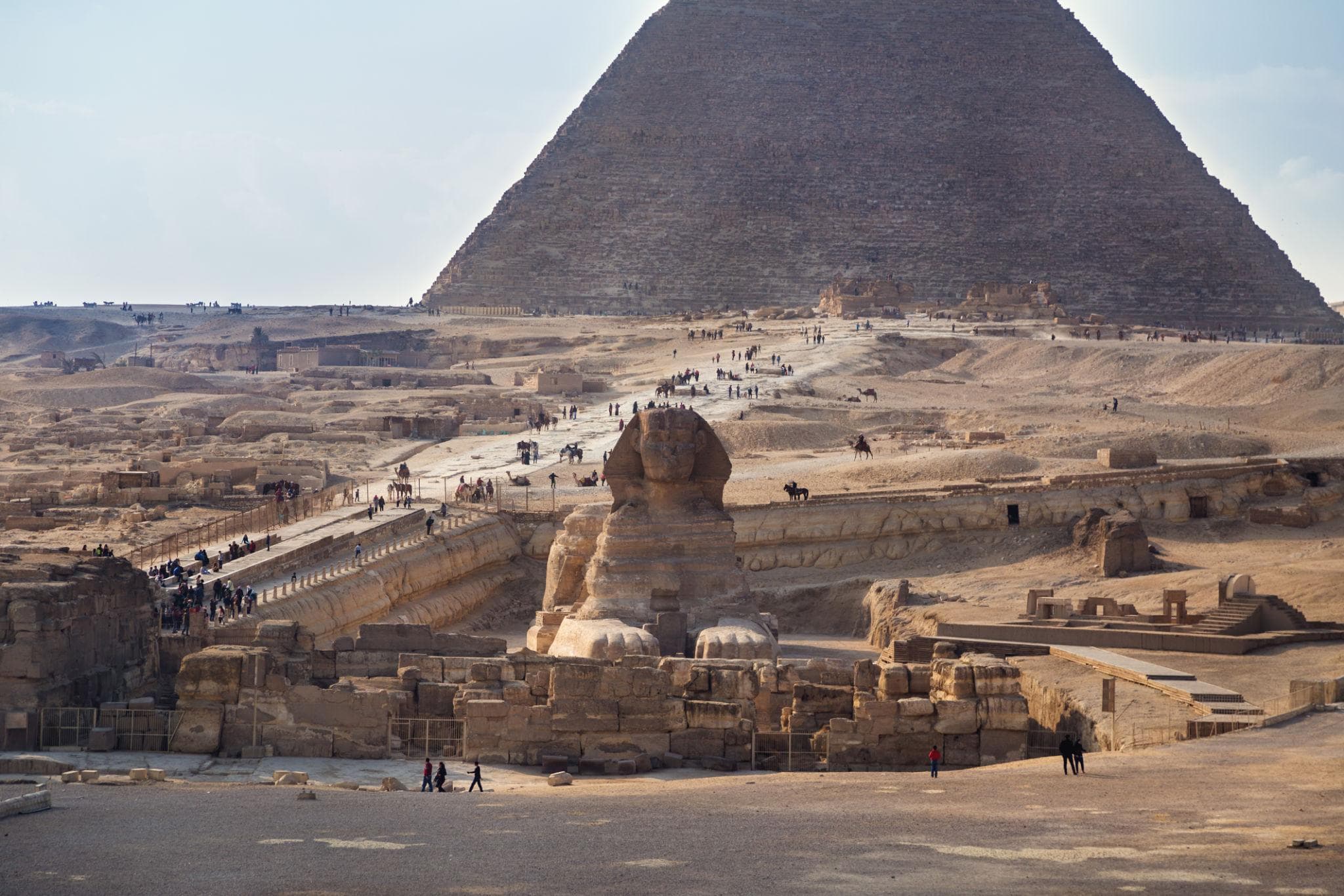
Stop 3 is the Great Sphinx, carved from the bedrock, about 73 m (240 ft) long and 20 m (66 ft) high, and usually attributed to Khafre. You see it from a terrace beside the Valley Temple, not at its paws. Stop 4 covers the ruined Sphinx Temple in front of it and the Dream Stela between its paws, set up around 1400 BC by Thutmose IV. Its text tells how the Sphinx appeared to the young prince in a dream and promised him the throne if he cleared away the sand that buried it.
Up Khafre's Causeway
From the Sphinx, walk up the causeway that once linked the Valley Temple to Khafre's pyramid temple, a sloping road of about 500 m (550 yards) and the quietest part of the plateau.
Stop 5, Campbell's Tomb, is a deep square shaft beside the causeway, a Late Period burial some two thousand years younger than the pyramids, named in 1837 by the explorer Howard Vyse after the British consul-general of the day. Stop 6, the Osiris Shaft, lies beneath the causeway: shafts dropping through three levels to a chamber with a stone sarcophagus surrounded by groundwater, later linked with Osiris, god of the dead. It is normally closed, so you hear its story at the gated opening. Stop 7 is the causeway itself, which shows how a pyramid complex worked: a valley temple, a covered processional road, a temple against the pyramid.
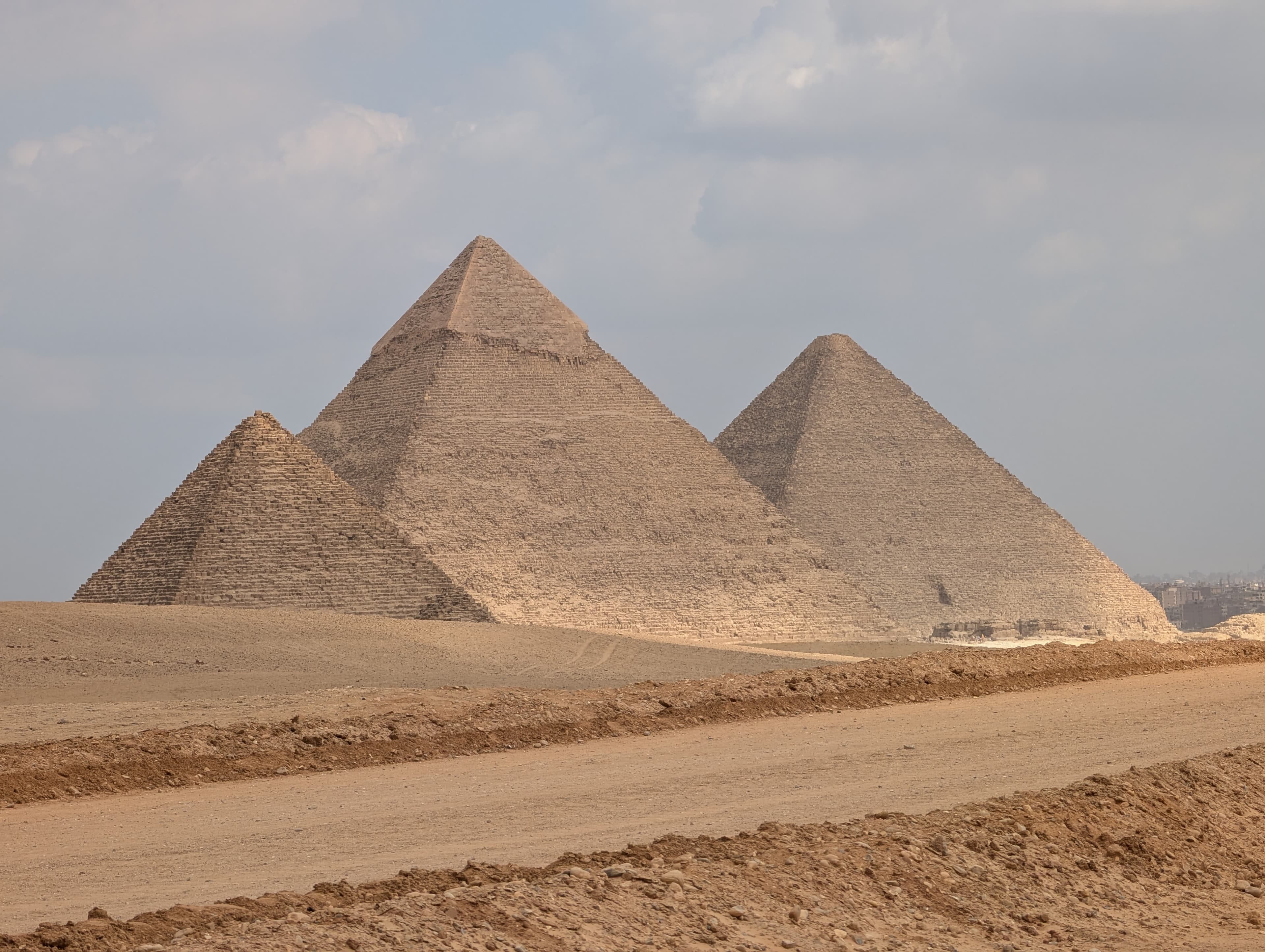
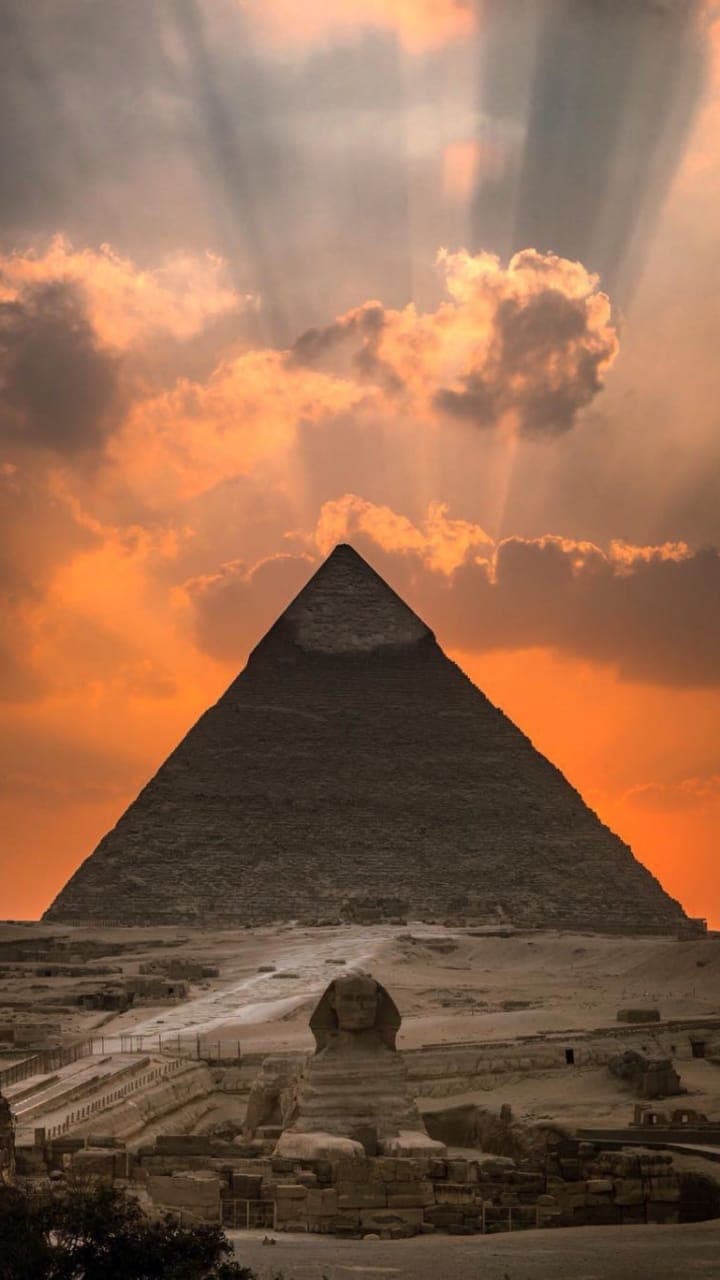
Stop 8 is the Pyramid of Khafre, about 136 m (446 ft) today. It stands on higher ground than the Great Pyramid and keeps a cap of its original smooth casing near the top, so in photographs it often looks the tallest. If its interior is the one open, the descending passage leads to a plain burial chamber where Giovanni Belzoni painted his name in 1818, when he became the first modern visitor to find the way in.
The Great Pyramid and the Eastern Cemetery
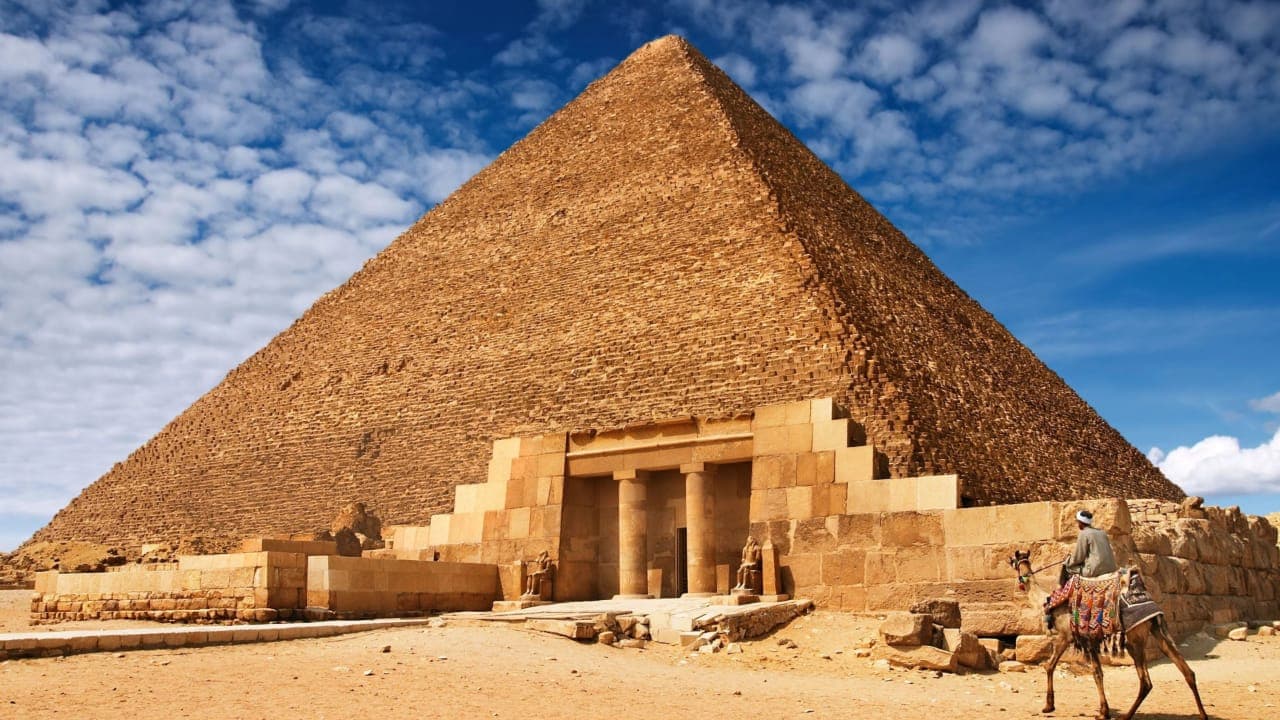
Walk north to the Great Pyramid, stop 9, built for Khufu around 2560 BC. It rose to about 146 m (479 ft), the tallest structure built by human hands for nearly four thousand years, and stands at about 138 m today on a base about 230 m (755 ft) a side. Our Great Pyramid page covers its history, and our post on how the pyramids were built explains the quarries and ramps.
Stop 10 takes you inside. You enter through a tunnel forced by early treasure hunters on the north face, join the ascending passage, then emerge into the Grand Gallery, a corbelled hall about 8.6 m (28 ft) high and 47 m (154 ft) long, before ducking into the granite King's Chamber with its empty sarcophagus. Expect handrails, warm still air and queues at busy times; allow 30 to 45 minutes.
Back outside, the east side holds stops 11 to 13. Khufu's pyramid temple has left little more than a basalt pavement; nearby, the Trial Passages reproduce the pyramid's corridors in the bedrock, beside three small Queens' Pyramids. Below lies the Tomb of Queen Meresankh III, Khufu's granddaughter and Khafre's wife, whose rock-cut chapel keeps painted walls and a row of ten standing female figures. Then walk round to the south face for stop 14: the cedar Khufu Boat found in a pit here in 1954 now stands in the Grand Egyptian Museum, and our post on the Khufu solar boat tells its story.
Menkaure, the Panorama and the Southern Tombs
Stop 15, the Western Cemetery, is the grid of mastaba tombs west of the Great Pyramid, laid out in streets for Khufu's officials and relatives. Then ride or walk about 1 km (0.6 miles) south-west to Menkaure, stop 16, the smallest of the three, originally about 65 m (213 ft) high and still clad in its lowest courses with red granite. The deep gash in its north face dates from 1196, when the sultan al-Aziz Uthman, a son of Saladin, set out to demolish it and gave up after months. Its three small Queens' Pyramids, stop 17, stand in a line to the south.
The Panorama, stop 18, is the rise to the south-west from which every photograph of the nine pyramids in a row is taken. The bus stops here, there is a café with shade, and the camel and horse operators wait here too.
The last two stops look back towards the Sphinx. The Tomb of Khentkaus I, stop 19, is a massive two-stepped monument on the low ground between the causeways of Khafre and Menkaure, built for a queen who may have ruled in her own right at the end of the Fourth Dynasty. The Tombs of the Pyramid Builders, stop 20, south of the Sphinx, were found in 1990 and showed a workforce that was organised, fed and buried with care in its own cemetery within sight of the pyramids. Access to both varies, so these stops are often heard from a viewpoint.
Warning: Touts, Camels and the Closed Gate Story
The redevelopment has cleared vendors from much of the plateau, but not all. The commonest trick is the friendly man outside a gate who says the entrance is closed, that tickets must be bought through him, or that foreigners need a guide by law. None of it is true. Buy tickets only at the official windows, machines or website.
Camel and horse rides operate from designated areas near the Panorama. If you want a ride, agree the price, the length of the ride and whether the price is per person or per animal before you get on, and pay at the end; the classic sting is the cheap ride that becomes expensive when you want to get off. Animal welfare groups have documented poor conditions for some animals at Giza, and the government has announced plans to restrict rides further, so whether you ride is your decision.
Anyone who wraps a headscarf round your head, hands you a trinket as a gift or waves you towards a fenced-off photo spot will expect payment. A firm "la, shukran", no thank you, said while you keep walking usually ends it. Our Egypt travel mistakes to avoid covers the rest.
Pro Tip: Heat, Timing and What to Carry
Be at the gate when it opens, at 7am for most of the year, ahead of the coach groups that build up from mid-morning. In the first two hours the light is low, the stone is cool and the queue for the Great Pyramid is short. There is almost no shade outside the visitor centre and bus shelters, and from May to September it reaches 35C (95F) or more by midday; even in December and January, with highs nearer 20C (68F), the sun reflects hard off the sand.
Carry at least 1.5 litres of water each, a hat, sunglasses and sunscreen, and wear shoes with grip for the loose sand over rock. Keep your bag small for the Great Pyramid's passages. If your phone holds your tickets, maps and an audio guide, charge it fully, bring a power bank, and pack earbuds.
In winter the last two hours before closing bring warm light and thinner crowds. Photography with phones and ordinary cameras is free on the plateau; drones are not permitted, and tripods need a permit.
Combining the Pyramids With the Grand Egyptian Museum
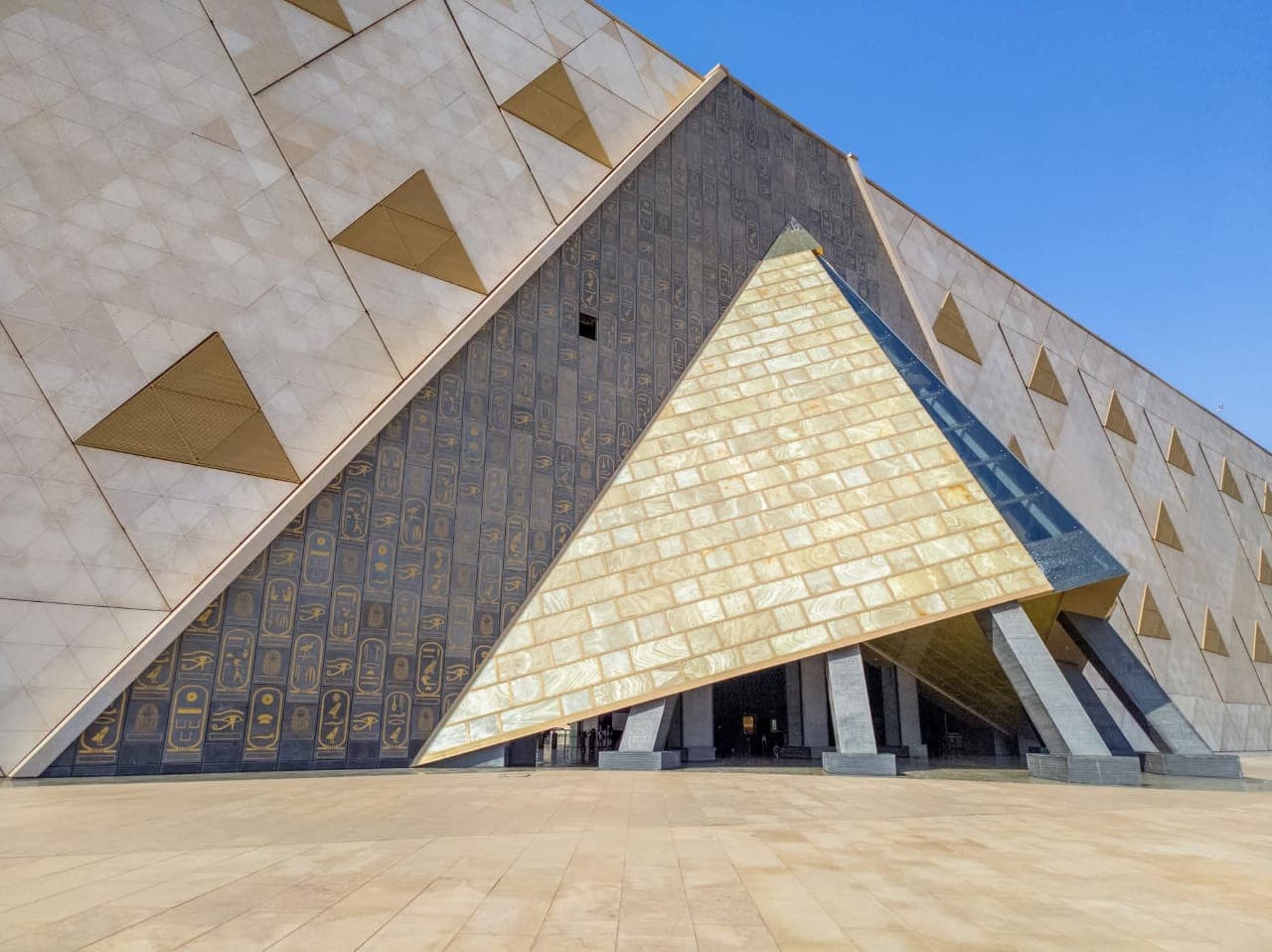
The Grand Egyptian Museum stands about 2 km (1.2 miles) from the pyramids, and the two make the natural full day in Giza. Do the plateau first while it is cool, stop for lunch, then spend the afternoon in the museum's air-conditioned galleries, where the Tutankhamun collection alone can absorb two hours. Since 1 November 2026 the foreign adult ticket has been 1,830 EGP; our Grand Egyptian Museum tickets guide explains the categories and time slots.
The two sites share neither a ticket nor an entrance, so you need a car or taxi between them, which makes a driver for the day the simplest arrangement. If you are passing through Cairo on a long connection, our Cairo layover tour fits the plateau into the hours between flights. And for a second day close by, our guide to visiting Saqqara without a guide applies the same approach to the older pyramids and painted tombs less than an hour to the south.
Planning Your Visit to the Giza Plateau
If you visit the Giza pyramids without a guide, the plan is short: a bank card for the tickets, water, an early start and the route above. You can hear the first stop of the Giza Plateau audio tour free before deciding; it costs US$7, one purchase covers all seven of its languages, and it works offline once opened on Wi-Fi. On site, the map shows where you are standing at each stop, and the diagrams help with the ruins that are hardest to read. Our audio guides overview lists the other five sites, from Saqqara to the Valley of the Kings.
If you would rather have someone beside you, our private Giza plateau tour pairs a car with an Egyptologist guide who handles tickets and timing, and our pyramids and Grand Egyptian Museum day adds the museum in the afternoon. Either way, the plateau rewards the visitor who arrives early and walks a little further than the crowd.