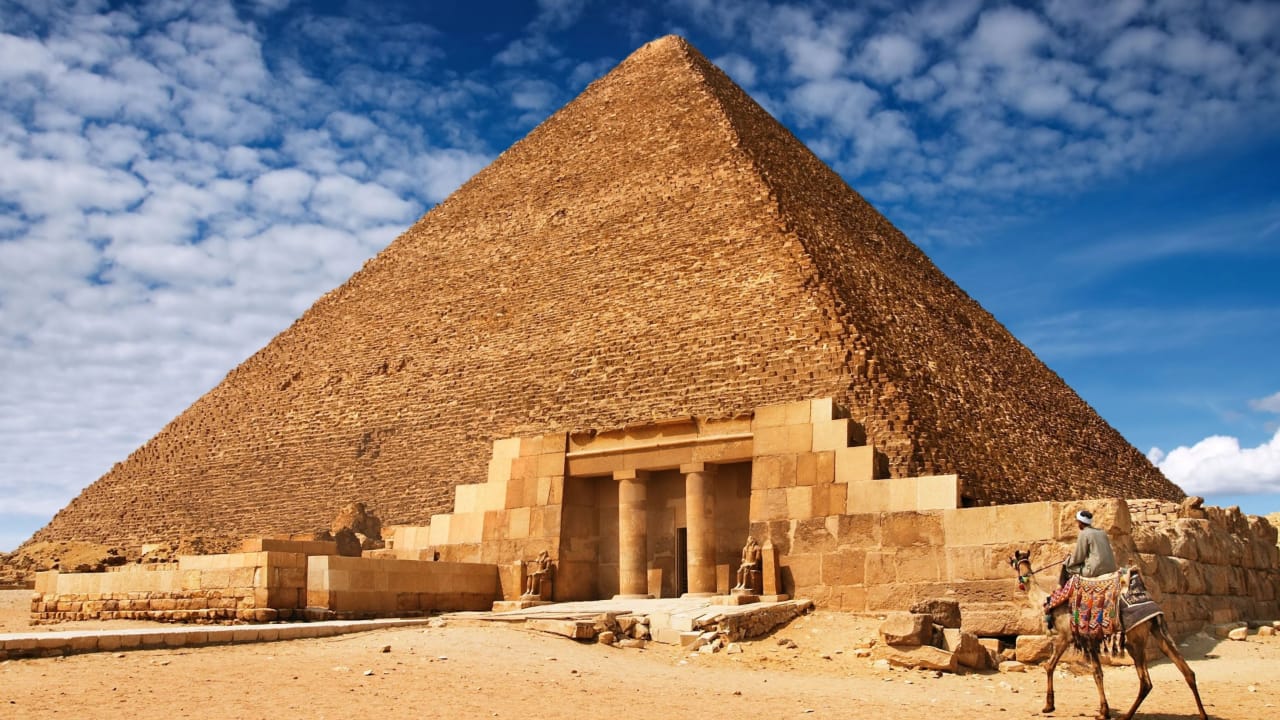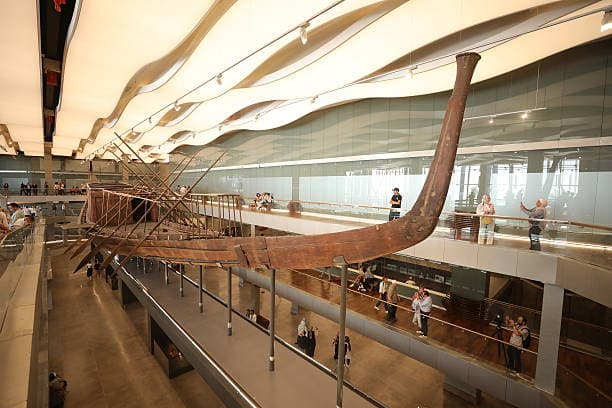
In May 1954 an architect named Kamal el-Mallakh broke through the limestone roof of a sealed pit beside the Great Pyramid and looked down on cedar planks and coils of rope, stacked in layers exactly where Khufu's workmen had left them some 4,500 years earlier. It took almost three decades to turn that timber into the Khufu solar boat, a royal ship more than 40 metres long that you can stand beside and look up at.
Today the ship fills its own climate-controlled building at the Grand Egyptian Museum, two kilometres from the pit where it was buried. Since December 2025 its twin has been rising beside it, timber by timber, in full view of visitors. It is a rare chance to watch a royal vessel of this age being put back together, and it will not last forever.
This guide covers what was found and how it was rebuilt, what the boats were probably for, how far the second boat's restoration has come by autumn 2026, and how to fit the Khufu Boats Museum into a GEM visit without running out of time or energy before you reach it.
At a Glance
What it is: a royal ship of Lebanese cedar, about 4,500 years old, buried in pieces beside the Great Pyramid
Found: 26 May 1954 by Kamal el-Mallakh, in a pit sealed by 41 limestone blocks
Size: 42 to 43 m (138 to 142 ft) long depending on the source, almost 6 m (19 ft) wide, rebuilt from 1,224 pieces
Where now: the Khufu Boats Museum, a separate building at the Grand Egyptian Museum, since August 2021
Second boat: some 1,650 pieces, reassembled in public since 23 December 2025, about four years of work expected
Tickets: included in the standard GEM ticket; foreign adults 1,830 EGP (about 33 USD) from 1 November 2026
Hours: galleries 9am to 6pm, until 9pm on Wednesdays and Saturdays, as of autumn 2026
Booking: online only, for a dated, timed slot
Time needed: about an hour for the boats building, on top of the main galleries
What Kamal el-Mallakh Found in 1954
The Great Pyramid was already known to have boat pits: hull-shaped trenches cut into the rock on its east side, found empty long before. In 1954, during clearance work along the southern flank, el-Mallakh and his colleague Zaki Nour came upon a row of enormous limestone blocks. There were 41 of them, each in the region of 15 tonnes, and some carried the name of Djedefre, Khufu's son and successor.
That detail matters more than it seems. It suggests the boat was dismantled and buried as part of Khufu's funeral, with the burial completed under the next king, which ties the ship firmly to the moment of the pharaoh's death rather than to some later dedication.
Beneath the blocks, the boat lay in 13 layers: hull planks, frames, deck beams, the parts of a cabin, oars and lengths of rope, all sealed in a dry, stable pocket of bedrock. Zahi Hawass later remembered el-Mallakh saying that when the pit was opened he could smell history. Lifting the contents out took about 20 months. A second pit alongside was identified the same year but left sealed, and that decision would shape the next seventy years of the story.
The Long Jigsaw of Hag Ahmed Youssef
The man who turned the pile into a ship was Hag Ahmed Youssef Moustafa, chief restorer of Egypt's antiquities service. He had joined the service in 1932 and spent around ten years working with the American archaeologist George Reisner at Giza, an apprenticeship in patient, meticulous recording that suited the job ahead. He was put in charge of the boat in 1957.
He had no plan to work from. No ancient shipwright's manual survives, and nothing comparable had ever been rebuilt. So he went looking for living knowledge: he spent time with boatbuilders on the Nile, studied vessels in tomb reliefs, and built his own scale models at 1:10 and 1:20 to test how the parts might fit. By his own account he produced thousands of photographs and drawings and gave every piece a number.
The first arrangements did not work. Over the centuries the hull had sagged and lost part of its curve, so the deck beams refused to sit where they should, and the assembly was taken apart and rebuilt several times before it settled into its present shape. The whole process took him close to 14 years. He died in 1999 at the age of 86, and about 95 percent of the timber in the boat today is original, a fair measure of how little he had to invent.
How the Khufu Solar Boat Was Built
Stand beneath the hull and the first surprise is how few fastenings there are. The boat was built shell-first: the planks of the hull were shaped and joined edge to edge, and the internal frames were added afterwards. Tenons of Christ's thorn wood keep the planks aligned, and the whole structure is lashed together with ropes of halfa grass passed through holes in the timber. The usual explanation for how such a hull stays watertight without caulking is that wet timber swells against the lashings and closes the seams.
There is no keel. The bottom is flat, the bow and stern rise in long, elegant curves, and some hull planks run to about 23 m (76 ft). That length is the giveaway on the timber: the Nile valley grows nothing remotely that size, so the cedar was brought from the Levant, roughly where Lebanon is now. The cost and effort of that import tells you this was a royal object from the first cut.
Oars, ropes and a deckhouse were found with the hull. What you see at the GEM is not a model or a reconstruction in new wood but the original ship, reassembled by hand, and among the oldest large vessels to survive from anywhere in the ancient world.
Did You Know: The Rope Marks Tell a Story
If the boat was purely symbolic, why do its timbers carry the impressions of wet ropes pressed into the wood? Several Egyptologists read those marks as evidence that the hull was in water at least once, which is one reason the debate about its purpose has never been settled.
Others point out that it has no mast or rigging and does not look built for long voyages. Both observations can be true at once. A single short ceremonial journey on the river would leave exactly this kind of trace and nothing more.
What Was It For? Three Theories
Calling it the Khufu solar boat is a modern habit and something of an assumption. There are three main readings, and none has been proved.
- A solar barque. In Egyptian belief the sun god Ra crossed the sky by day and the underworld by night in boats, and the dead king hoped to travel with him. On this reading, the ship was buried so that Khufu could take his place in that daily journey.
- A funeral barge. The boat may have carried the king's embalmed body along the Nile from the royal residence at Memphis to Giza, after which it was too sacred to reuse and was dismantled and buried beside the tomb.
- A pilgrimage ship. A third view holds that Khufu used it in his lifetime to visit holy places, and that it was buried for his use in the afterlife.
The answer we would give standing in front of it is that these ideas are not exclusive: a real vessel, used at least once in the funeral rites, then buried with a religious meaning attached. Our guide to the ancient Egyptian gods covers Ra and the journey of the sun across the sky and through the underworld.
The 2021 Move from the Pyramid to the GEM
From 1982 the boat stood in a purpose-built museum directly over its pit on the south side of the pyramid, a building that was never well suited to the job of protecting cedar from heat, light and tourist breath. It closed in August 2020, and a year later the boat made what will almost certainly be its last journey.
Encased in a padded steel cage and loaded onto a remote-controlled transporter brought in from Belgium, the 20-tonne load crossed the 7 or 8 km to the Grand Egyptian Museum, accounts differ slightly, in an operation most reports put at about 48 hours, arriving at dawn on Saturday 7 August 2021. Sensors tracked temperature, humidity and vibration throughout, and the restorers who inspected it on arrival found it in good condition. It then stayed inside its protective frame while the boats building was completed around it.
The new building was designed to hold both boats. Earlier plans had imagined the second boat standing on its own near the entrance to the plateau, but by 2021 the decision was settled: the pair would be shown side by side, the first time anyone has seen both boats assembled.
The Second Boat: Live Restoration in 2026
The second boat had a harder four and a half thousand years. Its timbers suffered from damp, and in 1987 a team from the National Geographic Society and Egypt's antiquities service drilled through the roof of the pit to lower a camera, then resealed the hole. Air got in, insects followed, and some of the beams were damaged. The same year, a team from Japan's Waseda University confirmed the boat's outline with ground-penetrating radar.
The rescue was slow and careful. Japanese funding was offered in 1992; the 41 cover slabs, each about 14 tonnes, began to come off in June 2011; and the first timbers were lifted in June 2013. One of the cover stones turned out to carry Khufu's own name. By July 2021 the excavation was complete: roughly 1,700 pieces lifted from 13 layers, documented and given first-stage conservation, most of them already moved to the GEM. The Japan International Cooperation Agency has funded the work, including a 3 million dollar grant for the final conservation and reassembly.
The reassembly began in public on 23 December 2025 in the hall beside the finished first boat. Egypt's Minister of Tourism and Antiquities, Sherif Fathy, described it at the launch as one of the most important restoration projects of the century, and the museum's head of conservation, Eissa Zidan, put the expected timeframe at about four years for some 1,650 pieces.
Progress, as of autumn 2026, is measured in individual timbers. In early October 2026 the museum announced that 16 restored pieces had been fixed in their original positions on the lowest level of the vessel, with conservation of the remaining components continuing. The work is a joint Egyptian and Japanese effort involving the GEM, the Supreme Council of Antiquities and Higashi Nippon International University, whose president, Sakuji Yoshimura, heads the Japanese team. Anyone visiting in 2026 or 2027 will see a ship under construction rather than a finished one, which is arguably the more interesting thing to watch.
Inside the Khufu Boats Museum
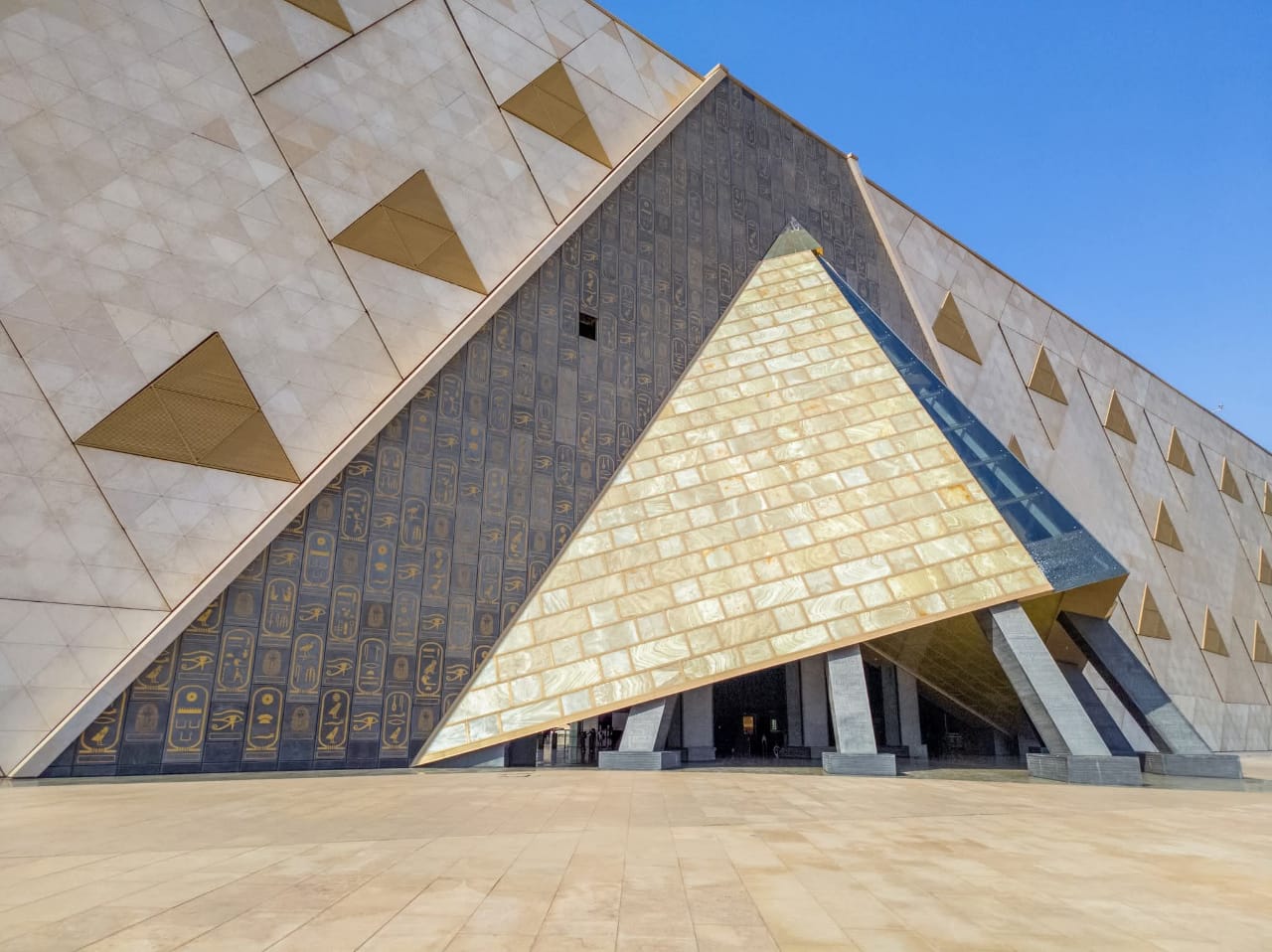
The Khufu solar boat and its twin are housed in the Khufu Boats Museum, a separate, climate-controlled building behind the main GEM galleries, reached across an open plaza. It is easy to leave too late: after three or four hours in the main galleries and the Tutankhamun halls, the walk across the plaza is the one people are tempted to skip.
Inside, walkways at several levels let you see the first boat from below, alongside and above, which is the only way to grasp the length of the hull and the sweep of its prow and stern. Some of the original limestone blocks that sealed the pit are displayed so that you can walk beneath them and look up at the ancient graffiti naming Djedefre. An interactive display sets out the competing theories about what the boats were for.
Then there is the second boat, taking shape on a steel framework beside the first as restored timbers are fixed back into place. We know of no published timetable for when the conservators are at work, so treat it as a bonus if you catch them handling a piece. Allow about an hour for the building as a whole.
Tickets, Hours and Getting In
There is no separate ticket for the Khufu solar boat. The boats building is included in standard GEM admission, which also covers the main galleries, the Grand Staircase and the Tutankhamun galleries.
Prices rise on 1 November 2026. The foreign adult ticket goes from 1,570 EGP to 1,830 EGP (about 33 USD), and the student and child rate from 790 EGP to 920 EGP (about 17 USD), following an increase announced in April 2026. Student rates need valid ID. If you booked a November visit before the change, check the total at checkout. Treat these figures as correct as of autumn 2026; our Egypt ticket prices guide covers every other major site.
As of autumn 2026 the galleries open from 9am to 6pm, with late opening until 9pm on Wednesdays and Saturdays and last entry an hour before closing. Hours shift during Ramadan and on some public holidays. Fridays and Saturdays are the busiest days, when Egyptian families visit in large numbers.
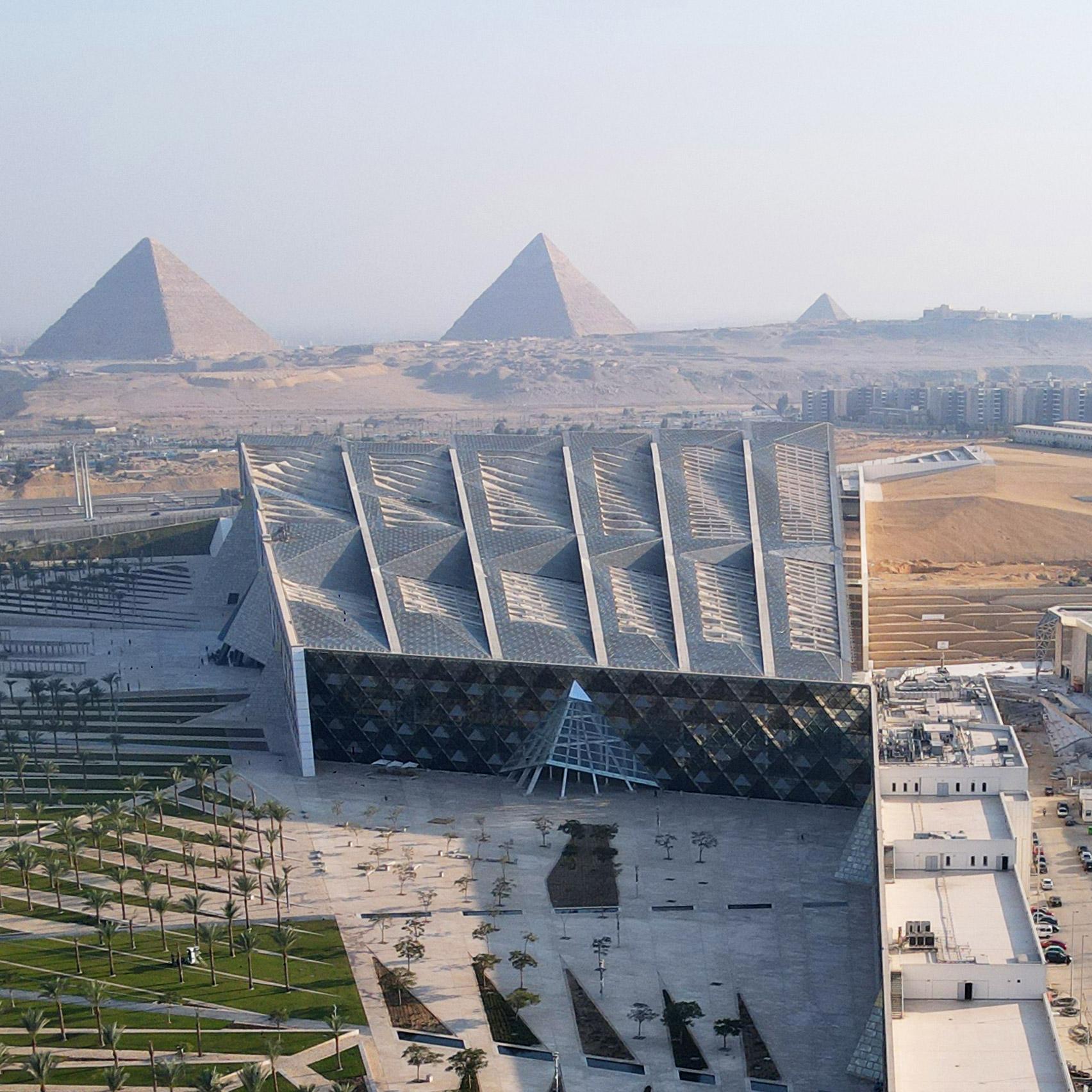
The museum is about 2 km from the pyramids of Giza, close enough to combine on the same day. Taxis and ride-hailing apps work well for the drop-off, but pick-ups outside the museum can be slow to arrange, which is one argument for a driver who waits. A metro connection has been planned for years; check its status before relying on it.
Warning: Buy Tickets Only From the Official Site
Foreign visitors cannot buy tickets at the door. Admission is sold online only, for a specific date and time slot, and third-party resellers have grown up around that system. Buy through the museum's own ticketing site, or let your tour operator handle it, and check the web address carefully before entering card details.
If you are travelling with a guide, ask which time slot has been reserved so you can plan the pyramid visit around it rather than discovering the clash at lunchtime.
Pro Tip: See the Pit Before the Boat
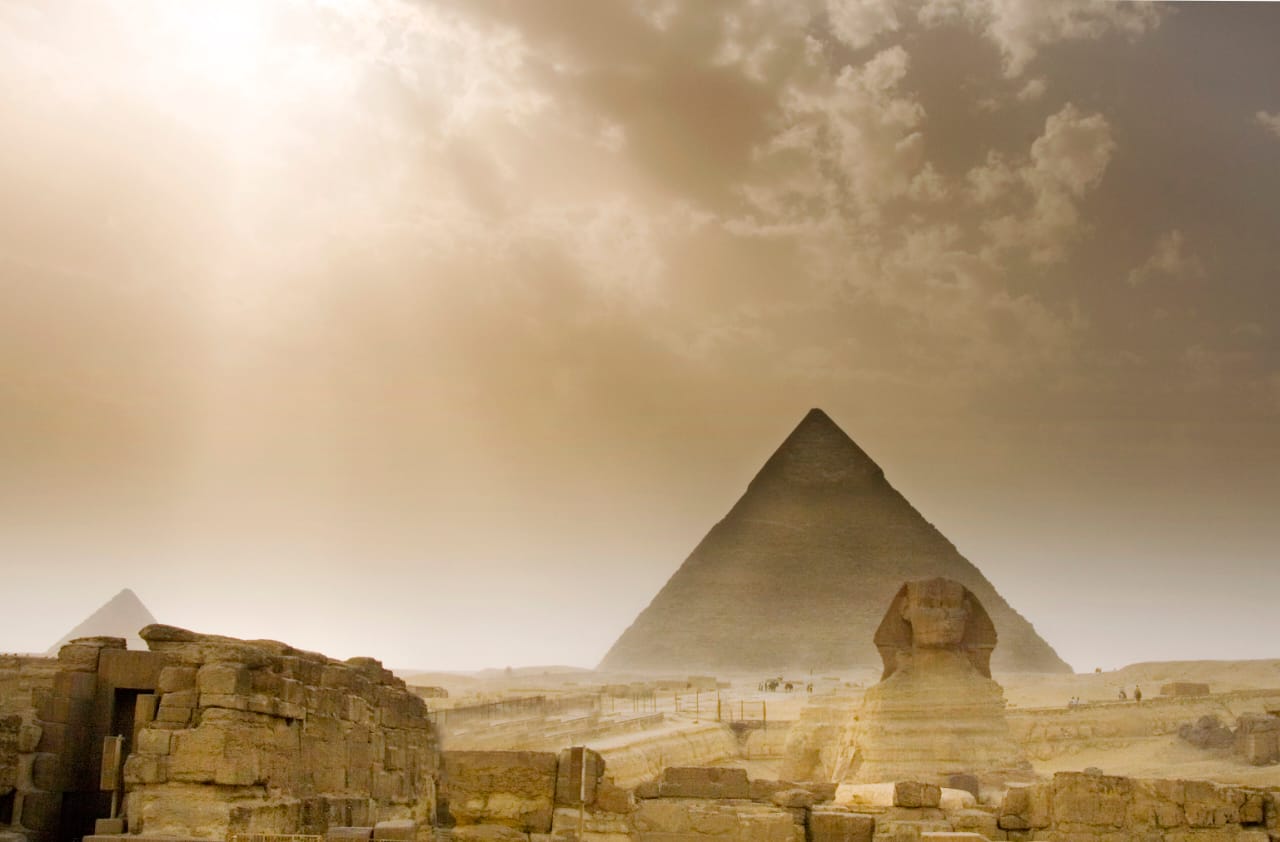
If you can, visit the pyramid before the museum, not after. The boat pits lie along the pyramid's southern side, where the old boat museum stood until it was dismantled, and standing there first, looking at the bedrock and picturing 41 blocks of around 15 tonnes sealing a dismantled ship beneath your feet, makes the hall at the GEM far more vivid.
It also suits the heat: the plateau in the cool of the morning, lunch, then the museum through the hottest part of the afternoon. Our ultimate guide to visiting the pyramids has the logistics for the plateau itself.
Planning Your Visit
For most travellers the boats fit best into a single long Giza day: the plateau at opening time, the Sphinx on the way out, then the Grand Egyptian Museum from early afternoon, heading for the boats building while you still have energy. Our Pyramids and GEM combined tour follows exactly that sequence, with an Egyptologist to explain the shell-first hull while you are standing under it. If you would rather go at your own pace, a private car and driver for a full Giza day also solves the pick-up problem.
With more time in Cairo, our three-day Cairo itinerary gives the GEM a day of its own, and the complete guide to the Grand Egyptian Museum covers the main galleries. For the story of the pyramid the boat was buried beside, read our account of how the pyramids were built.
If you would like help timing a visit around the second boat's restoration, or an Egyptologist who knows the boats well, get in touch with your dates and we will suggest a day that works.