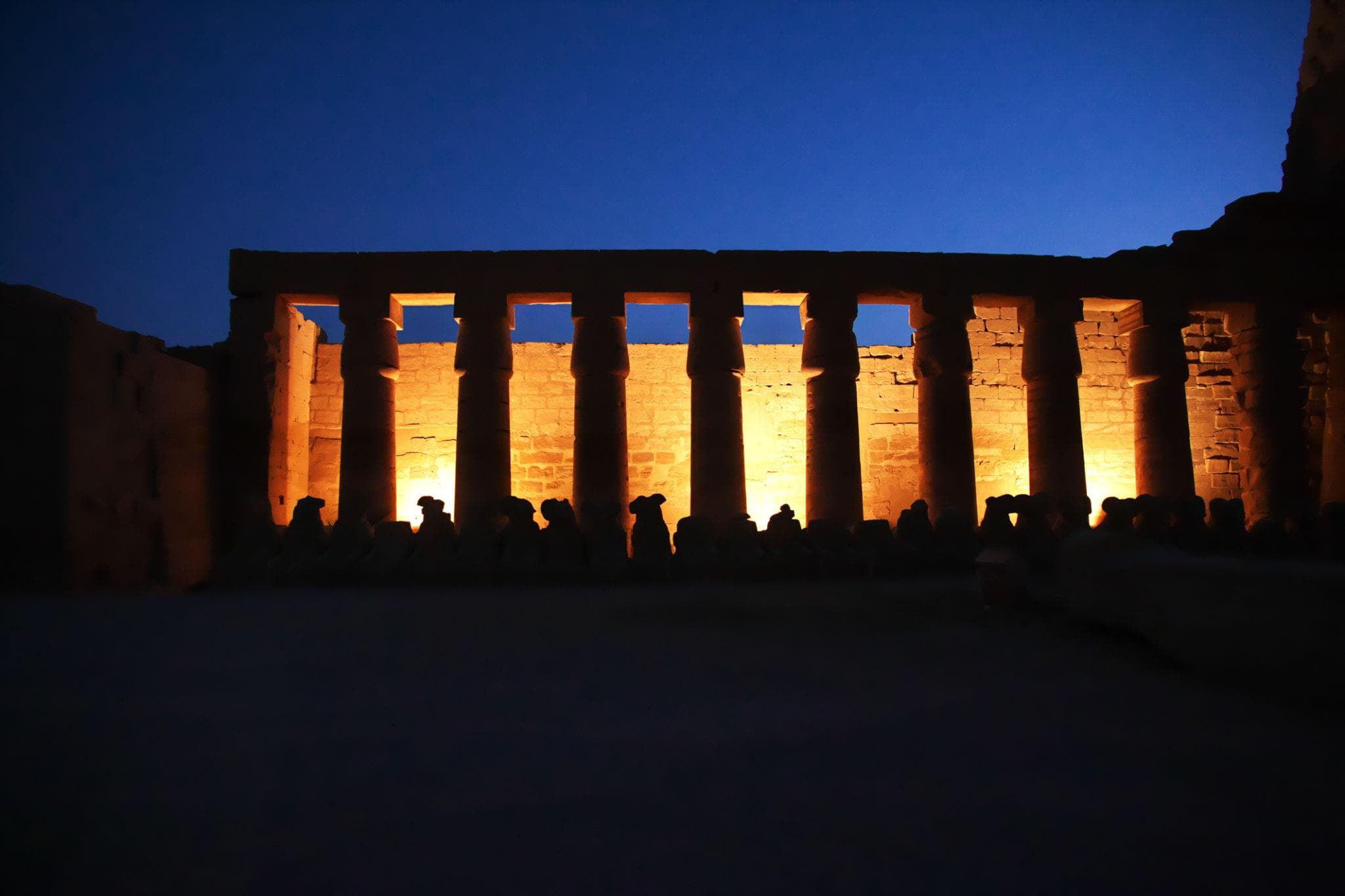
At six in the morning the forecourt of Karnak is grey and quiet, and the ram-headed sphinxes in front of the First Pylon throw long shadows towards the Nile. By nine the coach groups have arrived, and by eleven the stone is radiating the sun back at you.
A Karnak temple self-guided visit is easy to organise and easy to get wrong. It is the largest temple complex of ancient Egypt, built over some two thousand years, and without a plan most people see the hypostyle hall and the obelisks and miss the Festival Hall, the Sacred Lake and the Red Chapel. Luxor Temple, 3 km (2 miles) to the south, is smaller and easier, and at its best after dark.
This guide puts the two into one East Bank day: tickets and hours as of November 2026, the best order, a route through each temple that follows the stops of our two audio tours, the Avenue of Sphinxes between them, and how to get around.
At a Glance
Karnak ticket: 600 EGP, students 300 EGP, including the Open Air Museum, as of November 2026
Luxor Temple ticket: 500 EGP, students 250 EGP
Payment: bank card only at both ticket offices
Karnak hours: 6am to about 5pm, last entry around 4pm
Luxor Temple hours: 6am until about 9pm to 10pm, depending on season
Between the two: about 3 km (2 miles), joined by the 2.7 km (1.7 mile) Avenue of Sphinxes
Time needed: 2.5 to 3 hours at Karnak, about 1.5 hours at Luxor Temple
Best order: Karnak at opening, a long lunch, Luxor Temple from late afternoon into the evening
Getting around: taxi, calèche or on foot along the Corniche
Can You Visit Karnak Without a Guide
Yes. Karnak and Luxor Temple are among the easiest major sites in Egypt to visit on your own: both are in town, both sell tickets at the gate, and both are laid out along a clear axis that you can follow from front to back. Nothing requires a licensed guide.
What a guide adds at Karnak is selection and story. The precinct of Amun alone covers more than 25 hectares (60 acres), with pylons, courts and chapels added by pharaoh after pharaoh from the Middle Kingdom to the Ptolemies. Our Karnak audio guide has 15 stops and about 30 minutes of narration in English, and our Luxor Temple audio guide has 14 stops and about 26 minutes; both show your position on a site map and play offline once you have opened them on hotel Wi-Fi. Even without them, the routes below give you the order that works on the ground.
For the history of the complex in depth, read our Karnak Temple guide first; for Luxor as a whole, from hotels to the West Bank, see our Luxor travel guide.
Karnak Temple Tickets, Luxor Temple Tickets and Hours
As of November 2026, the foreign adult ticket for Karnak Temple is 600 EGP, or 300 EGP for students with an ISIC card, about US$11. It now includes the Open Air Museum on the north side of the Great Court, which older guidebooks list as a separate ticket. The Precinct of Mut, south of the main complex, has had its own small ticket; ask at the window if you want to see it. Luxor Temple costs 500 EGP, students 250 EGP. The evening sound and light show at Karnak is a separate ticket.
Payment at both ticket offices is by bank card only, as at all of Luxor's major sites. Karnak opens at 6am and closes at about 5pm, a little later in summer on some schedules, with last entry around 4pm. Luxor Temple opens at 6am and stays open into the evening, usually until about 9pm or 10pm; hours shorten during Ramadan.
The Luxor Pass, at US$130 for the standard version and US$250 for the premium, valid for five days, covers almost every site on both banks. It pays off only if you also spend two or three days on the West Bank, so for an East Bank day, buy single tickets. Some site prices are due to rise from April 2027; our Egypt ticket prices guide tracks the changes.
Our Pick: The Best Order for a Luxor East Bank Day
If you have one day for the Luxor East Bank, this is the order that works best:
- 6am to 9am: Karnak at opening, the main axis first while it is cool and empty
- 9am to 10am: the Festival Hall, the Sacred Lake and the Open Air Museum
- Late morning to mid-afternoon: lunch and a rest at the hotel through the hottest hours
- About 3pm: taxi to the Karnak end of the Avenue of Sphinxes and walk south, or walk a shorter section from the Luxor end
- Late afternoon into the evening: Luxor Temple, staying until the floodlights come on
The logic is light and heat. Karnak is vast and exposed, so it belongs to the early morning; Luxor Temple is compact and turns gold at sunset, then becomes a different building under its lights. Our guide to Luxor Temple by night explains why the evening visit is the one people remember.
Karnak Temple Self-Guided Route: From the Rams to the Second Pylon
A Karnak temple self-guided route follows the main east-west axis of the temple of Amun-Ra, as the first stops of our audio tour do. Stop 1 is a welcome on the forecourt. Stop 2 is the Avenue of Rams in front of the entrance: ram-headed sphinxes, the ram being sacred to Amun, each sheltering a small figure of the king between its paws.
Stop 3 is the First Pylon, the last great gateway added to Karnak, probably in the fourth century BC, about 113 m (370 ft) wide and never finished. Look behind its southern tower for the remains of the mud-brick ramp the builders used, still in place. Stop 4 is the Great Court beyond it, with a single surviving column from a kiosk of the Kushite king Taharqa and the small triple shrine of Seti II.
Stop 5, the Temple of Ramesses III, opens off the south side of the court: a complete small temple used as a resting place for the sacred boats of Amun, Mut and Khonsu during processions. Stop 6 is the Second Pylon, guarded by a colossal standing statue of a king with a small queen at his feet. Its core was packed with thousands of small sandstone blocks from the dismantled temples of Akhenaten, recovered by archaeologists in the twentieth century.
The Great Hypostyle Hall and the Obelisks
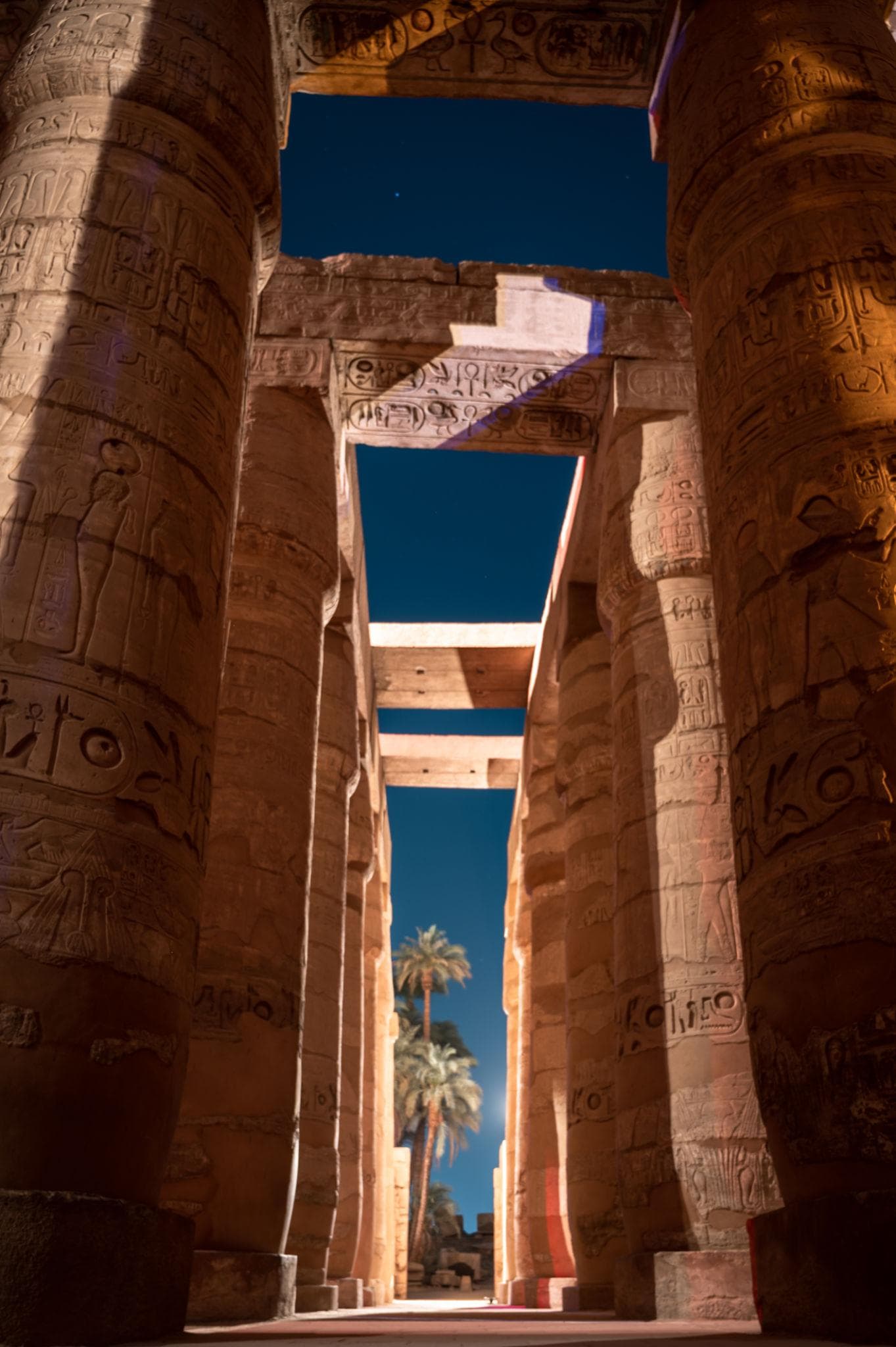
Stop 7 is the reason most people come. The Great Hypostyle Hall holds 134 sandstone columns in 16 rows. The twelve along the central aisle are about 21 m (69 ft) high, with open papyrus capitals, and the rest about 15 m (49 ft), and the hall covers roughly 5,000 square metres (54,000 sq ft). It was decorated mainly under Seti I and Ramesses II, and recent cleaning has brought back reds, blues and yellows on the capitals and architraves. Walk to the centre aisle, look up, then walk the outer rows, where it is quieter and the reliefs are lower.
Stop 8, the Obelisks, lies beyond the hall. The smaller one belongs to Thutmose I. The taller, about 29.5 m (97 ft), was raised by Hatshepsut and is the tallest ancient obelisk still standing in Egypt; the top of its fallen twin lies near the Sacred Lake. Hatshepsut's own temple across the river is covered in our Temple of Hatshepsut guide.
Stop 9 is the Sanctuary, the heart of the temple, where the god's barque stood. The granite shrine you see today was rebuilt in the name of Philip Arrhidaeus, Alexander the Great's half-brother, around 320 BC, inside walls covered with Thutmose III's records of his campaigns.
The Eastern Temples, the Sacred Lake and the Red Chapel
Behind the Sanctuary, the route opens out. Stop 10, the Middle Kingdom Court, is a wide, almost empty space where the first temple of Amun stood under Senusret I around 1950 BC. Stop 11 is the Festival Hall of Thutmose III, whose columns imitate tent poles, and whose side room, often called the Botanical Garden, is carved with the plants and animals the king brought back from campaigns in Syria.
Walk south to the Sacred Lake, stop 12, a stone-lined pool about 120 m by 77 m (394 by 253 ft) where priests purified themselves and sacred geese were kept. On its north-west corner stands the giant granite scarab of Amenhotep III, which local custom says to walk round several times for luck. Stop 13, the Cachette Court, is the courtyard on the north-south axis where, in 1903 and 1904, excavators found about 800 stone statues and some 17,000 bronzes buried by priests in antiquity.
Then head back west to the Open Air Museum for stop 14, the Red Chapel of Hatshepsut, a quartzite shrine for Amun's barque reassembled from blocks found inside a later pylon, with the White Chapel of Senusret I beside it, one of the finest Middle Kingdom buildings to survive. Stop 15, Before You Leave, is a short closing stop on the way back to the gate.
Pro Tip: Heat, Light and Timing at Karnak
Be at Karnak when it opens at 6am. In the first two hours the light is low, the hypostyle hall is cool and half in shadow, and you share it with a handful of photographers. From about 9am the coach groups arrive, and from late morning the open courts become very hot: Luxor reaches 40C (104F) or more in June, July and August, and even in December and January, when highs are around 23C (73F), the stone throws back the heat by noon. Winter mornings, by contrast, can start at 8C (46F), so a light layer helps.
Carry water, a hat and sunglasses, and wear comfortable shoes: the route above is about 3 km (2 miles) of walking inside Karnak, much of it on uneven paving. Toilets are by the visitor centre at the entrance. A charged phone with earbuds and a small power bank covers maps, photographs and an audio guide for the whole day.
Photography with phones and ordinary cameras is free at both temples; no flash in enclosed chapels, and tripods need a permit. In the hypostyle hall, the best light is early, when shafts of sun cut between the columns.
Walking the Avenue of Sphinxes
The Avenue of Sphinxes runs 2.7 km (1.7 miles) from the southern gates of Karnak to the front of Luxor Temple. It was the processional road of the Opet festival, when once a year the barque of Amun travelled from Karnak to Luxor Temple, and it was lined with more than a thousand sphinxes, most of them set up under Nectanebo I in the fourth century BC on a route laid out much earlier. After decades of excavation it was reopened on 25 November 2021.
You can walk the whole length, about 40 minutes at a steady pace without stops. As of late 2026 the avenue has no separate ticket, though the stretch immediately in front of Luxor Temple lies inside the temple enclosure. Signage is patchy, and visitors report having to ask the way, so keep a map open on your phone. It has no shade, so walk it from the Karnak end in the late afternoon, arriving at Luxor Temple as the light softens.
If the full walk is too long or too hot, take a taxi to a midpoint and walk the last kilometre, or simply see the restored southern section from inside Luxor Temple, where the sphinxes run straight out from the pylon towards the town. Cross the roads that cut the avenue with care.
Luxor Temple: The Pylon, the Mosque and the Colonnade
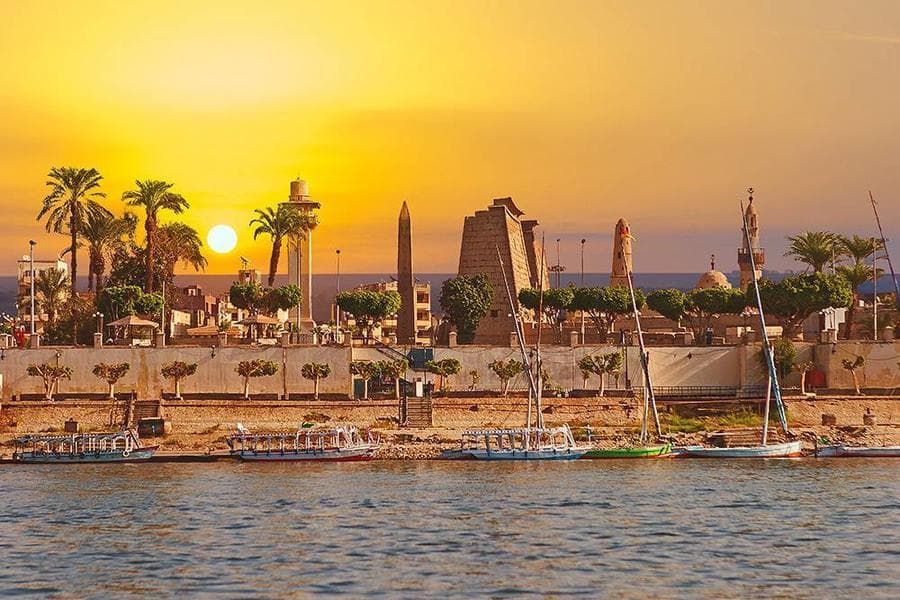
Luxor Temple was built mainly by Amenhotep III and Ramesses II for the Opet festival, and its stops follow the processional route from front to back. The entrance is on the Corniche at the northern end. Stop 1 is a welcome, stop 2 the southern end of the Avenue of Sphinxes, and stop 3 the Obelisk and the Colossi in front of the pylon. One obelisk of Ramesses II still stands, about 25 m (82 ft) high; its twin has stood in the Place de la Concorde in Paris since 1836.
Stop 4 is the Pylon of Ramesses II, carved with his account of the battle of Kadesh against the Hittites, and stop 5 the Court of Ramesses II behind it, ringed with columns and standing statues of the king. Stop 6 is the Mosque of Abu el-Haggag, built in the thirteenth century on top of the buried court and still in use. Its door hangs high above the floor of the court, showing how deep the rubble lay when the town grew over the temple.
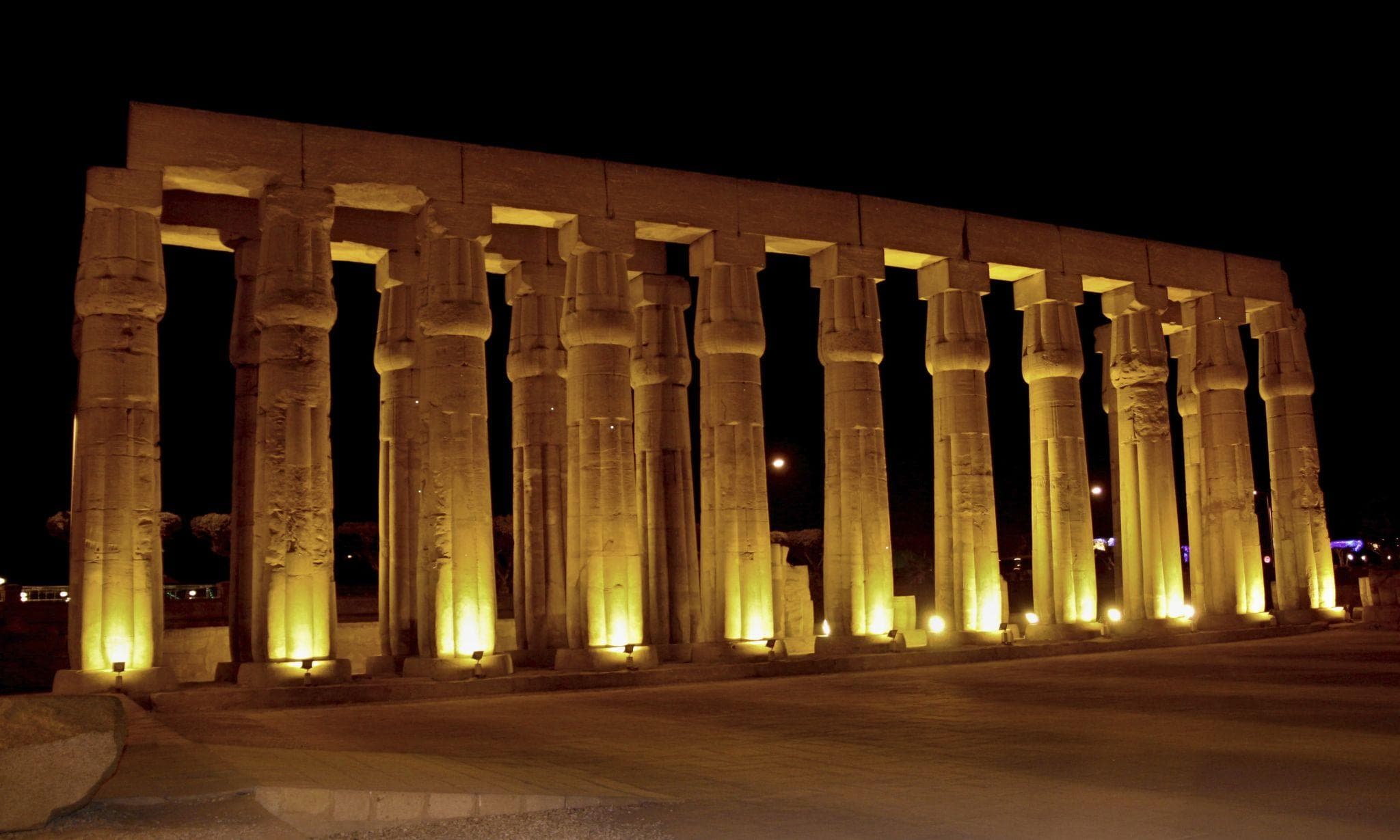
Stop 7 is the Great Colonnade of Amenhotep III, fourteen columns about 19 m (62 ft) tall with open papyrus capitals. The walls on either side, carved under Tutankhamun and Horemheb, show the Opet procession itself: boats on the river, musicians, dancers and offerings. It is the best single place to understand what these temples were for.
Luxor Temple: From the Sun Court to the Sanctuary
Stop 8 is the Sun Court of Amenhotep III, a broad court with double rows of papyrus columns. In 1989 workers found here a cache of statues buried in antiquity, now in the Luxor Museum on the Corniche, which is worth an hour on another day. Stop 9, the Hypostyle Hall, leads into the inner temple.
Stop 10 is the Imperial Cult Chamber, where around AD 300 Roman soldiers turned a hall into a shrine of the emperors and plastered over the pharaonic reliefs with paintings, parts of which survive and have been cleaned. Stop 11 is Alexander's Shrine, a barque chapel rebuilt in the name of Alexander the Great, who is shown on its walls as a pharaoh making offerings to Amun. Stop 12, the Birth Room, tells the story of Amenhotep III's divine conception and birth, and stop 13 is the Sanctuary at the far end. Stop 14, Stones of Luxor, closes the tour as you walk back along the side of the temple towards the exit.
The temple is lit after dark, and the lights change it: carvings that look flat at midday stand out in relief, and the colonnade glows against a black sky. Stay at least until the floodlights are on.
Warning: Calèches, Taxis and Temple Hassle
Luxor's hassle is more persistent than dangerous, but it can wear you down. Calèche drivers along the Corniche will offer rides, then quote one price at the start and another at the end, or detour to a shop. If you take one, agree the destination, the total price and whether waiting is included before you sit down; animal welfare groups have raised concerns about the horses, and you may prefer a taxi. Uber is not widely available in Luxor; local taxis, inDrive and Careem operate, with fewer drivers than in Cairo, so agree taxi fares in advance or have your hotel book a car.
Ignore anyone who says the temple is closed and offers to take you somewhere else, buy tickets only at the official windows, and expect touts at the Karnak car park and on the Corniche selling felucca rides. Inside, a guardian who offers to show you a closed area or pose you for a photograph will want a tip, and access to closed areas is against the rules. A polite, firm no while you keep walking is usually enough.
Planning Your Luxor East Bank Day
For a Karnak temple self-guided morning and Luxor Temple in the evening, you need a bank card, water, an early alarm and the order above. Both audio tours let you hear the first stop free before you buy; each costs US$7, works offline and shows your position on a site map, and our audio guides overview lists the West Bank tours too. Open both on Wi-Fi the night before, bring earbuds, and you can follow the stops in order without a signal. For the other side of the river, our guide to the best tombs in the Valley of the Kings picks up the next morning.
If you prefer a guide, our ultimate Luxor East and West Bank tour covers both temples and the royal tombs, our Luxor day trip from Cairo by plane fits the highlights into a single day, and our Luxor overnight trip from Hurghada includes an evening in town. Our Luxor destination page has everything else.