In the first hypostyle hall at Abydos the light comes in low and sideways, and the walls seem to move. Seti I offers incense to Osiris, Isis holds out her hand, and every figure is carved in raised relief so fine that the folds of a linen kilt and the beads of a collar stand clear of the stone. There are no crowds behind you, often no other group in the hall at all.
That quiet is the reason to make the Dendera and Abydos day trip from Luxor. Abydos, about 170 km (105 miles) to the north, holds what many Egyptologists consider the finest relief carving of the New Kingdom. Dendera, around 60 km (37 miles) from Luxor and an easy stop on the way back, is the best-preserved temple complex in Egypt, with its roof, its staircases and its painted ceilings intact. Together they make a long day, and one of the best in Upper Egypt.
This guide covers the route and timings, which temple to see first, the highlights at each, tickets and practicalities, and the alternatives: a cruise stop or Dendera by boat.
At a Glance
Route: Luxor to Abydos, about 170 km (105 miles) north, then back via Dendera, about 60 km (37 miles) from Luxor
Driving time: about 3 hours to Abydos, 1.5 to 2 hours on to Dendera, about 1.5 hours back to Luxor
Length of the day: 10 to 12 hours, leaving Luxor around 7am
Time at each temple: about 2 hours at Abydos, 1.5 to 2 hours at Dendera
Abydos highlights: Seti I's painted reliefs, the seven chapels, the King List, the Osireion
Dendera highlights: Hathor columns, the restored astronomical ceiling, rooftop chapels, crypts, Cleopatra relief
Tickets: Abydos 260 EGP, Dendera 300 EGP, plus 100 EGP each for Dendera's roof and crypt, as of November 2026, card only
Opening hours: both from 7am to 5pm
Best months: October to April; in summer, start earlier and keep the outdoor parts short
By water: Dendera is a stop on some longer cruises and dahabiya voyages north of Luxor
Is a Dendera and Abydos Day Trip Worth It
For anyone with a real interest in ancient Egypt, yes. Most visitors to Luxor see Karnak, Luxor Temple and the West Bank, and never travel north, missing two temples that are, in different ways, more complete than anything in the city itself.
Abydos was the holiest place in Egypt for the cult of Osiris, god of the dead and of resurrection, and for some two thousand years pilgrims came here or wished to be buried near the god. The temple Seti I built around 1290 BC is the reason most people come today: its reliefs, in fine white limestone, are among the most refined ever carved in Egypt. Dendera is far later, a Ptolemaic and Roman temple to Hathor, goddess of love, music and joy, and it is extraordinary for its state of preservation: roof, stairs, crypts and ceilings all in place.
The cost is time: six hours or so in a car, through cane fields and small towns that are pleasant rather than spectacular. With only two days in Luxor, the city's own monuments come first; with three or more, this is the day we recommend. Our guides to the Temple of Seti I at Abydos and the Temple of Hathor at Dendera cover each in more depth.
Route and Timings from Luxor
The usual road runs north through the cultivated valley by way of Qena and Nag Hammadi towards el-Balyana, the town nearest Abydos, whose temple stands on the edge of the desert. The drive takes about three hours. Dendera lies on the west bank opposite Qena, on the way back, so the day forms a simple out-and-back line with one stop on the return.
A realistic day runs like this. Leave Luxor at about 7am and reach Abydos at around 10am. Spend about two hours at the Temple of Seti I and the Osireion, with a look at the smaller temple of Ramesses II nearby if time allows. Have lunch at about midday, then drive an hour and a half to two hours to Dendera, arriving in the early afternoon. Give Dendera an hour and a half to two hours and you are back in Luxor between 5pm and 7pm.
Expect numerous police checkpoints and speed bumps on the roughly 360 km (225 mile) round trip, and at times a police escort or a loose convoy with other tourist vehicles. The practice varies; your driver will know the current arrangement. Keep your passport with you.
Food is simple on this route. There are a few simple places to eat near the temple at Abydos, and many travellers prefer a packed lunch from their hotel, eaten in the shade between the two sites.
Insider Tip: Abydos First, Dendera Last
This is the order we use for almost every visit, and there are good reasons for it. Abydos is the farther site, so you cover the long stretch of road in the cool of the morning while you are fresh, and arrive when the light is still soft on the façade. The Temple of Seti I has open courts in front of its halls, and the walk to the Osireion is exposed, so it is better done before midday.
Dendera, by contrast, is roofed and almost entirely enclosed. Its halls stay relatively cool in the afternoon, the interior is lit artificially in any case, and the rooftop chapels are pleasant in the late-day breeze. Visiting it last also means you finish closest to Luxor: if anything runs late, it is the short final drive that absorbs it, not a temple closing before you arrive.
Reverse it only for a reason, for instance if you are travelling on to Sohag, and do not try to add Karnak or the West Bank to the same day.
Abydos: The Temple of Seti I
Seti I, second king of the 19th Dynasty and father of Ramesses II, built the temple during his reign, around 1290 BC. He died before it was finished, and his son completed the outer parts. The difference shows. Seti's own reliefs, in the inner halls, are carved in delicate raised relief; much of Ramesses' work, in the courts and on the façade, is in quicker sunk relief. Walking from one to the other shows what royal craftsmen could do when given time.
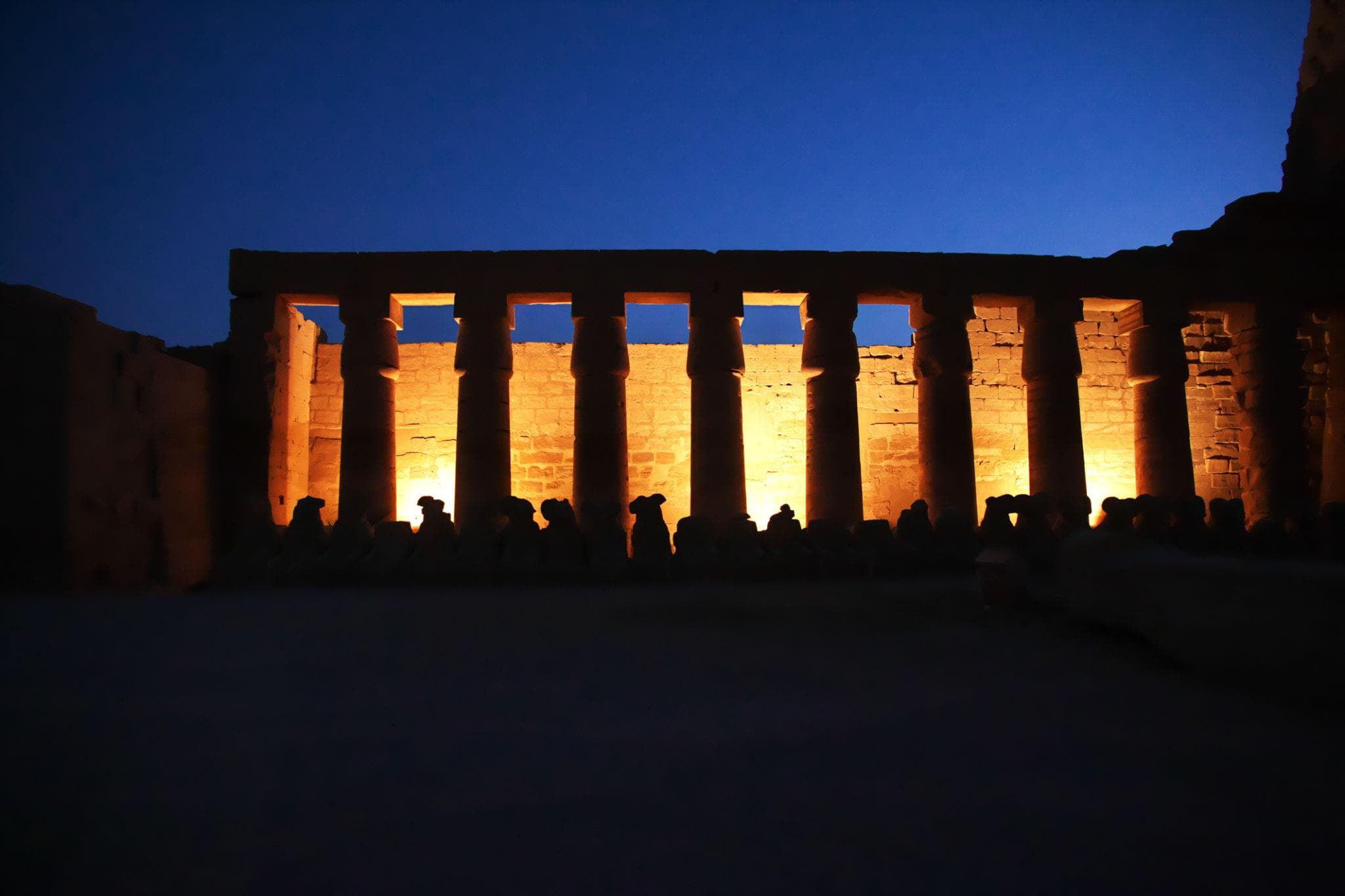
The plan is unusual. Instead of a single sanctuary on the axis, the temple has seven chapels side by side, for Seti himself as a god, for Ptah, Ra-Horakhty, Amun-Ra, and for the family of Osiris: Osiris, Isis and Horus. Seven processional aisles lead to them through two hypostyle halls. The temple is also L-shaped, with a wing turning off to the south, probably because the builders had to fit it around the Osireion behind it.
Inside the chapels the reliefs keep much of their colour: blues, reds and yellows on the gods' collars and the false doors at the back of each shrine. Look for the Osiris chapel and the halls beyond it, where the god's rituals are shown in detail. Our Abydos temple page sets out the plan.
The Abydos King List and the Osireion
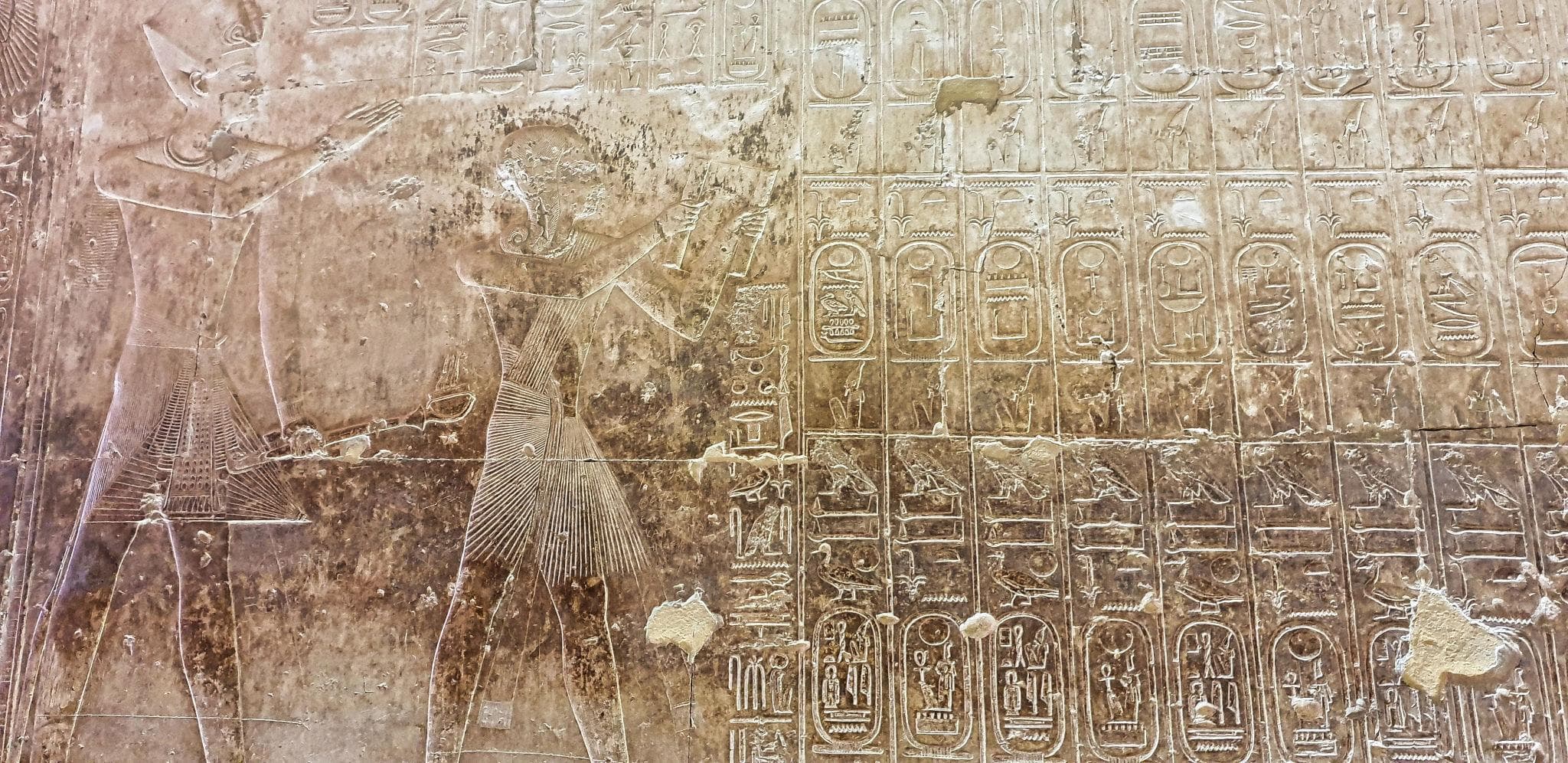
In a corridor leading off the second hypostyle hall, Seti and the young prince Ramesses stand before a list of 76 royal names in cartouches, from Menes, the legendary first king, down to Seti himself. It is one of the most important documents of Egyptian chronology, and its omissions are as telling as its contents: Hatshepsut is missing, and so are Akhenaten and his Amarna successors, Tutankhamun among them. The list records which kings the 19th Dynasty chose to remember.
On a ceiling beam in the first hypostyle hall you may be shown the carving that the internet calls the Abydos helicopter. It is a palimpsest: Seti's titles were filled with plaster and recut for Ramesses II, and as the plaster fell away the two sets of hieroglyphs overlapped into shapes that resemble modern machines.
Behind the temple lies the Osireion, a sunken structure of massive granite pillars built as a symbolic tomb of Osiris, and dated by Egyptologists to Seti's reign. Flinders Petrie and Margaret Murray found it in 1902 and 1903, and groundwater now fills its lower levels. You view it from above; its austere granite is quite unlike the temple in front of it.
Did You Know: Omm Sety of Abydos
For a quarter of a century the most famous resident of Abydos was an Englishwoman. Dorothy Eady, born in London in 1904, believed from childhood that she had been a priestess in Seti's temple in a former life. She moved to Egypt, worked for years with Egyptologists in Giza, and in 1956 settled in the village beside the temple, where she became known as Omm Sety.
She worked as a draughtswoman for the antiquities service, knew the temple more intimately than almost anyone, and her notes on its reliefs and its garden were taken seriously by professional scholars, whatever they thought of her beliefs. She died in 1981 and was buried at the edge of the desert near Abydos.
Her story has been told in books and documentaries. It is a reminder that Abydos has always drawn people who came for more than the carving, as pilgrims did for the festival of Osiris in antiquity.
Dendera Temple: Hathor's House
The Temple of Hathor at Dendera was begun in 54 BC under Ptolemy XII, continued under his daughter Cleopatra VII, and completed under the Roman emperors, who added the great front hall. Older temples had stood on the site for well over a thousand years, and the builders followed ancient plans. The result is a classical Egyptian temple built at the very end of pharaonic civilisation, and it survives almost intact.
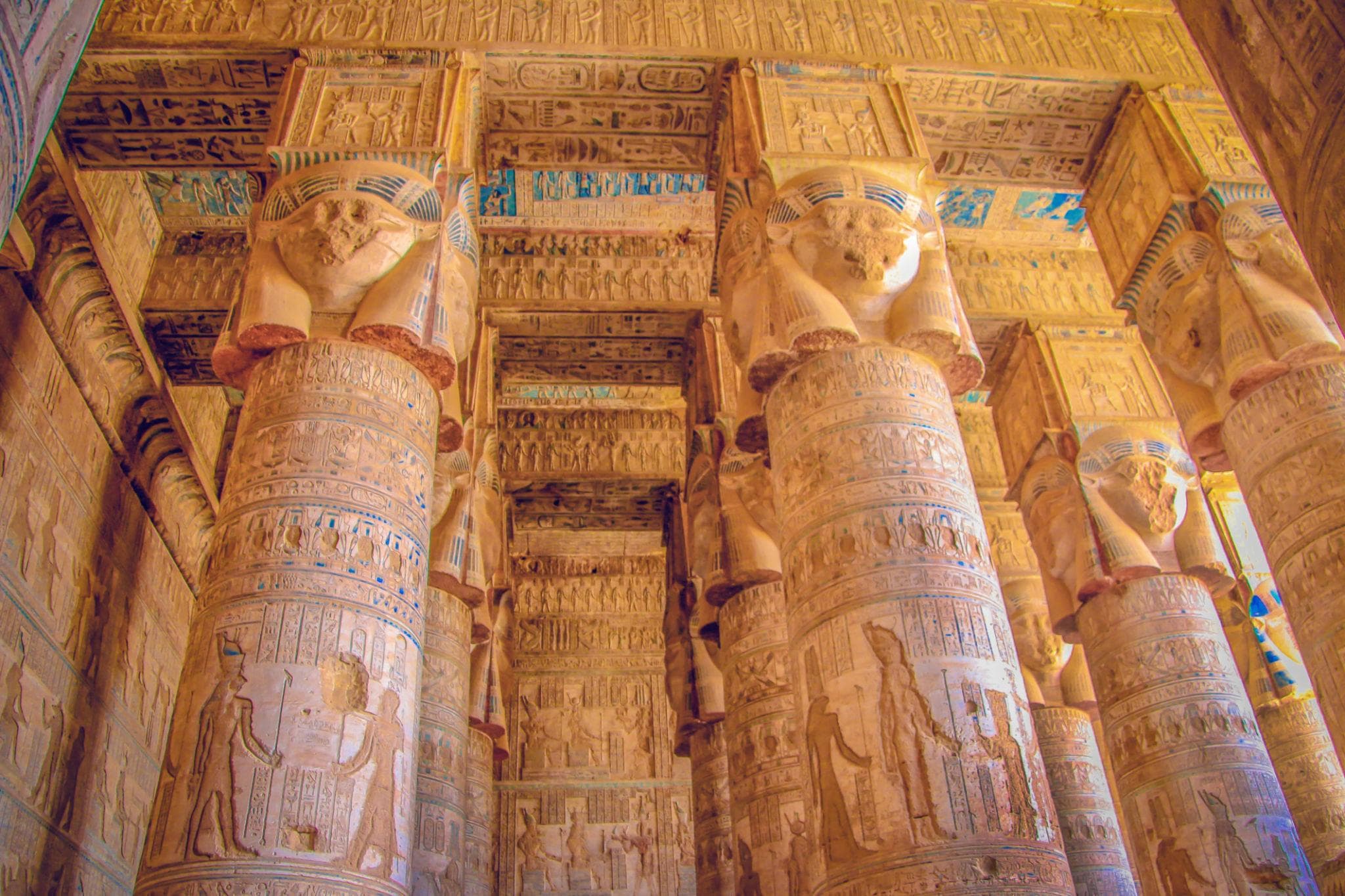
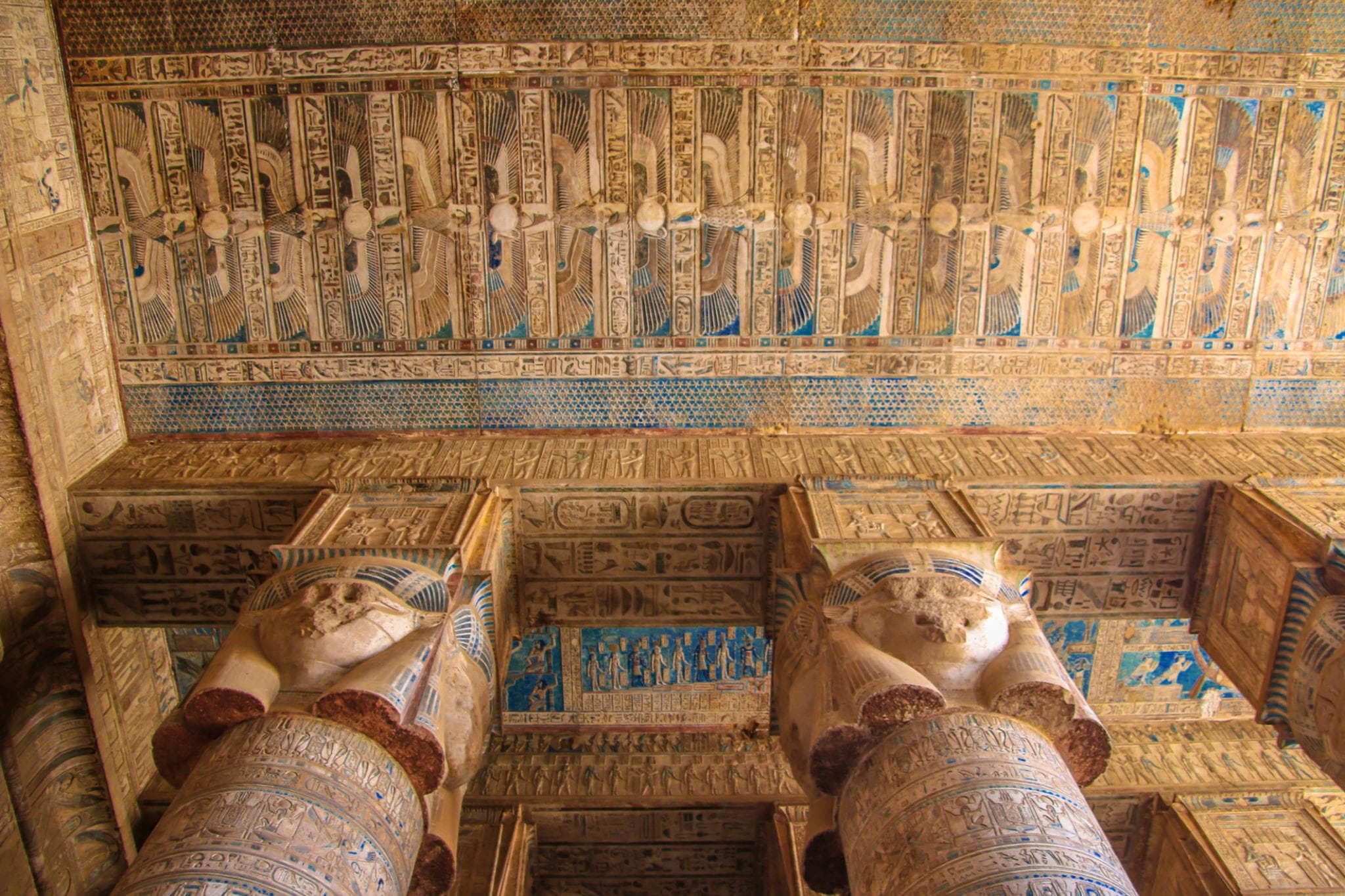
The façade is a screen of six columns, and the first hall behind it holds 24 columns with capitals carved as the face of Hathor, with her cow's ears, on all four sides. Many of the faces were hacked away in later centuries, but the effect of the hall, tall, dim and crowded with columns, is overwhelming.
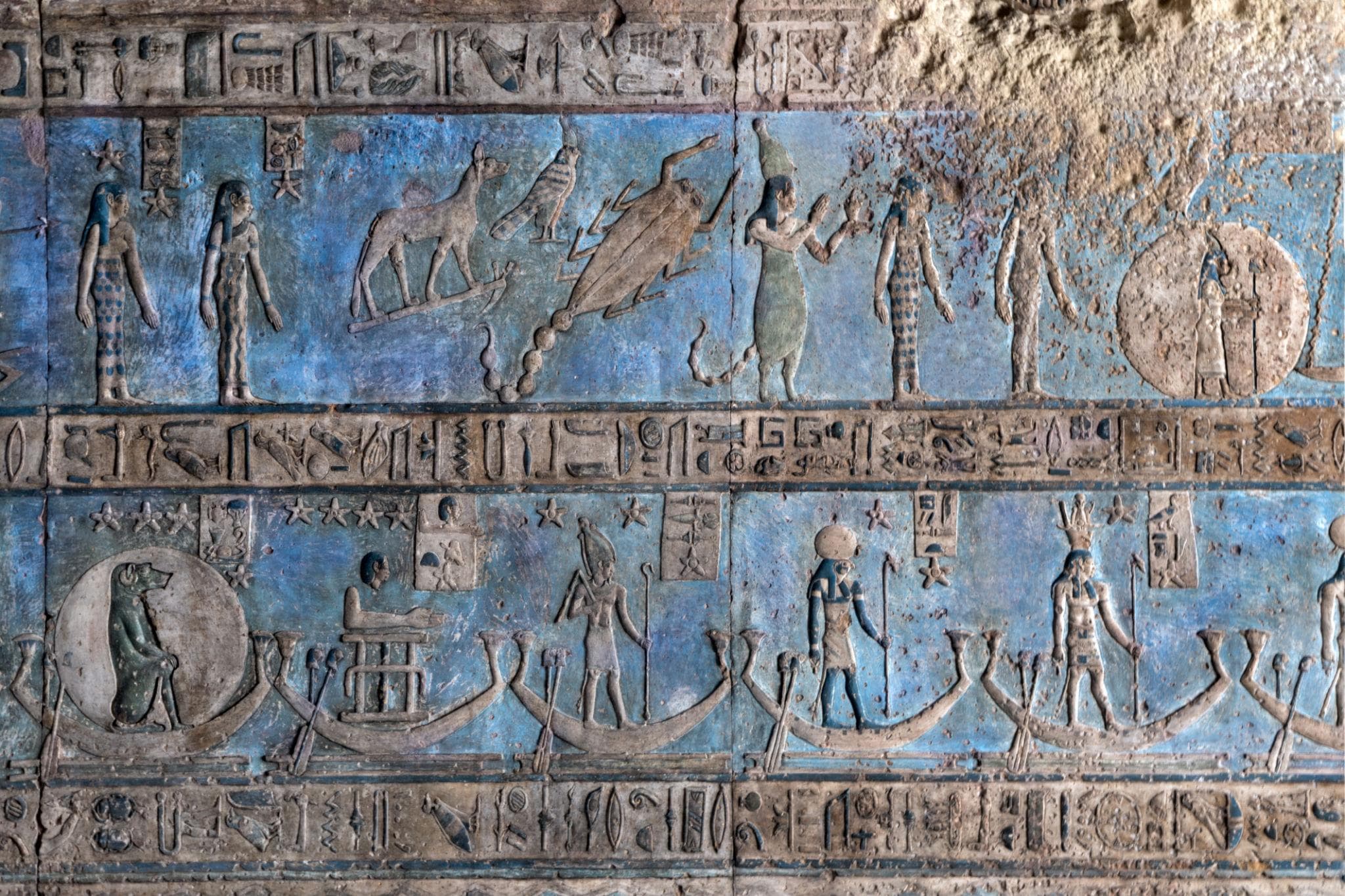
Look up. The ceiling of the front hall is an astronomical map of the sky, with the sky goddess Nut stretched across it, swallowing the sun at evening and giving birth to it at dawn, boats carrying the stars and the hours, and the signs of the zodiac. For centuries it was black with soot. Restoration in recent years, including a phase begun in 2021 in the great columned hall, has lifted the soot with paper compresses, revealing blues, yellows and reds that make it one of the most colourful interiors in Egypt, like the ceilings described in our guide to Esna's restored colours.
The Dendera Zodiac, the Roof and the Crypts
Behind the halls, staircases rise to the roof, decorated with processions of priests carrying the statue of Hathor up to meet the sun at New Year. On the roof stand small chapels used in the rituals of Osiris. One of them held the famous Dendera Zodiac, a circular map of the sky carved into its ceiling. It was cut out in 1821 and taken to Paris, where it is now in the Louvre; a copy takes its place, easy to miss in the dim chapel. Access to the roof needs a separate ticket, sold at the entrance.
Below the floor and within the walls run narrow crypts, built to store sacred objects and decorated as finely as the halls above. One of them contains the reliefs sometimes called the Dendera light, often claimed online as an ancient electric lamp. Egyptologists, guided by the inscriptions beside it, read a lotus flower giving birth to a snake, supported by a djed pillar: an image of creation. The crypts need their own ticket and are sometimes closed, and in early 2025 the crypt open to visitors was reported not to be the one with these reliefs, so ask before you pay.
Before you leave, walk round to the rear wall, where Cleopatra VII and Caesarion, her son by Julius Caesar, are shown in large relief making offerings: one of the few surviving temple images of the queen. The precinct also holds two birth houses, a Coptic church between them, a sanatorium where pilgrims came to be healed, a sacred lake planted with palms, and a small temple of Isis.
Pro Tip: Bring a Torch and Comfortable Shoes
Dendera is dark inside. The halls have electric lighting, but the crypts and some of the side rooms are dim, and the zodiac cast on the roof is easier to read with a light of your own. A small pocket torch leaves your phone free for photographs; use it to pick out the reliefs, never as a flash.
The crypts are entered through low openings and narrow passages, sometimes by a short ladder or steep steps, and they can be stuffy and warm even in winter. Anyone uncomfortable in confined spaces can skip them without missing the heart of the temple. The roof stairs are long but gentle.
Wear shoes with grip rather than sandals: the temple floors are worn smooth. Bring water and a hat for the outdoor parts of both sites, and some small notes for the guardians, who often expect a small tip for pointing out a detail.
Dendera and Abydos Tickets and Practicalities
Each temple sells its own ticket at the entrance. As of November 2026 the Temple of Seti I at Abydos costs 260 EGP for foreign adults and 130 EGP for students with an international student card, and Dendera costs 300 EGP and 150 EGP, with separate tickets of 100 EGP each for the roof and the crypt. That is roughly 10 USD (9 EUR) per adult for both temples, or about 14 USD with the extras. Payment is normally by bank card, so do not count on cash. Prices are revised from time to time, so check our Egypt ticket prices guide before you go.
Both temples open from 7am to 5pm, with shorter hours possible during Ramadan. Personal photography with a phone is included in the ticket, without flash inside the halls. Toilets are available near the entrances, and both sites have a few stalls selling water and souvenirs.
Dress as you would for any temple visit: shoulders covered and comfortable clothing, partly out of respect and partly because both sites are exposed to the sun outside the halls. Our Dendera Temple page has more on the layout of the precinct.
Private Car, Cruise Stop or Dendera by Boat
A private car with a driver and guide is the simplest way to see both temples in one day, and the only practical one for most travellers. Trains do stop at Qena and el-Balyana, but both temples lie outside the towns, and the connections make a single day impossible.
Some longer Nile cruises, especially itineraries that start and end in Luxor, include a visit to Dendera, either by sailing north to Qena or by coach. Abydos is visited far less often from the boats, and usually as an optional excursion by road. Otherwise, a day trip from your moored ship in Luxor works well.
Dendera can also be reached by water. A few dahabiyas and small ships sail north of Luxor on longer or seasonal itineraries, and there have been day boats between Luxor and Dendera in some seasons. Schedules change from year to year, so check what is running when you travel. Our dahabiya guide explains how the smaller boats work.
Planning Your Dendera and Abydos Day Trip
Our Dendera and Abydos day trip covers both temples in a single day from Luxor by private car, with an early start so that Abydos comes before the heat and Dendera on the way home. It fits best on the third or fourth day of a stay, after Luxor's own monuments.
For those, our Luxor East and West Bank tour covers the essentials in a day, and our Karnak temple guide explains what to look for there. If you prefer to explore Karnak at your own pace, our Karnak audio guide leads you through it stop by stop, and makes a good contrast after Dendera's single, perfectly preserved building. Travellers on our classic seven-day Egypt tour can ask us to add the day.
Tell us your dates and where you are staying through our contact page, and we will plan your Dendera and Abydos day trip around the light and the road.