Many visitors to Luxor never make it to Dendera, and that is exactly why it remains one of the most rewarding stops in all of Egypt. The Temple of Hathor here is the best-preserved temple complex in the country, with soot-blackened ceilings that have been cleaned to reveal astonishing original color, a roof you can actually climb, and crypts you can crawl into. If you have ever wanted to feel what an ancient Egyptian temple looked like when it was new, Dendera is the place.
Where Dendera Is and Why It Matters
Dendera (ancient Iunet, later Tentyris) lies on the west bank of the Nile about 60 km / 37 miles north of Luxor, near the modern town of Qena. By road it is roughly a 1 to 1.5 hour drive each way depending on traffic and checkpoints. The site has been sacred since the Old Kingdom, but almost everything you see today was built much later, between the 1st century BC and the 1st century AD, under the Ptolemaic dynasty and the early Roman emperors.
That late date is the secret to its preservation. Because the temple was completed and then quickly buried under sand and a Christian-era village, it escaped the wear that ruined older monuments. When archaeologists cleared it in the 19th and 20th centuries, they found walls, columns and ceilings still standing to their full height.
Dendera was the cult center of Hathor for more than two thousand years, and the rituals performed here were among the most joyful in the Egyptian calendar. The annual "Beautiful Reunion" festival saw the cult statue of Hathor carried by river some 160 km / 100 miles upstream to the temple of her consort Horus at Edfu, a pilgrimage of music, drinking and celebration that lasted roughly two weeks. Knowing this context transforms a walk through the halls: these were not silent museums but stages for processions, offerings and sacred drama.
The Temple of Hathor
The heart of the complex is the great Temple of Hathor, goddess of love, music, joy and motherhood. The main building is around 81 meters long and survives almost intact, from its monumental facade through the hypostyle halls to the sanctuary at the rear.
### The Hathor-Headed Columns
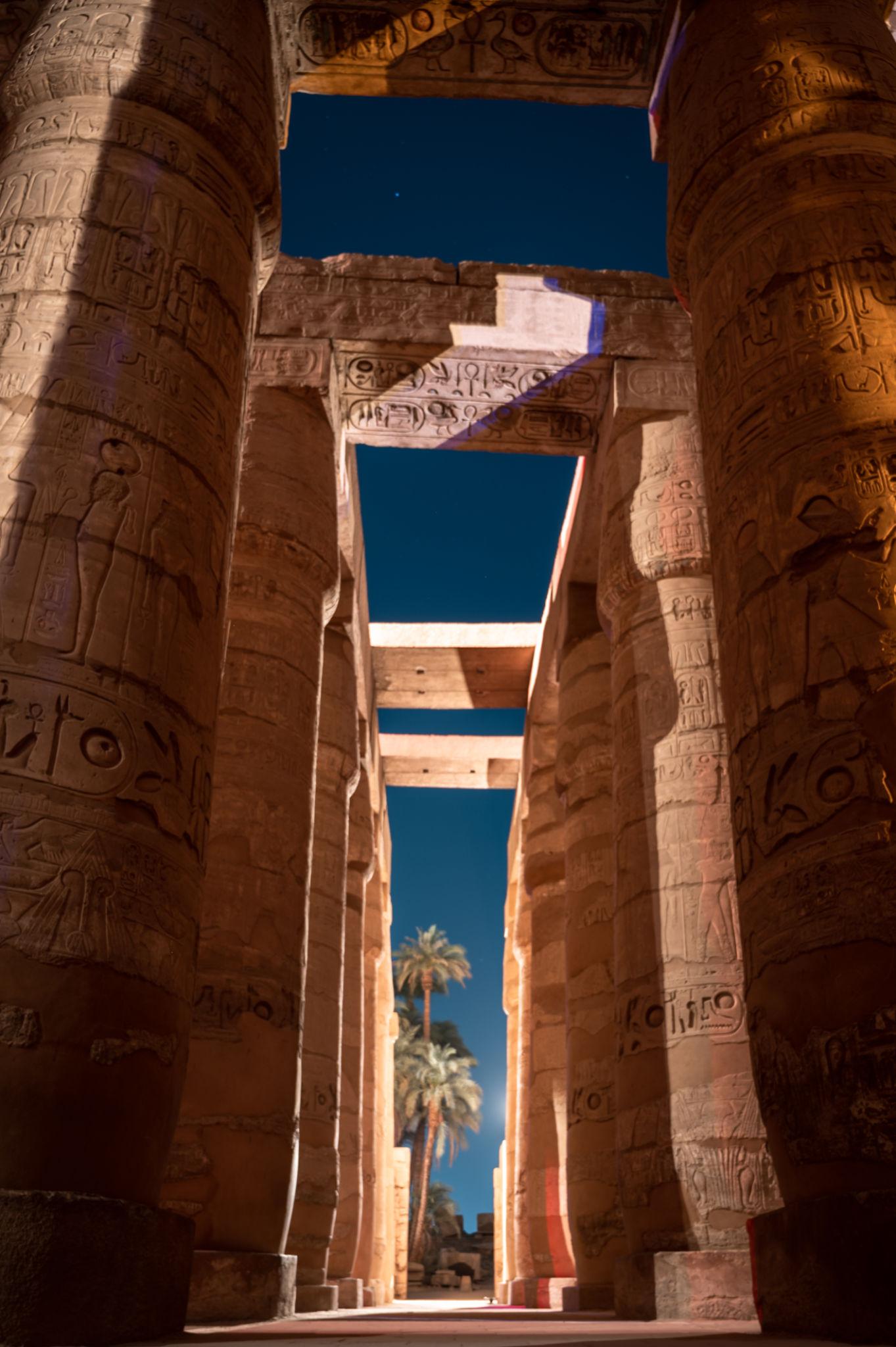
Step into the outer hypostyle hall and you are surrounded by 24 massive columns, each topped with the face of Hathor on all four sides, her cow ears unmistakable. Many of the faces were deliberately damaged in antiquity, but enough survive to show the original effect: a forest of divine faces gazing down in every direction.
### The Painted Ceiling
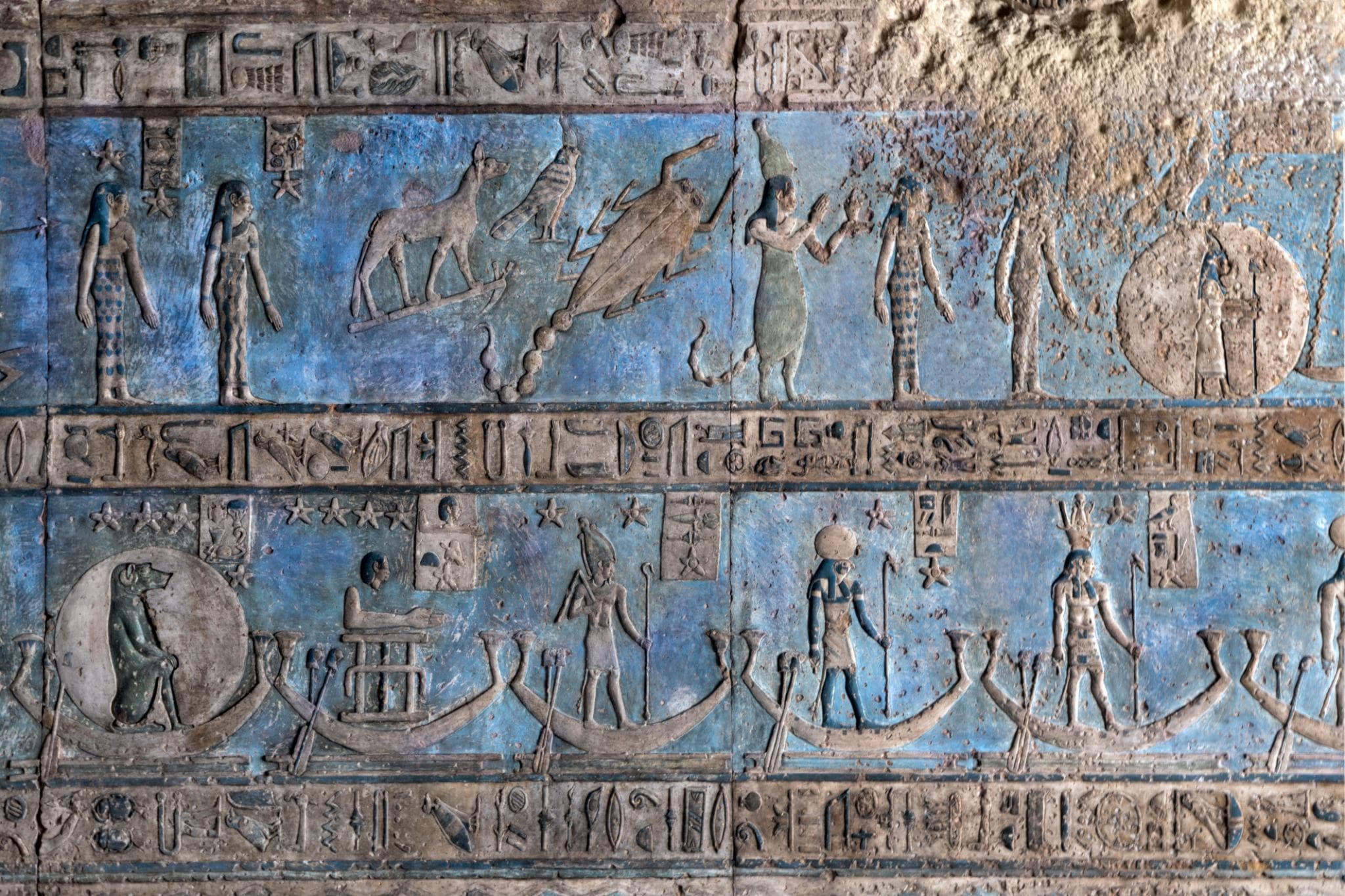
Look up. For centuries the ceiling was black with the soot of cooking fires lit by people who lived inside the ruins. A patient cleaning project, largely completed in the 2010s, removed the grime to reveal vivid blues, golds and reds underneath. The astronomical ceiling shows the sky goddess Nut swallowing and giving birth to the sun, the signs of the zodiac, the decans, and the journey of the sun across the heavens. It is one of the most photographed ceilings in Egypt for good reason.
The Dendera Zodiac
Dendera is famous for its zodiac, a circular star map carved on the ceiling of a small rooftop chapel dedicated to Osiris. It blends Egyptian constellations with Babylonian and Greek zodiac signs and is one of the earliest known depictions of the classical zodiac. The original was removed in 1821 and now hangs in the Louvre in Paris; what you see at Dendera today is a faithful cast. Even so, standing beneath it on the temple roof, surrounded by the original architecture, is far more atmospheric than any museum gallery.
The Rooftop Chapels
One of the great pleasures of Dendera is that you can climb to the roof, something forbidden at most Egyptian temples. A stairway with carved processional scenes leads up to a cluster of Osiris chapels where priests once performed rites for the resurrection of the god during the festival of the new year. From the roof you also get a sweeping view over the temple precinct, the surrounding fields and the desert beyond. The light here in late afternoon is superb for photography.
The Crypts
Beneath the floor, hidden behind sliding stone panels, run a series of narrow crypts that once stored the temple's most precious ritual objects. One of them can usually be entered (you crawl and stoop your way in) and contains beautifully preserved reliefs, including the so-called "Dendera light" relief that fringe theorists like to misread as an electric lamp. In reality it depicts a lotus flower, a snake and a djed pillar, standard religious symbolism. The crypt reliefs are exceptionally crisp because they were sealed away from light and weather.
There are around a dozen crypts in total, distributed within the thickness of the walls and below the floor, though only one or two are open to visitors. They functioned as a kind of sacred treasury and reference archive: the reliefs depict the very ritual objects, statues and amulets that were once stored inside, almost like a labeled inventory carved in stone. If your knees and patience allow, the descent is one of the most memorable few minutes in any Egyptian temple.
The Cleopatra Relief and Outer Walls
On the rear (south) exterior wall of the temple you will find a large relief showing Cleopatra VII, the last pharaoh, with her son Caesarion, both making offerings to the gods. It is one of the few ancient images associated with the famous queen. The exterior walls are densely carved with offering scenes and were once brightly painted; traces of color still cling to the protected sections.
Other Buildings in the Complex
Dendera is more than one temple. Within the mudbrick enclosure wall you will also find:
- **The Mammisi (birth houses)** — two small temples celebrating the divine birth of Hathor's son Ihy, one Roman and one earlier.
- **A Coptic basilica** — a 5th-century Christian church, a reminder that the site was reused for centuries.
- **The Sacred Lake** — a sunken stone-lined basin, now planted with palms, where priests purified themselves.
- **A small Temple of Isis** behind the main building.
Allow time to wander these; most visitors rush straight to the main temple and miss them.
A Brief History of the Site
The story of Dendera stretches back far beyond the buildings you see. Foundation deposits and inscriptions suggest a temple stood here as early as the Old Kingdom, with later kings of the Middle and New Kingdoms (including Thutmose III and Ramesses II) adding to or restoring earlier structures. The present Hathor temple was begun in the late Ptolemaic period, around 54 BC, and decoration continued under the Roman emperors Augustus, Tiberius, Nero and others, whose cartouches appear on the walls, often left blank where the carvers simply wrote "pharaoh" rather than naming a distant Roman ruler. Centuries later, Coptic Christians built a church inside the precinct and, in places, defaced the "pagan" reliefs they could reach. Each of these layers is still legible if you know where to look, making Dendera a single site where you can read 2,000 years of Egyptian religious history in stone.
Practical Information
### Tickets and Hours
As of 2026, entry to Dendera costs roughly 200 EGP (about 4 USD) for foreign visitors, with reduced prices for students; figures change with Egypt's frequent ticket revisions, so treat this as approximate. The site is generally open daily from around 7:00 or 8:00 in the morning until about 17:00, closing earlier in winter. There is sometimes a separate small fee for camera use; most phone photography is included.
### Getting There
Most people visit on a private day trip from Luxor, often combined with Abydos further north to make a long but fulfilling day. A private car with driver and guide is the most comfortable option. Public transport exists but is slow and not geared toward tourists. Bring water, as facilities at the site are limited.
### Crowds and Timing
Because it is an hour out of Luxor, Dendera sees a fraction of the crowds of the Valley of the Kings or Karnak. Arrive at opening for the best light and near-empty halls, or come mid-afternoon when morning groups have left. The interior is shaded and cool even in summer, but the rooftop bakes in the midday sun.
### How Long to Spend and Accessibility
Plan for at least 1.5 to 2 hours on site to do the temple justice, plus the crypts, the roof and the outlying buildings; rushed visitors do it in 45 minutes and miss most of what makes Dendera special. Accessibility is mixed: the ground floor of the main temple is largely flat and navigable, but the rooftop chapels and the zodiac require climbing a steep ancient staircase, and the crypts demand crouching and crawling. Travelers with limited mobility can still enjoy the magnificent hypostyle hall, the painted ceiling and the outer walls without the climbs.
### Common Scams and Annoyances
Dendera is far less scam-prone than the big Cairo and Giza sites, but a few site guardians may offer to show you a "special" room or unlock a gate and then expect a tip; a small note (10 to 20 EGP) is reasonable if they genuinely help, and a polite "la, shukran" (no, thank you) ends unwanted attention. Official guides are knowledgeable but not always present, which is why arriving with your own Egyptologist guide is worth it here more than almost anywhere.
### Insider Tips
- Bring a small flashlight (or use your phone) for the crypt; the lighting inside is dim.
- Look for the New Year staircase, decorated with priests carrying the goddess's statue up to the roof, and walk it in the direction the procession moved.
- Combine Dendera with Abydos and its exquisite Temple of Seti I for a full day of the finest reliefs in Egypt.
Plan Your Visit
Dendera pairs beautifully with a journey along the Nile. To see it alongside Luxor's west bank, Karnak and the temples of Edfu and Kom Ombo, consider a Nile cruise from Luxor to Aswan, which lets you combine the great sites of Upper Egypt at an unhurried pace. For more on the building you are exploring, see our dedicated guide to the Temple of Hathor at Dendera.