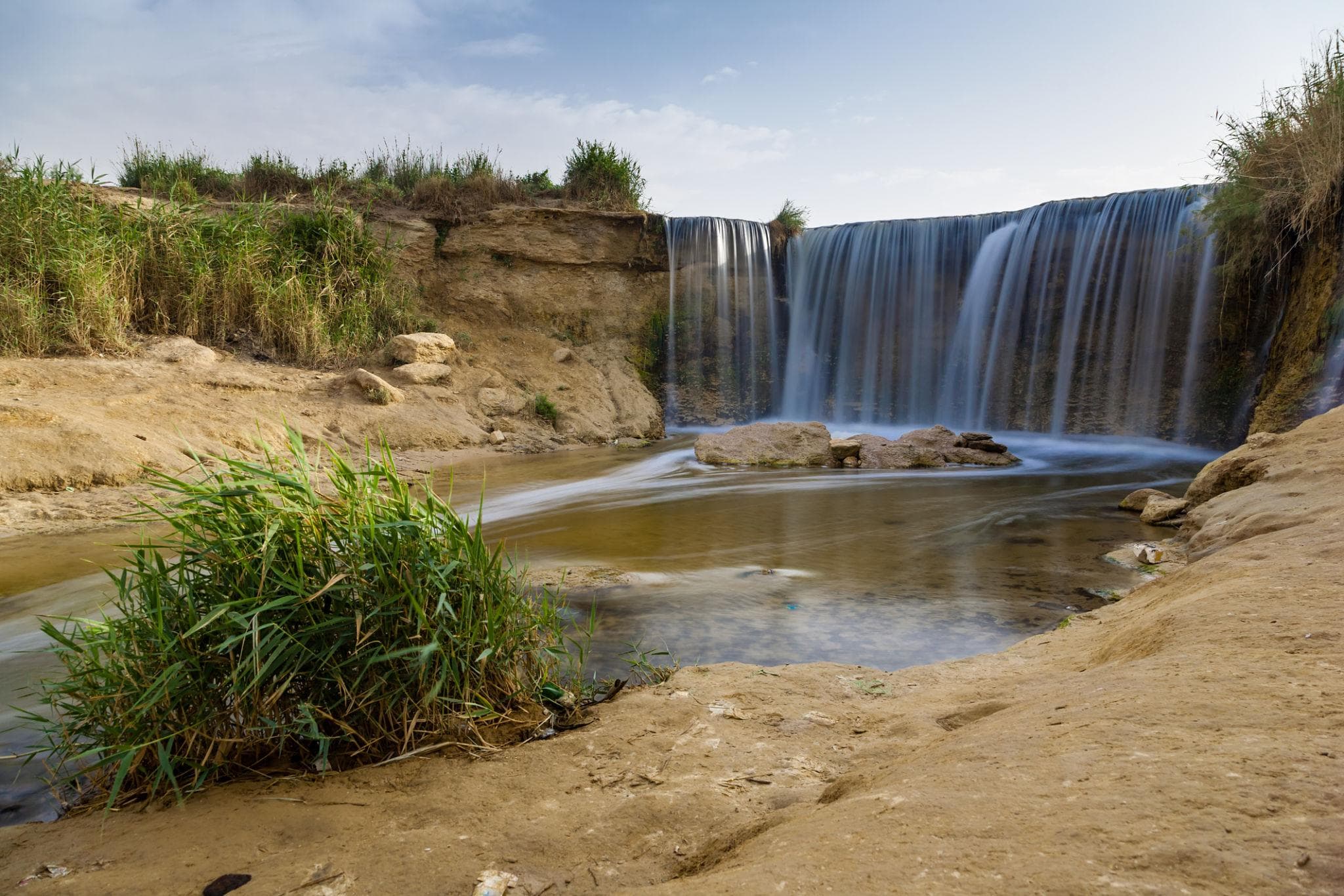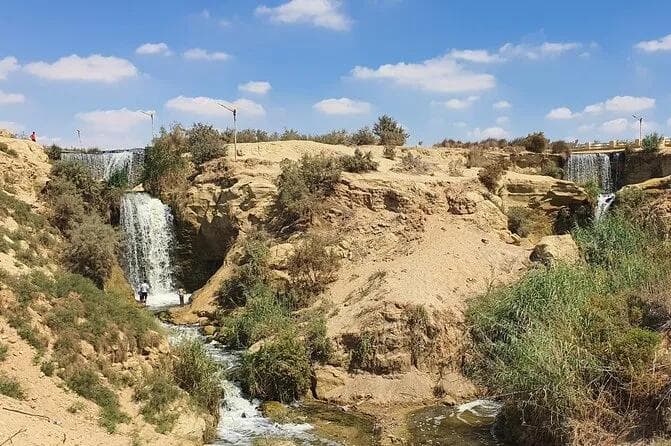
The first surprise at Wadi El Rayan is the sound. You hear running water before you see it, a steady rush coming out of a landscape of yellow sand and pale limestone where nothing ought to be flowing at all. The second surprise, for anyone who has pictured something grand, is the scale. The Wadi El Rayan waterfalls are a broad set of cascades a few metres high, where one lake spills into another over a shelf of rock. They are modest, they are man-made, and on a clear winter morning they are still one of the strangest sights within reach of Cairo.
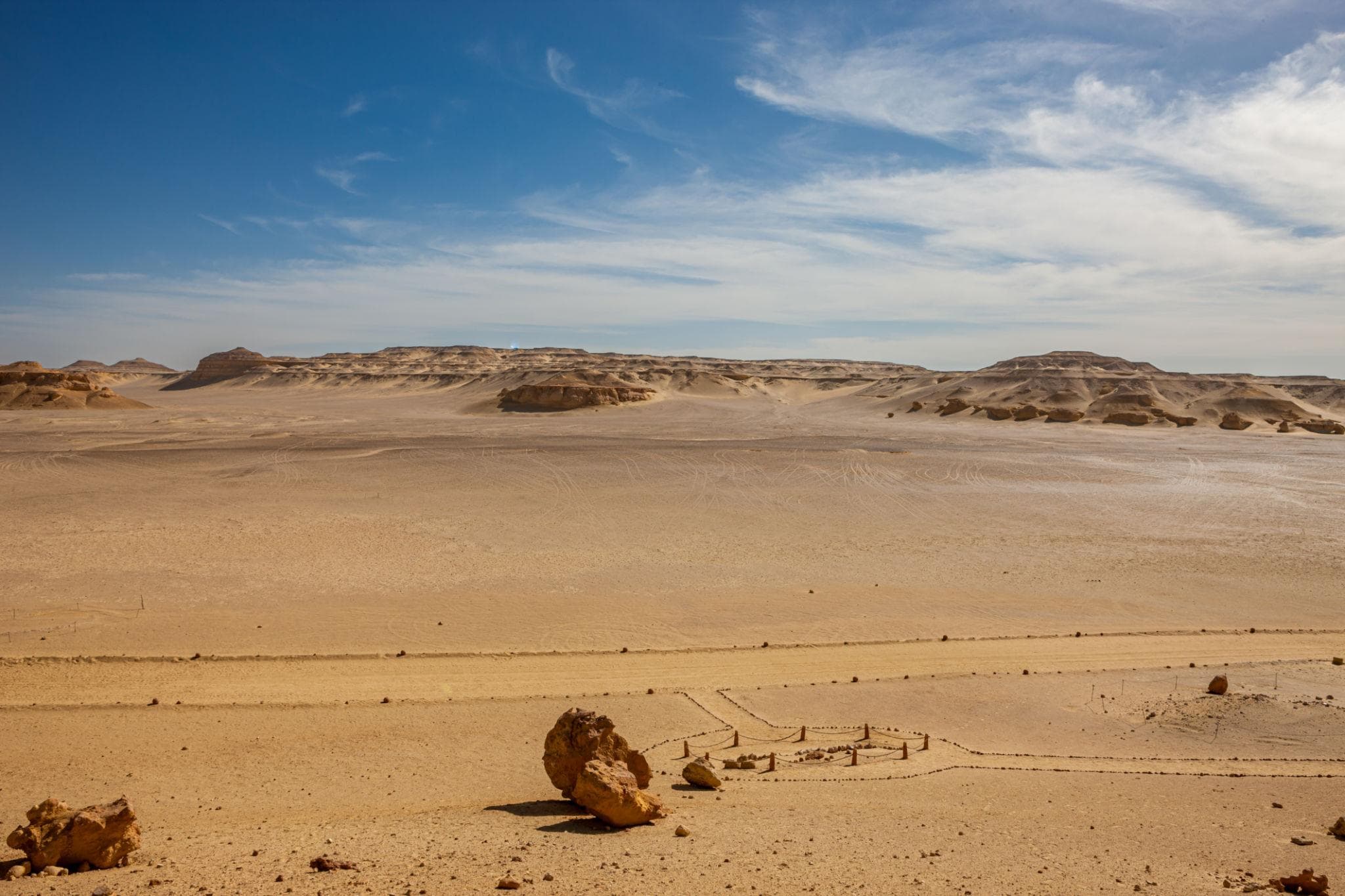
The falls sit in a desert depression on the south-western edge of the Fayoum, about 150 km (95 miles) from central Cairo, protected since 1989. Around them lie two large lakes, Magic Lake and its dunes, a viewpoint over the whole basin and, further into the desert, the fossil whales of Wadi al-Hitan.
This guide explains what the waterfalls are and whether they deserve a day, what else to see, the fees as far as they can be confirmed in November 2026, where you need a 4x4, and how to time the visit around the light, the heat and the crowds.
At a Glance
Where: south-western Fayoum, about 150 km (95 miles) south-west of central Cairo
Driving time from Cairo: usually 2 to 2.5 hours each way
Protected area: declared in 1989, about 1,759 km² (680 sq miles)
The waterfalls: cascades a few metres high between two lakes fed by farm drainage since 1973
Entry: reported at about US$5 per foreign visitor plus a vehicle charge, with a separate ticket for Wadi al-Hitan, as of November 2026
4x4 needed for: Wadi al-Hitan, the sand around Magic Lake and the sulphur springs
Best season: October to April
Best time of day: the falls in the morning, Magic Lake and the dunes in the late afternoon
Combine with: Wadi al-Hitan, a UNESCO World Heritage Site since 2005
Busiest days: Fridays, Saturdays and public holidays
What the Wadi El Rayan Waterfalls Really Are
The Fayoum is not a true oasis fed by springs. It is watered from the Nile through the ancient Bahr Yusuf canal, and the water left over from its fields has always drained north into Lake Qarun. By the 1960s more land was under the plough than ever, the lake was rising and threatening the villages on its shore, and planners needed somewhere else to send the surplus. They chose Wadi El Rayan, an empty basin lying well below sea level to the south-west.
Work began in 1968 and the first drainage water arrived in January 1973. It filled the northern part of the depression first, creating the upper lake. When that basin was full, the overflow ran south into a deeper hollow and began to fill a second, lower lake. Where the stream crosses a step of harder rock between the two, the cascades formed. Today the upper lake covers about 51 km² (20 sq miles) and the lower lake about 62 km² (24 sq miles).
So the honest answer to the question most people ask is this: the Fayoum waterfalls, as Egyptians often call them, are small, and they are a by-product of irrigation rather than a work of nature. They are also the only falls of their kind in Egypt, set among dunes and desert cliffs, and they are worth seeing as part of a day that includes Magic Lake and ideally Wadi al-Hitan. Driving five hours for the falls alone would disappoint.
The Upper Lake, the Lower Lake and the Falls
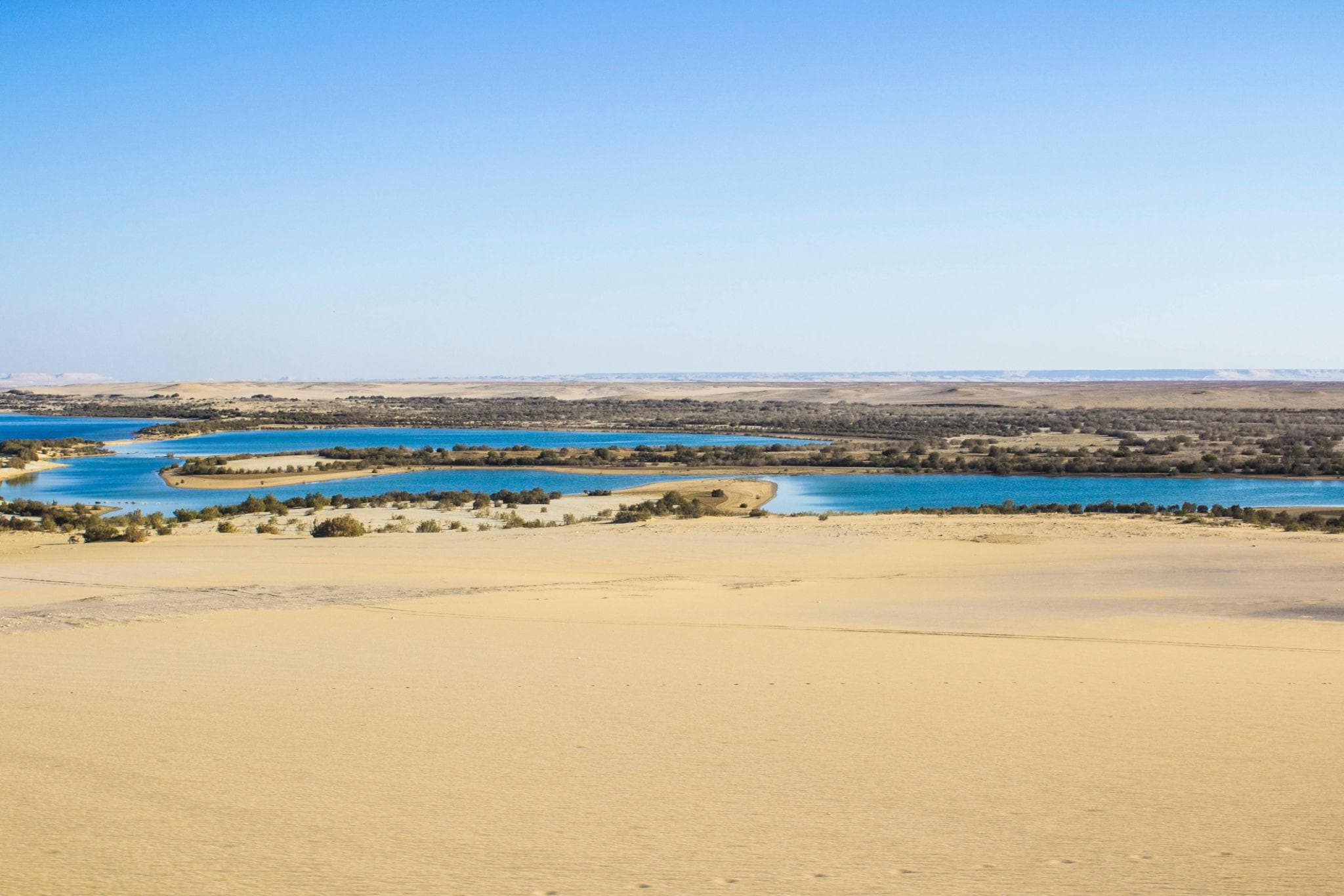
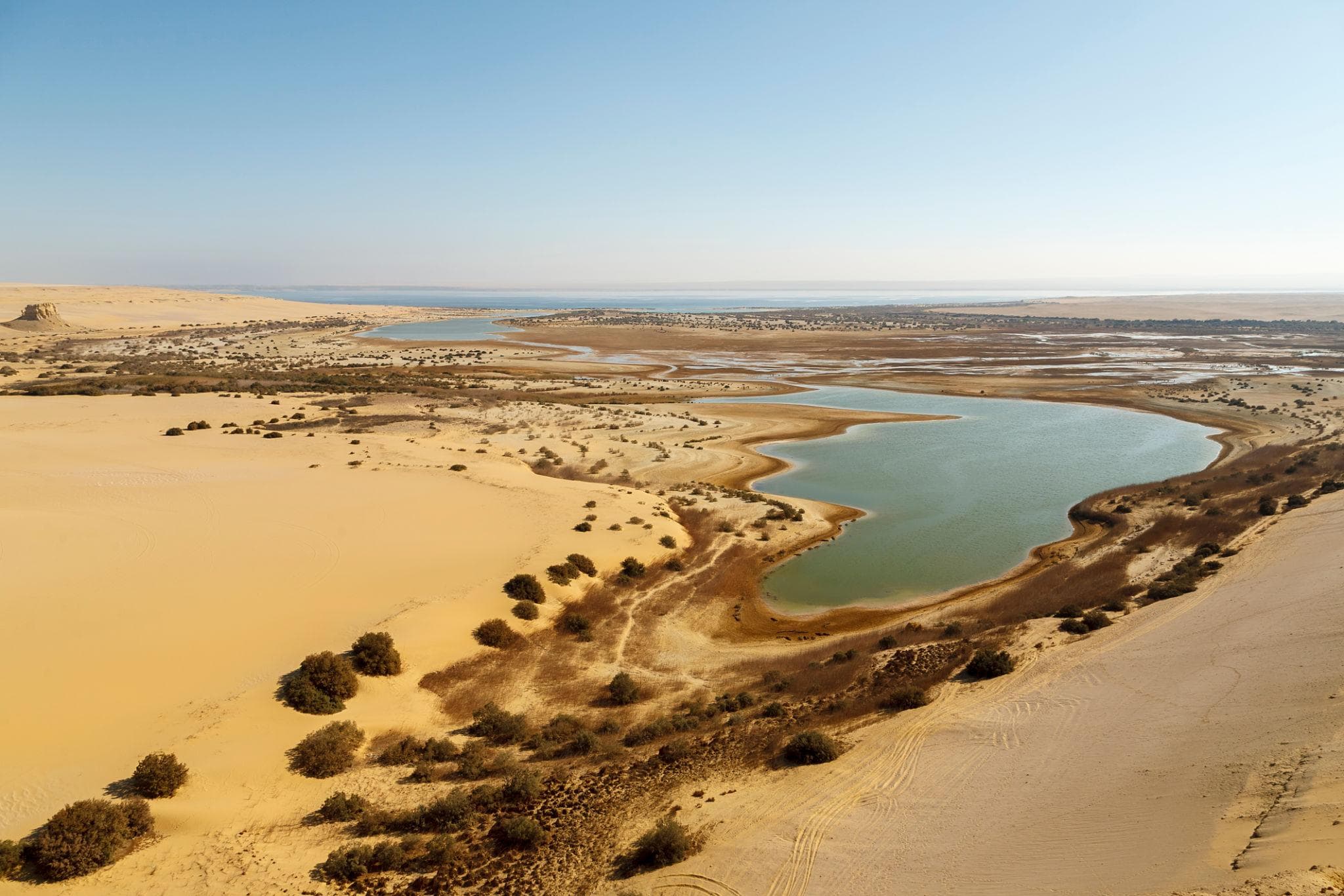
From the main gate of the Wadi El Rayan protected area, the asphalt road runs south between the two lakes, and the falls lie about 20 km further on, to the left of the road. The upper lake is shallow and fringed with reeds, its edges partly given over to fish farms. The lower lake is larger and deeper, a hard blue against the sand, with dunes running down to its southern shore.
At the falls the water drops in several short steps across a wide band of rock, and the ground around it has become an informal visitor area: a car park, simple cafés serving tea, snack stalls, and men offering camel rides, boat trips and sandboards. On a weekday in winter it is relaxed; on a Friday in spring, when families drive down from Cairo, it is noisy, crowded and cheerful.
Many people paddle below the cascades. Remember that this is agricultural drainage water, so it is not a place to swim, and the rocks are slippery with algae. Forty-five minutes to an hour is enough for most visitors.
The lakes are also a wetland of international importance, listed under the Ramsar Convention in 2012. In winter look for herons, egrets, grebes and ducks on the upper lake and birds of prey over the cliffs.
Good to Know: Wadi El Rayan Protected Area Fees
The reserve is run by the Egyptian Environmental Affairs Agency, part of the Ministry of Environment, not by the antiquities authorities, so its tickets do not appear on the price lists for temples and tombs. As of November 2026 we could find no official published tariff, so what follows is what visitors and operators report paying.
The gate fee for foreign visitors is most often reported at about US$5 per person, with a small extra charge for the vehicle, and recent visitors report paying it in US dollars in cash, with cards refused. Wadi al-Hitan has its own ticket, sold at its visitor centre and usually reported at about US$10 for foreigners, though one listing gives US$15. Camping carries a further nightly fee, reported at around 200 EGP (about US$4) per foreign visitor. In April 2025 the ministry introduced a new fee framework for protected areas, US$5 for foreigners by day and double at night, but the reports named the Red Sea and Sinai reserves, and it is unclear how far it applies in the Fayoum.
Carry cash in both currencies, including small US dollar notes and 50 and 100 EGP notes, because the gates cannot be relied on to take cards. If you book a tour, ask whether the protectorate and Wadi al-Hitan fees are included, as many operators list them separately.
Magic Lake Fayoum: Why the Colours Change
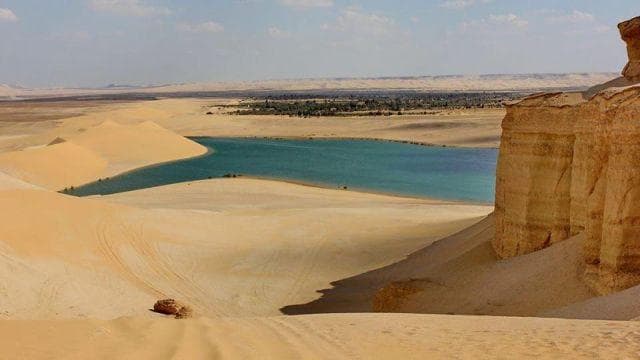
Magic Lake is the youngest of the three. It formed around the turn of the millennium, when drainage water seeping through the ground began to collect in a small, enclosed hollow among dunes and limestone hills near the lower lake. With no outlet and fierce evaporation it has become far saltier than the water that feeds it, as a scientific study published in 2020 confirmed.
The name comes from its colour, which shifts through the day. On a clear morning it can be turquoise at the edges and deep blue in the middle; at midday under a white sky it flattens to grey-green; in the late afternoon, with the sun low behind the dunes, it can turn almost violet while the sand glows orange. The usual explanation combines the angle of the sun, the colour of the sky, the depth of the water and its salt and mineral content. No study we have seen settles the question, so treat claims of a precise scientific cause with caution.
Set your expectations too. On a hazy day with dust in the air, Magic Lake can look like an ordinary salt pond. Come in the late afternoon on a clear day and it lives up to its name. There are no facilities beyond the occasional tea stall, so bring water and take your rubbish away with you.
Sandboarding the Dunes Above Magic Lake
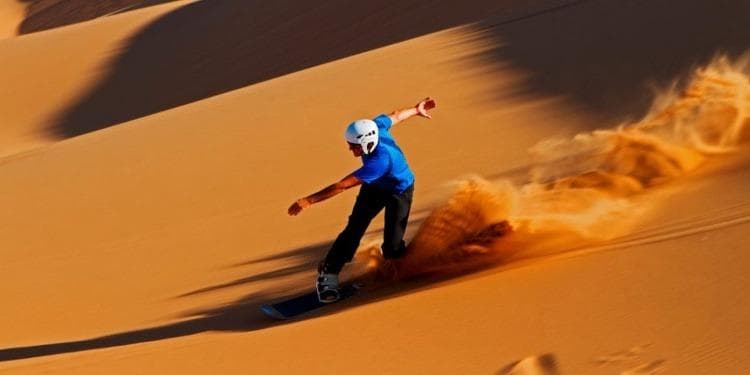
The tall dunes on the edge of Magic Lake are the best-known sandboarding slopes within a day of Cairo. There is no lift and no infrastructure. You climb the soft sand with the board under your arm, wax it, and ride or slide down towards the water, and after four or five climbs most people have had enough. The slopes are steep enough to be exciting and soft enough to forgive a fall, which suits beginners and older children.
Boards are rented on the spot or brought by tour operators, and quality varies. A board with proper bindings is far easier to control than a flat plank, and a block of wax makes the difference between gliding and stopping halfway.
Late afternoon is best: the sand has cooled enough to walk on barefoot, the light over the lake is at its richest, and you can finish with the sunset from the crest. At midday, even in winter, the surface can be uncomfortably hot. Our sandboarding guide to Egypt covers the other dunes worth trying around the country, from Siwa to the Western Desert.
Mudawara Mountain: The Best View Over the Lakes
From the road the lakes appear one at a time, and most visitors never see the basin as a whole. The place to understand it is Jebel al-Mudawara, a rocky hill a few kilometres past the turn-off for the lower lake. A rough path winds up through the rock, and the climb takes about 10 to 15 minutes at an easy pace.
From the top the landscape opens out: the lower lake below you, the line of dunes along its shore, the green band of reeds near the falls in the distance, and the desert running on to the horizon. It is the clearest way to see how the water sits in the depression, and the photograph that best explains why the lakes exist at all. Falcons often ride the updraughts along the cliffs.
Wear shoes with decent grip, since the rock is loose in places and the descent is easier to slip on than the climb. The summit is exposed and windy, with no shade, and in spring blowing sand can make the view hazy. If your day is short, choose between Mudawara and a long stop at the falls: the viewpoint gives you the geography, the falls the atmosphere.
Combining Wadi El Rayan With Wadi al-Hitan
The strongest reason to make the drive to the Fayoum is Wadi al-Hitan, the Valley of the Whales, inside the protected area to the south-west of the lakes. About 40 million years ago this desert was the floor of a shallow sea, and the skeletons of early whales lie where they died, weathering out of the sandstone. Many still have small hind legs, evidence that whales evolved from land mammals, which is why UNESCO inscribed the valley in 2005 as Egypt's first natural World Heritage Site.
A marked trail leads past fossils of Basilosaurus and Dorudon, many under low shelters, along with fossilised mangrove roots. The Fossil and Climate Change Museum, opened in January 2016, is built partly underground beside the visitor centre and displays an 18-metre (59-foot) Basilosaurus skeleton. Allow two to three hours for the trail and the museum.
The valley is reached by an unsealed track of about 35 km (22 miles) from the main road, roughly an hour each way in a 4x4. That makes the lakes plus Wadi al-Hitan a full day from Cairo, leaving around 7am and returning after dark. Our guide to Wadi al-Hitan and the Whale Valley covers the fossils and the museum in more depth.
Warning: Where You Need a 4x4
The main road through the protected area is asphalt, and an ordinary car can reach the gate, the upper lake, the falls and the foot of Mudawara. Everything else is sand. The approach to Magic Lake crosses soft ground; the track to Wadi al-Hitan is about 35 km of corrugated, unsealed surface; and the quiet sulphur springs of Ain el-Rayan, south of the lower lake, lie across dunes that only an experienced desert driver should attempt.
Do not try these routes in a hire car. Rental contracts rarely cover off-road damage, there is no fuel inside the protected area, and mobile coverage is patchy beyond the lakes. A 4x4 with a driver who knows the area is the normal way to visit, and good drivers lower their tyre pressure for the sand and carry tow ropes, shovels and spare water as a matter of routine.
Stay on existing tracks even in a 4x4: off-track driving scars the desert for years and is against the reserve's rules. Carry your passport, as there are police checkpoints on the roads into the Fayoum and a ranger post at the reserve gate. Our guide to desert safety and permits in Egypt explains the wider rules for the Western Desert.
Pro Tip: Time the Falls and the Dunes Separately
Plan the day around the light and the crowds rather than the map. See the falls in the morning, when the cafés are quiet and the water catches the early sun, and keep Magic Lake, the dunes and Mudawara for the last two hours before sunset, when the colours are richest and the sand has cooled. If you include Wadi al-Hitan, go there in the middle of the day: the museum gives you shade, and the fossils do not depend on the light.
Choose the season with care. From October to April daytime highs are usually around 20C to 27C (68F to 81F), ideal for walking and sandboarding. From June to August the depression bakes, often above 35C (95F) by late morning. Winter nights fall below 10C (50F), which matters if you camp, and in March and April the khamsin wind can bring dust storms that dull the lakes for a day or two.
Go on a weekday if you can. Fridays, Saturdays and public holidays bring large numbers of families from Cairo and the Fayoum towns, and the falls in particular lose their calm. Our guide to the best time to visit Egypt sets out the seasons across the country.
Getting There: A Fayoum Day Trip From Cairo
The usual route leaves Giza on the desert road to the Fayoum and reaches the edge of the oasis in about an hour and a half when traffic is light. The protected area lies roughly another hour beyond Fayoum city, through farmland and villages and then out into the desert. In total that is about 150 km (95 miles) and usually 2 to 2.5 hours each way, longer if you leave Cairo in the morning rush.
There is no practical public transport. Microbuses run from Cairo to Fayoum city, but nothing scheduled continues to the falls, and town taxis are not built for the sand tracks. Almost everyone comes with a private driver or a tour, which also solves the question of the 4x4.
The rest of the oasis is easy to add. Lake Qarun and the Ptolemaic temple of Qasr Qarun lie at its western end, with the potters' village of Tunis on the slopes above the lake. Our guide to the Fayoum oasis covers the rest of the oasis, and our overview of day trips from Cairo sets the Fayoum against the other options near the capital.
Planning Your Fayoum Day Trip
The simplest way to see the reserve properly is with a driver and a 4x4 for the day. A night in the desert is better still: camping is permitted at designated sites for the nightly fee mentioned above; once the day visitors leave the silence is complete and the sky fills with stars, though winter nights are cold and there is no electricity at the camps. Our Fayoum safari tour is the version for travellers who want the desert side of the oasis, while our Fayoum oasis overnight tour adds a second day and a slower pace, which suits anyone hoping to see Mudawara at sunset and Wadi al-Hitan without rushing. If pottery and village life interest you more than sand, the Tunis village pottery tour shows the gentler, greener side of the Fayoum.
Tell us when you are travelling, who is coming and how much time you have through our contact page, and we will suggest a plan for the lakes, the dunes and the whales that fits the season and the light.