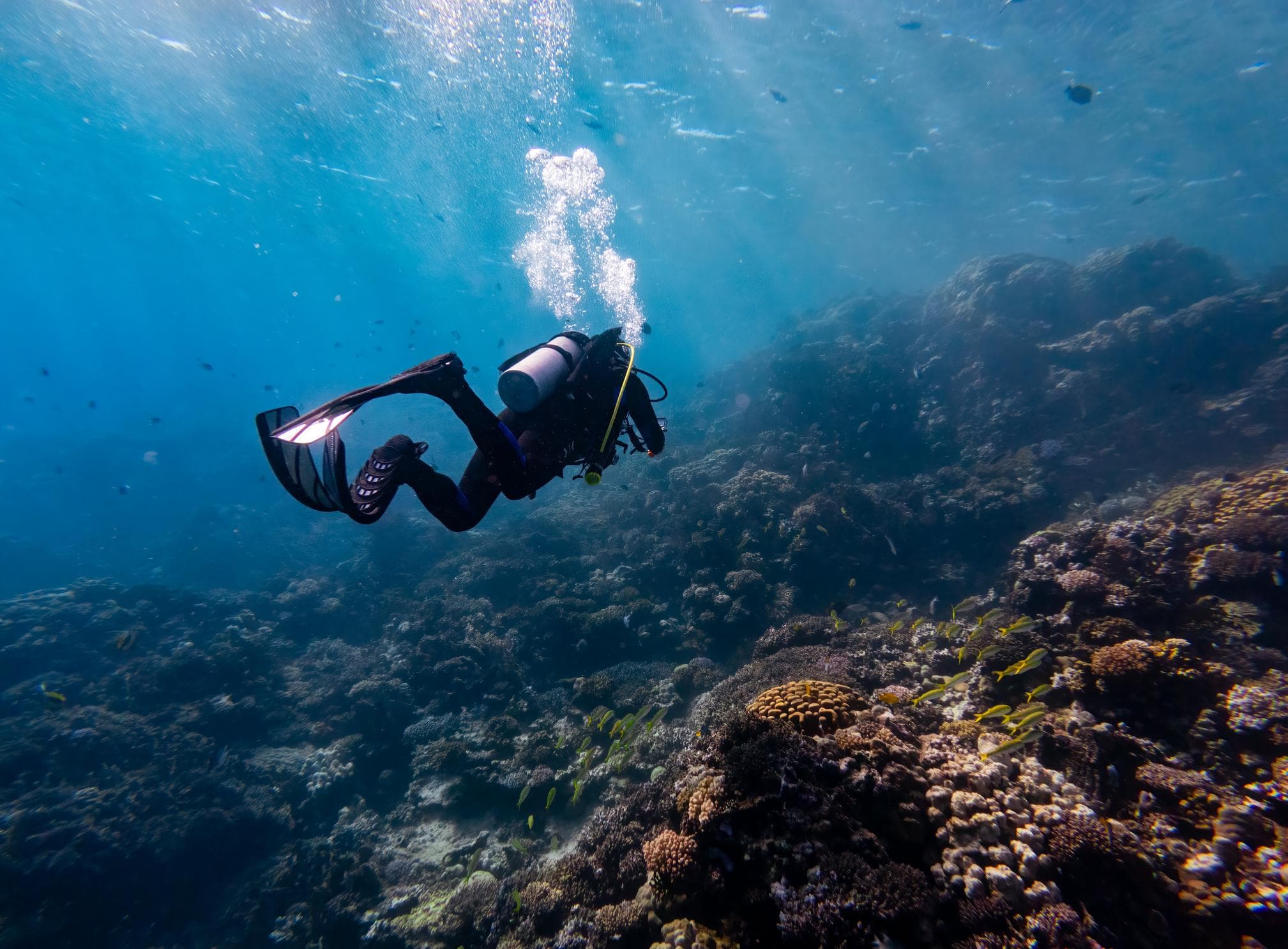
At five metres the noise of the boat disappears. You kneel on white sand, breathing a little too fast, and the instructor makes the OK sign and waits until you return it. Then she points: a parrotfish grinding at the coral, a cloud of tiny orange fish over the reef, the hull of the boat still sharp above you. This is diving for beginners in Hurghada, and most people remember that first breath under the Red Sea for years.
Hurghada is one of the easiest places in the world to take it. The town has dozens of dive centres, reefs within half an hour by boat, warm water for much of the year and instructors who teach first-timers every day. The choice is wide, which is good, and uneven, which is the reason to read on.
This guide covers the difference between a try dive and a full course, the age and medical rules, the best sites for a first dive, water temperatures through the year, how to choose a safe centre, what it costs, and why the timing of your dives matters if you plan to fly to Cairo or Luxor later in the week.
At a Glance
First dive: a try dive, such as PADI Discover Scuba Diving, with no experience or certificate needed
Minimum age: 10 for a try dive in open water or an Open Water course; 8 for pool programmes
Maximum depth: 12 m (40 ft) on a try dive; 18 m (60 ft) after an Open Water course
Open Water course: usually 3 to 4 days, with 5 confined-water and 4 open-water dives
Medical: a standard questionnaire before diving; some answers need a doctor's approval first
Beginner sites: the Giftun islands, Abu Ramada, El Fanadir and many hotel house reefs
Water temperature: about 21C to 22C (70F to 72F) in February, 28C to 29C (82F to 84F) in August
Best seasons: spring and autumn, with warm water and gentler weather
Flying after diving: at least 12 hours after a single dive, 18 hours after several; many centres advise 24
Licensing: dive centres in Egypt are licensed by the Chamber of Diving and Water Sports (CDWS)
Diving for Beginners in Hurghada: Try Dive or Course
There are two ways to start. The first is a try dive, sold by PADI as Discover Scuba Diving and by other training agencies under similar names. After a briefing and a short practice session in a pool or in shallow water, you make one or two dives to a maximum of 12 m (40 ft), always under the direct supervision of an instructor. There is no exam and no certificate. Hurghada centres often sell it as an introductory dive course for first-time scuba divers: a taste of breathing underwater, usually taken in half a day or as part of a day on a boat.
The second is a full course, most often the PADI Open Water Diver course or an equivalent from SSI or another agency. It takes three to four days and ends with a certificate that lets you dive with a buddy, without an instructor, to 18 m (60 ft), anywhere in the world.
Which suits you depends on time and curiosity. If you have one free day and want to know whether diving is for you, take a try dive. If you are already sure, or if you liked the try dive, an Open Water course in Hurghada is good value and the training conditions are among the best anywhere: warm, clear, sheltered water and reefs close to the harbour. Many centres will count your try dive towards the course if you sign up within a short period, so ask before you book.
What Happens on an Intro Dive in Hurghada
The day begins with paperwork: a medical questionnaire, a liability form and, for under-18s, a parent's signature. The instructor then explains the equipment and the handful of skills you will need: breathing slowly through the regulator, clearing water from your mask, recovering the regulator if it falls from your mouth, equalising the pressure in your ears, and the hand signals for OK, problem, up and down.
Next comes practice in shallow water, either in a hotel pool or standing on a sandy bottom where you can stand up at any moment. Only when the instructor is happy that you are relaxed and can perform the skills do you go deeper. On a boat trip, the first dive is usually on a shallow, sheltered reef at a few metres, often around 6 to 8 m, and a second dive, if included, may go a little deeper, never beyond 12 m.
Each dive lasts about 30 to 45 minutes. Your instructor stays within arm's reach throughout, manages your buoyancy for you if needed, and ends the dive the moment anything feels wrong. On a well-run try dive, you do nothing but breathe, look and enjoy the fish. If you find you cannot equalise your ears or feel anxious, saying so is perfectly normal, and a good instructor will either adjust the pace or stop without fuss.
Learn to Dive in Hurghada: The PADI Open Water Course
The PADI Open Water Diver course has three parts. Knowledge development covers the physics and physiology of diving, equipment and planning; most people now do it online through eLearning before they travel, which frees up holiday days. Confined-water training, five sessions in a pool or sheltered shallow water, builds the skills step by step. And four open-water dives, usually spread over two days on the boat, put those skills into practice on the reef.
Done that way, the course in Hurghada takes three to four days. Without eLearning, add a day of classroom sessions and a short exam at the centre. You will also need to show basic water skills: a swim of 200 m (or 300 m with mask, fins and snorkel) without stopping, and ten minutes of floating or treading water. Speed does not matter.
At the end you receive a certificate recognised worldwide, valid for life, though after a long break a refresher is wise. Many people who learn in Hurghada go on to the Advanced Open Water course the following year, which opens the deeper wrecks of the northern Red Sea. Our guide to Red Sea diving and snorkelling explains where those first certificates can take you along the coast.
Age, Health and the Medical Questionnaire
The minimum age for a try dive in open water and for the Open Water course is 10. Children of 10 and 11 are limited to 12 m and dive with a parent or a professional, and under 15s receive a junior certificate that can be upgraded to the full one at 15. For younger children, PADI's Bubblemaker programme lets eight- and nine-year-olds breathe from a scuba tank in a pool, at no more than 2 m. There is no upper age limit, but fitness matters more with every decade.
Before any dive you complete a standard diver medical questionnaire. It asks about heart and lung conditions, asthma, epilepsy, diabetes, recent surgery, ear and sinus problems, pregnancy, certain medications and more. If every answer is no, you can dive. If any answer is yes, you need a doctor's written approval on the accompanying form before you go in the water, and in Hurghada that usually means seeing a local doctor recommended by the dive centre. If you know a yes is coming, ask your own doctor at home before you travel.
Answer the questionnaire honestly. It exists because some conditions turn a small problem underwater into a serious one. Colds matter too: congested ears and sinuses make equalising difficult and painful, and it is better to postpone a dive by a day than to force it. Our Egypt health guide covers sun, stomach troubles and insurance for the rest of the trip.
Warning: Do Not Fly Too Soon After Diving
After a dive, your body holds extra nitrogen that leaves only gradually. Flying too soon, when cabin pressure falls to the equivalent of a mountain altitude, raises the risk of decompression sickness. The widely used guidance from the Divers Alert Network is a minimum surface interval of 12 hours after a single no-decompression dive, 18 hours after several dives in a day or diving on several days, and longer after decompression dives. Many dive centres simplify this to a rule of 24 hours, and we suggest you follow it.
That matters in Hurghada more than most people realise, because some of the most popular excursions involve a flight. A morning flight to Cairo for the pyramids the day after a two-dive boat trip is too soon. Plan the excursions first and the diving afterwards, or leave a full day between your last dive and any flight, including your flight home at the end of the holiday. Our guide to a Cairo trip from Hurghada explains which version of that trip involves flying.
The Best Beginner Dive Sites Around Hurghada
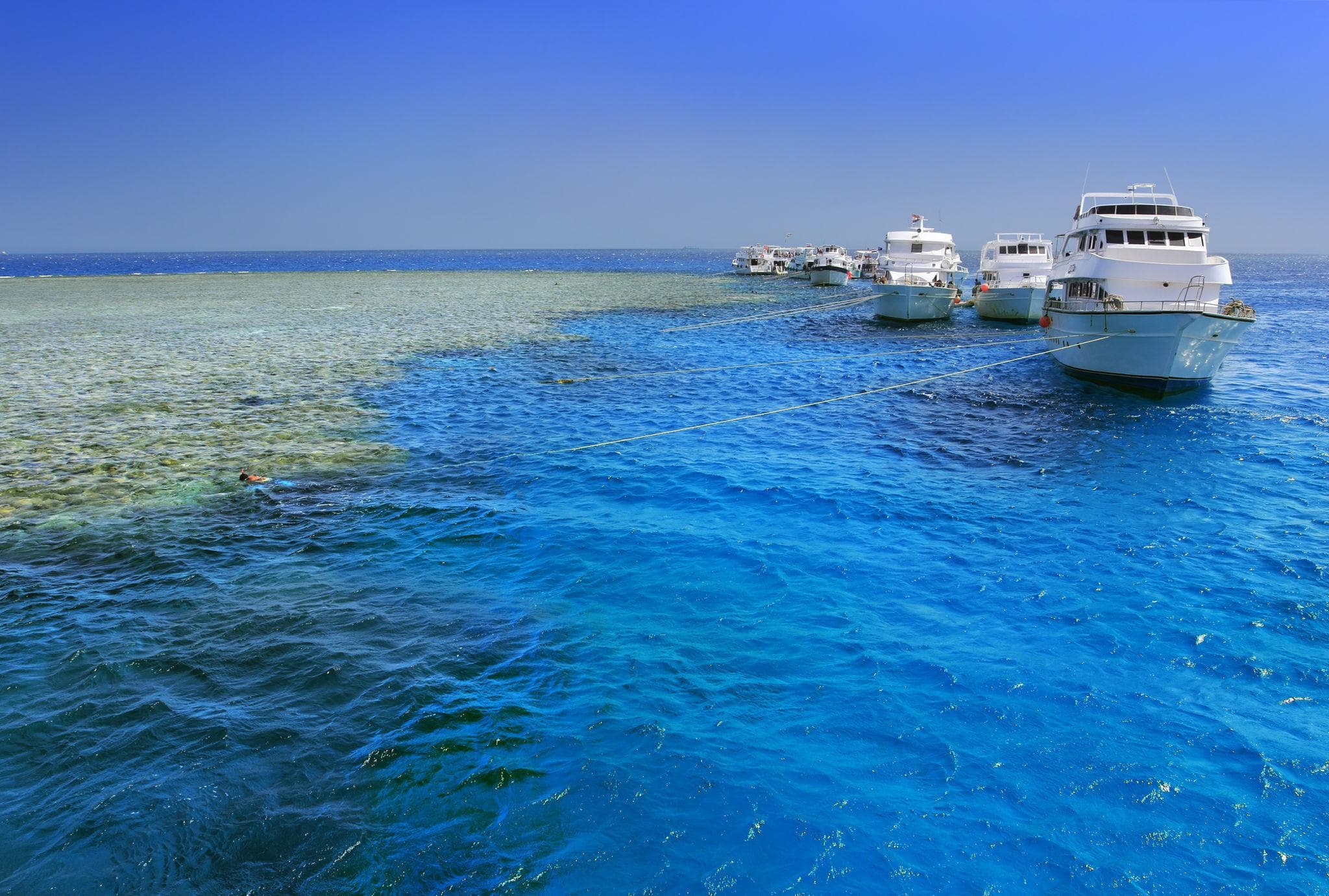
Most beginner dives from Hurghada take place around the Giftun islands, Giftun Kebir and the smaller Giftun Soraya, which lie about 30 to 45 minutes by boat from the marinas and form part of a protected marine park. Their sheltered sides offer sandy patches at 5 to 12 m beside coral gardens, ideal for a first descent. Abu Ramada, south of the islands, and the nearby shallow reef known to many centres as the Aquarium for its density of fish, are classic try-dive sites: gentle slopes, hard and soft corals, and the full cast of reef fish, from butterflyfish and anthias to clownfish in their anemones.
El Fanadir, a reef just off the coast north of the town centre, is close enough for a short boat ride and often calm in the morning. Many hotels in Makadi Bay, Sahl Hasheesh, Soma Bay and El Gouna also have house reefs or partner centres that run first dives from the shore or a jetty, which avoids the boat altogether and suits anyone prone to seasickness.
Not every famous name is for beginners. The wrecks of Abu Nuhas, the currents at some offshore reefs, and the SS Thistlegorm, the Second World War cargo ship that lies a long day's sailing north of Hurghada, are for certified, preferably experienced divers. They are an excellent reason to come back after your course.
Water Temperatures and the Best Season for a First Dive
You can learn to dive in Hurghada all year, but the seasons feel different. The sea is warmest in August, at about 28C to 29C (82F to 84F), and coolest in February, at about 21C to 22C (70F to 72F). In November it is still around 25C to 26C (77F to 79F). Centres provide wetsuits, typically 3 mm in summer and 5 mm, sometimes with a hood or vest, in winter, when a long second dive can feel cold to a beginner.
Spring, from about March to May, and autumn, from about September to November, are the best compromise: warm water, comfortable air temperatures and more settled weather. In summer the air on deck can exceed 35C (95F), so shade on the boat and plenty of water matter. Winter brings cooler water and some of the windiest days, when crossings can be choppy and, at worst, smaller boats stay in port.
Visibility on the reefs around Hurghada is often 20 m or more, although plankton and wind can reduce it. For anxious beginners, choose a calm morning and a sheltered site rather than a particular month: a flat sea makes the first giant stride from the boat much easier.
Pro Tip: How to Choose a Safe Dive Centre
Price is the wrong place to start. Ask first whether the centre is licensed by the Chamber of Diving and Water Sports, the body that regulates diving in Egypt, and which training agency it teaches for. Ask how many beginners each instructor takes on a try dive: two is ideal, and a good centre rarely goes beyond four. Ask which language your instructor speaks fluently, because understanding the briefing is part of safety.
Look at the equipment. Wetsuits should not be torn, masks should seal, and regulators and buoyancy jackets should look maintained rather than merely old. On the boat, there should be emergency oxygen and a first-aid kit, and the crew should be able to tell you the emergency plan and where the nearest hyperbaric chamber is. Recent reviews that mention instructors by name and describe the briefing are more useful than star ratings alone.
Finally, check that your travel insurance covers recreational diving to the depth you will reach, or take out specialist diving cover. Many insurers exclude scuba diving unless it is declared.
What Diving in Hurghada Costs
Prices vary with the centre, the season and what is included, and many Hurghada centres quote in euros. As a rough guide only, to be confirmed with the centre, a try dive from a boat usually costs roughly €50 to €90, often with a second dive available for a supplement. A full Open Water course is a larger commitment, commonly several hundred euros, roughly €300 to €450, with the eLearning fee and certification sometimes charged separately.
The details make the difference. Ask whether the price includes equipment, boat days, lunch on board, hotel transfers, the marine park or harbour fee, the learning materials and the certificate itself. A cheap price that excludes three of those is not cheap. If your hotel has a partner centre, compare it with an independent one in town: hotel centres are convenient, while independent centres sometimes offer smaller groups. Our Hurghada travel guide covers the areas of the coast and how far each is from the marinas.
Good to Know: Fitting Diving Around Luxor and Cairo
Most visitors to Hurghada want both: the reef and the pharaohs. The order of the days decides how easily they fit. Road trips to Luxor raise no flying question, so a Luxor day trip from Hurghada or our overnight Luxor trip from Hurghada can sit between dive days, as long as you allow for the early start and the long day.
Trips that involve a flight are different. Put the Cairo excursion early in the holiday, before your first dive, or leave at least 24 hours between your last dive and the departure. Our overnight Cairo trip from Hurghada can use the road in one or both directions when the timing of your diving makes a flight awkward. The private Luxor tour from Hurghada with a balloon flight raises a related question: if the balloon flight falls the morning after a dive, ask your instructor whether to leave a longer gap.
Planning Your First Dive in Hurghada
For diving for beginners in Hurghada, the easiest plan is simple: a try dive early in the week, and if you love it, an Open Water course over the following days, with the excursions to Luxor and Cairo arranged around them. A sheltered reef, a patient instructor and a calm morning are worth more than any particular site.
We do not run dives ourselves, but we arrange holidays on the Red Sea coast every week and know how to fit a first dive around the rest of a trip. Tell us your dates, your hotel and what you would like to see on land through our custom tour page, and we will suggest an order for the days that keeps the diving safe and the excursions relaxed. If you have not yet chosen a dive centre, we can point you towards licensed centres near your hotel and pass on the questions worth asking. If you have, we will simply plan the land days around your dive schedule, so that the flights, the early starts and the long drives never collide with the time you spend underwater.