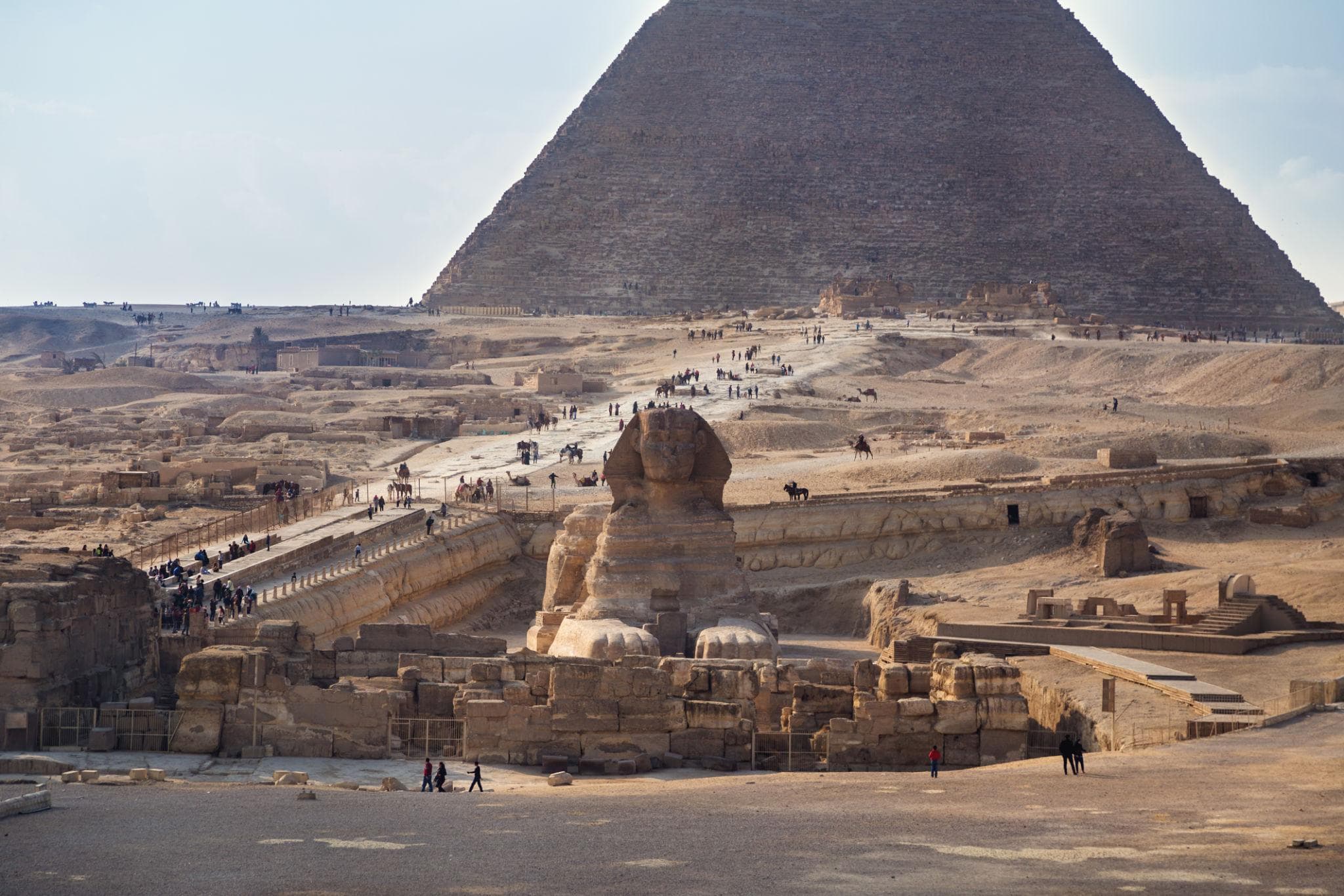
The question usually arrives before you reach the ticket office. At the Giza plateau a man falls into step beside you, says he is an official guide and offers to show you the pyramids for a good price. A few metres away, a guide with a photo card on a lanyard is briefing a family under a sunshade, pointing at a diagram of the Great Pyramid. Both are offering a person to explain what you are about to see. Only one of them is licensed to do it.
Do I need a guide in Egypt? Legally, no: independent travellers can visit the pyramids, the temples and the royal tombs on their own with a ticket. In practice the answer depends on the site, on you and on the day. A good Egyptologist can transform the Grand Egyptian Museum or a first morning at Giza. An audio guide can be the better companion at Karnak at your own pace, or on a second visit when you want the place to yourself.
We sell both, private guided tours and self-guided audio guides, so this is an attempt to be fair to each. It covers the rules on licensed guides, what they cost in 2026, when a guide is worth it, when an audio guide is enough, the hybrid plan many travellers settle on, and the touts to avoid.
At a Glance
Do you need a guide: not legally, if you travel independently; organised groups must use a licensed guide
Who may guide inside sites: only licensed Egyptian guides, carrying a ministry licence card
Guide fees: official minimum EGP 1,800 a day; roughly US$40 to US$80 booked directly, as of late 2026
Tipping a guide: expected; about 300 to 500 EGP a day from the group, drivers 150 to 300 EGP
Worth a guide: the Grand Egyptian Museum, a first day at Giza, children, limited mobility, deep interest
Audio guide enough: Karnak, Luxor Temple, Saqqara, Hatshepsut, repeat visits, your own pace
Our audio guides: six sites, US$7 each, first stop free, offline, seven languages
Avoid: anyone who approaches you at a gate offering to guide you
Do I Need a Guide in Egypt? The Short Answer
No law requires an independent traveller to hire a guide. You can buy a ticket at the pyramids, Karnak or the Valley of the Kings and walk in on your own, and thousands of people do every day. What the law regulates is who may guide: only licensed guides may lead visitors and explain the monuments inside archaeological sites and museums, and organised groups must use one.
Whether you should hire one is a different question, and it comes down to four things. The first is the site. Some places explain themselves reasonably well with a little reading; others, like the Grand Egyptian Museum with its tens of thousands of objects, are hard to make sense of alone. The second is you: how much you know and whether you enjoy asking questions. The third is the company you keep, since children, older relatives and travellers with limited mobility change the calculation. The fourth is budget.
For most first-time visitors the honest answer is a mix. A guide for the days and sites where a person makes the biggest difference, and an audio guide or a good book for the rest, gives you both the depth and the freedom. If you are planning to visit Egypt without a tour altogether, it can be done, but plan the logistics carefully, as we explain at the end.
What a Licensed Egyptologist Guide Is
Tour guiding in Egypt is a regulated profession, governed by a law of 1983 and reserved for Egyptians: a labour ministry decree in force since December 2025 again lists tourist guidance among the jobs foreigners may not do. Guides are licensed by the Ministry of Tourism and Antiquities and belong to the tour guides' syndicate. Since June 2026 the ministry has been issuing smart licence cards with a chip, which serve as the guide's ID and open the electronic gates at sites and museums; a guide will show theirs on request. Most guides have studied tourist guidance or Egyptology at university, and recent rules add a language proficiency test. Because guiding is reserved for licensed Egyptians, a foreign tour manager travelling with a group looks after the logistics while a local guide does the explaining.
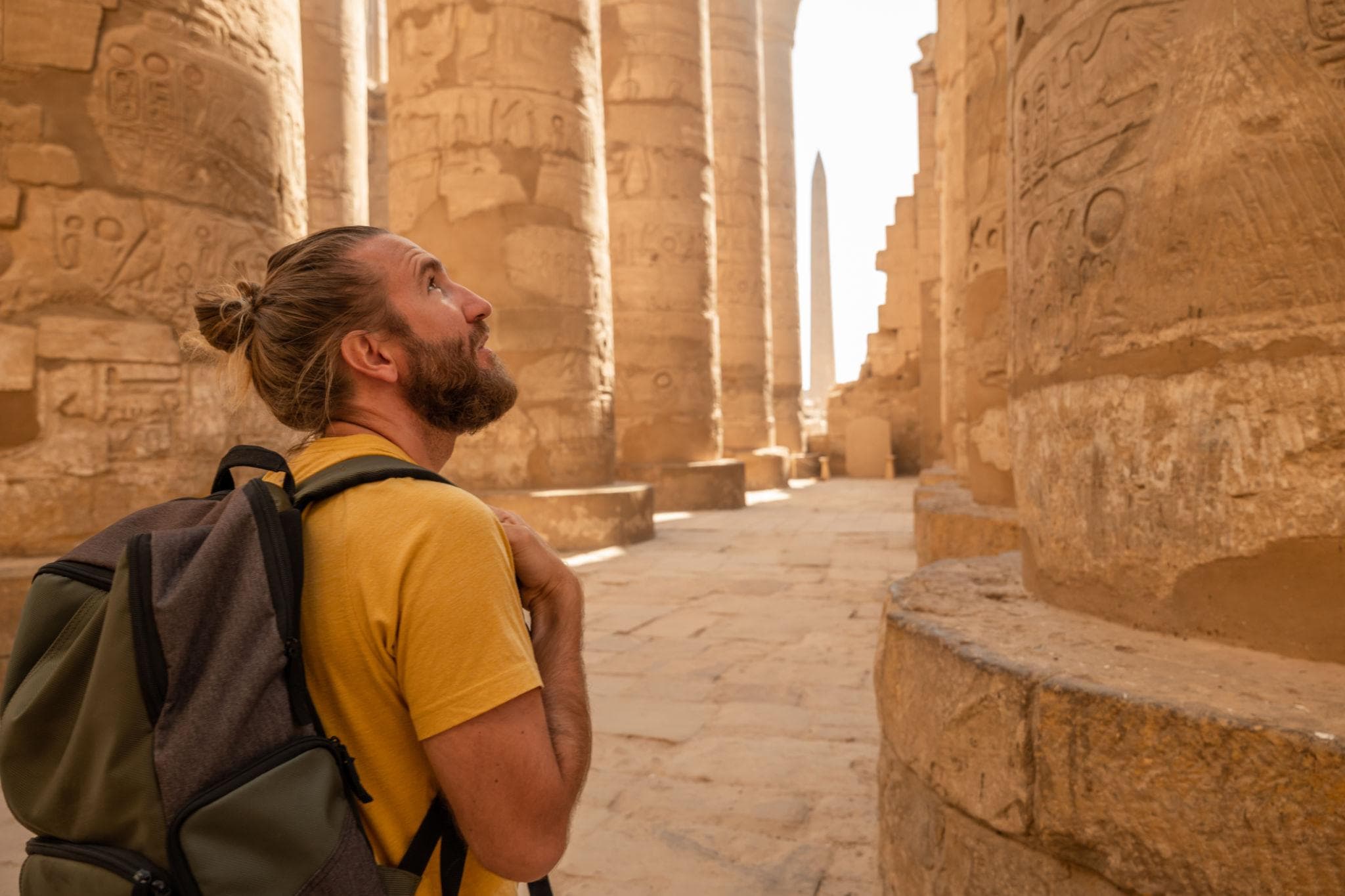
The term Egyptologist guide is used loosely. In everyday use it means a licensed guide trained in ancient history, not necessarily a research Egyptologist with a doctorate, and that is fine: the best guides combine solid knowledge with years of practice at the sites and a sense of what interests a particular visitor. A guide who has walked the Great Hypostyle Hall a thousand times knows where the light falls at nine, which relief children like, and where to stand while the coach groups pass.
Licensed guides also know the rules of each site, from the photography conditions to which tombs are open that week, and they deal with the ticket offices, the inspectors and the tourist police in Arabic. That practical knowledge is often worth as much as the history.
Egypt Tour Guide Cost in 2026
The ministry sets an official minimum wage that tourism companies must pay licensed guides. Since 1 October 2025 it has been EGP 1,800 for an eight-hour day and EGP 1,100 for a four-hour half day, about US$36 and US$22. Guides booked directly usually charge more: roughly US$40 to US$80 for a full day is a realistic range as of late 2026, more for rarer languages such as Japanese or Mandarin and for highly experienced Egyptologists, and luxury agencies charge several times that. Expect quotes in dollars or euros as often as in pounds.
A guide's fee usually covers the guide only. Site tickets, the car and driver, lunch and any extra tickets inside a site are separate, unless you book a tour that bundles them. That is why the price of a private guided tour from an agency, including ours, looks higher than a guide's day rate: it includes the vehicle, the driver, the planning and someone to call if something goes wrong. Our Egypt trip cost guide helps you budget for guides alongside hotels, transport and tickets.
Tips are expected on top. For a private full-day guide, our money and tipping guide suggests around 300 to 500 EGP (roughly US$6 to US$10) a day from the group, more for a long day or an exceptional guide, and 150 to 300 EGP a day for the driver. On a multi-day tour many travellers give a lump sum at the end.
Where a Guide Makes the Biggest Difference
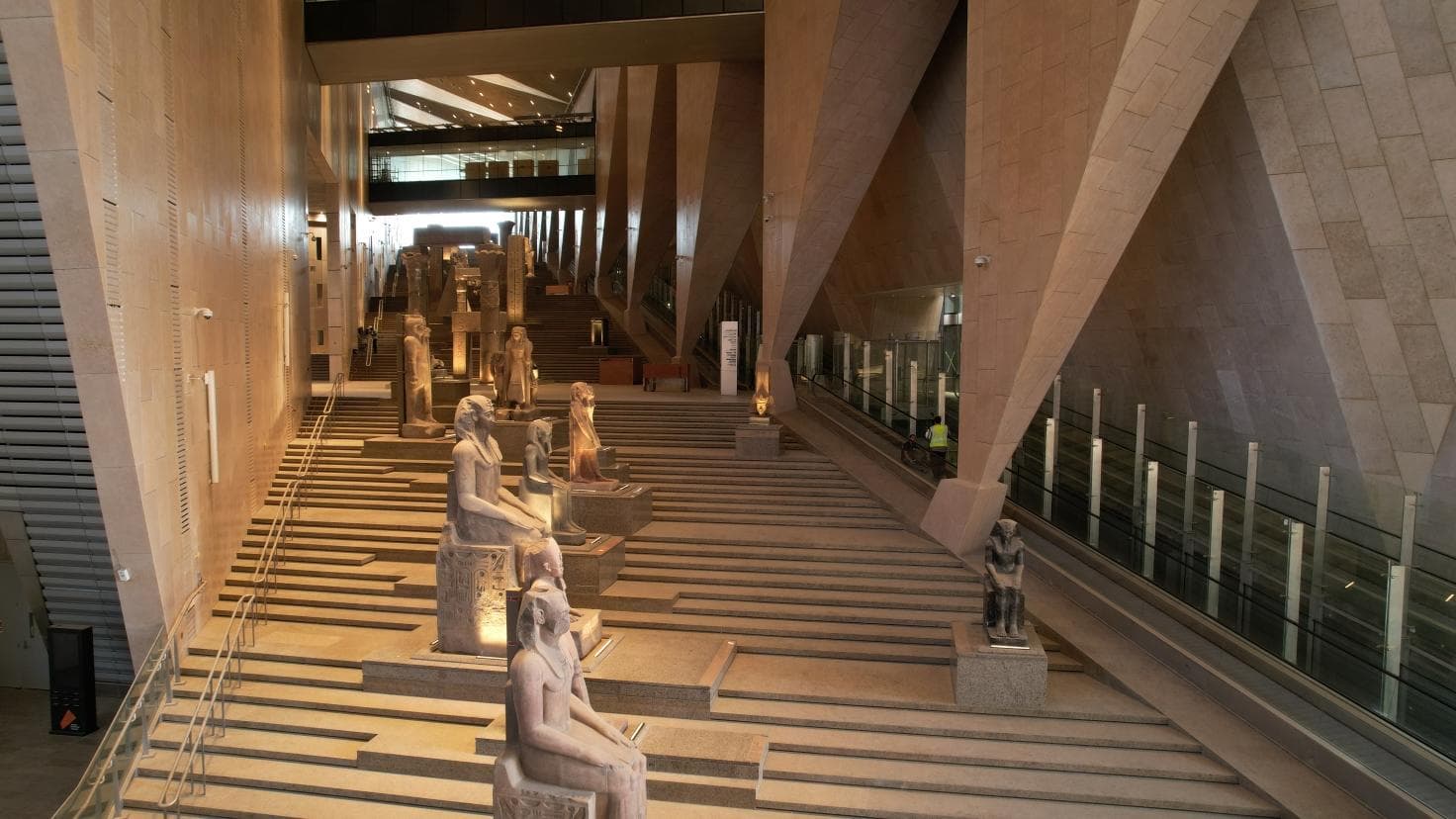
Some places reward a guide far more than others. The clearest case is the Grand Egyptian Museum. It holds tens of thousands of objects, including the complete Tutankhamun collection, and without a plan most visitors either rush or drown. A guide who knows the galleries will build a route around your interests and your stamina, and our Grand Egyptian Museum guided tour is built around that idea.
The second is a first day at Giza. The plateau is large, the ticketing has several layers, and the camel and horse touts are persistent. A guide on day one takes the friction away, explains the layout and leaves you confident enough to come back alone. Our Giza plateau guided tour is the simple way to do it.
The third is the choice of tombs in the Valley of the Kings. The standard ticket covers three of the tombs open that day, and some of the most famous cost extra. A guide who knows which tombs are open, which are crowded and which suit your interests saves you from spending your ticket on the wrong three. Guides usually brief you at each tomb entrance rather than inside, where space is tight, so the real value lies in the choosing.
Elsewhere, signage at most sites is limited to short panels in Arabic and English, and at smaller sites there may be almost nothing. The less a site explains itself, the more a guide adds.
Travellers Who Benefit Most From a Guide
Some travellers gain more from a guide wherever they go. Families with children are the first. A good guide turns a temple into a story, invents a game around the hieroglyphs and knows when to stop for a cold drink. Our guide to Egypt with kids has more on pacing a trip with children.
Travellers with limited mobility are the second. Egyptian sites involve uneven ground, steep ramps, stairs into tombs and long walks in the heat. A guide, working with a driver, can plan a route that avoids the worst of it, find the step-free entrances and arrange for the car to drop you as close as the rules allow. Our accessible travel guide covers access at the major sites in more detail.
The third group is first-time visitors who feel uneasy with the hassle, the language and the logistics, and who would rather have someone local beside them for the first day or two. The fourth is the deeply curious: anyone who wants to ask why, debate a theory or go into one subject far beyond what any recorded tour can cover. A guide responds to you; a recording, however good, cannot.
When an Audio Guide Is Enough, or Better
There are just as many situations where an audio guide is the better choice. The most obvious is pace. With a recording you can spend twenty minutes in front of one wall and walk past the next three, come back to a relief in better light, or sit in the shade while someone else explores.
Budget is the second. A guide for every site on a two-week trip adds up quickly, and at places that are fairly legible, such as Karnak Temple, Luxor Temple and the Temple of Hatshepsut, a well-structured audio tour covers what most visitors want to know. Photographers often prefer to go alone too, since they can wait for the light or for a group to move on without keeping anyone waiting.
Solo travellers who enjoy their own company, couples who want a quiet day, and visitors returning to a site they have already seen with a guide all fit the same pattern. So do families whose members have different interests or languages: our audio guides cover seven languages in one purchase and open on up to three phones, so each person can listen at their own speed and in their own language. And for evening visits, such as Luxor Temple under floodlights, a recording in your ear suits the mood better than a lecture.
Good to Know: How Our Audio Guides Work
Our audio guides cover six sites: the Giza plateau, Saqqara, Karnak, Luxor Temple, the Temple of Hatshepsut and the Valley of the Kings. Each costs US$7, bought separately, and the first stop of every tour is free to hear on its page before you buy. They play in your phone's browser, with no app and no account needed, and the access link arrives on screen and by email.
Each stop has narration, read-along text and a place on a map of the site, and on site the map shows your position by GPS. The Giza plateau audio tour and the Saqqara tour add a hand-drawn diagram for every stop. Open a tour once on hotel Wi-Fi shortly before your visit and it saves itself to the phone, then plays without a connection or roaming. One purchase opens on up to three devices and includes English, German, Spanish, Italian, Japanese, French and Mandarin Chinese; there is no Arabic version.
What they do not include matters as much: site tickets, transport and a guide. They are not narrated by an Egyptologist standing beside you, and they cannot answer questions. Our complete guide to the Egypt audio guides explains each tour stop by stop.
The Hybrid Plan: A Guide Where It Counts
Many travellers end up mixing the two, and for a first trip it is usually the best value. A typical week might look like this: a guide for the Grand Egyptian Museum and the Giza plateau on the first full day in Cairo, when everything is new; Saqqara the next morning with an audio guide, at your own pace, now that you know how the sites work; then, in Luxor, a guide for the West Bank, where the choice of tombs matters, and audio guides for Karnak in the early morning and Luxor Temple in the evening.
The logic is simple. Spend on a guide where a person adds most: the museum, the first day, the tomb choices, the days with children. Save at the sites that are easier to read, and use the savings on a longer stay, a balloon flight or a better hotel. Our Luxor East and West Bank tour can be booked as the guided core of a Luxor stay, with the Valley of the Kings audio tour or the temple tours for any return visits.
Warning: Unlicensed Guides and Touts at the Gates
At the entrances to the busiest sites, especially Giza, you will meet men who offer to guide you, show you a short cut, or tell you the entrance you want is closed. Some claim to be official guides, and some show cards that look official. Be polite and firm: a simple "no, thank you" and walking on usually works.
A licensed guide arranged through a reputable company or booked in advance will meet you at an agreed place and can show a proper licence card. Someone who approaches you at the gate is almost never the best option, even if he is licensed, because you have no way to check his knowledge or his intentions. Unlicensed guides cannot legally explain inside the sites, may steer you towards shops that pay commission, and sometimes demand far more at the end than was agreed at the start.
Agree any price and duration before you set off, in writing if possible. If someone becomes insistent, the tourist police at the major sites are there to help. Our list of common Egypt travel mistakes covers the other traps worth knowing about.
Pro Tip: How to Choose a Good Guide
Ask for recommendations from your hotel, a reputable agency or recent travellers, and confirm before you book that the guide is licensed and speaks your language fluently. Ask what they enjoy most about the sites: good guides answer with enthusiasm and detail, not a script.
Agree the plan in advance. Settle which sites you will visit, how long you will spend at each, whether lunch is included and, above all, whether there will be any shopping stops. If you do not want a papyrus or alabaster workshop on the way back from the pyramids, say so clearly at the start. Tell your guide what interests you, whether it is daily life, religion, architecture or photography, and how much walking and heat you are comfortable with.
On the day, do not be shy about pace. A good guide adjusts to you, not the other way round, and will happily stop talking while you take a photograph or sit in the shade for ten minutes.
Planning Your Guided and Self-Guided Days
If you plan to visit Egypt without a tour at all, the history is the easy part; the logistics need planning. Arrange transport between sites in advance, since Giza and Saqqara, or the sites of Luxor's West Bank, are too far apart to walk. Buy tickets at the site or on the official ticket website, carry a bank card, as most major ticket offices no longer take cash, and start early to beat both the heat and the coach groups.
Then go through your itinerary and mark the days where a person adds most: the Grand Egyptian Museum, the first day at Giza, the Valley of the Kings and any day with children or limited mobility. Book a guide for those, and consider audio guides for the rest; that is usually the honest answer to whether you need a guide in Egypt. Listen to the free first stop of each audio tour before you decide, and save the ones you buy on hotel Wi-Fi the evening before.
We can arrange the guided days, with a car, a driver and a licensed Egyptologist, and leave the self-guided ones to you. Tell us your dates and interests through our contact page, and we will suggest where a guide is worth it on your trip and where you will be happier on your own.