Stand in the Great Hypostyle Hall at Karnak at eight in the morning and you will hear a dozen languages at once, as guides explain the same reliefs in Spanish, Mandarin and German and move their groups on after ten minutes. Between the groups wander independent travellers, squinting at guidebooks and phones, trying to work out which pharaoh is which. An Egypt audio guide is meant for them: a clear explanation, at their own pace, in front of the right wall.
Our audio guides are six self-guided tours, for the Giza plateau, Saqqara, Karnak, Luxor Temple, the Temple of Hatshepsut and the Valley of the Kings, played in your phone's browser on site. They cost US$7 each, and the first stop of every tour is free to hear before you buy.
This guide explains what each tour covers, how buying, saving and listening work, how to plan a day around them in Cairo and Luxor, what they do not include, and when a live Egyptologist is the better choice. We also run guided tours, so we have tried to be fair to both.
At a Glance
Tours: Giza Plateau, Saqqara, Karnak, Luxor Temple, Temple of Hatshepsut, Valley of the Kings
Price: US$7 per tour, bought one at a time, with no bundle
Try first: the first stop of every tour is free on its page
Languages: English, German, Spanish, Italian, Japanese, French and Mandarin Chinese, all in one purchase
Devices: one purchase opens on up to three phones or browsers
No app: the player runs in the phone browser; no account or password needed
Offline: open the tour once on Wi-Fi shortly before the visit and it plays without a connection
On the map: GPS shows your position on site, with every stop marked
Not included: site entry tickets, transport and a guide
What the Egypt Audio Guides Are
Each audio guide is a walking tour of one site, divided into stops. At every stop you get narration, the same text to read along, and a place on a map of the site. You walk at your own pace, listen when you reach a stop, take photographs between stops and leave out what does not interest you. At Giza and Saqqara, where the ruins are hardest to picture, every stop also has a hand-drawn diagram.
The tours are a self-guided alternative to a live guide, or a complement to one. They are not narrated by an Egyptologist on site with you, they cannot answer questions, and they do not buy your tickets or drive you between sites. What they offer is a structured route through each site, explanations timed to what is in front of you, and the freedom to visit when and how you like.
The six are the sites where visitors most often feel lost without help: the Giza plateau and Saqqara near Cairo, and Karnak, Luxor Temple, the Temple of Hatshepsut and the Valley of the Kings in Luxor. Each costs US$7 and is bought separately, so you pay only for the sites you plan to visit; all six together come to US$42.
If you are deciding whether a self-guided tour in Egypt suits you at all, our honest comparison of a private guide and an audio guide sets out the trade-offs, including the hybrid plan many travellers choose.
How Buying and Listening Works
Every tour has its own page. Before paying anything you can listen to the first stop in full and try the player in a phone frame on screen, to judge whether the narration and the pace suit you.
Payment is by card, through Stripe, and access starts immediately. Your access link appears on screen and arrives by email, so you have it even if you close the page. There is no app to install and no account or password to create, although you can make an account if you prefer. The tour opens in your phone's ordinary browser.
One purchase opens on up to three devices, counted as browsers. When you open the tour on a second or third phone, the buyer receives a six-digit code by email to confirm it. In practice that means two travellers can each listen on their own phone with their own earbuds, and a third device, a tablet or a spare phone, can be added. Make sure the buyer can read their email on the trip, since the code goes there.
It is easiest to buy at the hotel the evening before, on Wi-Fi, which also lets you save the tour for offline listening, as explained below.
Inside the Player: Map, GPS, Text and Diagrams
The player is built around a map of the site with every stop marked. On site, once you allow your phone to share its location, the map shows where you are, so you can see which stop is closest and which way to walk. Your position is not shown when you are more than 3 km away, at your hotel for example; the map simply shows the site and its stops.
Each stop has narration and read-along text. The text helps in a noisy tomb, for checking a name you did not catch, or for anyone who takes things in better by reading.
The Giza and Saqqara tours add a hand-drawn diagram for every stop, 20 at Giza and 19 at Saqqara. These sites are spread out and heavily ruined, and a drawing of how a temple or a causeway once looked makes sense of the stones around you.
Narration totals 21 to 35 minutes per tour in English, but the time you spend on site is much longer, from about an hour at Hatshepsut to about three hours at Giza and Saqqara, because most of a visit is walking, looking and taking photographs between stops.
Seven Languages and Three Devices
Every tour is available in English, German, Spanish, Italian, Japanese, French and Mandarin Chinese, and one purchase covers every language of that tour.
That combination solves a problem mixed families and groups of friends often have with group tours. A couple with different first languages, or grandparents travelling with grandchildren who prefer English, can share one purchase, open it on up to three phones and each listen in their own language, at the same stop, at the same time. With a live guide, someone usually ends up translating.
There is no Arabic version of the tours. Map and diagram labels stay in English throughout, which rarely matters in practice, since the stop numbers and the narration carry the route.
Count your group before you buy. One purchase covers up to three devices, so a family of four or five who all want their own phone will need two purchases of the same tour, while a couple sharing one phone and a pair of splitter earphones needs only one. Each device stores its own copy for offline use, so save the tour on every phone you plan to bring.
Audio Guide for the Pyramids of Giza and Saqqara
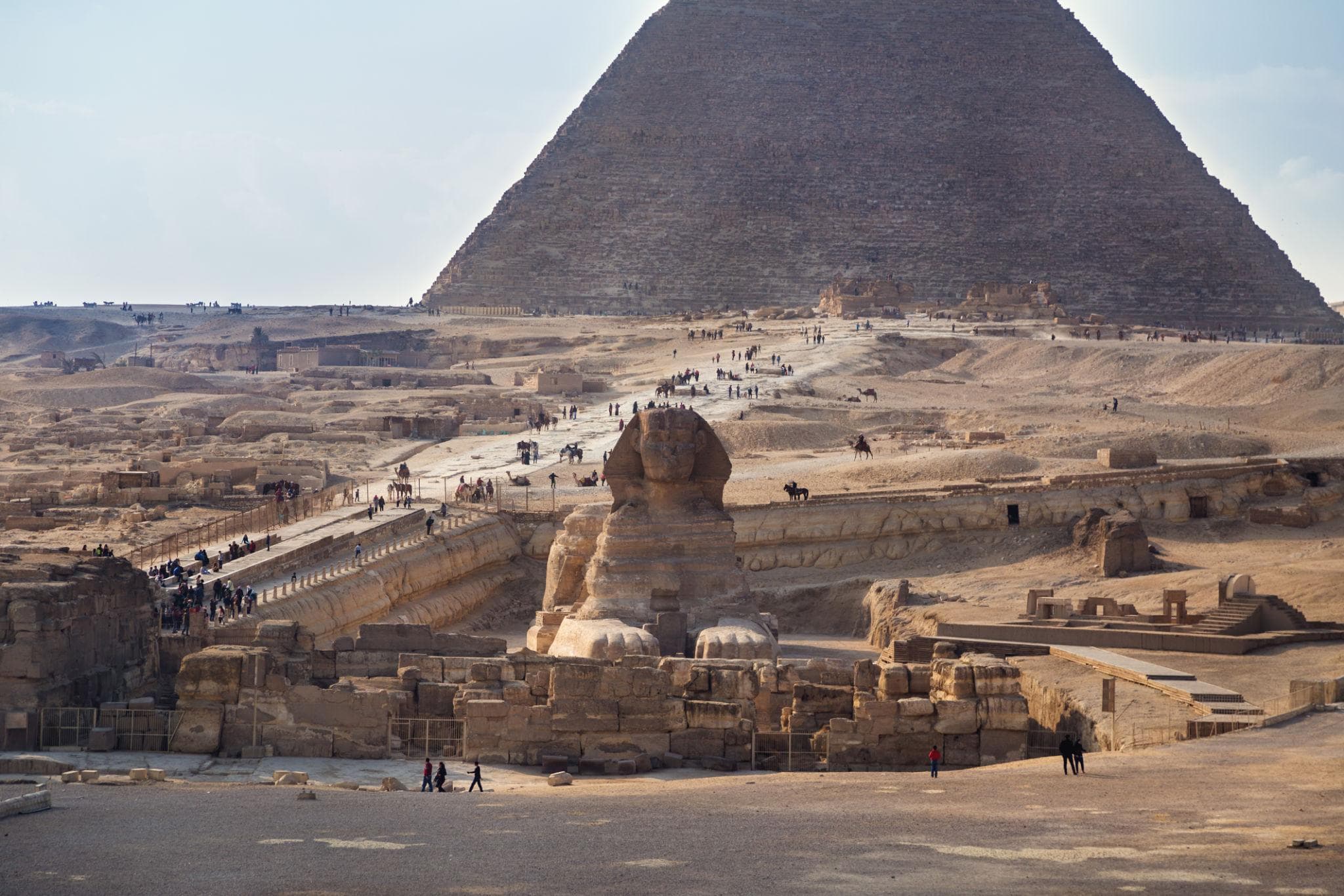
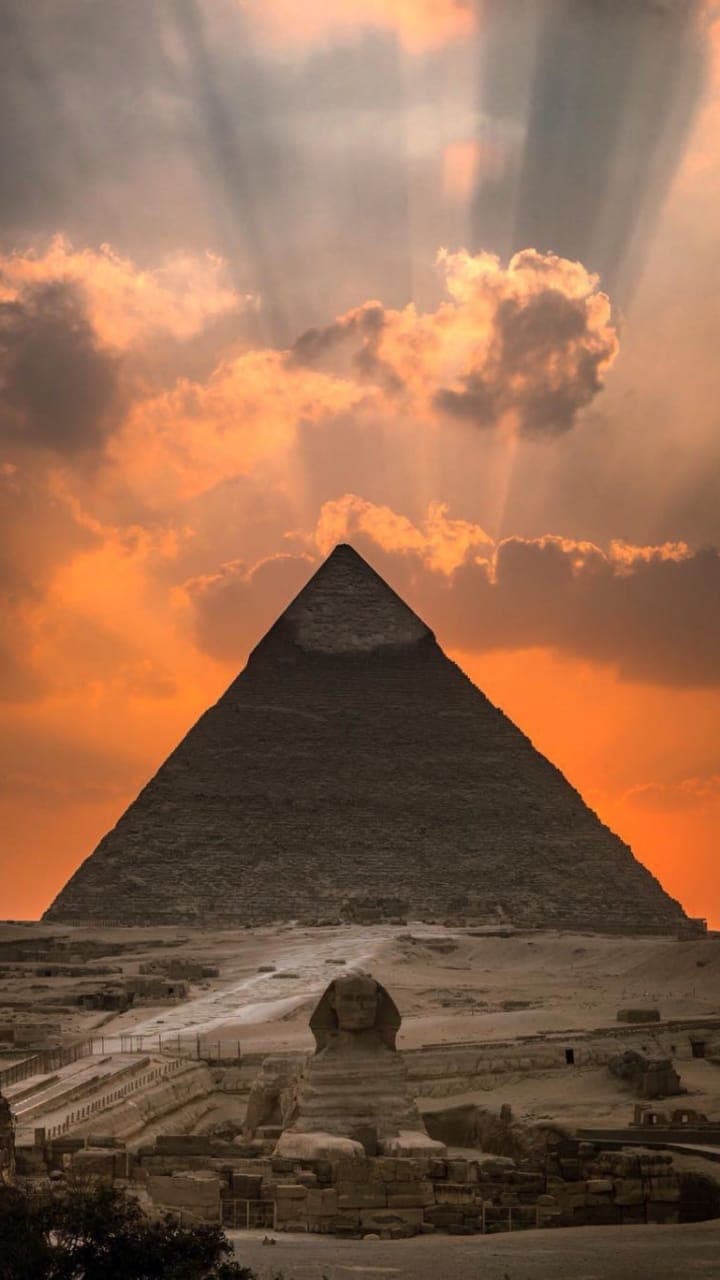
The Giza Plateau audio tour is the longest: 20 stops, about 35 minutes of narration in English and around three hours on site. It follows the natural route from the Valley Temple of Khafre and the Great Sphinx up Khafre's causeway to the three pyramids, with stops for the inside of the Great Pyramid, the queens' pyramids, the tomb of Queen Meresankh III, the Western Cemetery, the panorama and, at the end, the tombs of the pyramid builders. Our guide to visiting the Giza pyramids without a guide covers routes, entrances and timing for a visit on your own.
The Saqqara audio tour has 19 stops, about 29 minutes of narration and again around three hours on site. It starts with the entrance colonnade and the Step Pyramid of Djoser, then works through the Pyramid of Unas, the Persian tombs, the mastabas of Mereruka, Kagemni, Ptahhotep and Akhethotep, and Ti, the Bubasteion and the Serapeum.
Both tours have a diagram for every stop. Giza and Saqqara are about 20 to 25 km (12 to 16 miles) apart, usually 30 to 45 minutes by road, so a single long day can cover both: Giza at opening, lunch, and Saqqara in the afternoon, or the reverse in summer, when Saqqara's open ground is easier before the heat builds. If you would rather spend the second half of the day at the Grand Egyptian Museum, keep Saqqara for another morning.
Karnak and Luxor Temple: A Self-Guided East Bank
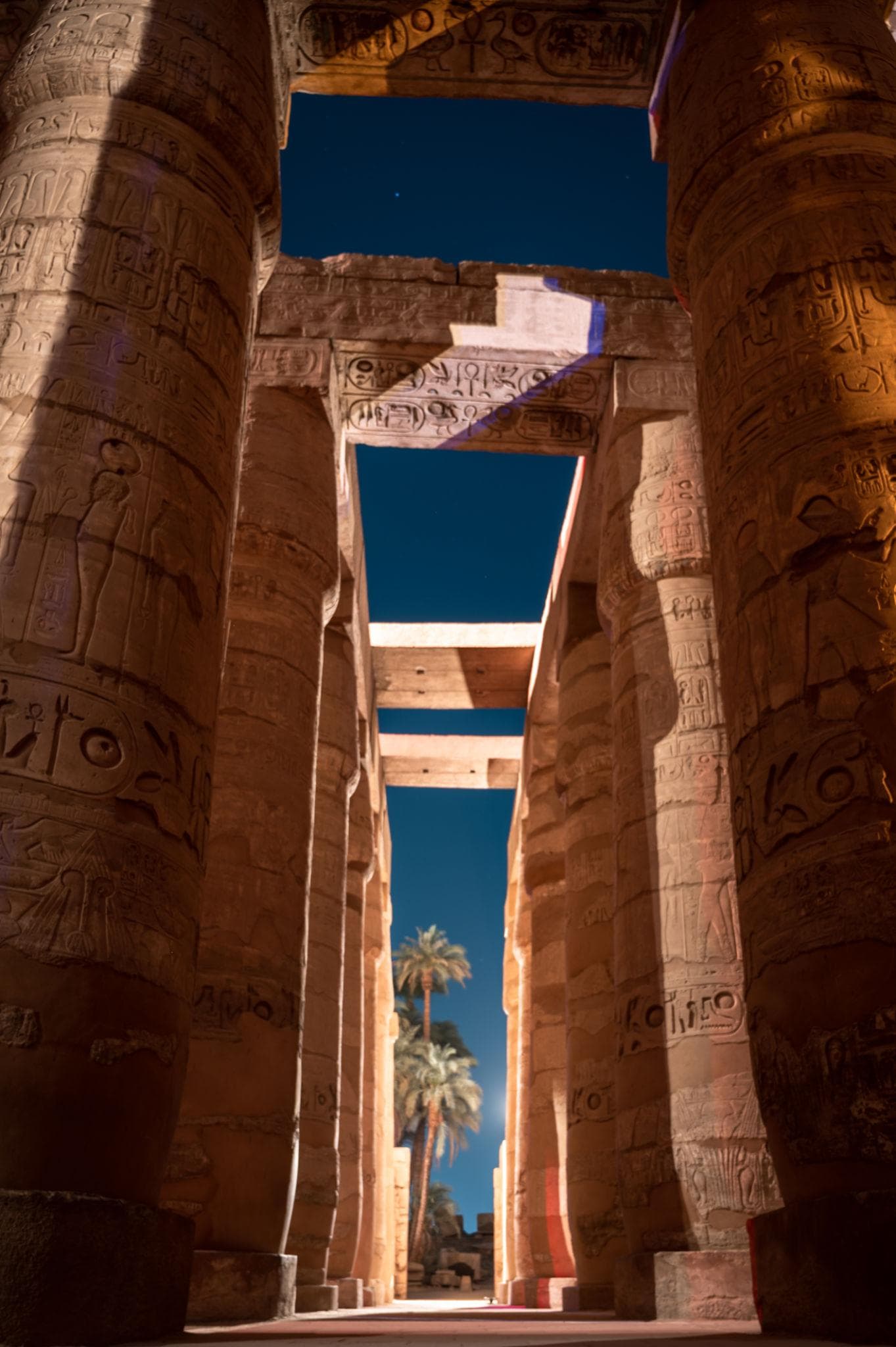
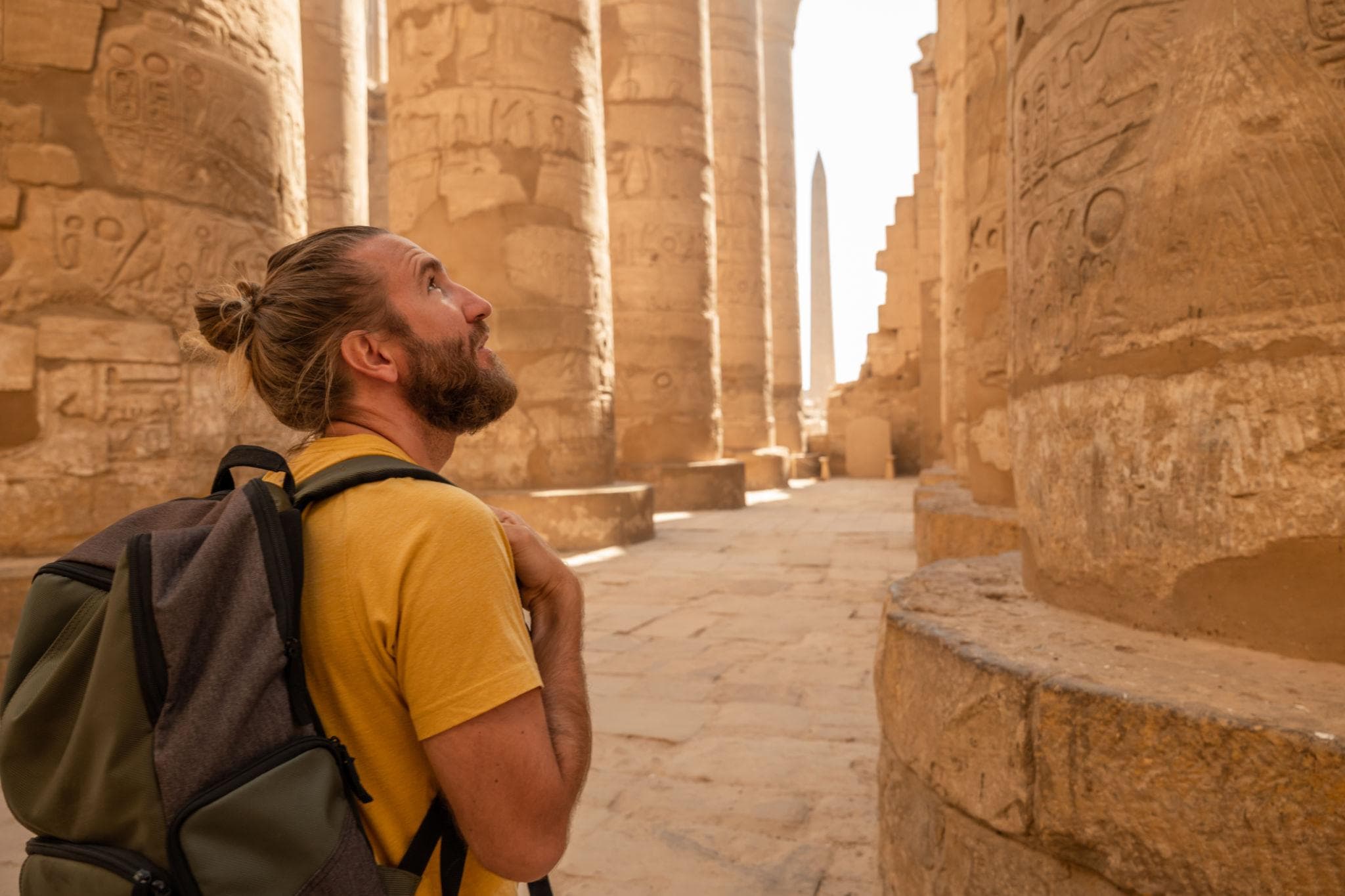
Our Karnak audio guide, the Karnak audio tour, has 15 stops, about 30 minutes of narration and around an hour and a half on site. It runs from the Avenue of Rams through the First Pylon and the Great Court to the Great Hypostyle Hall, the obelisks and the sanctuary, then out to the Festival Hall, the Sacred Lake, the Cachette Court and the Red Chapel.
The Luxor Temple audio tour has 14 stops, about 26 minutes of narration and around an hour and a quarter on site, from the Avenue of Sphinxes and the obelisk to the court of Ramesses II, the mosque of Abu el-Haggag, the great colonnade, the imperial cult chamber, Alexander's Shrine and the sanctuary.
The best plan for a day is Karnak at opening, while it is cool and before the tour groups arrive, a long lunch and a rest in the heat, and Luxor Temple in the late afternoon. Luxor Temple stays open into the evening, and walking through it as the floodlights come on is a fine end to the day. The two temples are about 3 km apart, linked by the restored avenue of sphinxes. Our guide to Karnak and Luxor Temple without a guide covers tickets, timing and routes for both.
Valley of the Kings and Hatshepsut Audio Tours
On the West Bank, the Valley of the Kings audio guide has 13 stops, about 26 minutes of narration and around two and a half hours on site. Its stops cover the tombs of Ramesses IV, the sons of Ramesses II, Ramesses IX, Tutankhamun, Ramesses V and VI, Merenptah, Ramesses III, Ramesses I, Seti I, Tausert and Setnakht, and Thutmose III. The tombs open to visitors rotate, the standard ticket covers three of those open that day, and some of the most famous are sold separately, so you will not enter every tomb on the tour. Use those stops at the entrance, or to choose which tombs to pay for. Our Valley of the Kings page describes the site itself.
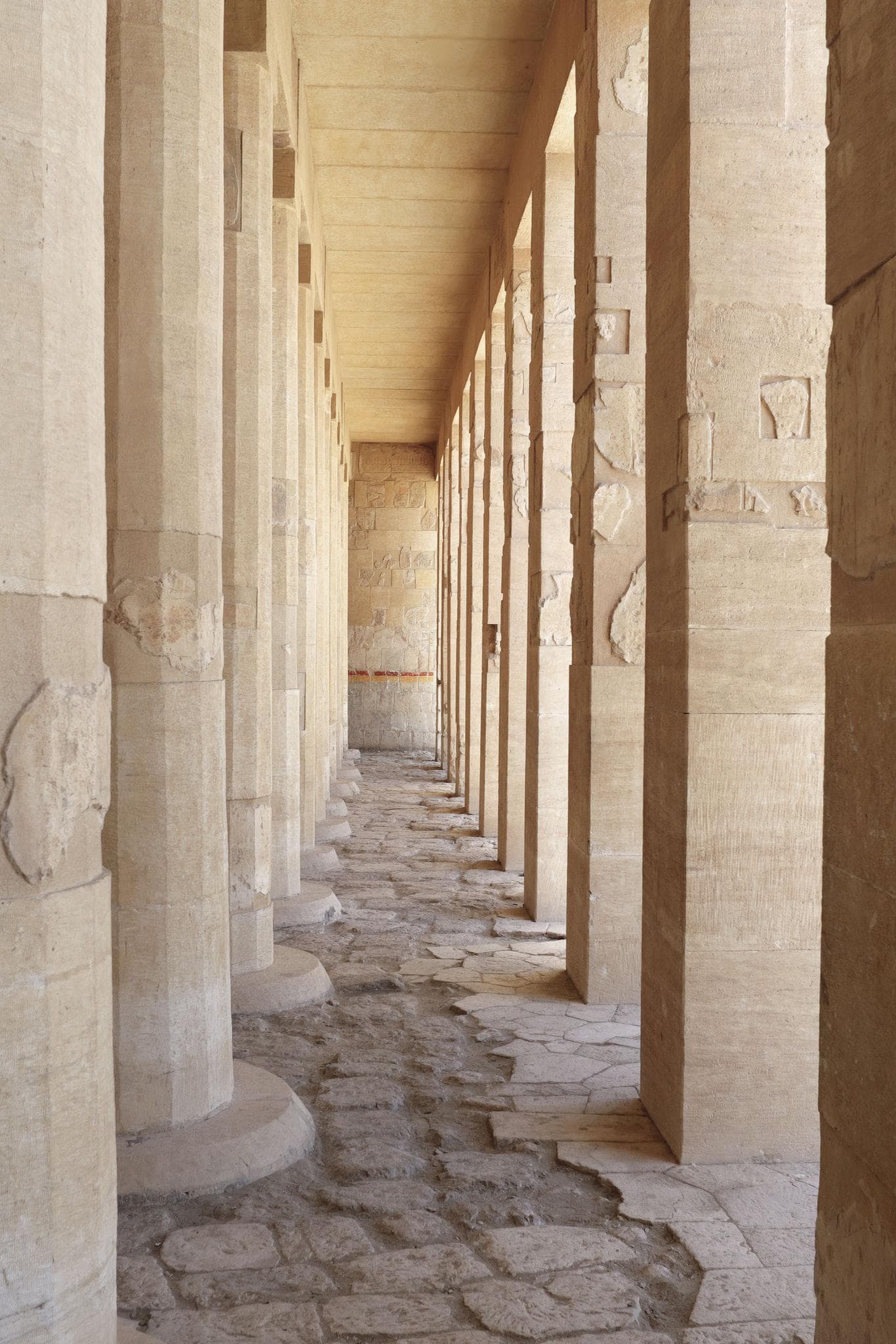
The Hatshepsut Temple audio tour is the shortest: 12 stops, about 21 minutes of narration and around an hour on site, climbing from the lower portico to the Punt colonnade, the chapels of Hathor and Anubis, the Osiride statues and the sanctuary of Amun.
The two sites lie just either side of the same ridge, a short drive apart, and fill a West Bank morning neatly. Go to the Valley of the Kings at opening, while the tombs are least crowded, and finish at Hatshepsut before the terraces become too hot and bright.
Pro Tip: Save the Tour on Hotel Wi-Fi
Mobile signal at the sites can be slow among the crowds, weak inside tombs and expensive if you are roaming. The tours are designed to work without it.
Open each tour once on Wi-Fi, at your hotel, shortly before your visit. The tour saves its recordings and its page on your phone, and from then on it plays without a connection or roaming. Check it has worked by switching your phone to flight mode and opening a stop or two.
Timing matters. Browsers may clear saved data after about a week without a visit, so if you buy a tour well before your trip, open it again on Wi-Fi the evening before you go. Do the same on every phone you plan to use, and keep the email with your access link easy to find in case you need to reopen a tour. A local SIM or eSIM is still worth having for maps and ride-hailing between sites.
Good to Know: Tickets Are Not Included
The audio guides do not include entry to the sites. You buy tickets separately, at the ticket office on arrival or through the official ticket website, and most major sites now take payment by bank card only. Prices change periodically, so check the current figures before you go.
Some monuments within the sites carry their own tickets on top of the general entry. At Giza that includes the interior of the Great Pyramid, 1,500 EGP for foreign adults and 750 EGP for students as of November 2026, with numbers limited in busy months; in the Valley of the Kings, some of the most famous tombs. The audio tours cover these places either way, so decide in advance which extras you want and buy them with your main ticket, since returning to the ticket office from the middle of a site wastes time.
Transport is not included either. In Cairo, Giza and Saqqara are far enough apart that you need a car between them, and on Luxor's West Bank the sites are spread over several kilometres. A driver for the day is simplest; ride-hailing apps work well for Giza but are less dependable to and from Saqqara.
Insider Tip: Earbuds, Batteries and the Heat
A phone that dies at the Sphinx is a tour that ends at the Sphinx, so treat battery life as part of the plan. Charge your phone fully the night before, lower the screen brightness where you can, and carry a power bank on long days: three hours at Giza or Saqqara, or a morning of tombs in the Valley of the Kings, with GPS, narration and photographs all running, will drain most phones.
Bring earbuds or headphones. The phone's loudspeaker is hard to hear outdoors and unwelcome in a tomb, and a pair of earbuds means you can listen without disturbing anyone. In busy places keep one earbud out so you can still hear what is going on around you, and step to the side of a path or doorway before you stop to listen.
Heat is the other enemy, of people and phones alike. Phones overheat when left in direct sun, so keep yours in a pocket or bag between stops. Carry water, wear a hat, and use the shade of colonnades and tomb entrances for the longer stops.
When a Live Egyptologist Is the Better Choice
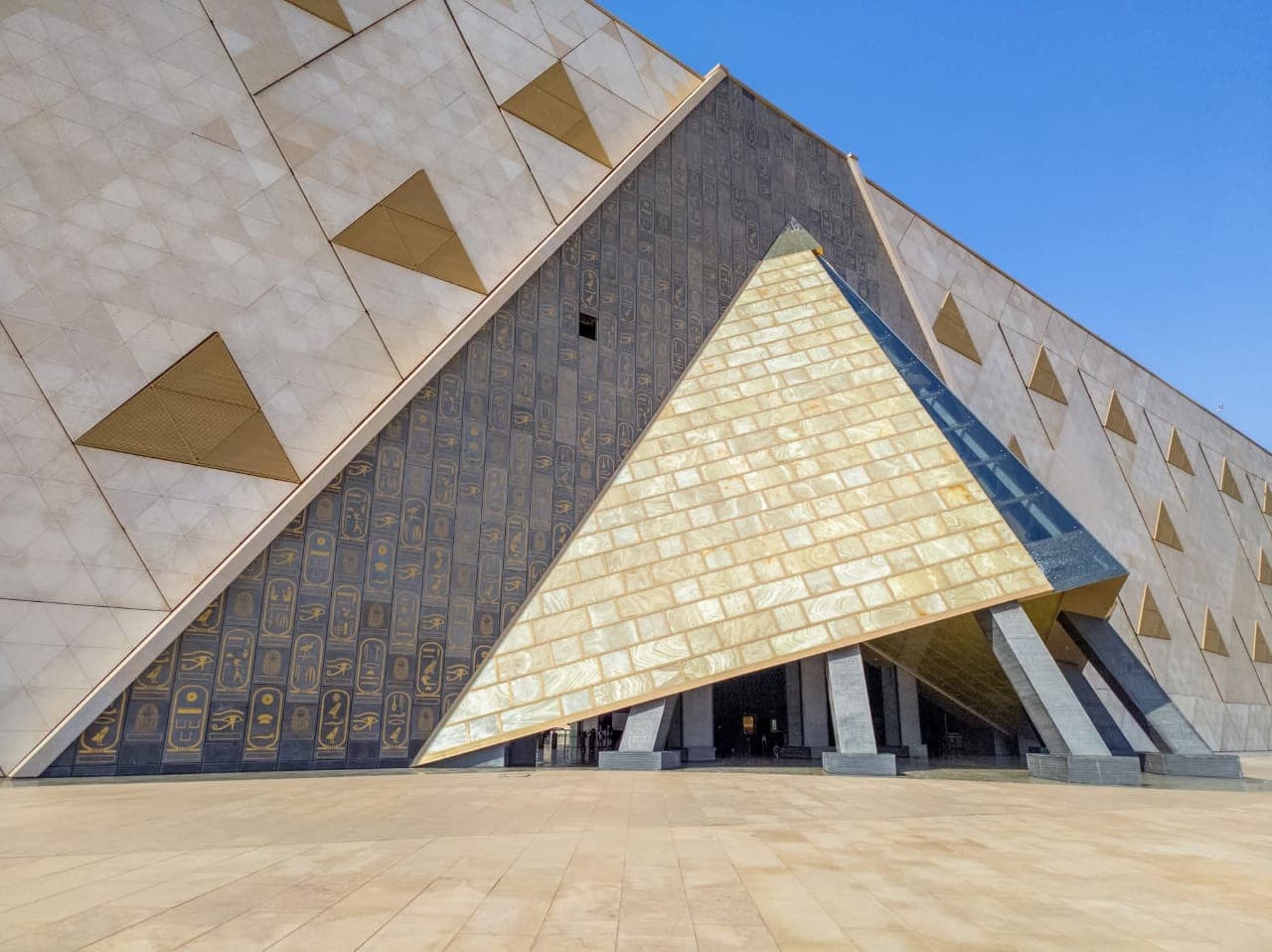
An Egypt audio guide is a good companion, but it is not a person, and there are days when a live guide is worth the extra cost. The first is any visit to the Grand Egyptian Museum, which our audio guides do not cover: its galleries hold thousands of objects, and a guide who knows the collection turns a bewildering morning into a coherent one. Our Grand Egyptian Museum and pyramids day pairs the museum with the plateau.
A guide also earns their fee on a first day at Giza if you are nervous about touts, ticketing and logistics; for travellers with children who need someone to keep them engaged; for anyone with limited mobility who needs routes planned around steps and distances; and for travellers who want to ask questions, debate theories or go deep on one subject. Our Giza plateau guided tour and Luxor East and West Bank tour cover the same ground with a guide beside you.
Many people combine the two: a guide for the museum and the first day, audio guides for the sites they want to explore at leisure or revisit later. It is often the best value of all, and the most relaxed way to see Egypt.
Planning Your Self-Guided Days
Before you travel, listen to the free first stop of each tour you are considering on our audio guides page, and buy only those that match your itinerary. Then decide which days, if any, you would rather spend with a guide. The evening before each visit, open the tour on hotel Wi-Fi, check it plays in flight mode, and charge your phone and power bank.
On the day, start early, buy your site tickets and any extras at the entrance or on the official website, and arrange transport between sites in advance. A self-guided tour of Egypt rewards a little preparation: with the tour saved, the tickets in hand and the heat planned for, the rest of the day is yours to take at your own pace.
If you would like a mix, with a guide for some days and audio guides for others, we can plan the guided days and leave the rest to you.