On the road in from Cairo airport, a few minutes before the city proper begins, a Hindu temple appears among the apartment blocks. Concrete elephants hold up the balconies, snakes and monkeys climb the cornices, Shiva and Krishna stand in niches, and a tiered tower rises at one corner like a shrine in Orissa. This is Baron Empain Palace, built for a Belgian tramway magnate who decided, in 1905, to raise a new city out of the desert north-east of Cairo and to live in its most improbable house.
For decades it was a ruin wrapped in rumour: abandoned, vandalised, whispered about as haunted. Restored by the Egyptian state and reopened in 2020, it is now one of the most rewarding short visits in the capital, and one of the easiest, because it sits about 8 km from Cairo International in a straight line.
This guide covers the man and the city he built, what the palace looks like inside and out, tickets and opening hours, the walk through Heliopolis that should follow, and how to fit it into a layover or a short Cairo stay.
At a Glance
What it is: a Neo-Hindu mansion completed in 1911 for Baron Édouard Empain, founder of Heliopolis
Architect: Alexandre Marcel, with interior decoration by Georges-Louis Claude
Inspired by: Angkor Wat in Cambodia and the Hindu temples of Orissa in India
Where: Orouba Road, Heliopolis, about 10 km north-east of central Cairo
From Cairo International: about 8 km in a straight line, often 20 to 30 minutes by road
Status: state-owned since 2005, listed as a monument in 2007, restored and reopened in June 2020
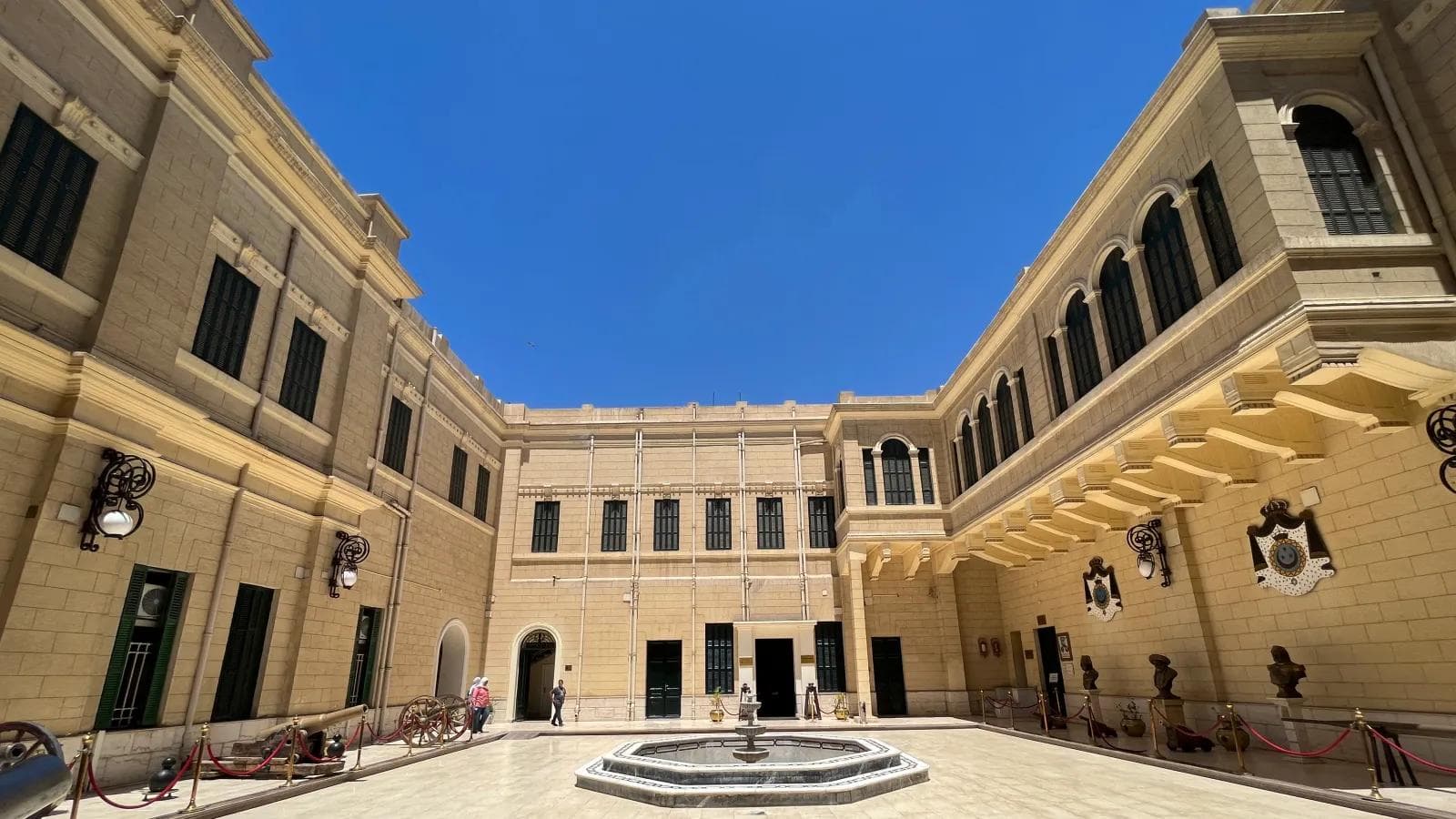
Inside: restored halls and a permanent exhibition on the history of Heliopolis, with a vintage tram car in the garden
Tickets: 220 EGP (about 4 USD) for foreign adults, 110 EGP for students, roof terrace 120 EGP extra, as of autumn 2026
Time needed: about an hour inside, two to three with a walk around Korba
Opening hours: daily from 9am, closing at 5pm or 6pm depending on the Ministry listing
Who Was Baron Empain
Édouard Empain was born in 1852 in Belœil, in southern Belgium, and started work in 1878 as a draughtsman at a metallurgical firm. Within two decades he had become one of the great railway and tramway builders of the Belle Époque, winning the original contract for the Paris Métro and, under King Leopold II, laying railways in the Belgian Congo. King Leopold made him a baron in 1907.
He came to Egypt on railway business and stayed to build a city. In May 1905 he signed a concession for a large tract of desert north-east of Cairo, and in early 1906 he founded the Cairo Electric Railways and Heliopolis Oases Company, with Boghos Nubar, son of the former prime minister Nubar Pasha, and a group of other investors. The company bought around 25 sq km of sand and promised a garden city linked to the capital by electric rail. Empain died in Belgium in 1929 and was buried in the basilica he had built in Heliopolis.
A City of the Sun in the Desert
The name was borrowed from antiquity. Ancient Heliopolis, the Greek name for the sun-god's city of Iunu, lay a few kilometres to the west at Matariya, where a single granite obelisk of Senusret I still stands. Empain's Heliopolis was something new: a planned suburb of wide boulevards, villas, apartment blocks with deep arcades, churches, a mosque, hospitals, sports grounds and, briefly, Africa's first amusement park, Luna Park, which opened in 1911.
The look of the place came largely from the Belgian architect Ernest Jaspar, who drew the master plan and defined what is still called the Heliopolis style: a blend of Moorish arches, Persian and Islamic ornament and European neoclassical order, with shaded colonnades suited to the climate. The Frenchman Alexandre Marcel, the Italian Antonio Lasciac and the Egyptian Habib Ayrout added landmark buildings. When money ran short in 1907, the British financier Ernest Cassel stepped in, and the plan was reshaped around the garden-city ideals then fashionable in Europe.
The company, nationalised in 1961, ran the suburb's trams until the end of 1991, after which state transport bodies took them over. Most of the network closed in 2014 and 2015 as streets were widened and flyovers built, and the last short stretch had stopped running by the end of 2019. One old tram car survives in the palace garden. The arcades remain, and walking under them is the best way to understand what Empain was selling.
The Palace: Angkor in Reinforced Concrete
Marcel was the obvious choice of architect. He had built the Panorama du Tour du Monde for the Paris Exposition of 1900 and Japanese and Chinese pavilions for King Leopold at Laeken, and he had a taste for the exotic that matched his client's. For Empain he drew a palace modelled mainly on Angkor Wat and the temples of Orissa, built between about 1907 and 1911 in reinforced concrete, at the time a luxury material and a statement of modernity.
The detail is the point. Look for elephants and lions supporting balconies and stairs, serpents along the parapets, monkeys and dancers on the friezes, and statues of Buddha, Shiva, Krishna and other deities set into the walls. The tower at the corner, tiered like a temple shikhara, is the building's signature. Inside, Georges-Louis Claude's decoration blended the same Indian vocabulary with European fittings and parquet. The plan is compact: servants' quarters in the basement, a reception hall, dining room and billiard room on the ground floor, and four bedrooms above, each with its own balcony and bathroom, all linked by a spiral staircase and a lift, with a roof terrace beside the tower. The building itself, rather than any collection, is the main exhibit.
From the gardens the building reads as a single sculpted mass in warm reddish tones, quite unlike anything else in Cairo. It is also smaller than photographs suggest, which makes it easy to take in properly in a visit of an hour.
Did You Know: The Legends of the Baron Palace
After the 1952 revolution the palace stood empty for half a century, and empty buildings in Cairo attract stories. One holds that the tower turned on a hidden base so that the baron could follow the sun all day, a story most historians of the building dismiss. Others concern a daughter said to have been hidden from the world, or a death within the walls, and these fed the palace's long reputation as a haunted house.
The 1990s added a stranger episode. Young people broke in for parties and left graffiti, and conservative commentators accused them of devil worship, an episode that kept the building's reputation dark for years. The restoration has scrubbed away the graffiti, though not the folklore, which many local visitors still come to discuss.
Rescue and Restoration
The Egyptian government acquired the palace in 2005, in time for Heliopolis's centenary, and the Supreme Council of Antiquities registered it as a historic monument in March 2007. In 2012 Egypt signed an agreement with Belgium to restore it as an international art and cultural centre, and preparations for the first restoration phase began at the end of November 2016, under the antiquities minister of the time, Khaled El-Enany.
The work itself was carried out by the Armed Forces Engineering Authority and Arab Contractors over roughly three years, at a reported cost of more than 100 million EGP. It cleaned and consolidated the facades, repaired the concrete and the sculpted ornament, and brought the interiors and gardens back into use. President Sisi inaugurated the palace on 29 June 2020 and it opened to visitors the next day, with a permanent exhibition on the history of Heliopolis; it has since hosted occasional events as well as daily visits. After decades in which the building seemed likely to crumble, it is sound again and open.
Visiting Baron Empain Palace: Tickets and Opening Hours
Baron Empain Palace is managed by the Ministry of Tourism and Antiquities and opens daily at 9am. The Ministry's monuments site gives the closing time as 6pm and its online ticketing site as 5pm, with shorter hours in Ramadan, so plan to arrive by 4pm. As of autumn 2026, tickets cost 220 EGP (about 4 USD) for foreign adults and 110 EGP for foreign students with a valid ISIC card, and the roof terrace beside the tower is a separate 120 EGP ticket. The Ministry revises its prices every year or two, often in November, so check before you go.
Many Ministry sites now take cards only, so carry a card rather than relying on cash. Phone photography has generally been allowed; bring a passport or a photo of it in case staff ask for identification with a student card. A visit to Baron Empain Palace takes about an hour: the gardens and facades first, then the rooms and exhibits.
Insider Tip: Go in the Late Afternoon
Come in the late afternoon, when the low sun brings the carving into relief and warms the colour of the walls. Weekday afternoons are also quieter than Friday and Saturday, when Cairene families and photo shoots arrive in numbers.
Pair it with a coffee in Korba afterwards, as the arcades fill and the shops reopen for the evening. If you are photographing, a wide lens and patience at the corner of the garden by the tower will give you the shot every postcard tries for; our Egypt photography tips cover the rest.
Korba and the Basilique
From the palace, the heart of old Heliopolis is a short walk or ride away. Korba, named after the square originally called Le Courbet, centres on Baghdad Street, lined with the arcaded blocks that defined the Heliopolis style. It is a place for strolling, for pastry and coffee, and for looking up: the balconies, domes and carved brackets above the shopfronts are a century old.
Nearby on Al-Ahram Street stands the Basilique Notre-Dame d'Héliopolis, the Catholic church Marcel built between 1910 and 1913, Byzantine Revival in style and modelled on Istanbul's Hagia Sophia. It is still a working co-cathedral, and Empain and members of his family lie in its crypt. The basilica publishes no tourist opening hours, so whether you can step inside depends on the church being open for services or parish activity; dress modestly, with shoulders and knees covered, and stay at the back during Mass.
The basilica and the arcades make a quieter companion to the better-known Christian heritage of Old Cairo, which our Coptic Cairo guide covers, and to the Belle Époque streets of Downtown in our Downtown Cairo and Zamalek walk.
Other Heliopolis Landmarks
Heliopolis rewards an extra hour for anyone interested in early twentieth-century architecture. Merryland, a park built around a lake, was the suburb's smartest outing in the 1960s and 1970s and now has a small funfair; it is a pleasant place to sit in the late afternoon. The Sultana Malak Palace and the villa of Boghos Nubar survive among later buildings, though neither is open as a museum.
Religious buildings from every community that lived here remain. The Melkite Greek Catholic church of Saint Cyril was designed by Habib Ayrout, the only Egyptian on the original architectural team, and the Vitali Madjar Synagogue stands on al-Masallah Street. The Heliopolis War Cemetery holds the Port Tewfik Memorial to more than 4,000 soldiers of the British Indian Army who have no known grave.
Warning: The Presidential Palace and Photography
Jaspar's other masterpiece, the Heliopolis Palace Hotel, opened in the suburb's early years as one of the grandest hotels in Africa and served as a military hospital in both world wars. Since 1981 it has been the Republican Palace, the president's office, and it is not open to visitors.
Do not photograph it, or the security around it, and do not fly a drone anywhere in Heliopolis: the area also includes military sites and lies close to the airport. Police will ask you to delete images at best. If in doubt, put the phone away while you pass, which is what Cairenes do.
Getting There and Getting Around
Heliopolis lies about 10 km north-east of central Cairo, between Downtown and the airport. From Downtown or Zamalek a taxi or ride-hailing car takes 30 to 45 minutes outside rush hour, and from the pyramids an hour or more; plan the visit for a morning or late afternoon rather than in the evening peak.
Line 3 of the Cairo Metro now runs through Heliopolis, with stations including Al Ahram, Haroun and Heliopolis Square, which makes the district straightforward to reach from Downtown by public transport. Within Heliopolis, short taxi hops and walking under the arcades are the easiest way between the palace, Korba and the basilica.
Baron Empain Palace on a Layover or Short Stay
The palace's position on Orouba Road, the main artery between the airport and the city, makes it the most practical sight in Cairo for a short stop. On a layover of around eight hours it is often the only visit worth leaving the airport for, and our Cairo layover guide sets out the timing rules we use.
On a short stay, Heliopolis pairs naturally with the medieval city: the palace and Korba in the morning, then Khan el-Khalili and Al-Muizz Street in the afternoon and evening, all on the airport side of the Nile. On a first visit to Cairo with more days to play with, slot it into the day you arrive or the day you leave, and keep the full days for Giza, Saqqara and the museums, along the lines of our three days in Cairo.
Planning Your Visit
The palace fits easily into any of our Cairo days with a little rerouting. On an arrival or departure day, a Cairo airport transfer can include an hour at the palace and a coffee in Korba; on a fuller day it pairs well with our Islamic Cairo, Citadel and Khan el-Khalili tour, or with a Nile dinner cruise for those who would rather see the city lit up. Our list of Cairo's lesser-known sights has more ideas in the same spirit.
If you would like Heliopolis built into your trip, or want to know whether your flight times leave room for it, tell us your dates and where you are staying. We will suggest a shape that keeps the time in traffic to a minimum.