Cleopatra is one of the most famous women in history, yet most of what people "know" about her is myth. She was not Egyptian by blood, she was not chiefly remembered in her own time for beauty, and her death by snakebite may never have happened the way the legend says. The real Cleopatra VII was a shrewd, multilingual ruler who fought to keep Egypt independent at the very moment Rome was swallowing the Mediterranean. This guide separates the woman from the myth and shows where you can still walk in her footsteps in Egypt today.
Who Was Cleopatra VII?
Cleopatra VII Philopator was born around 69 BC and ruled Egypt from 51 BC until her death in 30 BC. She was the last active ruler of the Ptolemaic Kingdom, a Greek-Macedonian dynasty founded by Ptolemy I, one of Alexander the Great's generals, after Alexander's death in 323 BC. That makes Cleopatra ethnically Greek, descended from Macedonian Greeks who had ruled Egypt for nearly three centuries.
What set her apart from her ancestors was that she embraced Egypt itself. Ancient writers report that she was the first of her line to actually learn the Egyptian language, and she presented herself as the living embodiment of the goddess Isis. She reportedly spoke many languages and conducted diplomacy without interpreters, an unusual feat for any monarch of the era. The famous emphasis on her "beauty" comes mostly from later Roman propaganda and Renaissance retellings; the Greek historian Plutarch, writing about a century after her death, stressed instead her charm, wit and the seductive quality of her conversation.
The Ptolemaic Dynasty and a Throne Worth Killing For
The Ptolemies ran Egypt from Alexandria, a glittering Greek city on the Mediterranean coast, for almost 300 years. It was a dynasty notorious for intrigue: siblings married each other to keep power concentrated, and family members routinely murdered one another for the throne. Cleopatra was no exception to the bloodshed around her. She co-ruled at various points with her younger brothers Ptolemy XIII and Ptolemy XIV (also her husbands by Egyptian custom) and later with her son.
Her reign was set against economic strain, famine after poor Nile floods, and the looming shadow of Rome, which by the mid-first century BC was the dominant power in the region and increasingly treated Egypt as a client state to be managed. Cleopatra's central political problem was simple and brutal: how to keep Egypt independent and wealthy when Rome could crush it at will.
Cleopatra and Julius Caesar
In 48 BC, locked in a power struggle with her brother Ptolemy XIII, Cleopatra made a famous gamble. According to the ancient sources she had herself smuggled into the royal palace in Alexandria to meet the Roman general Julius Caesar, who had arrived pursuing his rival Pompey. The romantic image of her being rolled out of a carpet is a later embellishment, but she did win Caesar's support.
With Roman backing she defeated her brother, who drowned in the Nile during the fighting, and secured the throne. She bore a son, Caesarion, whom she presented as Caesar's child, and she spent time in Rome itself, lodged in Caesar's villa across the Tiber, an arrangement that scandalised conservative Romans. Caesar's assassination on the Ides of March, 44 BC, threw the Roman world into chaos and forced her to return home and recalculate. The episode shows the pattern of her whole reign: Egypt was too weak to defy Rome militarily, so Cleopatra survived by attaching herself to whichever Roman strongman looked most likely to win.
Cleopatra and Mark Antony
After Caesar's death, power in Rome split between his heir Octavian and his lieutenant Mark Antony. Cleopatra allied herself, politically and romantically, with Antony. Their relationship, which began around 41 BC, produced three children and a genuine political partnership aimed at securing the eastern Mediterranean.
The alliance gave Octavian the propaganda weapon he needed: he painted Antony as a Roman gone native, enslaved by a scheming foreign queen, and made much of the so-called Donations of Alexandria in 34 BC, when Antony handed eastern territories to Cleopatra and their children in a lavish public ceremony. To Roman eyes this looked like a Roman general giving away the Republic's hard-won provinces to a foreign dynasty. War became inevitable. At the naval Battle of Actium in 31 BC, off the coast of western Greece, the fleets of Antony and Cleopatra were decisively defeated by Octavian's admiral Agrippa; Cleopatra's squadron broke away and sailed for home, and Antony followed. The couple fled back to Egypt with their cause effectively lost, their army melting away as allies defected to the winning side.
The Death of Cleopatra
In 30 BC, with Octavian's forces closing on Alexandria, Antony took his own life, reportedly on a false report that Cleopatra was already dead. Cleopatra followed soon after. The legend says she died from the bite of an asp (an Egyptian cobra), a serpent symbolically linked to Egyptian royalty and the goddess Isis. Many modern historians are sceptical: a reliably fatal snakebite is hard to arrange, and some suggest poison administered another way. Whatever the method, her death at around 39 marked the end of the Ptolemaic dynasty and of pharaonic Egypt. Egypt became a province of Rome, and the age of the pharaohs, after roughly three thousand years, was over.
Separating the Woman from the Myth
It is worth stating plainly what the evidence does and does not support. Cleopatra was not ethnically Egyptian but Greek-Macedonian. There is no contemporary basis for the idea that she was extraordinarily beautiful; her power lay in intellect, languages, political cunning and charisma. The carpet story, the pearl dissolved in vinegar, and the precise manner of her suicide are all anecdotes recorded by Romans, sometimes hostile, often long after the fact. She was, above all, the last serious obstacle to Rome's total control of the Mediterranean, which is why Roman writers had every reason to caricature her.
Following Cleopatra's Footsteps in Alexandria
Cleopatra's capital was Alexandria, and it remains the best place to feel her world, even if the ancient city largely lies underwater or beneath the modern one. The royal quarter, including very likely the palace where she lived, sank into the harbour after earthquakes and subsidence; underwater archaeologists have recovered statues, sphinxes and columns from the seabed since the 1990s. On land, the Bibliotheca Alexandrina (the modern revival of the legendary ancient library) and the Graeco-Roman Museum help set the scene, while the Roman-era Pompey's Pillar and the catacombs of Kom el-Shoqafa evoke the city soon after her time.
### Practicalities for Alexandria
Alexandria sits about 220 kilometres northwest of Cairo, roughly a 2.5 to 3 hour drive or a comfortable train ride of similar length. As of 2026, expect modest entry fees at most sites, often in the region of 100-300 EGP (roughly 2-6 USD) for foreigners per site. The Mediterranean climate is milder than Cairo's, and the corniche, seafood restaurants and Greek-era atmosphere make it a rewarding day or overnight trip. Note that the famous lighthouse, the Pharos, one of the Seven Wonders of the ancient world, is long gone; its stones were partly reused in the 15th-century Qaitbay Citadel that now guards the harbour entrance.
A Temple Cleopatra Would Recognise: Philae
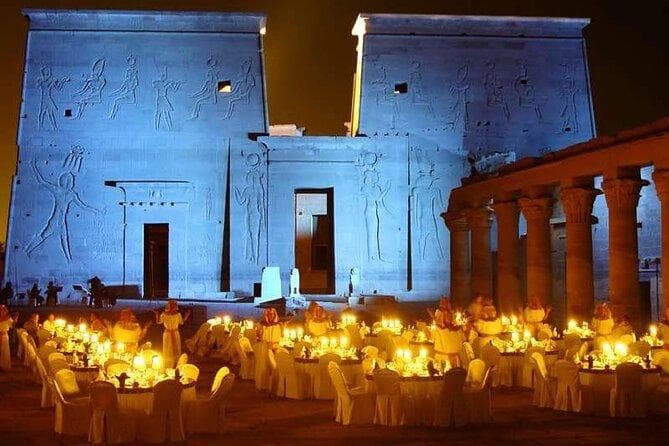
For a temple that breathes the late Ptolemaic world Cleopatra knew, head south to Philae Temple near Aswan. Dedicated to the goddess Isis, with whom Cleopatra identified so closely, Philae was built and expanded by the Ptolemies and later Roman emperors, so its art and architecture belong to her era's religious world. The temple was painstakingly relocated stone by stone to the island of Agilkia in the 1970s to save it from the rising waters of the Aswan High Dam, and today you reach it by a short, atmospheric boat ride. Visit in the morning for cooler temperatures, or come back for the evening sound-and-light show, which dramatises the legend of Isis against the floodlit colonnades.
Insider Tips and What to Skip
Don't go to Egypt expecting Cleopatra-specific monuments; very little survives that you can point to and say "she stood here." Instead, treat the journey as immersion in her Greek-Egyptian world: Ptolemaic temples, Alexandria's submerged grandeur, and the cult of Isis. Skip the tourist traps selling "Cleopatra" trinkets and invest your time in a good museum guide who can explain the Ptolemaic context. An insider tip: in Alexandria, time your visit to Qaitbay Citadel for late afternoon, when the light on the harbour is beautiful and the heat has eased, and pair it with fresh seafood on the corniche afterwards.
Plan Your Cleopatra-Inspired Journey
To step into Cleopatra's capital, our Alexandria day trip takes you from Cairo to the Mediterranean coast and the key Graeco-Roman sites in a single well-paced day, with a knowledgeable guide to fill in the history the ruins leave out. To go deeper into the world that produced her, pair this with our guide to the pharaohs of Egypt and our explainer on mummification in ancient Egypt, both of which illuminate the beliefs and dynasties that shaped the last pharaoh's reign.